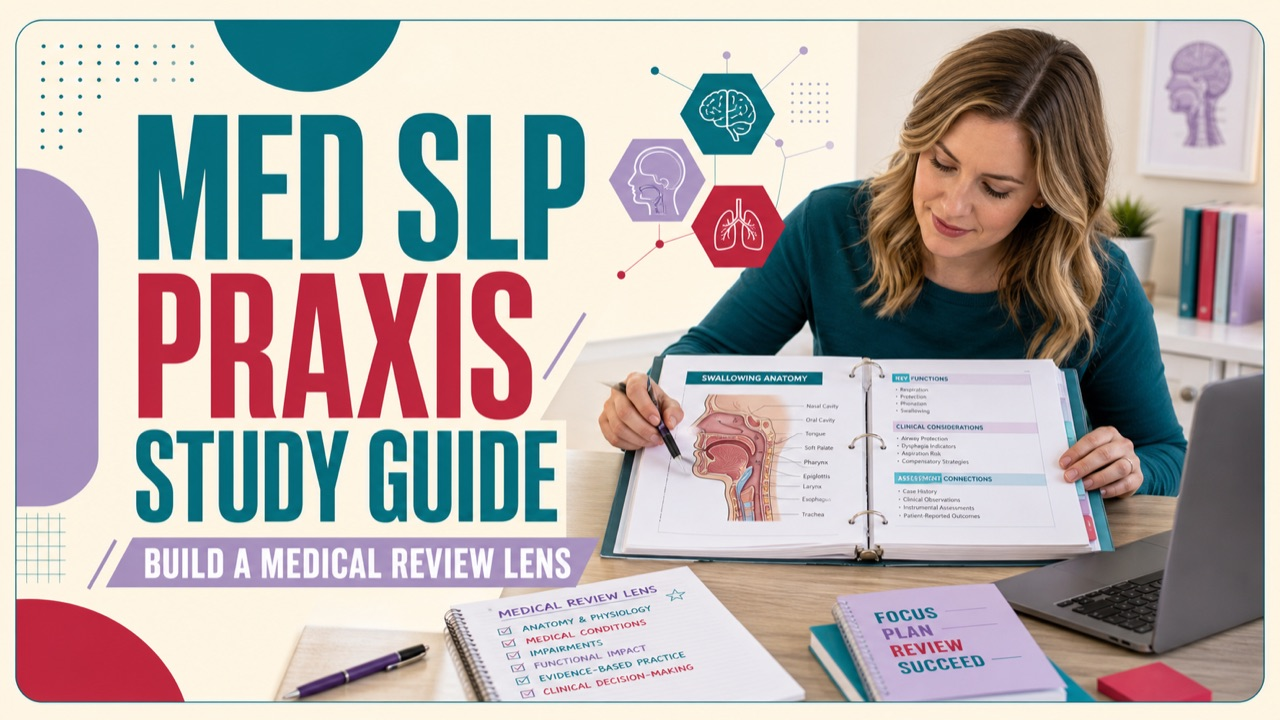
med slp praxis study guide is most useful when it supports a specific study decision. A med SLP Praxis study guide can organize medical topics, but preparation is stronger when those topics connect to assessment evidence, function, collaboration, access, and the current 5331 context. This guide is written for learners with medical SLP interests or clinical experience who want to organize hospital, outpatient, dysphagia, neuro, voice, and related topics without narrowing the whole plan too early. It focuses on a medical-SLP lens that keeps clinical depth connected to the wider exam and professional reasoning task and keeps current source facts, clinical learning, practice evidence, and personal planning in separate lanes.
Medical content is one lens of preparation; the reasoning task still asks you to connect systems, evidence, person, environment, and action. Use the current ETS Speech-Language Pathology 5331 page for exam-context boundaries and the ASHA Praxis preparation page for preparation framing. The ASHA Practice Portal can add clinical depth, but a study resource should not be treated as the owner of a changing administrative detail.
Resource offerings, exam processes, and professional requirements can change. Record the source owner and date checked, protect private account or score information, and treat the examples here as educational planning guidance rather than an individual certification, licensure, employment, or clinical decision.
What this resource should do
A study resource has four possible jobs: it can orient you to scope, deepen a concept, create a retrieval condition, or help you reflect on an error. Trouble begins when one book, course, page, or question set is expected to do all four without a clear handoff. Decide which job matters in the current phase before you decide whether the resource belongs in the plan.
For med slp praxis study guide, a useful workflow begins with a target and ends with evidence. The evidence may be a definition you can state, a contrast you can explain, a case decision you can defend, or a delayed prompt you can solve after the original wording is gone. A page count or a feeling of familiarity is not enough to choose the next action.
| Resource layer | What it contains | Decision it supports |
|---|---|---|
| System | Relevant anatomy, physiology, or mechanism | What process supports the observed function? |
| Evidence | History, observation, measure, or response | Which finding deserves attention first? |
| Risk and function | Safety, communication, participation, or quality of life | What outcome matters in this context? |
| Team | Referral, collaboration, documentation, and scope | Who contributes to the next decision? |
| Access | Language, culture, hearing, vision, setting, and support | What changes how the person can participate? |
Keep the layers visible in your notes. A source can be excellent for one layer and unhelpful for another. That is not a contradiction; it is a reason to give the source a narrow assignment and use a different tool when the study question changes.
Start with the current 5331 context
Begin with the current ETS Speech-Language Pathology 5331 context. It gives you a provider-owned starting point for the test identity and preparation materials. Use ASHA preparation information and clinical resources for their stated roles, then return to the responsible organization when a process, scope, or current requirement matters.
- Save the page title, owner, URL, and date checked.
- Separate test context from a personal study recommendation.
- Mark which note is durable clinical learning and which note may change.
- Keep 5331 terminology consistent across your map.
- Use an official preparation resource as one input, not as a prediction of an individual result.
- Link clinical topic notes to the professional resource that explains them.
- Write an unresolved issue as a question instead of filling the gap with a guess.
- Recheck the source before publishing or sharing a time-sensitive statement.
This source trail makes later editing safer. If a page changes, you can update the current-detail note without discarding your concept map, retrieval prompts, or personal error analysis. It also helps you tell a study partner which part of a discussion is a source question and which part is a planning choice.
Give the material one clear job
Give the material one clear job for the current week. A broad review book might serve as a concept map. An official page might anchor scope. A question set might create timed retrieval. An ASHA clinical resource might deepen a mechanism or professional issue. Your own note might make a contrast visible. When the job is explicit, you can judge whether the resource helped without confusing exposure with progress.
- 1. Map the system: Start with the mechanism or body system, then connect it to the communication, feeding, swallowing, voice, or cognitive task.
- 2. Separate observation from interpretation: Write what was seen or reported before naming the possible explanation or next question.
- 3. Add the functional frame: State what the person is trying to do and what environmental or partner demands matter.
- 4. Practice team reasoning: Compare what an SLP can assess or address with what may require collaboration, referral, or another professional role.
- 5. Re-enter the broader map: Place the medical topic beside development, assessment, intervention, ethics, access, and professional-practice threads.
Do not make the plan fragile by assigning every topic a new tool. Start with the smallest stack that can answer the current question. If the next session shows a different gap, add one targeted resource or change the task condition. A deliberate pause is also useful evidence: it may show that the resource duplicates an existing job or that the study question was too broad.
Turn reading into retrieval and application
Reading becomes active when it is followed by something you must produce. Close the chapter, page, or lesson and write a definition, distinction, sequence, evidence chain, or next-action explanation. Then compare the output with the source. The comparison should identify what was missing, not invite you to copy the page.
| Output | Prompt | What to record |
|---|---|---|
| Definition | What is the concept in plain language? | Term, mechanism, and one boundary. |
| Contrast | What neighboring idea could be confused with it? | Feature that separates the pair. |
| Evidence chain | Which detail supports the decision? | Observation, measure, history, or response. |
| Case application | What changes under a new context? | Person, partner, setting, access, or function. |
| Repair | What will you do differently next time? | One targeted prompt and a later check. |
If the first output is weak, narrow the task. If the output is fluent but does not survive a changed case, add application. If the answer changes only when the timer starts, record pacing as part of the condition. The resource is giving you information about the next study move, and that is more useful than a general confidence label.
BUILD A MEDICAL SLP REVIEW LENS
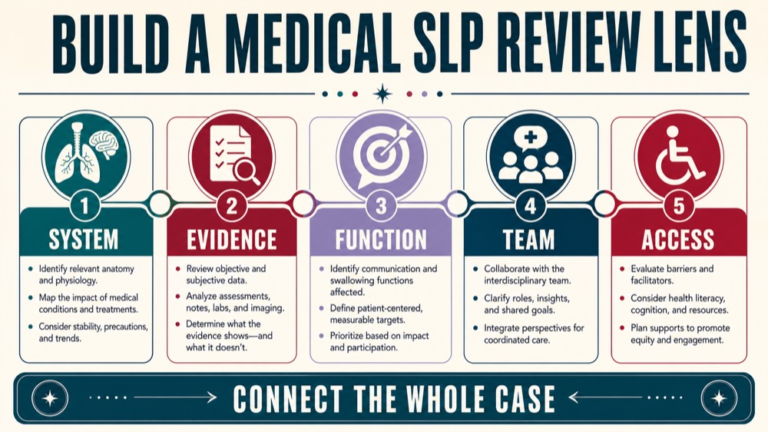
The first visual summarizes the article-specific study move: build a medical slp review lens. Use it as a planning card, not as a replacement for the source or the full explanation. Start at the target, move through the evidence or study action, and finish with the output you will keep.
A visual is most helpful when it reduces a decision to a few visible relationships. If the card tells you only to read more, add the missing output: retrieve, compare, apply, explain, or transfer. That final verb makes the image part of a workflow rather than a decorative reminder.
- Name the target before opening the resource.
- Choose one output that can be checked.
- Keep the source owner beside a current-detail note.
- Change one case or context variable after the first pass.
- Record confidence separately from correctness.
- Explain the closest alternative in your own words.
- Schedule a delayed return to the same concept.
- Use the result to choose the next study block.
SYSTEM, EVIDENCE, FUNCTION
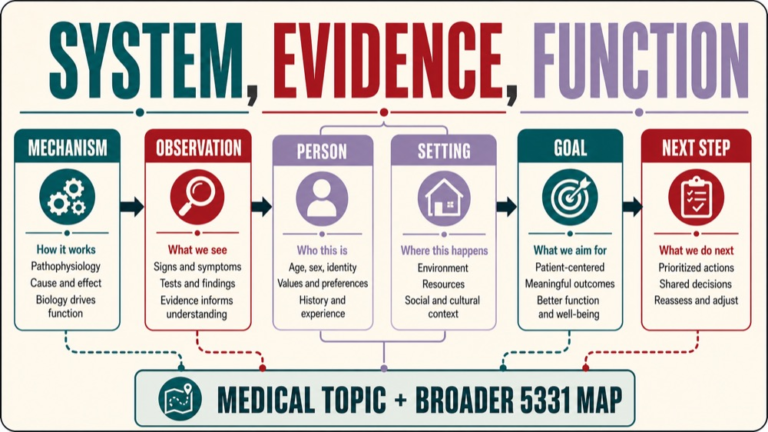
The second visual turns the learning signal into a next action: system, evidence, function. Use it after a chapter, case, practice set, or comparison. The path should preserve the difference between what the source said, what you produced, what condition shaped the result, and what you will test next.
| Signal | Possible meaning | Next check |
|---|---|---|
| Can define, cannot distinguish | The neighboring concept is underdeveloped. | Write a two-column contrast and retrieve it later. |
| Recognizes wording, misses case | Application or context weighting needs work. | Change person, setting, partner, or function. |
| Correct but uncertain | Recall is available but not stable. | Use delayed retrieval without the original cue. |
| Misses under time | Pacing, reading, or attention may be involved. | Repeat a defined condition and log the reason. |
| Rationale remains unclear | The source or question may need verification. | Return to the owner and write the unresolved question. |
Do not use the visual as a claim about a reported score or credential outcome. Its purpose is narrower: it helps you decide what evidence to collect and how to make the next study action specific.
Track evidence instead of collecting impressions
Track conditions, not just impressions. A practice result can look different when the task is timed, mixed, open-resource, repeated, verbal, written, completed late at night, or interrupted by fatigue. The condition does not invalidate the result; it tells you what the result represents.
- Record the date and the type of task.
- Note whether the set was timed or untimed.
- Mark confidence before checking the explanation.
- Write the evidence detail that drove the choice.
- Name the closest alternative and why it was tempting.
- Classify the gap as knowledge, reading, reasoning, pacing, or access.
- Write one repair rather than rewriting the whole plan.
- Schedule a follow-up under a changed condition.
A total can be useful as one trend, but it cannot explain the trend by itself. Keep provider-reported results and administrative pathway information in a separate record. Your study log is for learning signals, and its value comes from the details that make a signal actionable.
Use cases to test context and function
Use a case to test whether content has become reasoning. Start with a familiar scenario and then change one variable: age, language, dialect, communication mode, hearing or vision access, partner, setting, task demand, or participation goal. Ask what evidence changes, what remains stable, and what action is proportionate to the available information.
| Case layer | Question | Study output |
|---|---|---|
| Person | Who is communicating or participating? | Relevant history, priorities, and strengths. |
| Task | What does the person need or want to do? | Functional communication, swallowing, safety, or participation goal. |
| Environment | What partner, setting, or access condition matters? | Context variable that changes interpretation. |
| Evidence | What is observed, measured, or still missing? | Fact, limitation, and unresolved question. |
| Action | What is the next defensible step? | Assessment, explanation, intervention, collaboration, or referral frame. |
When a study resource provides a case, ask what it leaves out. When you write your own case, avoid private or identifying information. The goal is to practice relationships among evidence, person, context, function, and action without presenting a study example as an individual clinical plan.
Protect source boundaries and professional judgment
Keep source ownership visible. The ETS 5331 page and preparation resources have one role; ASHA preparation and clinical pages have another; a commercial book or course describes its own organization and offerings; a state, agency, school, employer, or facility may own a separate requirement. A useful study note names who should settle the question.
- Use ETS for current test-context and provider-material questions.
- Use ASHA preparation pages for their stated professional preparation context.
- Use the ASHA Practice Portal to deepen relevant clinical topics.
- Use a book or course for explanation, organization, or practice according to its design.
- Do not infer a current process from a chapter written for a prior context.
- Do not turn a practice explanation into a provider-reported fact.
- Ask a qualified professional when a clinical example exceeds educational study scope.
- Recheck receiving-organization requirements before relying on a pathway detail.
This boundary work is part of good SLP reasoning. It keeps preparation accurate without asking one resource to speak for every organization. It also protects readers from treating a confident sentence, a product description, or a familiar phrase as the final authority for a time-sensitive issue.
Make the study condition usable
The best resource on paper can be a poor fit in practice if the format blocks access or creates unsustainable fatigue. Consider text size, audio, visual structure, captions, screen-reader compatibility, noise, lighting, breaks, language support, technology, and the time of day. These are study conditions, not afterthoughts.
Clinical learning also benefits from keeping language, culture, communication mode, and participation visible. The ASHA Cultural Responsiveness resource can support that reflection when a case includes relevant language or cultural context. A study tool should help you reason with the person’s context rather than flattening it into a label.
- Choose the reading, audio, or visual format that supports the task.
- Set breaks before attention drops.
- Record when environment or technology changed the condition.
- Separate language access from content knowledge in the error log.
- Include communication partners and participation demands in cases.
- Protect private account, score, workplace, and patient information.
- Use a sustainable pace before drawing conclusions from a long session.
- Document limitations before making a broad interpretation.
Review the stack before adding more
Before you add another guide, revisit what your current materials have already shown. The next resource should fill a named gap. If your issue is mechanism, you may need a deeper explanation. If it is application, you may need changed cases. If it is pacing, you may need a defined timed condition. If it is access, a different format may matter more than another chapter.
| Current signal | First adjustment | Evidence to seek |
|---|---|---|
| Mechanism without function | Add a participation or safety outcome | Why does the mechanism matter here? |
| Premature interpretation | List observations before hypotheses | What evidence is actually available? |
| Narrow medical focus | Add a nonmedical 5331 domain | What broader professional skill is involved? |
| Team boundary confusion | Write the next collaboration question | Who owns the next piece of information? |
| Case lacks context | Add language, access, partner, and setting | Would the plan remain usable for this person? |
Resource decisions can be reversible. Test a small section, record the output, and pause the resource if it does not change a decision. A smaller stack that you can inspect is often easier to update than a large stack whose roles are unclear.
A practical resource checklist
Use this checklist before you call the current resource plan ready:
- Medical mechanisms are connected to a functional communication or swallowing consequence.
- Observation, interpretation, and action are recorded as separate lines.
- The person’s goals, context, language, and access needs are visible.
- Team, referral, documentation, and scope questions are not collapsed into a diagnosis label.
- A medical topic is reviewed alongside the wider 5331 content map.
- ASHA clinical resources are used for topic depth, not as a substitute for current process rules.
- Practice cases vary by setting, age, partner, acuity, and participation demand.
- Private patient or workplace information is excluded from study notes.
The checklist does not promise a particular result. It helps you make missing pieces visible and gives you a clean record to discuss with an instructor, supervisor, mentor, or study partner.
Questions to ask before the next study block
Ask the following before your next block:
- What exact question should this material answer today?
- Which source owns the fact, process, or professional boundary I am checking?
- What will I produce with the page closed?
- Which neighboring concept or close alternative needs comparison?
- What person, language, access, setting, or function variable will I change?
- How will I record confidence and error category?
- What evidence would make me narrow, pause, or replace the resource?
- When will I perform the delayed transfer check?
- What belongs in a private note rather than a shared study file?
- What is the smallest next action that I can complete and inspect?
These questions keep preparation grounded in decisions. They also help you distinguish a need for more content from a need for more retrieval, more case reasoning, clearer source checking, or a more usable study condition.
Sources and next steps
Start with the current ETS Speech-Language Pathology 5331 page and the ASHA Praxis preparation page. The ETS preparation-materials store and the ETS preparation-course page can help you identify the role of provider materials when comparing a book, course, or personal notes.
For clinical depth, consult the ASHA Practice Portal and the ASHA Cultural Responsiveness resource when relevant. Recheck current state, agency, school, employer, facility, and receiving-organization requirements before relying on a pathway detail.
Next, write the resource job, target concept, practice condition, evidence signal, repair, and delayed check in separate lines. That small record turns med slp praxis study guide from a search phrase into a study system you can inspect and update.
Continue your preparation: Explore the SLP Study Center learning resources.