
praxis study guide speech language pathology is most useful when it gives you a reliable way to decide what to study, what to verify, and what to practice next. A praxis study guide speech language pathology learners can actually use should connect exam preparation with the way SLP questions are reasoned through. That means studying content, evidence, function, context, and the next defensible action together. This article focuses on a Speech-Language Pathology-specific plan that links content domains to clinical reasoning while keeping provider facts, clinical references, practice signals, and personal plans in separate lanes.
Use the current ETS Speech-Language Pathology 5331 page for exam-context boundaries and the ASHA Praxis preparation page for preparation framing. The ASHA Practice Portal can support clinical topic review, but a study guide should not be presented as a replacement for the current source that owns a fact.
Administrative details, resource offerings, and professional requirements can change. Add a checked date to your notes, use the responsible organization when two pages differ, and treat the study examples here as educational guidance rather than an individual certification, licensure, employment, or clinical decision.
Why this study guide should be a decision tool
A useful study guide answers three different questions. What does the current exam or professional source say? What does your practice evidence show under a defined condition? What is the next action that could improve understanding or clarify an uncertainty? When those questions are mixed together, a full page of notes can still leave a learner without a usable plan.
Think of the guide as a control panel. One section holds current source links and checked dates. Another holds the concept map. A third records practice conditions, errors, confidence, explanations, and transfer checks. The final section turns the evidence into a small next step. This structure makes it easier to update one part without rewriting everything.
| Guide component | Purpose | Decision it supports |
|---|---|---|
| Content knowledge | Build a precise vocabulary for anatomy, development, assessment, intervention, and professional practice. | Which concept is being tested, and which detail changes its meaning? |
| Person and context | Include age, language, culture, access, participation, setting, and communication partner. | What context variable changes the interpretation or option? |
| Evidence | Identify the observation, measure, history detail, or response that supports the decision. | Which fact deserves the most weight in this question? |
| Functional goal | Connect the choice to communication, swallowing, participation, safety, or quality of life. | What outcome matters to the person in this setting? |
| Professional action | Choose the next step that fits scope, ethics, collaboration, and available information. | What would you do next, and what would you still verify? |
The best format depends on the question. A short comparison table can expose a distinction. A case map can show how evidence changes a choice. A retrieval prompt can show what you know without the page in front of you. A dated review note can show whether the repair still works later.
Start with current ETS and ASHA anchors
Begin with the current source that owns the information. ETS provides the test-specific context and preparation materials; ASHA provides professional and clinical context. If a third-party guide summarizes either source, use the summary as a study aid and return to the responsible page when a scope, process, or current-detail question matters.
- Record the page title, owner, URL, and date checked.
- Separate exam context from a study recommendation.
- Mark which statements are current-process details and which are educational explanations.
- Use the 5331 page to keep the exam identity clear.
- Use ASHA clinical pages to deepen a topic without treating them as a score rule.
- Save one precise question when a page does not settle an issue.
- Recheck links before changing a public note or time-sensitive plan.
- Keep private account, score, or application details out of shared study files.
A source trail also improves your reading. When a study guide makes a broad statement, ask whether it is defining a concept, describing a common pattern, reporting a current process, or proposing a study method. Each type of statement deserves a different verification step.
Translate exam scope into a study map
Convert the current exam context into a map of questions you can answer. Start broad, then add the distinctions that make a question harder: person, age, language, communication mode, setting, measure, task demand, participation goal, ethics, and collaboration. The map should help you choose a review action, not become another encyclopedia.
| Map layer | What to include | Useful prompt |
|---|---|---|
| Concept | Term, mechanism, system, or professional principle. | Can I define it in plain language? |
| Contrast | The neighboring idea that could be confused with it. | What feature separates the two? |
| Evidence | Observation, history detail, measure, or response pattern. | Which fact carries the decision? |
| Context | Person, partner, setting, access, culture, language, and task. | What changes when the context changes? |
| Action | Assessment, explanation, intervention, referral, collaboration, or documentation. | What is the proportionate next step? |
As you build the map, avoid turning every concept into an isolated flashcard. Add relationships. A communication measure can have a purpose, a population, a response format, and a limitation. An intervention choice can depend on the goal, evidence, dosage, cueing, participation, and the person’s priorities. The relationship is often the part that requires the most reasoning.
Choose a resource stack that has a job
Give each resource one job before you add it to your study system. An official page can anchor current scope. A clinical reference can explain a mechanism. A question set can create a retrieval condition. Your own notes can synthesize an error pattern. A video or audio resource can change the access format. When two resources have the same job, compare their usefulness before adding more material.
- SCOPE: verify the exam or professional boundary.
- DEPTH: explain the concept, mechanism, distinction, or exception.
- RETRIEVAL: make you produce an answer without rereading.
- APPLICATION: require evidence, comparison, and a next action.
- FEEDBACK: show why an option fits and why a close alternative does not.
- TRANSFER: change context so the principle has to be used again.
- ACCESS: make the information usable under your study conditions.
- REFLECTION: capture what changed and what remains uncertain.
Resource selection is also a boundary decision. A commercial page may describe its own product, while an official page describes a provider process. A clinical guide may organize evidence for learning, while a state or agency page may define a pathway requirement. Put the source owner beside the note so the role of the resource remains visible.
Build a weekly review loop
A review loop is easier to sustain when it has an opening question, a retrieval phase, an application phase, a feedback phase, and a closing action. The amount of time can vary. The structure matters because it turns study into a sequence that produces information about your reasoning.
- Open: choose one domain and write the decision you want to improve.
- Retrieve: state key ideas before consulting the source.
- Apply: work through a question, case, comparison, or explanation.
- Review: classify the gap and read the rationale carefully.
- Transfer: change one context variable after a delay.
Rotate broad domains so your study does not become dependent on one familiar format. At the same time, retain a small thread from prior sessions. A topic that appears stable in a single sitting may look different when the stem changes, the communication partner changes, or the question asks for a next step instead of a definition.
Close each block with one sentence: “The next time I see this, I will check…” That sentence is more useful than a long list of highlights because it tells you what to look for during the next retrieval attempt.
Learn clinical reasoning, not isolated recall
SLP preparation asks you to connect knowledge with evidence and function. A strong answer usually names what is known, what the person is trying to do, what context matters, what uncertainty remains, and which action fits the information available. A study guide should make that chain visible.
| Reasoning question | What to notice | How to write it |
|---|---|---|
| What is the task? | Assessment, interpretation, intervention, communication, swallowing, ethics, or documentation. | Name the decision point. |
| What is the evidence? | History, observation, measure, response, or environmental detail. | Cite the detail that carries weight. |
| Who and where? | Person, partner, language, culture, access, setting, and participation. | State the context that changes the choice. |
| What remains unclear? | A missing measure, conflicting observation, or untested condition. | Write the uncertainty as a question. |
| What next? | A proportionate assessment, explanation, action, referral, or collaboration. | Choose the next defensible step. |
When reviewing a practice question, avoid stopping at the selected letter. Explain the evidence, then explain the closest distractor. If the distractor would fit under a different condition, write that condition down. This approach turns an answer key into a clinical reasoning exercise without claiming that a practice item reproduces a provider’s test content.
CONNECT 5331 DOMAINS TO REASONING
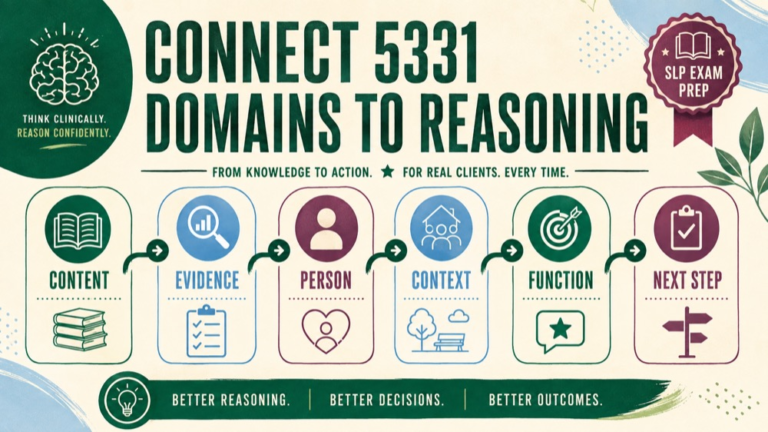
Use the first visual map as a study starting point. Put the current source at the top, then connect domains, evidence, context, practice, and review. The map should help you see which piece is missing when a session feels unproductive.
For example, a learner may have a concept but lack a contrast, know the definition but not the functional consequence, or recognize a pattern but miss the access or language variable. The next study action should match the gap rather than defaulting to more reading.
CONTENT, CONTEXT, CLINICAL ACTION
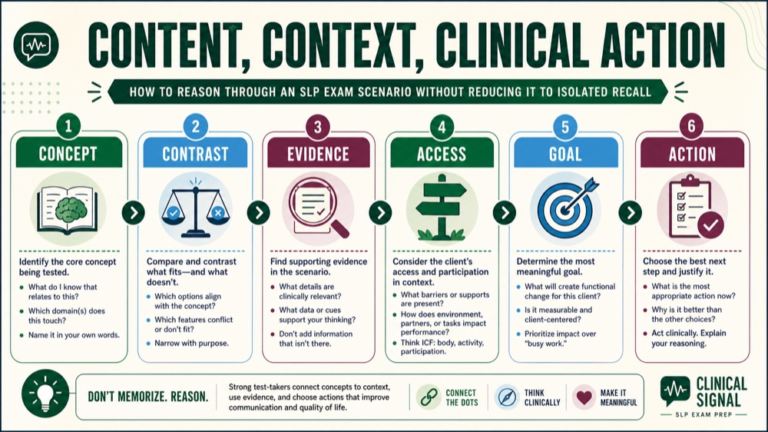
The second visual turns a resource and a practice signal into a next action. A current source can answer a process question. A clinical reference can deepen a mechanism. A practice response can reveal a reasoning gap. Your note should preserve which lane produced the information.
- SOURCE: identify who owns the fact.
- CONCEPT: state the principle in plain language.
- CONTEXT: name the person, task, setting, language, and access variables.
- SIGNAL: record the practice condition and the observed pattern.
- REPAIR: choose one targeted change.
- TRANSFER: set a later check with a changed condition.
Track evidence from practice
Practice evidence is more informative when you record its conditions. Note whether the set was timed, mixed, open-resource, repeated, verbal, written, or completed after fatigue. Add confidence, the reason for the choice, the closest alternative, and the explanation you would give a colleague.
- Mark knowledge gaps separately from reading or interpretation gaps.
- Record whether the stem was understood before comparing options.
- Note the context variable that changed your reasoning.
- Separate an error from a low-confidence correct response.
- Track whether the repair was retrieval, comparison, pacing, or transfer.
- Use a dated follow-up rather than editing the original record.
- Protect private or identifying information in shared files.
- Compare patterns across several conditions before changing the plan.
A practice total can be one signal, but it does not tell you why an answer changed. The explanation, confidence, condition, and transfer result are the pieces that make the signal actionable. Keep the provider-reported score and pathway information in a separate administrative note.
Use explanations as feedback
Read explanations as feedback about a decision, not as a paragraph to copy. Ask what evidence the explanation prioritized, what assumption made the tempting alternative attractive, and what new condition would make you reconsider the choice. Then write the smallest repair that addresses the gap.
| Feedback layer | Question | Possible repair |
|---|---|---|
| Recall | Which term, mechanism, or fact was missing? | Create a short retrieval prompt. |
| Interpretation | Which phrase or detail was misread? | Underline the decision point before viewing options. |
| Context | Which person, partner, setting, or access detail changed the choice? | Add a context comparison. |
| Reasoning | Why did the close distractor feel plausible? | Write a two-column evidence contrast. |
| Transfer | Can the same principle guide a new case? | Change one variable and retry later. |
This feedback loop is also a guard against resource overload. If the explanation shows a reasoning gap, a new book may not solve it. A targeted comparison, a spoken explanation, a changed context, or a brief conversation with a supervisor or instructor may produce better information.
Adjust for access, language, and context
Study performance is shaped by access and context. Consider language history, dialect, communication mode, hearing, vision, motor demands, technology, noise, fatigue, time of day, and the expectations of the task. These details do not make the evidence useless; they tell you what the evidence actually represents.
For clinical learning, use person-centered language and connect a choice to activity and participation. For administrative notes, protect private information and use the channel named by the responsible organization. For source review, distinguish a general professional resource from a rule that applies to a specific state, agency, program, or employer.
- Choose text, audio, visual, or combined formats that support the task.
- Plan breaks and attention supports before a long review block.
- Record when language or access changes the condition.
- Include communication partner and environment in case reasoning.
- Check whether the study tool’s interface creates an avoidable barrier.
- Use ASHA’s cultural-responsiveness resource when language and culture are relevant to the case.
- Ask for appropriate professional support when the question exceeds a study guide’s scope.
- Write the limitation of the observation before drawing a broad conclusion.
Compare resources without chasing novelty
New material can feel productive because it creates motion. A better test is whether the resource changes what you can retrieve, explain, compare, or transfer. Before adding another guide, look at your error log and ask which job remains uncovered.
| If the problem is… | Try first… | Then check… |
|---|---|---|
| Vocabulary | A concise definition and contrast map. | Can you explain it without the page? |
| Mechanism | A source with a diagram, example, or sequence. | Can you connect mechanism to function? |
| Application | A changed case or mixed question. | Which evidence drives the choice? |
| Pacing | A defined timed condition with later review. | Did pacing change reading or reasoning? |
| Transfer | A delayed task with one changed variable. | Does the principle still guide the action? |
Resource comparison should include access and sustainability. A format that you can use consistently may create better evidence than a dense format that leaves you depleted. The goal is a study system you can inspect and adjust, not a shelf that proves how much material you collected.
Quick study-guide checklist
Before you call a study guide ready, check the following:
- The current ETS 5331 page is linked and dated in your notes.
- ASHA preparation and clinical sources have clear roles.
- Each resource in the stack has one defined job.
- The concept map includes contrasts, evidence, context, and action.
- Practice conditions are recorded with confidence and error type.
- Explanations are reviewed for evidence and close alternatives.
- At least one delayed transfer check is scheduled.
- Access, language, culture, fatigue, and environment are considered.
- Private account, score, and application information is protected.
- The next session has one small, observable purpose.
A checklist is not a substitute for judgment. It is a way to make missing pieces visible before you spend more time or money on another resource.
Questions before you commit to a resource
Use these questions when evaluating a guide, course, question bank, or personal note system:
- Which current source anchors the claim or scope?
- What specific study job does this resource perform?
- Does it explain the distinction, mechanism, or decision point?
- What practice condition will let me observe a change?
- How will I record confidence, error type, and reasoning?
- Which person, language, access, or setting variable should I change for transfer?
- What information belongs to ETS, ASHA, a state, an agency, or another receiving organization?
- What will I do if two sources use different language?
- When will I review the resource again?
- What evidence would tell me to pause, replace, or narrow the resource?
Good questions keep preparation grounded. They also help you discuss your plan with an instructor, supervisor, mentor, or study partner without asking another person to guess what a source or score means.
Sources and next steps
Start with the current ETS Speech-Language Pathology 5331 page, the ASHA Praxis preparation page, and the ETS preparation-materials store. Use the ETS SLP preparation-course page as one official-resource example when comparing the role of a course with the role of a study guide.
For clinical topic review, consult the ASHA Practice Portal and the ASHA Cultural Responsiveness resource when relevant. Recheck current provider, state, agency, school, employer, facility, and professional requirements before relying on an administrative detail.
Next, write the source, study job, target concept, practice condition, error pattern, and one dated action in separate lines. That small record turns a guide from a static document into a review system you can keep improving.
Continue your preparation: Explore the SLP Study Center learning resources.