
If you are using slp praxis clinical scenario questions to prepare, the most useful practice is not memorizing a label after seeing one symptom. It is learning to identify the clinical purpose, select the strongest evidence, and explain why the other choices do not fit the whole case. This original practice set uses four short scenarios to make that reasoning visible.
Read each stem once for the client, setting, and task. Then read it again for the detail that changes the decision. The explanations use general SLP clinical reasoning and source boundaries; they are not a substitute for checking current ETS exam information or the relevant ASHA guidance before you study from this page.
Table of Contents
- Read the task before choosing a label
- Build the clinical pattern before looking at the options
- Match assessment or intervention to purpose
- Work through original practice questions
- Recognize common clinical-scenario traps
- Use the quick review checklist
- Verify current sources
SLP Praxis Clinical Scenario Questions: Read the Task Before the Label
Clinical scenarios compress a referral question, a client profile, a setting, and a possible decision into a few lines. The first question to ask is not, “What disorder does this remind me of?” Ask, “What is the item asking the clinician to decide right now?” A next-step question, an interpretation question, a treatment-selection question, and a safety question can use similar facts but require different answers.
- Name the task: Decide whether the stem asks for screening, assessment, diagnosis, treatment planning, measurement, referral, or immediate safety action.
- Locate the client: Note age, onset, medical history, communication profile, participation needs, and any factor that changes the risk or interpretation.
- Locate the setting: Acute care, school, outpatient, and community scenarios carry different timelines, team roles, and functional priorities.
- Underline the decisive evidence: Look for a pattern across tasks, modalities, consistency, timing, and context rather than grabbing the most memorable symptom.
- Test the answer against the purpose: The best choice should solve the stated clinical problem and stay within the information available in the stem.
A technically reasonable action can still be the wrong answer when it is premature, too narrow, or mismatched to the question. For example, a screening may identify a need for further evaluation, but it does not replace a comprehensive assessment. A treatment technique may be useful later, but the best first step may be to establish a baseline or clarify the communication goal.
Build the Clinical Pattern Before Looking at the Options
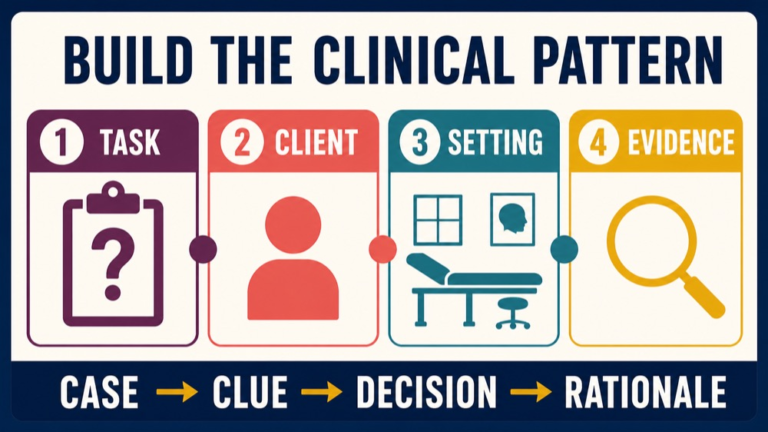
Strong clinical reasoning connects the observed behavior to a construct and then checks that connection against context. In language assessment, consider comprehension, expression, repetition, reading, writing, discourse, and functional communication. In speech assessment, separate speech sound patterns, motor execution, motor planning features, voice, fluency, and language. In swallowing, consider alertness, respiratory status, oral and pharyngeal signs, meal context, and the question the evaluation must answer.
| Stem clue | Reasoning move | Common mismatch |
|---|---|---|
| A single unusual symptom | Look for repeated patterns across tasks and contexts. | Assigning a disorder label from one sign. |
| A request for the next step | Choose the action that gathers or protects the information needed next. | Starting a favorite treatment before evaluation. |
| A change in safety or alertness | Prioritize immediate risk management and team communication. | Continuing a trial to collect extra data without reassessing risk. |
| A participation limitation | Include functional goals, access, and communication partners. | Reducing the plan to an impairment drill alone. |
Patterns also need boundaries. Inconsistent speech errors and disrupted prosody may justify a motor-speech-focused assessment, but they do not by themselves settle a diagnosis. Effortful speech after a neurological event may involve language, motor speech, or both, so the evaluation should sample the relevant modalities. Coughing during a meal is a warning sign that changes the immediate plan, not a complete explanation of the swallowing physiology.
When an option sounds confident because it uses specialized vocabulary, pause and ask whether the stem supplied enough evidence for that level of certainty. A careful answer can still be decisive: it may recommend a focused evaluation, protect safety, gather a functional sample, or collaborate with the appropriate team member.
Choose the Assessment or Intervention That Fits the Purpose
Many practice items are really asking you to match a tool or action to a purpose. Screening answers a brief identification question. A comprehensive evaluation describes strengths and needs across relevant domains. A diagnostic interpretation integrates history, observations, formal and informal measures, and differential considerations. Treatment planning then uses that information to select measurable targets and a way to monitor change.
- Clarify the referral question: What does the team, client, or family need to know or do?
- Choose evidence that can answer it: Combine appropriate tasks with observation, interview, records, and functional communication information when relevant.
- Respect access and participation: Consider hearing, vision, language background, motor access, fatigue, partner support, and the communication environments that matter.
- Plan the next decision: Explain how the result will affect referral, intervention, accommodations, safety, or outcome measurement.
That sequence helps across clinical domains. For aphasia, a naming score alone cannot describe the person’s ability to understand, converse, read, write, or communicate with partners. For a child with possible motor-speech differences, repeated productions, prosody, connected speech, and broader language information may be more informative than one isolated word. For AAC planning, access, vocabulary functions, partner modeling, and use across settings belong in the conversation from the start.
In a dysphagia scenario, the setting and immediate risk matter. A bedside observation can identify signs that require a safer plan and further evaluation, while an instrumental assessment may be selected when the clinical question requires visualization of swallowing physiology. The correct answer should respect the clinician’s role, collaboration needs, and the evidence available at that moment.
Original Practice Questions: Clinical Reasoning in Action
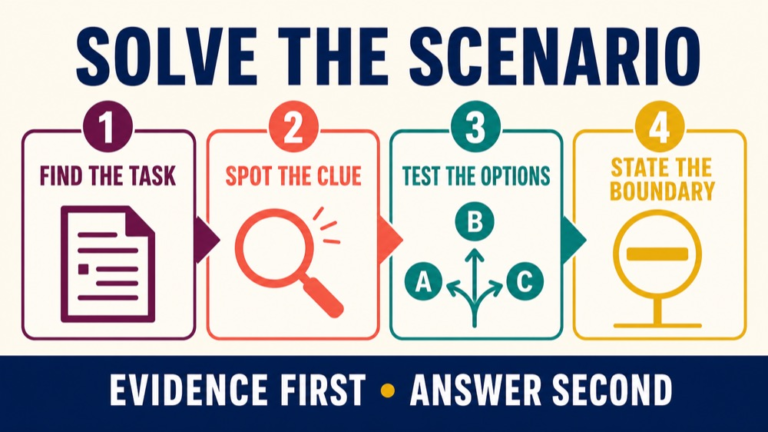
Original practice content: The four items below were written for this learning article. They are single-best-answer exercises, not a source of live test content. Choose an answer before reading the explanation, then identify the exact stem detail that made the answer stronger than its distractors.
Original Practice Question 1: Adult language assessment
Scenario: A 68-year-old right-handed adult is three weeks post left-hemisphere stroke. Conversation is effortful, phrases are short, and grammatical words are frequently omitted. The person follows simple and two-step directions with occasional repetition, but has difficulty naming, explaining a recent event, reading a short paragraph, and writing a message. The referral asks the SLP to characterize communication needs and plan the next phase of care. What is the best next step?
- A. Label the presentation as dysarthria and begin oral-motor strengthening before collecting more language data.
- B. Complete a comprehensive language evaluation that samples relevant modalities and functional communication, using history and communication-partner information as appropriate.
- C. Start confrontation-naming drills immediately and postpone evaluation until the person can name more pictured objects.
- D. Treat the pattern as a hearing problem and use a hearing screen as the sole explanation for the communication changes.
Correct Answer: B. The referral asks for characterization of communication needs, and the stem describes changes across naming, discourse, reading, and writing. A comprehensive language evaluation can organize those findings, examine comprehension and expression more fully, and connect impairment results to functional communication. The effortful speech pattern may raise a language or motor-speech question, but the broader profile calls for information across modalities before a narrow interpretation or treatment plan.
Why the Other Options Are Wrong: Each distractor either labels too early, begins treatment before establishing needs, or narrows a broad communication profile to one possible contributor. The important mismatch is between the option’s limited action and the referral’s comprehensive purpose.
- A. Dysarthria concerns speech-motor execution, while this stem also describes naming, reading, writing, and discourse changes. Oral-motor strengthening would not characterize the language profile.
- C. Naming treatment may become one component of care, but starting it before a broader evaluation ignores the stated need to characterize communication and establish priorities.
- D. Hearing status can affect communication and should be considered, yet a hearing screen alone cannot explain or characterize changes across language modalities.
Exam Trap: An effortful speech description can pull you toward a motor-speech label. When the stem lists problems in several language modalities and asks for characterization, choose the evaluation that samples the full communication profile rather than the first familiar label.
Original Practice Question 2: Child motor-speech assessment
Scenario: A 6-year-old child has hearing results within expected limits and age-appropriate comprehension during a brief interaction. Across repeated attempts at the same multisyllabic words, consonant errors are inconsistent, stress patterns vary, and the child sometimes appears to search for the articulatory placement. The family wants to know why intelligibility changes from one attempt to the next. Which next step is most defensible?
- A. Assign a definitive motor-speech diagnosis from the visible searching movement and begin one fixed treatment protocol.
- B. Complete a motor-speech-focused assessment with repeated productions, consistency and prosody measures, connected speech, and consideration of language and hearing information.
- C. Use a minimal-pair activity as the only assessment because all inconsistent errors represent a phonological contrast problem.
- D. Prescribe nonspeech oral exercises to build speech strength before examining speech movement and prosody.
Correct Answer: B. The decisive evidence is a pattern across repeated productions, consistency, prosody, and apparent movement planning, not one isolated observation. A focused assessment can test those features in a controlled and connected-speech context while keeping language, hearing, and other contributors in view. The result can guide a treatment decision without claiming more certainty than the stem supports.
Why the Other Options Are Wrong: The distractors turn a reason for further assessment into a settled diagnosis or select a treatment method before the relevant pattern has been described. The best next step preserves diagnostic caution while collecting the evidence needed for a useful clinical decision.
- A. Searching can be clinically meaningful, but it is not enough by itself to establish a diagnosis or justify one predetermined protocol.
- C. Minimal pairs may help when a contrast-based phonological pattern is the treatment target, but using them as the only assessment misses repeated-production and prosody questions.
- D. Speech planning and sequencing concerns are not resolved by assuming a generalized strength problem; nonspeech exercises would bypass the speech evidence in the stem.
Exam Trap: When several motor-speech clues appear together, the tempting answer is a confident label. The stronger answer often names the targeted assessment that can confirm or refine the pattern before treatment is selected.
Original Practice Question 3: Dysphagia safety and next steps
Scenario: During an acute-care bedside meal observation, an adult recovering from stroke coughs twice after thin liquid, develops a wet vocal quality, and becomes noticeably drowsier than at the start of the trial. The referral asks whether oral intake can be advanced safely. What is the most appropriate immediate SLP response?
- A. Continue the same trial until enough coughs occur to calculate a reliable percentage.
- B. Stop the current oral trial, prioritize immediate safety, document the observations, notify the medical team, and arrange further evaluation as indicated by the clinical question and setting.
- C. Independently prescribe thickened liquids as the permanent plan and close the swallowing evaluation.
- D. Teach larger sips and a chin-tuck strategy without reassessing alertness or gathering more information.
Correct Answer: B. New coughing, wet vocal quality, and reduced alertness change the risk picture during the observation. The immediate priority is to stop the current trial and communicate the change so the team can protect safety and decide what additional clinical or instrumental information is needed. The answer does not assume that one bedside sign explains the physiology; it chooses a safe, collaborative next step.
Why the Other Options Are Wrong: The distractors continue exposure despite a change in alertness, prescribe a restriction without the needed assessment and collaboration, or apply a strategy without checking whether the patient can safely participate. Each option skips the immediate safety question that the stem makes central.
- A. Collecting more trials is not the priority after the patient’s alertness changes and airway-protection warning signs appear; the plan should be reassessed first.
- C. Thickening may have a role in some individualized plans, but an SLP should not treat it as a permanent independent order or substitute it for evaluation.
- D. A compensatory strategy may be considered after assessment, yet larger sips and chin tuck are not a safe universal response to drowsiness and observed changes.
Exam Trap: A question that includes an airway-related sign and a new safety change is testing priority, not your ability to name a favorite strategy. Protect the immediate situation, communicate, and match the next evaluation to the clinical question.
Original Practice Question 4: AAC treatment planning
Scenario: An 8-year-old student uses pointing, eye gaze, and vocalizations but cannot reliably communicate pain, refuse an activity, answer a classroom question, or tell a partner what happened at recess. The student has consistent visual access and can select large targets with a supported hand position. The team asks for a communication plan that can be used across school routines. Which recommendation is best?
- A. Require a spoken approximation before giving access to aided communication so speech remains the primary goal.
- B. Provide multimodal AAC with an access evaluation, partner modeling, and vocabulary for requesting, refusing, social interaction, information sharing, and repair.
- C. Limit the system to a few preferred objects until the student demonstrates readiness for a larger vocabulary.
- D. Delay AAC until formal testing shows that the student has sufficient language and cognition to benefit from it.
Correct Answer: B. The scenario describes a participation need, an available access method, and communication functions that extend beyond requesting. A multimodal plan can support immediate communication while the team evaluates access, teaches partners to model use, and expands vocabulary for real routines. AAC planning should be responsive to the student’s current communication needs rather than contingent on a speech or readiness prerequisite.
Why the Other Options Are Wrong: The distractors make aided communication conditional, restrict the student’s communicative purposes, or postpone support until after an artificial threshold. Those choices conflict with the stated need for reliable communication across routines and do not use the access information supplied in the stem.
- A. Requiring speech before communication access can increase frustration and removes a needed means of expressing refusal, pain, and information.
- C. A small starting set may be one design decision, but limiting the system to preferred objects omits social, academic, repair, and self-advocacy functions.
- D. Assessment should inform access and teaching, not delay communication until a readiness label is achieved; the stem already supplies a clear functional need.
Exam Trap: Some options sound cautious because they promise to wait for more testing. When the stem shows a functional communication gap and a workable access route, choose the plan that provides communication while continuing individualized assessment and teaching.
Common Traps in Clinical-Scenario Questions
The most difficult distractors are rarely absurd. They are often appropriate actions placed at the wrong time, actions that fit only one part of the case, or actions that ignore the setting. Compare each choice with the task, the strongest evidence, and the client’s participation or safety needs.
- Label before purpose: A diagnostic-sounding answer may be premature when the item asks for an evaluation step.
- Single sign reasoning: One symptom can guide a hypothesis, but a broader pattern and context are needed for a defensible interpretation.
- Screening versus evaluation: A screen identifies whether more information is needed; it does not answer every diagnostic or treatment question.
- Favorite-treatment bias: Do not choose drills, strategies, or restrictions before the stem establishes the target and immediate priorities.
- Impairment-only planning: Functional communication, access, partners, and participation can determine whether a plan is clinically useful.
- Ignoring setting: Acute-care safety, school participation, outpatient rehabilitation, and community support involve different next steps.
- Overreading confidence: Specialized vocabulary does not make an option correct if the stem lacks the evidence it requires.
- Missing the timing word: Terms such as immediate, initial, next, and best can change the priority even when several actions could eventually be reasonable.
Quick Review Checklist
Before you commit to an answer, use this short checklist. It keeps the reasoning anchored to the case rather than to a memorized association, and it gives you a repeatable way to review a missed item.
- What exact decision does the question ask me to make?
- What client, setting, timeline, and risk details constrain that decision?
- Which finding is a pattern-level clue, and which finding is only a hypothesis starter?
- Is the answer proposing screening, assessment, interpretation, treatment, measurement, referral, or safety action?
- Does the answer match the information available now, or does it assume unprovided evidence?
- Does it address function, participation, access, partners, or safety when the stem makes those central?
- Can I state in one sentence why each distractor is less appropriate?
- What current ETS or ASHA source should I verify before relying on a changing exam or practice claim?
For review, write the decisive evidence beside the question rather than copying the full rationale. If you miss an item, classify the error: did you miss the task, the clinical pattern, the setting, the timing, or the boundary of the answer? That diagnosis of your reasoning process is more useful than simply marking the letter and moving on.
References and Current-Source Check
Exam scope, registration, delivery, scoring, and test-day rules can change. Before using this article for a current study plan, review the ETS Speech-Language Pathology (5331) test page and the ASHA overview of the SLP Praxis exam. Use the ASHA Practice Portal for topic-specific clinical guidance and the ASHA policy resources for current professional boundaries.
This page is a learning aid built from original examples. Confirm the source version, setting, client factors, and applicable professional requirements before transferring a general explanation to a real clinical decision.
Continue your preparation: Explore the SLP Study Center learning resources.