
speech pathology praxis questions and answers can be more than a recall drill. Use speech pathology Praxis questions and answers as a structured rationale practice: choose, defend, compare, classify the miss, and transfer the reasoning to a new context. Questions and answers become a stronger study asset when the answer key is only the beginning. Review the evidence, context, sequence, and closest distractor so you can explain the decision when the wording changes.
Use the current ASHA Speech-Language Pathology 5331 content page for the study frame and the live ETS 5331 page for current exam context. The ASHA Practice Portal provides clinical topic context. All questions, explanations, and maps below are original educational material, separate from live test material and not individualized clinical advice.
Write the purpose of the session before you begin. You may be checking timing, content switching, explanation quality, access reasoning, functional transfer, or professional sequence. A defined purpose makes the review actionable and tells you which notes deserve attention when the clock stops.
What speech pathology praxis questions and answers should teach
Each item should represent a decision rather than a vocabulary contest. Identify the person, activity, context, evidence, and professional boundary. Then ask whether the selected answer is proportionate to what the stem actually gives you.
| Signal | Question | Study record |
|---|---|---|
| Decision | What action does the stem request? | Underline clarify, assess, treat, monitor, refer, or document. |
| Evidence | Which detail changes the choice? | Write one evidence-to-action sentence. |
| Context | What affects access or interpretation? | Record language, mode, partner, setting, and support. |
| Function | What activity or participation outcome matters? | Name the person’s real-world task. |
| Boundary | What must happen first or be handed off? | Note safety, consent, privacy, competence, or local process. |
| Transfer | What changes if one variable moves? | Write a paired prompt for delayed review. |
This record helps you separate a content gap from a reading or process gap. A missed item may come from pacing, a missed contrast, an inaccessible condition, an answer at the wrong level, or a sequence error. Those problems need different repairs.
Define the outcome before the clock
Choose one observable outcome for the session. For a timed run, the outcome might be a stable checkpoint and a completed rationale block. For explanation practice, it might be a one-sentence bridge from the controlling clue to the action.
Keep the score, confidence, and explanation separate. A score can tell you what happened under one condition. Confidence can show uncertainty. The explanation shows whether you can defend the choice and recognize what would change it.
- Set: select a mixed group of original questions.
- Condition: define time, environment, tools, and breaks.
- Record: mark answer, confidence, clue, and return items.
- Review: compare the best option with the closest alternative.
- Transfer: change one variable and solve again later.
Use current 5331 public sources
Use the ASHA content page and ETS page when you write notes about current exam context, preparation resources, or administrative details. Add a checked date to details that may change, and revisit the source before relying on them.
For clinical reasoning, the ASHA Multilingual Service Delivery resource and ASHA Cultural Responsiveness resource can help you notice language history, cultural context, access, collaboration, and person-centered goals. Bring those checks into the rationale when the case gives you the relevant condition.
Keep original practice content clearly labeled and separate from restricted live-test material. A useful study page teaches how to inspect evidence and choose an action; it does not imply access to protected questions or a credential result.
Build a balanced question set
Mix evaluation, treatment, foundations, communication access, safety, and professional practice. Vary the requested verb so you must decide whether to clarify, assess, interpret, act, monitor, refer, document, or collaborate. This keeps the set focused on decisions rather than repeated recognition of one familiar format.
| Lane | Typical decision | Review lens |
|---|---|---|
| Evaluation | What information or measure belongs next? | Validity, access, history, and representative conditions. |
| Treatment | What update fits the response and goal? | Cueing, target, partner, activity, and outcome. |
| Foundations | Which concept explains the pattern? | Mechanism, contrast, and limits of inference. |
| Access | What condition affects opportunity? | Language, dialect, mode, hearing, environment, and support. |
| Safety | What changes the order? | Stop rule, escalation, communication, and follow-up. |
| Professional | What protects the person and process? | Consent, privacy, competence, supervision, and handoff. |
Use enough variety to make switching visible, but not so much that the review becomes vague. The right set is one you can finish, explain, and revisit with a changed condition. Keep the mix stable for several sessions so comparisons remain meaningful.
Read every stem for decision and context
Start with the action word, then locate the person, activity, setting, evidence, and boundary. This prevents a familiar technical phrase from becoming the answer before you have read the conditions around it. It also makes the closest distractor easier to evaluate on the same terms.
- Person: who is communicating and what matters to them?
- Activity: what task, partner, or participation outcome is named?
- Condition: where, when, and with what supports did the response occur?
- Evidence: what contrast, response, limitation, or missing detail controls the choice?
- Boundary: what must happen first, be communicated, or be handed off?
If a detail is missing, treat that absence as information. A proportionate answer may gather history, clarify the concern, observe another condition, or confirm a local process before making a broader decision. State what you need to know and why it would change the next action.
Audit evidence and distractors
After choosing, identify the closest distractor and name its mismatch. It may be a reasonable action at the wrong time, an unsupported conclusion, a choice that ignores context, or a step outside the role described.
- Does the answer match the verb?
- Does it use the controlling clue?
- Does it account for language, dialect, culture, mode, hearing, partner, and setting?
- Does it connect to the person’s activity and participation?
- Does it put safety, consent, privacy, competence, and follow-up in order?
- Does it stay within the information and authority supplied?
Write “fits because” and “misses because” for the two closest choices. This makes the explanation portable when a later item changes one word or condition, and it shows whether the original decision depended on evidence, context, timing, or professional sequence.
Check access, function, and sequence
Access is part of interpretation. Language history, dialect, communication mode, hearing, vision, motor access, technology, fatigue, noise, partner behavior, and response format can change the opportunity to show a skill. Name the condition rather than treating it as background detail after the answer has been chosen.
Function is the bridge from a structured result to a person’s life. Notice whether a cue, strategy, or measure changes effort, accuracy, message success, partner understanding, activity completion, or participation. Then state what you would monitor next.
Sequence is the final check. Clarification, safety, consent, and communication may come before measurement or treatment. When the case gives a local process, make the process visible in the rationale and explain what information or handoff follows.
CONNECT EACH PRAXIS ANSWER TO ITS EVIDENCE
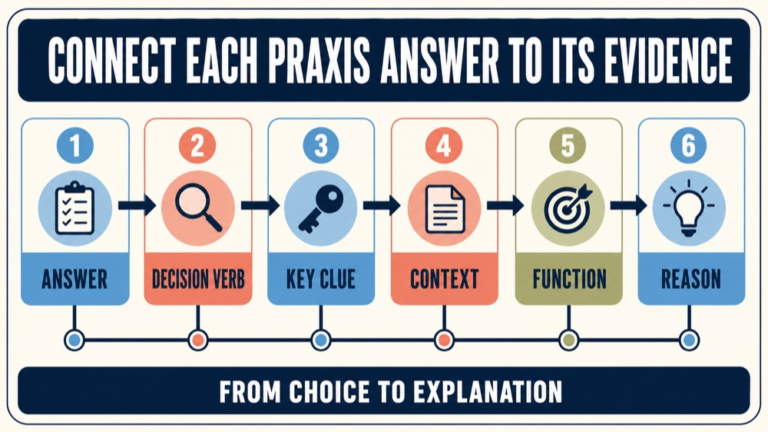
Use the first map to design the session before you begin. The question set, timer, evidence log, context check, and review block should work together. If the intended outcome is explanation quality, reserve enough time to defend the choice after the timed run.
| Build step | Write down | Why it matters |
|---|---|---|
| Purpose | Timing, explanation, access, or transfer. | Keeps the session interpretable. |
| Mix | Domains and decision verbs. | Makes switching visible. |
| Condition | Time, setting, tools, and breaks. | Makes comparisons fair. |
| Log | Answer, confidence, clue, distractor, and boundary. | Turns a result into feedback. |
| Review | Protected explanation time. | Reveals the reason behind the choice. |
| Transfer | One changed variable. | Tests whether reasoning travels. |
Keep the build lightweight enough to repeat. A reliable routine creates more useful comparisons than a complicated plan that appears once and disappears. Choose a format you can use on both a strong day and a tired study day.
COMPARE THE ANSWER WITH THE CLOSEST DISTRACTOR
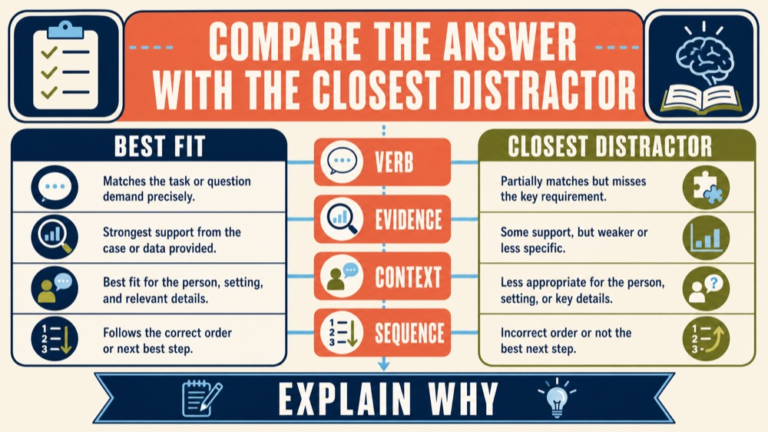
The second map is the explanation routine: decision fit, evidence fit, context fit, and sequence fit. Use it for missed and low-confidence correct answers. Recognition without an explanation is a cue to review, not a final study signal.
| Check | Prompt | Repair |
|---|---|---|
| Decision fit | What action did the stem request? | Rewrite the verb and answer. |
| Evidence fit | Which clue changed the choice? | Circle the contrast or limitation. |
| Context fit | What condition affects access or interpretation? | Add person, partner, mode, or setting. |
| Sequence fit | Is this the right action now? | Put clarify, act, communicate, and follow up in order. |
Finish with a paired prompt: change one variable, predict what should change, and explain why the rest of the reasoning stays stable. This final comparison turns a single answer into a small test of transfer.
Question 1: an evaluation decision
Practice Question 1. A question asks for the best next step after a communication sample is collected, but the language history and communication mode are not described. Which response is most proportionate? After choosing, record the condition that made the decision difficult so the explanation stays tied to the case.
- A. Interpret the sample as a complete disorder profile.
- B. Gather the missing history and clarify the mode and context before selecting broader conclusions.
- C. Ignore the missing details because the sample is easier to score.
- D. Choose the most intensive treatment before reviewing the sample conditions.
Correct Answer: B. The missing history and mode affect interpretation. A proportionate next step gathers the information needed to understand the sample before expanding the conclusion or plan. Note the evidence-to-action link in your review log so you can reuse the reasoning when a context detail changes.
Why the Other Options Are Wrong: A and C treat limited evidence as complete. D jumps to treatment without defining the decision. B makes the missing context explicit. Compare the closest alternative by decision, evidence, context, and sequence rather than by technical vocabulary alone.
Exam Trap: In an answer-and-rationale page, missing information can be the clue that controls the next step. Add one short transfer prompt after the review to check whether the rule travels beyond this wording.
Question 2: a functional treatment decision
Practice Question 2. A client’s intelligibility is higher with a slower rate in drills, but the client wants to be understood during a fast-paced handoff at work. Which answer best addresses the goal? After choosing, record the condition that made the decision difficult so the explanation stays tied to the case.
- A. End the plan because drill accuracy is higher.
- B. Practice supported handoffs with rate choices, listener feedback, repair strategies, and a participation measure.
- C. Remove all rate supports so only the hardest condition is measured.
- D. Use more drills without including the work handoff.
Correct Answer: B. The drill result provides a strategy signal, while the work handoff defines the functional context. Practice should connect rate, listener, repair, and participation. Note the evidence-to-action link in your review log so you can reuse the reasoning when a context detail changes.
Why the Other Options Are Wrong: A stops before transfer is addressed. C removes a potentially useful support. D repeats a narrow condition. B uses the answer and the context together. Compare the closest alternative by decision, evidence, context, and sequence rather than by technical vocabulary alone.
Exam Trap: A good rationale explains how a structured result informs a functional next step instead of treating the drill as the final outcome. Add one short transfer prompt after the review to check whether the rule travels beyond this wording.
Question 3: a professional-practice decision
Practice Question 3. A patient shows a new change during a facility-approved screen, and the protocol directs the clinician to stop and notify the care team. Which answer is best? After choosing, record the condition that made the decision difficult so the explanation stays tied to the case.
- A. Continue until enough observations have been gathered.
- B. Record only the earlier observations and omit the change.
- C. Stop under the protocol, notify the team, document the condition and response, and arrange follow-up within the role.
- D. Ask a family member to continue while the clinician moves to another task.
Correct Answer: C. The protocol and new change control the sequence. The response protects safety, communication, documentation, and role boundaries. Note the evidence-to-action link in your review log so you can reuse the reasoning when a context detail changes.
Why the Other Options Are Wrong: A delays the stated action. B omits information that changes interpretation. D transfers responsibility without appropriate competence. C follows the process. Compare the closest alternative by decision, evidence, context, and sequence rather than by technical vocabulary alone.
Exam Trap: When an answer choice sounds efficient but skips a stated safety process, efficiency is not the deciding criterion. Add one short transfer prompt after the review to check whether the rule travels beyond this wording.
Classify errors before changing resources
Give each miss one primary category before you choose a repair. This protects you from replacing every resource when the real problem is one reading habit or one missing context check.
| Category | Signal | Repair |
|---|---|---|
| Pacing | The last items or review block collapse. | Use checkpoints and a return rule. |
| Verb | The explanation answers a neighboring action. | Underline clarify, assess, treat, monitor, refer, or document. |
| Evidence | A contrast or limitation was missed. | Write the controlling clue and implication. |
| Access | Language, mode, partner, or setting disappears. | Add access to the first read. |
| Function | The answer ends at a score or drill. | Name the activity and participation outcome. |
| Sequence | A reasonable action is premature. | Write what must come before it. |
| Boundary | Safety, consent, privacy, or competence is absent. | Add communication and handoff. |
| Transfer | The rule fails after one variable changes. | Solve a paired case later. |
Review patterns across multiple sessions. A repeated category is stronger evidence for a study change than one isolated miss.
Repeat with delayed transfer
Return to a question after a delay and change one variable: partner, setting, language, support, urgency, response mode, or activity. Solve the new version before looking at the first rationale.
- Write the original decision and controlling clue.
- Change one condition only.
- Predict what stays stable and what changes.
- Explain the new action, context, and boundary.
- Compare both cases and schedule a later check.
Delayed transfer helps you learn a relationship instead of memorizing a phrase. Keep the variation small enough that you can see which variable did the work.
Study checklist
Before closing the session, confirm that you have:
- Checked current ASHA and ETS context.
- Defined one observable session outcome.
- Set the question mix, time boundary, environment, and review block.
- Identified person, activity, decision verb, evidence, and boundary.
- Accounted for access and function when relevant.
- Compared the selected answer with the closest distractor.
- Classified each miss and chosen one targeted repair.
- Written one evidence-to-action sentence.
- Created one changed-variable transfer prompt.
- Scheduled delayed review.
The checklist is complete when it produces a next action. If you have only a score, return to the log and add the clue, distractor, boundary, and repair.
Sources and next steps
For current exam context, review the ASHA Speech-Language Pathology 5331 content page and the live ETS 5331 page. For clinical context, use the ASHA Practice Portal, including its Multilingual Service Delivery and Cultural Responsiveness resources.
Use the ETS practice-test page for current preparation-resource context. The questions, answers, explanations, and maps here are original educational material separate from live test content. Recheck current state, employer, school, agency, facility, professional, and administrative requirements before relying on them.
Next, run one mixed set, write a rationale for the closest distractor, classify one miss, and solve a paired case after a delay.
Continue your preparation: Explore the SLP Study Center learning resources.