praxis speech language pathology mock exam can give your preparation a realistic decision day, but a useful simulation needs a clear purpose. The goal is not to create a dramatic endurance test or to promise a result. It is to practice pacing, mixed-domain reasoning, evidence comparison, access checks, professional boundaries, and post-session review under a defined condition.
Use the current ASHA Speech-Language Pathology 5331 content page for the study frame and the live ETS 5331 page for current exam context. The ASHA Practice Portal provides topic-specific clinical context. The mock scenarios, rationales, visual maps, and checklist below are original educational material, separate from live test material and not individualized clinical advice.
Before a mock session, decide what you will measure: pacing, confidence, reading accuracy, evidence use, transfer, or a combination. Afterward, use the log to choose your next study action. A clock can show where the process changes, but the rationale explains why.
What a Praxis speech language pathology mock exam is for
A mock exam is a structured rehearsal of decisions. It can help you notice how you distribute time, how quickly you identify a decision verb, how often you overlook context, and whether you can explain a choice after the clock stops. It should produce information for the next review rather than a broad judgment about your readiness.
| Phase | What to do | Useful output |
|---|---|---|
| Plan | Confirm current source context, choose a mixed set, set a time window, and prepare an error log. | A clear simulation boundary. |
| Run | Read the scenario, decide, mark uncertainty, and keep moving according to your chosen pacing. | A timed decision record. |
| Review | Compare evidence, sequence, access, function, and professional boundaries after the clock stops. | A rationale and distractor analysis. |
| Transfer | Change one context variable and solve a paired case after a delay. | A rule that is usable beyond one item. |
Use a mock session after you have studied enough content to make the data interpretable. If every topic is new, a low result mostly tells you that the material is unfamiliar. A simulation is more informative when you can identify whether a miss came from content, access, sequence, pacing, or confidence.
Check the current 5331 frame first
Confirm the exam identity and current study frame before planning a simulation. The ASHA content page and ETS page are source anchors for the current context. Third-party mock pages can show common formats and learner language, but a search result or quiz page does not establish current scoring, administration, clinical truth, or professional requirements.
Write the checked date beside any time-sensitive note. If your mock plan mentions registration, timing, score reporting, or resource availability, return to the live source when you revise the plan. Keep stable reasoning rules separate from administrative facts that may be updated.
Use ASHA topic resources for clinical concepts and professional context. The ASHA Multilingual Service Delivery resource and ASHA Cultural Responsiveness resource support attention to language history, access, collaboration, reflection, and person-centered practice when a case includes those details.
Design a realistic but useful simulation
Set the simulation boundary before you begin. Choose a mixed set, define a time window, remove avoidable interruptions, and prepare a log. The purpose is to create a repeatable condition, not to make the session uncomfortable for its own sake.
| Design element | Plan | Why it helps |
|---|---|---|
| Content mix | Include evaluation, treatment, foundations, access, safety, and professional practice. | A balanced review target, not a claim about item distribution. |
| Time rule | Use a defined window and record unanswered or uncertain items for later review. | Timing data that can be interpreted. |
| Environment | Reduce avoidable interruptions while keeping a realistic study setup. | A repeatable condition. |
| Answer log | Record choice, confidence, decisive clue, and error category. | Evidence for the next plan. |
| Source check | Separate current ETS and ASHA facts from original practice content. | A dated source note. |
| Recovery | Plan a break, hydration, and a post-session review block. | Sustainable practice rather than a single endurance event. |
Use original questions with complete rationales and plausible choices. Avoid material described as leaked, recalled, or guaranteed to represent a live test. Your study record should make the source boundary clear and should distinguish practice content from current ETS information.
Use four phases instead of one long sprint
Break a mock session into plan, run, review, and transfer. The run phase can be timed, but the review phase should have its own protected time. Without review, you know which letters you selected but not why your reasoning succeeded or failed.
- Plan: choose the mixed set, review current source notes, set the time boundary, and open an error log.
- Run: read the stem, identify the decision, choose, mark uncertainty, and move according to the pacing rule.
- Review: revisit evidence, sequence, access, function, professional boundaries, and the closest distractor.
- Transfer: change one context variable and solve a paired case after a delay.
- Schedule: assign the error category to a future topic review rather than repeating the same set immediately.
Use checkpoints if the session is long. A checkpoint can ask whether you are spending too much time on a single item, rushing because of uncertainty, or skipping the explanation log. The answer is an adjustment to the process, not a reason to make an unsupported claim about your outcome.
Manage uncertainty without rushing
Uncertainty is expected in a mixed set. Give each item a confidence mark before you read the explanation. A low-confidence correct answer and a high-confidence incorrect answer need different review. The first may need rationale and transfer practice; the second may need slower evidence reading and comparison with the strongest distractor.
| Confidence pattern | What to review | Next move |
|---|---|---|
| High confidence, correct | Did the rationale use the decisive clue? | Add a changed-case version to test transfer. |
| Low confidence, correct | Which choice was almost selected and why? | Compare fit, sequence, access, and evidence. |
| High confidence, incorrect | Which assumption or missed clue drove the choice? | Rebuild the stem spine and name the error. |
| Low confidence, incorrect | Was the issue content, reading, or context? | Separate the problem before choosing a resource. |
| Unanswered | Was the barrier time, uncertainty, or missing knowledge? | Use a checkpoint and schedule a targeted review. |
Do not change a defensible answer only because another option uses more technical vocabulary. Return to the action requested, the evidence provided, the person’s activity, and the professional boundary.
Review choices by evidence and function
After the mock clock stops, review the best answer and the strongest distractor together. Ask whether each choice fits the decision verb, decisive clue, sequence, access, function, and boundary. A choice can be technically familiar and still be weak for the case because it comes too early or skips a condition.
| Review question | Write | What it reveals |
|---|---|---|
| What was requested? | The exact decision verb. | Whether you answered the actual item. |
| What mattered? | The contrast, limitation, or boundary clue. | Whether the evidence drove the answer. |
| What fits? | The link between the clue and the selected action. | Whether the rationale is defensible. |
| What failed? | The specific mismatch in the closest distractor. | Which error category to repair. |
| What transfers? | One changed condition and revised action. | Whether the rule is portable. |
Connect clinical reasoning to participation. A structured accuracy gain may not answer a work, school, family, or care activity. A clean observation may not represent a noisy environment. A safety change may require a stop and handoff. The review should preserve those distinctions.
Keep access and professional boundaries visible
Read mock scenarios for language, dialect, culture, hearing, vision, motor access, communication mode, technology, partner, environment, fatigue, consent, privacy, competence, supervision, safety, and local process. The details matter when they change what the person can show or what action is appropriate.
- Ask whether the directions and response mode were accessible.
- Separate a language or communication difference from a disorder conclusion.
- Connect evaluation or treatment to the person’s activity and stated priority.
- Record what support changes in opportunity, effort, accuracy, or participation.
- Notice the role, authorization, privacy, competence, and supervision boundary.
- Stop, communicate, document, refer, or hand off when the scenario requires that sequence.
These checks are part of an accurate answer. Do not add them as a generic paragraph after choosing a technical action. The strongest choice accounts for the condition that the case makes relevant.
RUN A MOCK EXAM IN FOUR PHASES
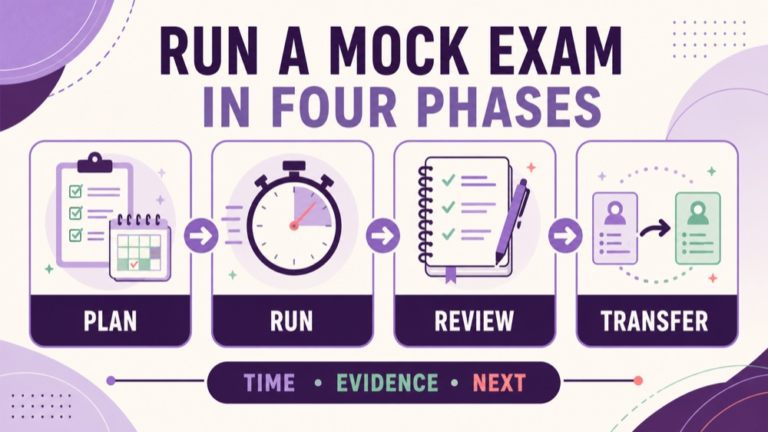
The four-phase map keeps the simulation complete: plan the boundary, run the timed set, review the reasoning, and transfer one rule. Use a separate note for each phase so the time result does not swallow the explanation. A mock exam earns its value in the review and transfer steps.
| Phase note | Example entry | Why keep it |
|---|---|---|
| Plan | Mixed domains, 45-minute window, confidence log ready. | Defines the condition. |
| Run | Marked three items for return and maintained the checkpoint. | Records pacing behavior. |
| Review | Missed a sequence clue in a safety scenario. | Names the reasoning repair. |
| Transfer | Changed the setting and kept the stop rule visible. | Tests portability. |
Customize the duration to your current study stage. A shorter simulation with complete review can be more informative than an exhausting session with no rationale. Recheck the live ETS page before writing any exam-specific timing or administration note.
REVIEW THE MOCK BEFORE THE NEXT ROUND
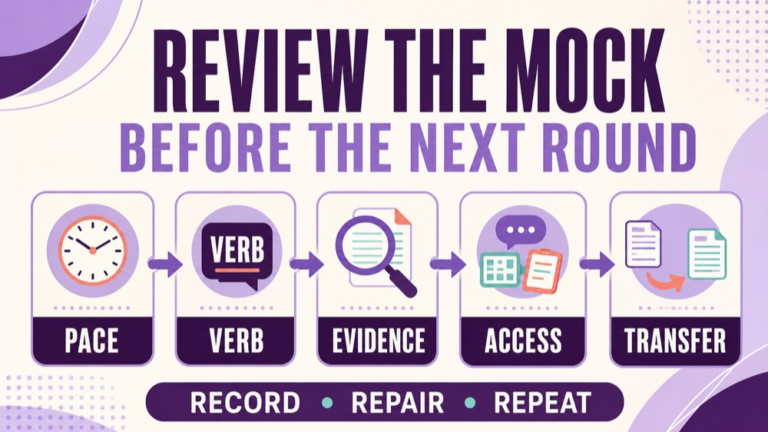
Do not launch the next mock session until you know what the previous one taught you. Sort misses by pace, verb, evidence, access, function, sequence, boundary, and transfer. Select one or two repair targets and change the next simulation only enough to observe whether the process improves.
| Mock result | Review question | Next round adjustment |
|---|---|---|
| Pacing slipped | Where did the time go? | Use a checkpoint and mark items for return. |
| Many correct, weak explanations | Did recognition outrun reasoning? | Require one clue and one distractor sentence. |
| Context misses | Which access or setting detail was ignored? | Add a paired case with one changed condition. |
| Sequence misses | Which action should have come first? | Write the options on a timeline. |
| Transfer misses | What changed when the wording changed? | Hold the evidence steady and vary one field. |
Review correct but uncertain answers too. The goal of the next round is not merely to raise a number; it is to make the decision process more deliberate, efficient, accessible, and transferable.
Question 1: a mock evaluation decision
Practice Question 1. A student performs a short language task in a quiet room but misses directions during a noisy classroom transition. The teacher requests a broad score without a language history or hearing review. In a mock exam, which response is the best next step?
- A. Select the broadest test immediately because a broad score will cover every possible concern.
- B. Conclude that the student has a global language disorder from the classroom report.
- C. Clarify the participation question, review language and hearing context, observe the classroom demand, and select representative evidence.
- D. Use the quiet-room performance as the final description because it is easier to control.
Correct Answer: C. The condition changes between quiet individual work and a noisy group routine. A careful next step defines the concern and checks language, hearing, partner, rate, noise, and representative activity before selecting a measure or interpreting the pattern broadly.
Why the Other Options Are Wrong: A begins with a tool before the referral question is defined. B expands one context-specific report into a global conclusion. D removes the condition in which the concern appears. C matches the evidence to a proportionate evaluation plan.
Exam Trap: When a stem asks for the next step, do not skip clarification simply because a test name appears in the scenario.
Question 2: a mock treatment decision
Practice Question 2. An adult shows higher accuracy on a speech target during structured trials with a visual cue but still avoids speaking during a team meeting. Which mock-exam answer best connects treatment data to function?
- A. Count structured accuracy as evidence that the meeting goal has been reached.
- B. Remove the cue immediately so every new trial tests unaided performance.
- C. Keep the useful support while adding meeting practice and tracking accuracy, cueing, effort, and participation.
- D. Replace the target with a different exercise without reviewing the meeting demand.
Correct Answer: C. The structured result is useful but does not answer the entire participation question. Retaining a helpful support while adding the relevant listener, activity, timing, and outcome creates a treatment plan that can be adapted using both target and functional data.
Why the Other Options Are Wrong: A treats a narrow measure as the whole outcome. B removes support before understanding its role. D changes the plan without addressing the named activity. C links target, support, activity, and participation.
Exam Trap: A cue can be an access support and a treatment variable. Do not equate support with lack of progress.
Question 3: a mock safety and handoff decision
Practice Question 3. During a facility-approved swallowing screen, a patient becomes less alert and develops a new vocal change after a trial. The local process says to stop and notify the team. What should a mock-exam answer prioritize?
- A. Continue until enough trials have been collected for a fuller result.
- B. Use the earlier trial as the final result and continue the meal.
- C. Stop under the process, communicate the change, document the conditions and response, and arrange qualified follow-up.
- D. Ask an untrained helper to complete the remaining trials while the clinician writes the note.
Correct Answer: C. The new condition and stated stop rule control the sequence. Stopping, communicating, documenting, and arranging qualified follow-up respects safety, role, and continuity without expanding a screen into a broader evaluation.
Why the Other Options Are Wrong: A disregards the local process. B treats earlier performance as final after conditions changed. D transfers a safety-sensitive task without appropriate competence or oversight. C makes the boundary and handoff visible.
Exam Trap: A mock exam can test sequence and professional communication. More observations are not the priority after a stop signal.
Classify mock-exam misses
Use one error category for each miss, then write a repair that fits that category. “More practice” is too broad to guide your next session. The table turns a result into an action.
| Error type | What it looks like | Repair |
|---|---|---|
| Pace | Spent too long on one stem or rushed the final set. | Use a checkpoint and mark uncertain items for return. |
| Verb | Answered an assessment question with a treatment action or another nearby decision. | Underline the requested action. |
| Evidence | Missed a contrast, limitation, or change in condition. | Circle the detail that changes the answer. |
| Access | Ignored language, dialect, mode, hearing, partner, environment, or support. | Write how the person could show the skill. |
| Function | Chose a narrow task with no connection to participation. | Name the activity and outcome. |
| Sequence | Selected a later action before clarification, safety, referral, or handoff. | Place the choices on a timeline. |
| Boundary | Forgot consent, privacy, competence, supervision, collaboration, or local process. | Add the role and continuity requirement. |
| Transfer | Could explain the original item but not a changed case. | Change one variable and solve again. |
Look for repeated patterns across domains. If the same access omission appears in evaluation, treatment, and professional questions, the issue is not limited to one content chapter. If only the final items suffer, the repair may be pacing or recovery rather than a new content review.
Build a repeatable mock-exam calendar
Use a calendar that alternates simulation and repair. The calendar below is a structure you can adapt to your schedule and current content review; it is not a claim about the exam’s weighting.
- Session 1: short mixed set with a full evidence and error log.
- Session 2: targeted evaluation and access repair with paired scenarios.
- Session 3: treatment, function, cueing, and outcome review.
- Session 4: professional practice, safety, documentation, consent, and handoff.
- Session 5: timed mixed simulation with checkpoints and confidence marks.
- Session 6: delayed review of misses and low-confidence answers.
- Session 7: transfer session that changes setting, partner, language, mode, support, or decision verb.
Use the current ASHA and ETS pages to refresh date-sensitive notes. Use the log to determine whether the next round should change its content, pacing, review method, or environment.
Mock-exam checklist
Before starting and after finishing, check the following points:
- Did I confirm the current 5331 study frame and record the source date?
- Did I define the simulation purpose, time window, and review block?
- Did I use a mixed set with evaluation, treatment, access, safety, and professional context?
- Did I identify the decision verb before scanning the choices?
- Did I mark confidence and unanswered items before reading explanations?
- Did I review the decisive clue and the strongest distractor?
- Did I check language, dialect, culture, hearing, mode, environment, partner, and support?
- Did I connect the answer to function and participation?
- Did I notice consent, privacy, competence, supervision, safety, and handoff boundaries?
- Did I classify each miss by pace, verb, evidence, access, function, sequence, boundary, or transfer?
- Did I create one paired case and schedule delayed review?
A complete mock session produces a next action. If the session only produces a percentage, return to the rationale log and make the repair specific.
Sources and next steps
For the current study frame, review the ASHA Speech-Language Pathology 5331 content page and the live ETS 5331 page. For clinical topic context, use the ASHA Practice Portal. For language and cultural context, review the ASHA Multilingual Service Delivery and ASHA Cultural Responsiveness resources.
For current preparation-resource context, check the ETS practice-test page. The mock scenarios, choices, rationales, visual maps, and checklist here are original educational material, separate from live test material. Recheck current sources before relying on administrative, scoring, professional, state, school, agency, or facility requirements.
For the next session, run one defined mock phase, record the clue behind each uncertain answer, classify one miss, and solve a paired version after a delay. Let the review decide the next simulation.
Continue your preparation: Explore the SLP Study Center learning resources.