praxis speech language pathology sample questions are most useful when they train a repeatable decision process under light time pressure. A sample item should help you identify the requested action, find the decisive clue, compare plausible choices, and explain the answer in a way that transfers. Timing matters, but an unexamined answer does not become stronger simply because it was fast.
Use the current ASHA Speech-Language Pathology 5331 content page for the study frame and the live ETS 5331 page for current exam context. The ASHA Practice Portal provides topic-specific clinical context. The questions, rationales, maps, and checklist below are original educational material, separate from live test material and not individualized clinical advice.
Use a clock as a feedback tool, not as a reason to hide uncertainty. Record what slowed you down: reading the verb, weighing evidence, noticing access, choosing sequence, or explaining the distractor. That diagnosis of your study process is not the same as a clinical diagnosis, and the review plan should remain specific to the learning task.
What Praxis speech language pathology sample questions should teach
A sample question is a compact case, not just a prompt followed by a letter. Its educational value increases when the scenario gives you a person, activity, context, evidence, and decision. Your review should end with a reason that you can apply to a changed setting, partner, language, support, or professional boundary.
| Layer | Question to ask | Study evidence |
|---|---|---|
| Orient | What is the decision verb and who is affected? | A one-sentence question spine. |
| Decide | Which option best fits the evidence and sequence? | One answer and confidence before the key. |
| Explain | Why does the selected choice fit and why are alternatives weaker? | A rationale with a specific clue. |
| Transfer | What changes if one condition changes? | A paired scenario and revised action. |
| Schedule | What should be reviewed later? | An error category and date. |
Use this layer model whether the sample set is free or paid. A page with many questions but no explanation may increase familiarity without improving reasoning. Fewer items with careful review can give you a clearer map of what to practice next.
Anchor your sample-question session to current sources
Start with the source that defines the current study frame. The ASHA content page and ETS page are useful anchors for exam identity and preparation context. Third-party question pages can reflect learner intent and provide practice formats, but a search result does not establish current scoring, clinical truth, or a professional obligation.
Mark date-sensitive notes. If a sample page states an administration detail, registration rule, resource status, or scoring fact, check the live source before carrying it into your study plan. Keep stable reasoning ideas, such as comparing evidence with the requested decision, separate from details that may be updated.
Use ASHA topic resources for clinical concepts and professional context. The ASHA Multilingual Service Delivery resource and ASHA Cultural Responsiveness resource are reminders to include language history, access, collaboration, reflection, and person-centered interaction when a scenario calls for them.
Use a three-pass timing method
Timed practice works better when each pass has a job. Start with orientation, then make a decision, then explain it. If you spend all your time rereading the opening sentence, you may be using the clock to measure anxiety rather than reasoning. The method below gives every second a purpose.
| Pass | What to do | Output |
|---|---|---|
| Pass 1: orient | Read the question, decision verb, and scenario spine without chasing every detail. | A clear task and a confidence estimate. |
| Pass 2: decide | Compare the top choices for evidence, sequence, access, function, and boundary. | One committed answer. |
| Pass 3: explain | Write why the answer fits, why the distractors fail, and what changes in a paired case. | A reusable rule for review. |
During a first pass, do not chase every unfamiliar word. Find the action and the contrast. During the decision pass, compare the two strongest choices for fit and sequence. During the explanation pass, record the clue and the distractor error. If a question remains uncertain, mark it and continue rather than allowing one item to consume the session.
Read the stem for evidence and sequence
Before scanning the answers, write six short fields: action, person, activity, condition, evidence, and boundary. This prevents a technical phrase in a choice from redefining the case. It also helps you notice whether the item is asking for clarification, evaluation, treatment, referral, monitoring, documentation, or collaboration.
| Field | Prompt | Why it matters |
|---|---|---|
| Action | What does the question ask me to do? | The verb controls the answer shape. |
| Person | Who is communicating, learning, eating, working, or receiving care? | Needs and priorities are person-specific. |
| Activity | What outcome matters in daily participation? | Function keeps the choice grounded. |
| Condition | Where, with whom, in what language or mode, and under what demand? | Conditions alter opportunity and interpretation. |
| Evidence | What is reported, observed, measured, changed, or missing? | The answer must stay within the case. |
| Boundary | What safety, consent, privacy, role, or local-process clue is present? | Boundaries can change the sequence. |
If the stem does not provide hearing history, language history, consent, or a local protocol, state that the information needs to be gathered or confirmed. Do not fill a missing fact with a confident assumption. This keeps the rationale proportional to the evidence.
Use a comparison grid for answer choices
When several options sound reasonable, compare them on the same grid. A choice may be clinically familiar but still be weaker because it answers a different verb, arrives too early, ignores access, or makes a larger conclusion than the evidence supports.
| Fit check | Question | Examples |
|---|---|---|
| Question fit | Does the choice answer the verb actually asked? | Clarify, assess, interpret, treat, refer, or monitor. |
| Evidence fit | Which case detail supports the choice? | Report, observation, measure, response, or missing information. |
| Sequence fit | Does this action belong now? | Put clarification, safety, assessment, action, and follow-up in order. |
| Access fit | Does the choice account for communication opportunity? | Language, dialect, mode, hearing, partner, and setting. |
| Function fit | Does the action connect to the person’s activity? | Participation, work, school, care, or daily communication. |
| Boundary fit | Does it respect the role and process? | Consent, privacy, competence, supervision, and handoff. |
Write one sentence for the best choice and one sentence for the strongest distractor. “It is wrong” is not enough for review. Name the missing step, the context mismatch, the unsafe sequence, or the unsupported conclusion. That language is what transfers to the next sample.
Protect access, function, and professional context
Many sample questions include a context detail that changes interpretation. Read for language, dialect, culture, communication mode, hearing, vision, motor access, technology, fatigue, noise, partner behavior, consent, privacy, competence, supervision, and safety. The detail is relevant when it changes what the person can show or what action is appropriate.
- Ask whether the directions and response mode were accessible.
- Separate language difference or dialect from a disorder conclusion.
- Connect the action to the person’s activity, participation, and stated priority.
- Record whether support changes opportunity, effort, accuracy, or participation.
- Notice the partner, environment, culture, and preferred communication.
- Pause when a safety or local-process clue requires a stop, referral, or handoff.
These checks are part of the answer, not a final decoration. An option that sounds efficient may be weaker if it removes the condition that lets the person participate or skips a role and authorization boundary.
Write a rationale that survives a new case
After choosing, write the rationale before looking at the explanation. State the requested action, decisive clue, selected-option fit, distractor mismatch, evidence limit, and transfer change. A rationale that only repeats a definition may sound polished while failing to explain this case.
| Rationale line | Sentence starter | Review question |
|---|---|---|
| Action | The item asks for… | Did I answer the verb? |
| Clue | The detail that matters most is… | Did I use a fact from the stem? |
| Fit | The best option fits because… | Did I connect evidence to action? |
| Distractor | The closest alternative is weaker because… | Did I name the mismatch? |
| Limit | The case does not establish… | Did I avoid overreaching? |
| Transfer | If the condition changed to…, I would… | Can I apply the rule again? |
Keep the change in the transfer version narrow. Change one setting, partner, language, support, urgency, or decision verb and hold the other facts steady. If every detail changes, you are writing a new case rather than testing the original reasoning.
PACE A SAMPLE QUESTION WITH PURPOSE
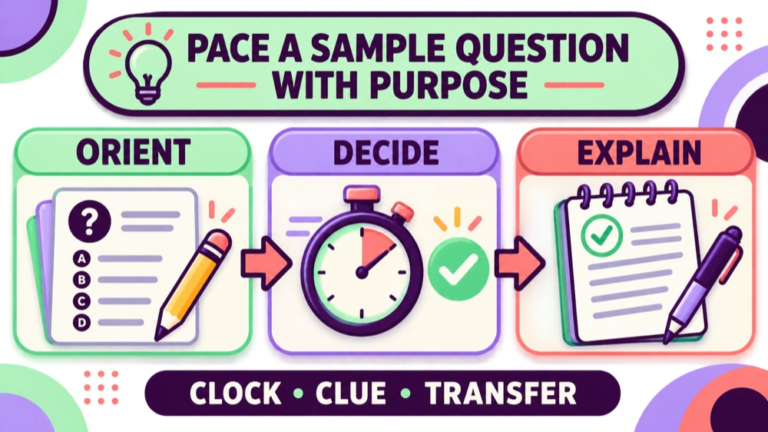
The timing map shows a useful rhythm: orient, decide, and explain. Use the first pass to find the question, the second to commit, and the third to capture a rule. This pacing gives you a way to review both speed and accuracy without treating the clock as the only measure of progress.
| Timing note | What it may mean | Next adjustment |
|---|---|---|
| Fast and correct | The decision and evidence were clear. | Add one transfer version to test depth. |
| Fast and uncertain | You may have guessed from a familiar term. | Write the clue and compare the closest distractor. |
| Slow and correct | Reasoning may be sound but the reading path is inefficient. | Practice the six-field stem spine. |
| Slow and incorrect | The case may have contained a missed context or sequence clue. | Classify the error and rebuild the timeline. |
| Correct but vague | Recognition arrived before an explanation. | Rewrite the rationale without the answer key. |
Record the reason for the time, not only the number of seconds. A clock can show where the process needs attention, but it cannot tell you whether the problem was evidence, access, function, sequence, or confidence without a short explanation.
REVIEW THE CLUE AFTER THE CLOCK
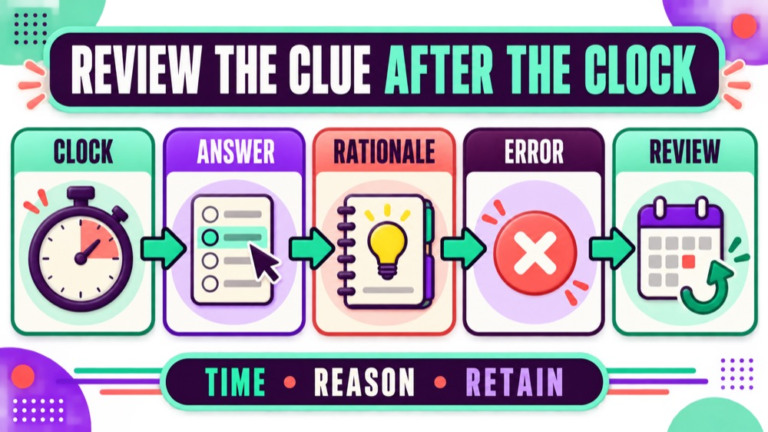
After the timed decision, return to the decisive clue. Ask whether the selected answer fits the person, activity, evidence, context, and boundary. Then write what the closest distractor gets wrong. This short review prevents speed practice from becoming unexamined letter selection.
| After-the-clock check | Write | Why |
|---|---|---|
| Verb | The exact action requested. | Prevents answering a neighboring question. |
| Clue | The fact that changed the decision. | Keeps the explanation evidence-based. |
| Fit | How the answer responds now. | Connects the choice to the case. |
| Distractor | Why the strongest alternative is weaker. | Turns an error into a rule. |
| Boundary | What must be confirmed, stopped, protected, or handed off. | Keeps sequence and role visible. |
| Next | One changed-case question and review date. | Creates spaced transfer practice. |
If your answer changes after the clock, record both versions. The change may reveal a reading issue, a confidence issue, or a need to slow down at the decision verb. Treat that observation as study data and use it to choose the next sample.
Question 1: an assessment sample
Practice Question 1. A child follows a short direction in a quiet room but misses directions during a noisy classroom transition. A teacher requests a broad language score before the clinician has reviewed hearing, language history, or the classroom demand. What is the best next step?
- A. Choose the longest language measure immediately because it may provide the broadest score.
- B. Interpret the classroom report as enough evidence for a global language conclusion.
- C. Clarify the participation concern, review relevant language and hearing context, observe the routine, and select evidence that answers the refined question.
- D. Use the quiet-room result as the final description because that condition is easier to control.
Correct Answer: C. The contrast between quiet and noisy conditions is the decisive clue. The next step should define the concern and examine language, hearing, partner, rate, noise, and representative classroom demands before a broad measure or conclusion is selected.
Why the Other Options Are Wrong: A starts with a tool before the question is defined. B turns one context-specific report into a broad interpretation. D removes the condition in which the concern appears. C uses the evidence to choose proportionate evaluation steps.
Exam Trap: The request for a score may be a request for help with a participation problem. Name the activity before choosing the measure.
Question 2: a treatment sample
Practice Question 2. An adult reaches a speech target more accurately during structured practice with a visual cue but still avoids speaking during a weekly team meeting. Which treatment response best fits the sample case?
- A. Count the structured accuracy as evidence that meeting participation is complete.
- B. Remove the visual cue immediately so every practice trial measures unaided performance.
- C. Keep the useful support while adding supported meeting practice and tracking target performance, cueing, effort, and participation.
- D. Replace the target with a new exercise without examining the meeting activity.
Correct Answer: C. The structured result shows that the cue may help, while the unchanged meeting behavior shows that transfer conditions require practice. A functional plan can retain access support and shape the target in the activity and partner context that matter to the adult.
Why the Other Options Are Wrong: A treats a narrow drill measure as the entire outcome. B removes support before its role is understood. D changes the target without addressing the stated activity. C connects target, support, practice, and participation.
Exam Trap: Independence is not the only meaningful outcome. Ask how a support changes opportunity, effort, accuracy, and participation.
Question 3: a collaboration sample
Practice Question 3. A clinician is asked to share a client’s communication recording with a student group. The client’s consent does not cover that use, and the supervisor asks the clinician to pause before sharing. What is the best response?
- A. Share the recording without identifiers because removing the name solves the entire concern.
- B. Send the recording to the group and ask students not to save it.
- C. Pause, follow the consent and privacy process, consult the supervisor, and use an approved educational alternative if permission is not available.
- D. Ask a student to share the file from a personal account so the clinician is not the sender.
Correct Answer: C. The intended use is outside the stated consent and the supervisor has given a pause instruction. The response should protect privacy, follow the local process, consult the appropriate supervisor, and select an approved alternative rather than treating informal handling as sufficient.
Why the Other Options Are Wrong: A assumes de-identification resolves every consent and privacy question. B relies on a request rather than a controlled process. D transfers the same concern to another person and account. C keeps authorization, supervision, and continuity visible.
Exam Trap: A professional-practice question may be testing authorization and process rather than technical skill. Do not solve a boundary problem with a workaround.
Turn timing data into targeted review
Timing data becomes useful when you connect it to an error category. Do not respond to a slow item by simply doing more items. Identify the part of the process that slowed or failed, then choose a focused repair.
| Error type | What it looks like | Repair |
|---|---|---|
| Clock pressure | You selected a familiar technical term before defining the action. | Slow the first read and write the decision verb. |
| Evidence omission | You missed a contrast, limitation, or change in condition. | Circle the clue that changes the interpretation. |
| Context omission | You treated language, mode, hearing, partner, or setting as minor. | Write the access condition beside the answer. |
| Sequence error | You chose a later action before clarification, safety, or referral. | Build a short timeline of the options. |
| Function gap | You chose a narrow task with no participation outcome. | Name the activity and the result that matters. |
| Boundary gap | You forgot consent, privacy, competence, supervision, or communication. | Add the role and handoff requirement. |
| Transfer gap | The rule worked in the original wording but failed after one change. | Change one variable and solve a paired case. |
Review correct but low-confidence answers as well as misses. A correct letter with a weak rationale can signal the same learning need as an incorrect answer. Track the clue, fit, and transfer response alongside your timed result.
Build a sample-question week
A weekly cycle gives you variety while preserving time for explanations. Adjust the rotation to your current ASHA content review and your own error categories. It is a flexible study structure, not a claim about how an exam will distribute questions.
- Day 1: evaluation purpose, referral questions, representative evidence, and interpretation limits.
- Day 2: language, dialect, culture, hearing, communication mode, and access.
- Day 3: treatment goal, target, cue, activity, partner, and outcome.
- Day 4: screening, safety, stop rules, referral, and follow-up.
- Day 5: consent, privacy, competence, supervision, collaboration, and documentation.
- Day 6: one cross-domain item under light time pressure and one changed-case version.
- Day 7: delayed review of misses, low-confidence answers, and rationale quality.
Use current ETS and ASHA pages when updating exam or professional notes. Use your log to select the next sample instead of letting a broad score determine your entire plan.
Sample-question checklist
Before ending a sample-question session, check the following points:
- Did I identify the decision verb before comparing options?
- Did I name the person, activity, setting, partner, language or mode, and urgency?
- Did I mark the decisive clue and separate evidence from assumption?
- Did I compare the best choice with the strongest distractor?
- Did I check access, culture, hearing, communication mode, support, and environment?
- Did I connect the action to participation or the person’s stated goal?
- Did I notice safety, consent, privacy, competence, supervision, or handoff boundaries?
- Did I explain what the evidence does not establish?
- Did I record timing and confidence without treating either as a final judgment?
- Did I write a transfer version by changing one variable?
- Did I assign an error category and a later review date?
- Did I recheck live sources for date-sensitive details?
A complete session leaves a compact record: action, clue, answer, distractor error, boundary, transfer, and next review. That record makes your practice cumulative and keeps the clock in its proper role as feedback.
Sources and next steps
For the current study frame, review the ASHA Speech-Language Pathology 5331 content page and the live ETS 5331 page. For topic-specific clinical context, use the ASHA Practice Portal. For language and cultural context, review the ASHA Multilingual Service Delivery and ASHA Cultural Responsiveness resources.
For current preparation-resource context, check the ETS practice-test page. The questions, choices, rationales, maps, and checklist here are original educational material, separate from live test material. Recheck current source pages before relying on administrative, scoring, professional, state, school, agency, or facility requirements.
For your next session, time one sample question, write the six-field stem spine, compare the strongest distractor, and solve one paired version after a delay. Record the error category that deserves the next review.
Continue your preparation: Explore the SLP Study Center learning resources.