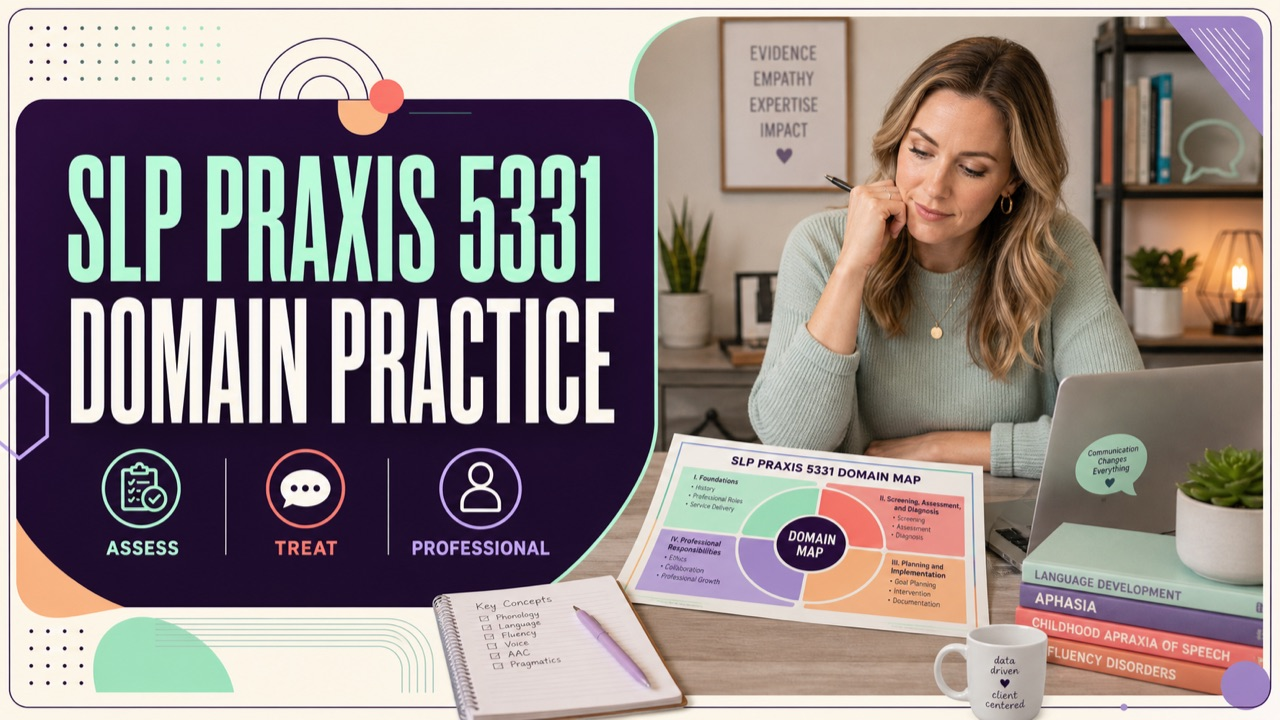
slp praxis 5331 domain practice questions help you study the SLP Praxis 5331 content frame without reducing it to a list of isolated labels. A domain tells you which lane of knowledge to review; the scenario still requires you to identify the person, task, evidence, context, decision, and follow-up. The best answer connects the domain to the action the question actually asks for.
Use the current ASHA Speech-Language Pathology 5331 content page for the current professional study frame and the live ETS 5331 page for current test identity and administrative details. The ASHA Practice Portal supplies topic-specific clinical context. The questions, rationales, maps, and checklists below are original learning material, separate from live test material and not individualized clinical advice.
Because exam sources and administrative details can change, this guide does not freeze a question count, percentage allocation, or date-sensitive format as a permanent fact. Instead, it teaches a durable way to use the current source and reason through domain-based clinical scenarios.
A domain review becomes useful when it ends in a decision you can explain. For each topic, identify the person or population, the construct, the evidence, the access conditions, and the professional responsibility. Then ask what the clinician should do with the information: gather more evidence, provide support, begin or adapt treatment, communicate with the team, refer, document, or monitor. This keeps your practice set aligned with clinical reasoning rather than simple word matching.
Use the current source for the boundary and the case for the application. If a scenario changes the language, setting, partner, communication mode, health status, or decision purpose, reconsider the evidence and action instead of repeating the same answer. That habit is useful for exam preparation and for responsible learning beyond the test.
What SLP Praxis 5331 domain practice questions are testing
Domain questions may ask you to recognize assessment, diagnosis, treatment, professional practice, counseling, collaboration, prevention, or participation content. Recognition is only the first step. You must connect the content area to the evidence and decision in the stem.
| Domain lane | Typical evidence or action | Question to ask |
|---|---|---|
| Assessment and evaluation | Referral purpose, history, observation, measure selection, language access, interpretation, and functional integration. | What evidence answers the assessment decision? |
| Diagnosis and differential reasoning | Converging patterns, alternatives, context, and limits of a single score or behavior. | What does the evidence support, and what remains open? |
| Treatment and intervention | Goal, target, method, support, practice conditions, outcomes, and adaptation. | Why does this action fit the person and activity? |
| Counseling and collaboration | Shared decisions, communication access, partner roles, values, referrals, and continuity. | Who needs information, support, or a defined role? |
| Professional practice | Competence, ethics, documentation, consent, privacy, supervision, advocacy, and scope. | What boundary or responsibility controls the action? |
| Prevention and participation | Access, education, environmental support, health literacy, and meaningful communication or swallowing routines. | How can the plan support function and reduce barriers? |
Do not assume that one scenario belongs to one domain. A multilingual assessment case can test assessment, access, evidence-based practice, and professional collaboration. A treatment case can test goal setting, outcome measurement, counseling, cultural responsiveness, and documentation. A swallowing case can test screening, safety, referral, scope, and interprofessional communication.
Mark the decision verb before you mark the domain. “Which is the best next step?” may require an assessment action even if the stem mentions treatment. “Which interpretation is most appropriate?” may require validity and language-access reasoning even if the domain label is diagnosis. The requested action controls the answer.
Use the current blueprint as a study map
The current ASHA and ETS pages should be your source of truth for the test identity and current content frame. Use the blueprint to organize study time and identify content relationships, not to memorize stale operational details copied from an old preparation page.
| Study field | What it means | How to use it |
|---|---|---|
| Domain name | The broad content area named by the blueprint or question. | Use it to select a knowledge lane, not to answer the case by itself. |
| Construct | The skill, behavior, clinical process, or professional responsibility being examined. | Define what must be described or decided. |
| Evidence | The history, observation, measure, report, source, or outcome in the stem. | Judge fit, quality, access, and limits. |
| Decision | The action requested: clarify, assess, interpret, treat, refer, document, or monitor. | Choose the answer that solves this decision. |
| Context | Person, language, culture, partner, setting, health, mode, safety, and time course. | Explain why the best answer may change by condition. |
| Transfer | A new scenario with a different domain, person, or activity. | Apply the rule without memorizing the original wording. |
A good study map has three layers. The first layer is the domain name. The second is the clinical or professional construct inside that domain. The third is the decision a scenario asks you to make. For example, “assessment” becomes “select evidence for a classroom communication question,” and “professional practice” becomes “protect safety and competence during a handoff.”
When you review the current blueprint, write down the source URL and date you checked. If a later version changes wording, update the study map rather than treating the old phrase as a permanent rule. This is especially important for test administration, registration, scoring, and delivery information.
Separate domain labels from clinical decisions
A domain label is not a diagnosis, recommendation, or answer. It is a location on the study map. The clinical decision requires additional reasoning: what happened, under which conditions, what evidence is available, and what action is proportionate.
| Label | Too-fast conclusion | Better question |
|---|---|---|
| Assessment | Use the longest battery. | Which evidence answers the referral and represents the person? |
| Diagnosis | One score supplies the label. | What converging evidence and alternatives must be considered? |
| Treatment | Choose the technique named in the lecture. | Which goal, target, support, practice condition, and outcome fit? |
| Professional practice | Follow a broad permission statement. | What competence, consent, privacy, supervision, and local rule apply? |
| Counseling | Give advice quickly. | What information, adjustment, choice, and referral support the person? |
| Prevention | Use one universal handout. | Which audience, access need, environment, and routine should the support fit? |
Use “domain → construct → decision” as a three-word margin note. If you cannot state the construct or decision, you are not yet ready to judge the answer choices.
Build cross-domain links
The most useful domain study is relational. Practice how one domain supplies information or a boundary for another. This prepares you for scenarios that move from assessment to treatment, from access to interpretation, or from a clinical observation to a professional handoff.
| Connection | What the link means | Practice question |
|---|---|---|
| Assessment → treatment | Assessment identifies target, strengths, barriers, and functional goal. | Treatment plan uses the evidence and monitors meaningful response. |
| Access → interpretation | Language, dialect, mode, hearing, and environment shape opportunity to respond. | Interpret the sample within those conditions. |
| Treatment → outcome | Practice conditions and cueing affect the response. | Track skill, participation, support, preference, and safety. |
| Professional practice → action | Competence, consent, privacy, supervision, and local requirements constrain the plan. | Document role, communication, and handoff. |
| Prevention → participation | Education and environmental support can change access to communication or swallowing routines. | Connect system support to the person’s activity. |
| Evidence → review | New information or an outcome may refine the working interpretation. | State what would make you adapt or refer. |
For each link, write a short example. Assessment identifies that a student follows directions in quiet but not in a group; treatment may include accessible direction formats and practice in the classroom; professional practice requires clear collaboration and documentation; outcome review checks participation. The domains are distinct, but the case decision crosses them.
- Choose a primary domain from the current source.
- Name the construct inside that domain.
- Add one adjacent domain that changes the interpretation or action.
- Write the evidence that connects them.
- State the action and the outcome or review point.
This exercise keeps “domain practice” from becoming trivia. You are learning how the content areas work together in a scenario.
Match evidence to the domain being tested
Evidence must fit both the domain and the decision. A report can frame an assessment question. A formal measure can provide structured evidence. A natural observation can connect the finding to participation. A treatment response can show that a support changes access. A professional document can show role, consent, communication, or continuity.
| Evidence | Useful for | Boundary |
|---|---|---|
| History and report | Referral clarification, time course, priorities, language, health, hearing, routines, and partner perspective. | A report needs task and context before it becomes a clinical interpretation. |
| Formal measure | Structured sampling of a named construct under defined conditions. | A score does not answer a different construct or erase access limits. |
| Natural observation | Functional communication, swallowing, participation, partner interaction, and environmental demand. | Describe the routine, support, and consequence. |
| Dynamic change | Response to a cue, model, device, language-access adjustment, or environmental change. | A response to support informs planning but is not the whole profile. |
| Treatment outcome | Skill, activity, participation, safety, effort, preference, and partner response over time. | Track conditions and support so the change is interpretable. |
| Professional record | Documentation, consent, supervision, referral, handoff, and decision accountability. | Follow current law, policy, role, and setting requirements. |
When a question asks for interpretation, explain the evidence and the limit. When it asks for action, explain how the evidence changes the plan. When it asks for professional responsibility, explain the role, communication, competence, and continuity boundary.
Keep language, culture, and access visible
Domain questions often hide access in the details. Language history, dialect, culture, communication mode, hearing, vision, motor output, device use, literacy, health literacy, environmental noise, and partner behavior can change what a score or observation means.
The ASHA Multilingual Service Delivery resource supports attention to language history, exposure, use, dialect, language access, and appropriate collaboration. The ASHA Cultural Responsiveness resource supports reflective and accessible interaction. Use these resources to refine the reasoning, not to apply a rigid checklist.
- Identify the languages, dialects, modes, partners, and routines relevant to the scenario.
- Check whether the method’s instructions, materials, response demands, and reference frame fit the person.
- Use accessible communication and qualified collaboration when needed.
- Document adaptations and state how they affect interpretation.
- Include the person’s priorities, culture, preferences, and participation outcome.
- Separate communication difference or access barrier from evidence of disorder.
If changing the language, mode, partner, or setting changes the result, treat that as evidence about context and access. Do not erase the difference by averaging it away or treating one condition as the only valid one.
Use professional practice across domains
Professional-practice reasoning is not a separate box that appears only in ethics questions. It shapes assessment, treatment, counseling, collaboration, prevention, documentation, and referral. Keep competence, consent, privacy, supervision, scope, access, safety, and applicable local requirements in view.
| Professional field | Question to ask | Action to show |
|---|---|---|
| Competence | Does the clinician have the education, training, experience, and supervision for this action? | Consult, supervise, refer, or continue within competence. |
| Consent and autonomy | Does the person understand the purpose, participants, choices, and relevant burdens or risks? | Communicate accessibly and support shared decisions. |
| Privacy | Who needs the information, for what purpose, and through which authorized channel? | Protect records and share only what is appropriate. |
| Safety | Is there a risk clue or stop condition in the setting’s process? | Pause, notify, document, and follow qualified follow-up. |
| Collaboration | Which team member or partner has the role or information needed? | Define the question, handoff, communication, and continuity. |
| Documentation | Can another professional understand the evidence, action, limit, and next step? | Record conditions, response, rationale, and review. |
For live professional decisions, verify current ASHA guidance, state law, payer rules, employer, school, facility, and program requirements. A practice page can teach the boundary but cannot replace the governing requirement for a particular setting.
Handle changing exam and source details
Exam identity, registration, delivery, scoring, and study resources can change. Use the live ETS page for current administration information and the current ASHA page for the professional content frame. Keep date-sensitive facts separate from durable clinical reasoning principles.
- Confirm the test name and code on the current ETS page.
- Record the access date and note any stated version or update.
- Use the current ASHA 5331 content frame to organize domain review.
- Do not transfer a number, date, score, question count, or rule from another test or old page.
- For state or agency requirements, verify the responsible jurisdiction or agency separately.
- Use original practice questions to test reasoning, not to imply access to live test content.
This habit is part of professional study. Source checking is not a distraction from clinical reasoning; it is how you keep the study plan accurate while preserving the reasoning rules that remain useful across updates.
Map the 5331 Study Domains
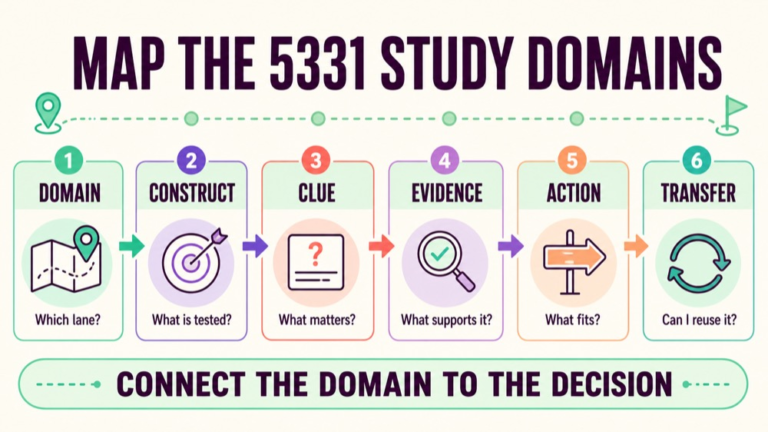
Use this map to build a domain review session. Start with the current source label, name the construct, write one case clue, choose the decision, and add the connected domain or professional boundary. End with a transfer question.
| Map step | Margin prompt | Output |
|---|---|---|
| 1. Domain | Which current content lane is involved? | Assessment, treatment, professional practice, or another lane. |
| 2. Construct | What skill or responsibility is actually being tested? | A precise clinical or professional target. |
| 3. Clue | Which fact in the scenario carries the most weight? | Context, evidence, risk, access, or outcome clue. |
| 4. Decision | What action or interpretation is requested? | The task verb and next step. |
| 5. Link | Which adjacent domain changes the answer? | Access, function, treatment, safety, collaboration, or ethics. |
| 6. Transfer | What changes if the setting or person changes? | A portable reasoning rule. |
Do not memorize the map as a fixed sequence for every item. Use it as a way to expose the reasoning field that an option may be skipping.
Connect Domains to the Case
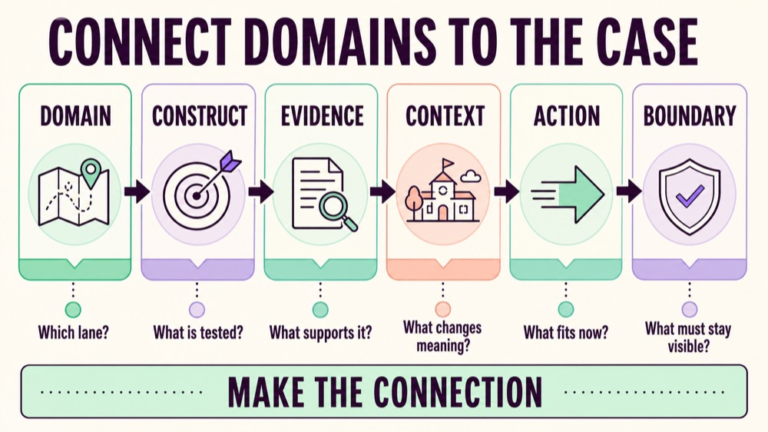
A case is solved when the domain label becomes a decision. Use a five-card board: domain, construct, evidence, context, and action. Add a sixth card for the boundary or review point whenever the scenario involves safety, access, competence, or changing outcomes.
| Board card | Write down | Check |
|---|---|---|
| Domain | The content lane named by the current study frame. | Am I using the current source rather than an old label? |
| Construct | The skill, process, or responsibility in the stem. | What exactly needs to be understood? |
| Evidence | Report, history, observation, measure, response, or outcome. | What does the source support? |
| Context | Person, language, mode, partner, setting, health, culture, and access. | What changes interpretation or opportunity? |
| Action | Assess, interpret, treat, support, refer, document, or monitor. | Which option fits the decision? |
| Boundary | Safety, competence, consent, privacy, local rule, or review trigger. | What must remain visible? |
After the board, explain one option in two sentences: “This fits the domain because ___. It fits the case because ___.” Then add: “It does not claim ___; I would review ___.” That practice turns recognition into a defensible rationale.
Question 1: assessment domain and measure fit
Practice Question 1. A student misses multi-step classroom directions but follows short directions in a quiet room with a visual cue. The referral asks which assessment information is needed before selecting support. Which option best reflects the assessment domain?
A. Choose a broad language label based on the classroom report and begin treatment immediately.
B. Administer a familiar test without reviewing hearing, language history, task demands, or the group setting.
C. Clarify the direction and participation demands, review hearing and language context, observe the relevant routine, and select evidence that matches the refined question.
D. Use the quiet-room response as the sole measure because it is easier to control.
Correct Answer: C. The assessment domain is about defining the decision and selecting evidence that represents the relevant construct and conditions. The contrast between quiet individual work and noisy group work makes hearing access, language load, visual support, partner behavior, and environmental demand important to review before a broad interpretation.
Why the Other Options Are Wrong: A jumps from a report to a label and skips assessment reasoning. B chooses a tool before defining its purpose and fit. D uses the easiest sample rather than the activity that prompted concern. C connects referral, context, access, observation, and measure selection.
Exam Trap: The domain label does not replace the decision. Ask what information the assessment must provide and which conditions shape the sample.
Question 2: treatment domain and functional outcome
Practice Question 2. An adult wants to participate more effectively in weekly work meetings. In structured practice, the adult organizes a short update with a visual outline, but conversation with unfamiliar coworkers remains difficult. Which answer best connects the treatment domain to an outcome?
A. Keep the same structured drill and record the visual-outline response as generalization.
B. Remove the outline immediately so the next session measures unsupported performance only.
C. Practice meeting updates with varied topics, listeners, and support levels while monitoring message organization, participation, and cueing needs.
D. Replace the functional goal with a broad speech goal because the structured task improved.
Correct Answer: C. Treatment reasoning links the functional goal to a measurable target, practice conditions, support, and outcome. The visual outline may be an effective access support, while varied listeners and topics provide information about transfer. Tracking participation and cueing prevents a structured gain from standing in for the work goal.
Why the Other Options Are Wrong: A confuses a supported structured response with transfer. B removes an access route before checking how it can be adapted or faded. D changes the goal without using the functional information in the scenario. C keeps the activity, support, variability, and outcome connected.
Exam Trap: Treatment questions often include a real improvement that does not yet answer the person’s functional goal. Look for the missing context and outcome.
Question 3: professional-practice domain and safety
Practice Question 3. A clinician is asked to complete a swallowing procedure outside the clinician’s current training. The patient has a new safety concern, and the facility requires notification and qualified follow-up. Which response best reflects the professional-practice domain?
A. Complete the procedure anyway because the clinician is generally familiar with swallowing care.
B. Ask an untrained assistant to perform the procedure while the clinician documents the result.
C. Stay within current competence, follow the facility safety pathway, notify the responsible team, and arrange qualified supervision, consultation, referral, or follow-up.
D. Avoid documenting the concern until a specialist has provided a final interpretation.
Correct Answer: C. Professional practice includes competence, safety, role clarity, supervision, communication, documentation, and continuity. The scenario supplies both a competence boundary and a safety pathway. The responsible action is to follow the protocol, communicate the concern, document the facts and limit, and connect the patient to qualified follow-up.
Why the Other Options Are Wrong: A treats general familiarity as current competence for a specific procedure and risk. B transfers a safety-sensitive task without appropriate training or oversight. D delays documentation of the observed concern and weakens continuity. C respects the professional boundary while still moving the case forward.
Exam Trap: When a question combines risk and competence, the answer must handle both. Referral or supervision is a responsible action when paired with communication and continuity.
Review common domain-question distractors
Domain distractors often repeat a source word but miss the decision. Use the table to identify the shortcut.
| Pattern | Why it sounds right | Correction |
|---|---|---|
| Domain keyword matching | The answer repeats a word from the stem. | Check the decision, evidence, and function behind the word. |
| Static blueprint memory | A memorized list feels safer than reasoning. | Use the current source and apply the domain to the case. |
| Domain equals diagnosis | The domain label sounds like a conclusion. | Separate content area, construct, evidence, and interpretation. |
| One-domain tunnel vision | The question seems to belong to one lane. | Notice cross-domain assessment, treatment, access, and professional links. |
| Technical action without fit | A known procedure or technique sounds sophisticated. | Match method and action to purpose, person, and setting. |
| Exam detail over clinical clue | A number or format fact is memorable. | Use current ETS information and focus on the asked decision. |
| Caution without action | Avoiding overclaiming feels responsible. | State a clear proportionate next step and boundary. |
| Action without review | The answer sounds complete after the first decision. | Name the outcome, handoff, or monitoring point. |
When two choices remain, compare domain fit, construct fit, evidence fit, access fit, professional fit, and review fit. The strongest answer usually links more of those fields with fewer unsupported assumptions.
Build a domain practice block
Build each study block around relationships rather than isolated memorization. Use one assessment item, one treatment item, one professional-practice item, and one cross-domain item. Check the current ASHA and ETS pages before adding date-sensitive notes.
- Choose one current domain label and write its source URL and access date.
- Translate the label into a construct and decision.
- Write a short scenario with one access or context variable.
- List two evidence sources and one important limitation.
- Write four original answer choices with one best fit.
- Explain the correct choice and the error in each distractor.
- Add one connected domain that would change or constrain the action.
- Change one variable and solve the item again.
Use a domain log with columns for label, construct, clue, evidence, action, boundary, and transfer. A blank column tells you where your study plan needs more work.
Track domain errors and confidence
Record the type of error instead of only the domain name. You may know the assessment label but miss language access, or know the treatment label but miss the outcome. Specific error labels make review more efficient.
| Log field | Example entry | What it reveals |
|---|---|---|
| Domain | Treatment and intervention | Which content lane was active. |
| Construct | Functional communication in work meetings | What the question really examined. |
| Decisive clue | Structured gain with unfamiliar-listener difficulty | Whether transfer was noticed. |
| Error type | Supported response treated as generalization | Which shortcut needs repair. |
| Boundary | Track cueing, listener, topic, and participation | What keeps the conclusion calibrated. |
| Confidence | 61% before rationale, 92% after explanation | Whether the rule transfers. |
| Next review | Rewrite with a different partner and setting | How to apply the domain again. |
Review correct but low-confidence choices. Explain the domain, construct, evidence, action, and boundary without looking back at the answer. This helps distinguish recognition from usable reasoning.
Domain practice questions checklist
Use this checklist before choosing an answer. It is a study aid, not a replacement for current ASHA or ETS information, local requirements, supervision, or individualized clinical judgment.
- Did I check the current ASHA or ETS source for the date-sensitive part of the question?
- Did I identify the domain without treating it as the answer?
- Did I define the construct and decision verb?
- Did I use the evidence and context rather than only a repeated keyword?
- Did I consider language, dialect, culture, mode, hearing, motor access, technology, partner, and environment?
- Did I match assessment evidence to the question and treatment choices to function?
- Did I notice safety, competence, consent, privacy, supervision, collaboration, and local requirements?
- Did I connect adjacent domains when the scenario crosses content areas?
- Did I explain why each distractor is out of sequence, poorly fitted, inaccessible, unsafe, or unsupported?
- Did I state the boundary and review point?
- Did I keep original practice material separate from live test material?
- Did I record the reasoning error so the next study block is targeted?
The durable sequence is: current source, domain, construct, clue, evidence, context, decision, boundary, transfer.
Sources and next steps
For the current Praxis study frame, review the ASHA Speech-Language Pathology 5331 content page and current ETS Speech-Language Pathology 5331 page. For topic-specific clinical context, use the relevant ASHA Practice Portal guidance. For language and culture, review ASHA Multilingual Service Delivery and ASHA Cultural Responsiveness.
For current preparation-resource context, use the live ETS practice-test page. Recheck the live sources before relying on exam format, score, registration, state, agency, or professional requirements. The maps, questions, rationales, and checklists here are original educational material.
For your next review, choose one domain and write a paired item: keep the clinical facts but change the decision from assessment to treatment, or from treatment to professional handoff. Explain why the answer must change with the question.
Continue your preparation: Explore the SLP Study Center learning resources.