
speech language pathology case study questions become much easier when you read the case as a timeline of decisions instead of a pile of symptoms, scores, and reports. Identify why the person came to attention, what activity or safety issue matters, which conditions change performance, and what the team must decide next. Then separate facts from interpretations and choose evidence that can answer the specific question.
The current ASHA Speech-Language Pathology 5331 content page provides a study frame that includes screening, assessment, treatment, evidence-based practice, professional practice, and culturally and linguistically responsive service. The ASHA Practice Portal provides topic-specific clinical context, and the live ETS Speech-Language Pathology 5331 page provides current exam identity. The cases, answer choices, rationales, and maps here are original learning material, separate from live test material and not individualized clinical advice.
A good case-study answer does not invent missing facts. It uses the facts that are present, names the most important uncertainty, protects access and safety, and selects a proportionate next step. This approach works across speech, language, fluency, voice, cognition, AAC, feeding, swallowing, hearing access, and professional-practice scenarios.
What speech language pathology case study questions are testing
Case-study questions test whether you can organize information and make a defensible decision. The case may contain a referral label, a time course, several informants, a formal score, a natural observation, a treatment response, a safety clue, or a professional boundary. Do not give all details equal weight. Sort them by the decision they help you make.
| Case field | Question to locate | Reasoning output |
|---|---|---|
| Presenting concern | What activity, change, risk, or participation issue prompted the referral? | State the decision in concrete terms. |
| Time course | When did the pattern begin, change, fluctuate, or become meaningful? | Use onset and change to set priority and urgency. |
| Context | Where, with whom, under which task demands, and with what supports does it occur? | Compare conditions before assigning meaning. |
| Strengths | What does the person do successfully, and which modes or partners support that performance? | Use strengths to plan access and next evidence. |
| Constraints | What health, hearing, motor, language, cultural, environmental, or professional factors limit interpretation? | Name the boundary rather than hiding it. |
| Decision point | What must the clinician or team decide now, and what information will guide the decision? | Choose a proportionate next step. |
| Follow-up | What outcome or new information will cause review, adaptation, or referral? | Make the plan learn from the case. |
Notice the difference between a case detail and a case conclusion. “Misses directions in group work” is a detail. “Has a language disorder” is a conclusion that requires evidence and context. “Uses a visual cue” is a detail. “Is independent” is a conclusion that depends on support level, task, partner, and outcome. Strong options preserve those distinctions.
Answer choices may be written in polished clinical language. Translate each choice into an action: gather history, observe, measure, interpret, support, treat, refer, document, or monitor. Then check whether the action is in the right sequence for the question. A technically reasonable action can still be a poor answer if it comes before the case has been clarified.
Read the case as a timeline
Start by locating change over time. Ask what was present before, what changed, what remains stable, and whether the pattern is variable across tasks or settings. A new change may affect urgency and referral. A longstanding pattern may call for developmental, educational, environmental, or participation context. A variable pattern may make conditions and supports especially important.
- Before: What was the person doing, using, or participating in before the concern?
- Change: What event, demand, setting, health factor, or communication partner made the concern visible?
- Now: Which performance, activity, safety, or support need is present today?
- Compare: Under what conditions does the pattern become easier or harder?
- Decide: What must be assessed, supported, treated, referred, or monitored next?
Timeline reasoning prevents a common error: treating the most recent event as the only explanation. Recent onset can matter, but so can prior communication history, language experience, hearing, access, health, education, medication, fatigue, or partner change. The best answer uses the time course to choose the next question rather than writing a complete story from one date.
When the case asks for priority, look for the detail that changes safety, access, or the decision’s consequences. A swallowing risk, sudden communication change, inability to communicate basic needs, or missing language access may come before a lower-urgency measurement question. State the immediate action and the follow-up rather than ignoring the priority clue.
Separate facts, interpretations, and priorities
Use a three-column note. In the fact column, write what was observed or reported with the task and conditions. In the interpretation column, list plausible explanations or meanings. In the priority column, write what needs attention first and why. This small structure helps you keep an informative report from becoming a premature conclusion.
| Column | Example | How to use it |
|---|---|---|
| Fact | The adult follows short written steps for a familiar medication routine. | Preserve the task, format, and support. |
| Report | A family member describes the adult as confused during appointment planning. | Translate the label into specific tasks and conditions. |
| Interpretation | Appointment management may add memory, language, sequencing, technology, and partner demands. | Keep plausible contributors open. |
| Priority | Determine what support is needed for the next appointment while including the adult’s priorities. | Choose the immediate functional decision. |
| Review | Check whether the support improves successful scheduling and attendance. | Make the plan measurable and revisable. |
Do not turn a report into a diagnosis, and do not dismiss a report because it uses imprecise language. Reports are useful when you ask what the observer saw, when it happened, who was involved, and what consequence followed. The answer choice that refines a vague report is often stronger than the choice that accepts or rejects it wholesale.
Rank the decision before choosing a method
Case questions commonly tempt you to choose a familiar test or intervention before defining the decision. Reverse that order. Name the decision, specify the construct or activity, then select evidence that can answer it. A measure that is excellent for one purpose may not fit another language, person, setting, or task.
| Decision type | Evidence direction | Question to protect fit |
|---|---|---|
| Screening | Brief information that helps decide who needs further evaluation or support. | Is the output a risk or referral decision rather than a full profile? |
| Evaluation | Multiple sources that describe the relevant communication or swallowing profile. | Does the evidence represent the person, language, access, and activity? |
| Treatment planning | Baseline, target, functional goal, support, response pattern, and preferences. | Will the data guide a specific and meaningful plan? |
| Progress review | Comparable observations across time, conditions, partners, and outcomes. | Did the conditions remain interpretable, and what changed? |
| Referral or collaboration | Information that defines the question another professional or team member should address. | Is the handoff clear, timely, accessible, and within role? |
| Safety response | Immediate observation, protocol, notification, precaution, and follow-up. | Does the risk clue change the order of actions? |
A case may require more than one decision. For example, a patient may need an immediate safety response and later a comprehensive assessment. A student may need an access support now and a fuller evaluation after relevant history is gathered. Separate the decisions so the answer does not make a later question block a necessary immediate action.
Integrate conflicting information
Conflicting reports are often the most useful part of a case. They may show that the activity, language, partner, environment, cueing, fatigue, or stakes changed. Do not resolve the conflict by picking the report that sounds most clinical or most confident. Compare what each source observed and decide what additional evidence would explain the difference.
| Source | What it may add | Question to ask |
|---|---|---|
| Case history | Onset, development, health, hearing, language use, prior services, routines, and person or family priorities. | Frames the case and points to questions that need direct evidence. |
| Report | Teacher, caregiver, patient, nurse, physician, partner, or other observer description. | Shows what happens across settings and perspectives; check the task behind the label. |
| Direct observation | A relevant speech, language, fluency, voice, AAC, feeding, swallowing, or participation activity. | Shows performance under named conditions. |
| Formal measure | A method chosen for construct, population, language, access, response demand, and purpose. | Provides structured evidence within its administration limits. |
| Functional sample | Conversation, classroom work, meeting, meal, home routine, or other meaningful activity. | Connects skill and support to participation. |
| Response to support | A change in cue, visual, partner behavior, task structure, mode, or environment. | Shows what support changes access; it does not settle the entire explanation. |
| Outcome data | Change in skill, activity, safety, effort, preference, or partner success over time. | Guides continuation, adaptation, or another question. |
Use convergence and contrast. Convergence occurs when different sources describe a similar pattern under comparable conditions. Contrast occurs when the pattern changes by context. Both are valuable. Convergence can support a focused interpretation; contrast can identify access needs, task demands, partner supports, or a reason to examine more than one setting.
If a formal score conflicts with functional performance, inspect the construct and response demand. If a caregiver report conflicts with a clinic sample, examine routine, familiarity, fatigue, partner behavior, and communication mode. If a treatment score improves but participation does not, check cueing, generalization, listener, task purpose, and opportunity. The reasoning move is to investigate the difference, not erase it.
Use language, culture, and access as case data
A case is incomplete when language history, dialect, communication mode, hearing, vision, motor access, technology, health literacy, or cultural context is missing from an interpretation that depends on them. Ask which languages and modes are used across routines, who the relevant partners are, and whether the assessment or treatment conditions let the person show knowledge and participate.
The ASHA Multilingual Service Delivery resource supports attention to language history, exposure, use, dialect, access, and appropriate collaboration. The ASHA Cultural Responsiveness resource supports reflective, accessible, person-centered interaction. Neither resource turns a translated task, a cultural checklist, or one language sample into a universal conclusion.
- Record languages, dialects, modes, literacy experiences, and communication partners across relevant routines.
- Check whether the case task adds unfamiliar vocabulary, literacy, motor, hearing, technology, or cultural demands.
- Invite the person’s priorities and explain choices in an accessible form that supports shared decision-making.
- Use qualified language-access collaboration when needed and document how it shaped the process.
- Interpret scores and observations within administration, norming, response, language, and context limits.
- Separate a communication difference or access barrier from evidence of a communication disorder.
A strong case answer does not treat access as a courtesy after assessment. Access can change the evidence and the person’s opportunity to participate. If performance changes when the format, partner, language, device, or environment changes, carry that fact into the next decision.
Connect the case to assessment and treatment
Assessment and treatment decisions should be connected. Assessment identifies the target, context, strengths, barriers, and decision need. Treatment uses that information to select a goal, method, support, practice condition, and outcome. A case-study answer that jumps from a label to a technique without this chain is incomplete.
| Link | Case question | Plan output |
|---|---|---|
| Activity | What does the person need or want to do? | Functional goal and meaningful partner or routine. |
| Target | Which observed skill or barrier affects the activity? | Specific baseline and reason for selection. |
| Method | What evidence-based approach fits the target and context? | Intervention, practice conditions, and rationale. |
| Support | What cue, mode, partner, environmental change, or adaptation helps? | Access plan and support level. |
| Outcome | What skill, participation, safety, effort, preference, or partner result matters? | Data and review point. |
| Adaptation | What would make you continue, change, consult, or refer? | Decision rule for the next session or handoff. |
Do not treat a structured gain as proof that the functional goal has been met. Record the conditions that made the response possible and then examine whether the skill transfers to relevant partners, settings, and tasks. At the same time, do not discard a useful support because it is visible. A supported response can show an effective access route and provide information for a plan.
Protect safety, scope, and communication
Some case studies are testing professional process more than a clinical label. Look for safety risk, consent, privacy, competence, supervision, communication access, role clarity, and the need for referral. If a local protocol provides a stop condition, follow it. If the question exceeds the current role or evidence, communicate the boundary and involve the appropriate person or team.
- Name the safety or professional issue without exaggerating the evidence.
- Pause, modify, or stop the activity when the stated protocol or risk requires it.
- Communicate the observation and next action to the responsible person in an accessible format.
- Use qualified collaboration or referral for the question that exceeds the current role or competence.
- Document the conditions, response, decision, handoff, limitation, and follow-up.
In real practice, consult current ASHA guidance and applicable state, payer, employer, school, facility, and law requirements. Case-study practice teaches a reasoning sequence; it does not replace local policy, supervision, or individualized judgment.
Build a Case Study Evidence Map
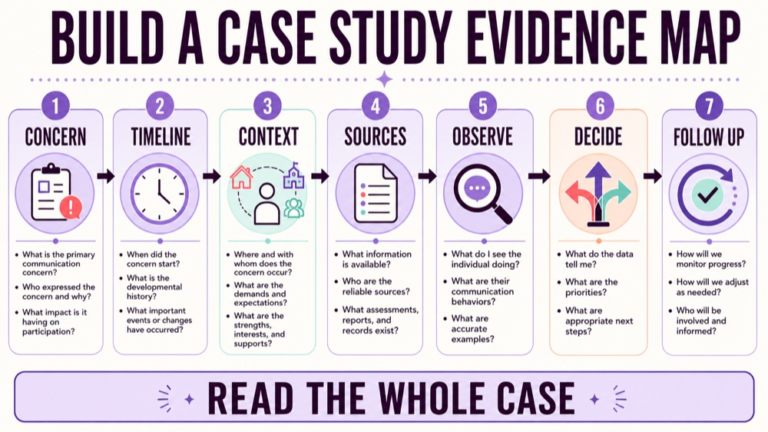
Use this map when a case contains more details than you can hold in working memory. Start with the activity or risk, place the timeline next, add person and access information, then sort evidence by source and condition. End with the decision the evidence needs to support. The map helps you avoid letting one vivid detail control the answer.
| Map step | Write in the margin | Check before choosing |
|---|---|---|
| 1. Activity or risk | What matters to the person or what requires immediate attention? | Did I name the real decision? |
| 2. Timeline | Before, change, now, variability, urgency. | Did I use the time course? |
| 3. Person and access | Strengths, languages, modes, health, hearing, partners, culture, supports. | Did I protect interpretation and participation? |
| 4. Evidence | Report, history, observation, measure, functional sample, response to support. | What does each source actually show? |
| 5. Next decision | Assessment, support, treatment, referral, documentation, monitoring, review. | Is the action proportionate and sequenced? |
Write one sentence under the map: “The current evidence supports ___, but I still need ___ before deciding ___.” That sentence gives uncertainty a practical role and makes it easier to explain why one option fits better than another.
Turn a Case Study Into a Review Plan
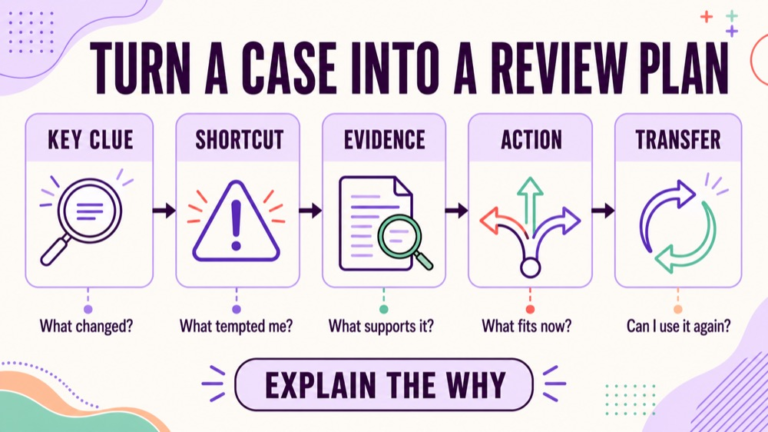
After answering a case, turn it into a review plan. Record the key clue, the tempting shortcut, the evidence that defeated the shortcut, and the transferable rule. This is more useful than copying the correct letter because it preserves the reasoning structure for a new case.
| Review field | Example prompt | Transfer question |
|---|---|---|
| Key clue | Which contrast, time point, report, or risk changed the decision? | Would I notice the clue in a new topic? |
| Tempting shortcut | Did I choose a label, score, long battery, or technique too early? | What wording pulls me toward the shortcut? |
| Decisive evidence | Which fact or missing fact determines the next step? | How could the evidence be gathered fairly? |
| Access check | Which language, mode, partner, setting, or support affects interpretation? | What would change if the conditions changed? |
| Transfer rule | When I see this pattern, I will first check ___ because ___. | Can I apply the rule without copying the case wording? |
Use a second pass to change one variable. Keep the same report but change the language history. Keep the same score but change the functional goal. Keep the same treatment response but change the cue level. Keep the same safety sign but change the protocol. Explain why the action should or should not change.
Question 1: timeline and assessment priority
Practice Question 1. A first-grade student is referred because the student “cannot tell stories.” A teacher reports short answers during whole-group discussion. A caregiver reports detailed stories during play at home. The student uses two languages across settings, and no language history has been collected. Which next step best fits the case?
A. Administer an English narrative test immediately and use the score to select a broad language goal.
B. Assume the home report is more accurate and close the school referral without further observation.
C. Clarify the story demands and languages across settings, collect relevant observations and history, and select responsive narrative evidence before making a broad interpretation.
D. Ask the caregiver to use only English at home so the school sample will be easier to compare.
Correct Answer: C. The reports describe different activities, partners, languages, and contexts. The next step is to clarify the case and obtain evidence that represents the relevant communication demands. A responsive process can examine narrative organization, language experience, classroom participation, and supports without treating one English sample as the whole profile.
Why the Other Options Are Wrong: A selects a measure before checking language history and may confuse performance in one language with a broad narrative conclusion. B dismisses a meaningful school concern simply because the child communicates well in another context. D removes a home language and does not create a valid comparison. C keeps both reports visible and identifies the evidence needed to answer the referral.
Exam Trap: Case-study questions often place two apparently conflicting reports together. The contrast is a reason to examine language, task, partner, and setting—not a reason to choose one informant automatically.
Question 2: conflicting reports and functional context
Practice Question 2. An adult who had a recent neurologic event communicates basic needs with speech, gesture, and a text-to-speech device. A family member reports “confusion,” while the adult follows a familiar medication routine when information is presented in short written steps. The referral asks whether the adult needs support for managing appointments. What is the most useful reasoning move?
A. Use the family member’s word “confusion” as the primary diagnosis and avoid asking the adult for input.
B. Test only decontextualized memory tasks because appointment management is a functional outcome.
C. Define the appointment tasks, compare communication modes and support conditions, gather the adult’s priorities and partner report, and assess the specific cognitive-communication demands.
D. Recommend that the family manage all appointments permanently before examining the adult’s current abilities and preferences.
Correct Answer: C. The referral names a functional activity, so the assessment should examine the steps, information, partners, modes, and supports involved in appointment management. The family report is relevant, but it should be translated into observable tasks and considered with the adult’s perspective and direct performance. Comparing supported and less-supported conditions can guide a useful plan.
Why the Other Options Are Wrong: A turns a broad report into a conclusion and removes the adult from shared decision-making. B may sample one construct but does not represent the appointment activity. D transfers responsibility before checking what support, mode, and level of assistance would be appropriate. C matches the assessment to the activity and preserves autonomy and access.
Exam Trap: When a case includes a broad label such as confusion, look for the functional task underneath it. The strongest answer makes the task measurable and includes the person’s communication access and priorities.
Question 3: treatment data and adaptation
Practice Question 3. During treatment, a client’s accuracy on a structured speech target improves with a visual cue, but the client’s participation in phone calls has not changed. The clinician has recorded target accuracy but not cue level, listener, call purpose, or client-reported effort. Which next step is most appropriate?
A. Continue the same structured practice because the accuracy percentage increased.
B. Stop treatment because the structured target and phone participation do not match.
C. Review the functional goal and baseline, add supported phone-call practice with relevant conditions, record cueing and listener factors, and monitor both target performance and participation.
D. Remove the visual cue so the next accuracy score will represent independence.
Correct Answer: C. The data show a possible transfer gap and incomplete documentation of the conditions that shaped performance. The plan can preserve a useful visual cue while adding practice that represents the phone activity, listener, purpose, and support needs. Monitoring both target accuracy and participation helps the clinician decide what to adapt next.
Why the Other Options Are Wrong: A treats a structured gain as the complete outcome and does not address the stated activity. B discards information that may be useful instead of adapting practice. D removes an access support before checking whether it enables meaningful participation. C uses the discrepancy as evidence for a better treatment plan.
Exam Trap: A case can contain a real improvement and a real unmet goal at the same time. Do not force one measure to stand in for the whole outcome; inspect the conditions and add the missing functional data.
Review common case-study distractors
Case-study distractors often use a true clinical idea at the wrong time or with the wrong evidence. Name the error before you judge the wording.
| Pattern | Why it sounds attractive | Correction |
|---|---|---|
| First detail wins | The first symptom or score feels like the central clue. | Read the whole timeline and identify the decision. |
| Label equals construct | A referral phrase sounds specific. | Translate the phrase into an observable task and evidence need. |
| Most tests is best | A larger battery sounds careful. | Choose methods that answer the case question. |
| One report is enough | A confident informant sounds definitive. | Compare the activity, setting, partner, and perspective. |
| Low score explains everything | Numbers feel objective. | Check language, access, construct, context, and functional evidence. |
| Technique before target | A familiar intervention is easy to remember. | Name the target, goal, support, and outcome first. |
| Referral ends responsibility | Another professional may be needed. | Communicate, document, and coordinate the handoff. |
| No decision after data | Collecting information feels productive. | State how the evidence will change the plan. |
When two options both seem plausible, score them against fit: decision fit, evidence fit, access fit, safety and role fit, and follow-up fit. The best answer usually connects the most fields with the fewest unsupported assumptions. A choice that is cautious but offers no next action may be incomplete; a choice that is decisive but ignores missing context may overreach.
Build a case-study practice block
Use cases from different domains so the reasoning rule does not become tied to one diagnosis or vocabulary set. Mix developmental, adult, medical, school, outpatient, and professional-practice scenarios. For each case, practice reading the timeline before the options.
- Underline the presenting concern, activity, risk, and decision verb.
- Write the timeline: before, change, now, and conditions of variability.
- List the person’s strengths, language, mode, partners, access, and priorities.
- Sort each fact into report, observation, measure, response to support, or outcome.
- Write the most important missing information and why it could change the plan.
- Choose the next assessment, support, treatment, referral, documentation, or monitoring step.
- Explain why each distractor is too broad, too early, inaccessible, unsafe, or unsupported.
- Change one case variable and solve it again without reusing the original wording.
Keep an answer rationale to three sentences: “The case shows ___. The decisive context or evidence is ___. Therefore, the next step is ___, while ___ remains to be checked.” This format is short enough for timed review and detailed enough to reveal a reasoning gap.
Track case reasoning and confidence
Record the decision and the reason behind it. A confidence score is useful only when paired with the clue you used and the uncertainty you noticed. Review items you answered correctly for the wrong reason because a lucky selection may not transfer.
| Log field | Example entry | What it reveals |
|---|---|---|
| Decision | Choose responsive narrative evidence for a school referral. | Whether the question was defined. |
| Timeline | School group discussion differs from detailed bilingual home play. | Whether change by context was noticed. |
| Missing information | Language history and task demands across settings. | What should be checked next. |
| Action | Clarify, observe, gather history, and select responsive evidence. | Whether the plan matches the case. |
| Distractor | One English score treated as a global conclusion. | Which shortcut to repair. |
| Confidence | 48% before rationale, 86% after explaining the contrast. | Whether the rule is becoming explicit. |
| Review trigger | The answer changes when language and partner conditions change. | When to revisit the plan. |
Build a small library of transfer rules: define the activity before the label; compare reports by task and context; treat support level as data; match measure to decision; pause for safety; and document how the evidence led to the next action. These rules are portable across case topics.
Case-study questions checklist
Use this checklist before committing to an answer. It is a study aid, not a substitute for current professional guidance, applicable law, supervision, local policy, or individualized clinical judgment.
- Did I identify the person’s activity, priority, risk, partner, and decision?
- Did I read the timeline instead of treating the newest or loudest detail as the whole case?
- Did I separate direct observation, report, interpretation, and conclusion?
- Did I compare performance across language, dialect, mode, partner, setting, time, and support?
- Did I choose evidence that answers the decision rather than the longest or most familiar method?
- Did I interpret formal scores within construct, administration, language, and access limits?
- Did I connect treatment choices to a functional goal, target, support, practice condition, and outcome?
- Did I recognize safety, consent, privacy, competence, supervision, and referral boundaries?
- Did I include the person’s priorities and communicate the plan accessibly?
- Did I document what the current evidence supports and what remains unknown?
- Did I state what new information or outcome would change the plan?
- Did I explain why each alternative fails for the facts in the case?
The core sequence is simple to remember: timeline, task, context, evidence, decision, review. Use it to make a case manageable without pretending that a short vignette contains more certainty than it does.
Sources and next steps
For the Praxis study frame, review the current ASHA Speech-Language Pathology 5331 content page and the current ETS 5331 page. For topic-specific clinical context, use the relevant ASHA Practice Portal guidance. For language and cultural context, review ASHA Multilingual Service Delivery and ASHA Cultural Responsiveness.
For current preparation-resource context, use the live ETS practice-test page. The cases, answer choices, rationales, maps, and checklists on this page are original educational material. Recheck live sources before relying on exam administration details, state or agency requirements, clinical policy, or a professional decision.
For your next review, take one case and write two versions of the plan: one for the current setting and one after changing the language, partner, or access condition. Explain which evidence changes, which action remains, and what outcome would trigger another review.
Continue your preparation: Explore the SLP Study Center learning resources.