
Register for praxis speech pathology is a search phrase that usually hides several different decisions: finding the correct ETS test, choosing an appointment, preparing acceptable information, and understanding what registration does and does not accomplish. A clear process matters because a registration error can create a deadline problem even when your academic preparation is strong.
This guide focuses on the Speech-Language Pathology Praxis 5331 exam. It explains the registration path, the information to gather first, and the distinctions among test registration, a passing score, ASHA certification, state licensure, and graduate-program requirements. It does not freeze a fee or promise that a particular date, location, or delivery option will be available. Those details belong to the current ETS account and should be verified before payment.
Table of Contents
- Why registration is more than choosing a date
- The 5331 registration path
- How to choose a date, format, and location
- What to prepare before registration
- What to verify after registration
- Registration versus credential requirements
- Common mistakes and practical fixes
- Quick review checklist
Why Registration Is More Than Choosing a Date
Praxis registration is an administrative decision with academic consequences. The account transaction determines which test you are scheduling, where and when you will take it, how your name and contact information are recorded, and which reporting choices you make at that point. It does not decide whether a graduate program accepts your timing, whether a state board has a particular application rule, or whether you have completed every requirement for the Certificate of Clinical Competence in Speech-Language Pathology.
Start by separating the four questions below. Keeping them separate prevents a common form of confusion: treating an appointment confirmation as proof that every credential requirement has been satisfied.
| Decision | What it controls | Who or what to verify |
|---|---|---|
| Test registration | Your appointment for the Speech-Language Pathology Praxis 5331. | The live ETS account, test code, date, format, location, and confirmation. |
| Exam result | The score report produced after you take the test. | Current ETS score-reporting information and the recipient instructions for your pathway. |
| ASHA certification | A broader professional credential pathway. | Current ASHA requirements, including education, clinical fellowship, and other applicable steps. |
| State licensure | Permission to practice under a state or jurisdiction’s rules. | The relevant state licensing authority and your program or employer guidance. |
The research packet checked on August 22, 2026, captured an ETS result that listed the 5331 test as 150 minutes with 132 questions. Use that as a planning snapshot only, then confirm the live ETS page because exam specifications can change. The same caution applies to appointment windows, delivery formats, registration fees, rescheduling charges, refund rules, and score-recipient policies.
Register for Praxis Speech Pathology: The 5331 Registration Path
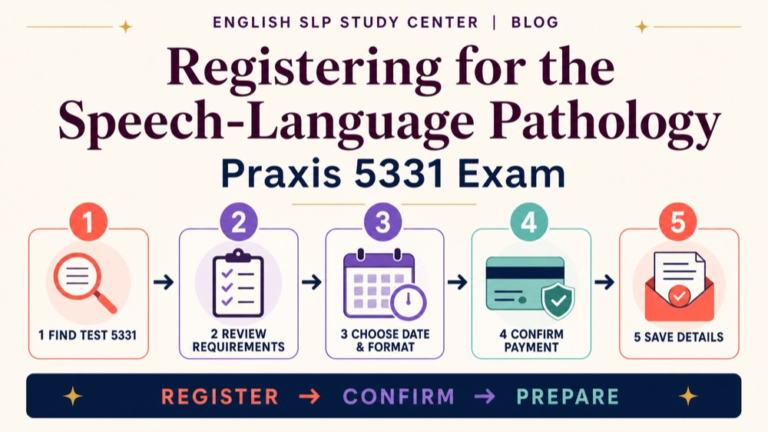
The safest registration process follows the order used by ETS: identify the test, review availability, choose the appointment, enter accurate information, review the transaction, and save the confirmation. Open the ETS registration process page first, then use the live account for the actual choices. The page is a process guide; it is not a guarantee that a particular center, time, fee, or delivery mode will appear for every candidate.
- Confirm the test identity. Search for Speech-Language Pathology and confirm the 5331 designation before moving through checkout. Similar words in a search box are not enough; the test title and code should match the requirement you are trying to meet.
- Check your timing. Compare your intended test date with graduate-course completion, clinical-practicum timing, application deadlines, score-report deadlines, and any state or employer process that matters to you. ASHA advises candidates to register and take the exam no earlier than completion of relevant graduate coursework and graduate clinical practicum; read the current ASHA exam guidance and verify your program’s rule.
- Review the displayed availability. Use ETS to see the current appointment choices. Availability is a live inventory, so a search result is only a possible option until the registration is completed and confirmed.
- Choose the delivery setting and location. Select a test-center appointment or another displayed option only after checking the environment, identification requirements, technology or room requirements, travel time, and your own ability to complete the session there. The ETS test-center page can help you understand the location search, but the account controls the current appointment.
- Enter your identity details carefully. Use the name and personal information that align with the identification you expect to present. If your legal name has changed or your documents do not match, resolve the issue through the applicable ETS support process before test day.
- Review score-recipient choices. Decide which program, agency, or credential pathway needs the result, and check its current instructions before selecting recipients. Do not guess a code from an old form or assume that registration and score reporting are the same action.
- Read the payment and change terms. Before submitting payment, inspect the amount shown, accepted payment method, rescheduling or cancellation language, deadline, and any accommodation or identification notes. Fees and policies are time-sensitive; this article intentionally does not substitute a fixed dollar amount for the current ETS screen.
- Complete the transaction and save proof. Save the confirmation number, test title, date, time, delivery setting, location, recipient information, and any follow-up instructions. A screenshot can help you remember the details, but the confirmation email and current ETS account remain the stronger records.
That sequence also gives you a practical stopping point. If the test title is wrong, the name does not match your expected identification, or the date does not protect your deadline, pause and resolve the issue before completing payment. Registration speed is less important than a correct, documented appointment.
Choose a Test Date, Delivery Format, and Location
The best appointment is not automatically the earliest appointment. It is the option that fits your preparation, required deadlines, travel or technical conditions, and the current rules for changing the appointment. Treat scheduling as a small risk-management exercise rather than a race to click the first available slot.
| Choice | Questions to ask | Evidence to save |
|---|---|---|
| Date | Will there be enough study time? Does the score timeline fit my application or program deadline? | The selected date, time zone, and the deadline it protects. |
| Test center | Can I reach it reliably? Does the current ETS listing show the session I need? | Center name, address, appointment time, and travel plan. |
| At-home or other displayed option | Do I meet the current technical, room, identity, and monitoring conditions? | The option’s current ETS instructions and any system check or appointment notice. |
| Change protection | What are the current reschedule, cancellation, refund, and deadline rules? | The policy shown at registration and the support path for a problem. |
Build backward from the date that matters. If a university or state process asks for a score by a certain point, allow time for the test appointment, score processing, possible administrative questions, and the receiving organization to update its record. The exact score-release schedule is a current-policy question, so verify it with ETS and the receiving program instead of relying on a study-group estimate.
Also consider the difference between a convenient location and a workable testing environment. A short commute may still be a poor choice if the appointment conflicts with required clinical responsibilities. An at-home option may be attractive for travel reasons, but it can carry specific room, equipment, identity, and monitoring requirements. Read the current instructions before assuming that an option is available or suitable.
Prepare the Information You Need Before Registration
Preparing the details before opening the payment screen makes the process calmer and reduces the chance of entering a rushed error. Keep your information in one place, but protect account credentials and personal identifiers. The goal is not to memorize every policy; it is to know which details require a deliberate check.
- Test identity: confirm Speech-Language Pathology Praxis 5331, not a neighboring Praxis title.
- Legal name: compare the account entry with the identification you plan to present.
- Contact information: use an email address and phone number you can monitor for appointment notices.
- Academic timeline: note graduate-course completion, clinical-practicum timing, and program deadlines.
- Credential or state instructions: identify what your program, ASHA pathway, or state authority currently asks you to do.
- Score-recipient information: obtain current recipient directions from the organization rather than an old shared spreadsheet.
- Payment plan: have an accepted method ready, while checking the current amount and terms in ETS.
- Accommodation needs: review the current ETS process early if you need testing accommodations or another supported arrangement.
- Location plan: estimate travel, parking, arrival time, or the technical and room conditions for a displayed remote option.
- Study runway: decide what you will study between registration and test day, including full-length timing practice.
This preparation list also reveals when registration should wait for clarification. If your program has not explained when it wants the score, if your identification is changing, or if an accommodation request needs lead time, use the relevant ETS or institutional support channel before treating the appointment as final. The decision is administrative, but the consequences are personal and deadline-sensitive.
Verify the Confirmation and Build the Right Study Timeline
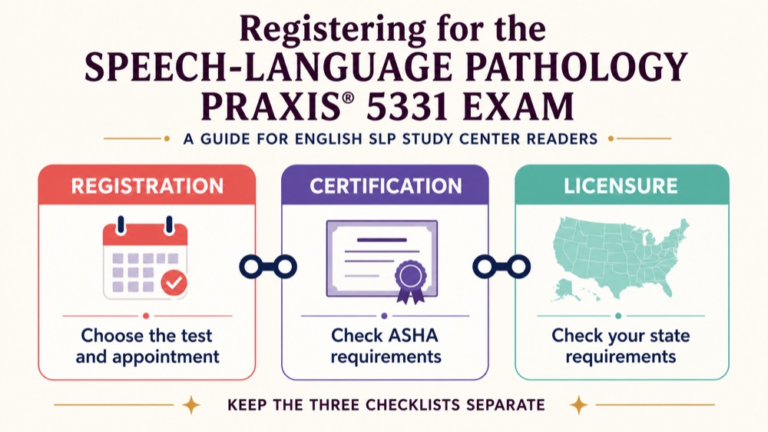
After registration, read the confirmation as if you were checking a clinical referral: compare the documented details with the decision you intended to make. Confirm the test title and 5331 code, appointment date and time, time zone, location or delivery setting, identification instructions, score-recipient choices, and any steps that remain open. If one of those details is missing or inconsistent, contact the appropriate ETS support channel while the transaction is easy to trace.
Next, turn the appointment into a study timeline. Registration should change your preparation from a vague intention into a sequence of decisions. Reserve time for blueprint review, content retrieval, application practice, timed sets, error analysis, and a final logistics check. The current ETS page and the valid blueprint should control the exam scope; an old calendar or a competitor’s summary is not enough evidence for a current test fact.
Use the time between registration and test day to strengthen distinctions, not only to accumulate practice scores. For example, ask whether a question is testing anatomy and physiology, assessment reasoning, treatment selection, professional practice, or the interpretation of evidence. Then explain why the decisive fact supports one option and why the nearby alternatives do not. That habit is more transferable than recording a percentage without reviewing the reasoning behind each missed item.
Before test day, perform one final administrative check using current ETS instructions. Reconfirm the appointment, identification, arrival or technical requirements, and any change policy that could affect your plan. Registration evidence should make the final check easier, not replace it.
Registration, Certification, Licensure, and School Requirements Are Different
Many registration questions are really credential questions. The words sound connected, but they refer to different decisions. The ASHA Praxis registration guidance and the ETS-hosted ASHA overview are useful starting points, while your university and state authority remain important for pathway-specific instructions.
| Term | Plain-language meaning | What it does not establish |
|---|---|---|
| Registering | Scheduling the 5331 test through the ETS process. | It does not establish that you meet every credential or state requirement. |
| Passing the Praxis | Meeting a score rule that applies to a particular pathway at a particular time. | It does not automatically complete a clinical fellowship, education review, or state application. |
| ASHA certification | A professional credential with its own current requirements and documentation. | It is not created by an appointment confirmation alone. |
| State licensure | A jurisdiction-specific authorization to practice. | It cannot be inferred from a general national exam page. |
| School or employer requirement | An institution’s deadline, documentation rule, or onboarding condition. | It may not match another school’s or employer’s timeline. |
This distinction matters when deciding whether to register now. ASHA’s exam-context guidance discusses timing after graduate coursework and clinical practicum, but an individual candidate still needs to verify the rule that applies to the candidate’s program and credential pathway. If two sources appear to conflict, record the exact question, ask the responsible institution or authority, and keep the answer with your registration records.
Common Registration Mistakes and Practical Fixes
Most registration problems are avoidable when the learner checks the right evidence at the right moment. These are the mistakes worth screening for before submitting the transaction:
- Searching by a loose phrase: select the full Speech-Language Pathology 5331 title and code shown by ETS.
- Choosing the earliest date automatically: compare the date with coursework, practicum, preparation time, and score deadlines.
- Assuming a listed center is reserved: save the appointment only after the transaction produces a confirmation.
- Using a name that will not match identification: resolve the mismatch through the current ETS support route before test day.
- Copying an old fee or policy: read the amount and change terms displayed in the current account.
- Guessing a score-recipient instruction: ask the receiving program or authority for its current direction.
- Ignoring accommodation lead time: review the current ETS process early and preserve the approval or support record.
- Treating registration as certification: keep the appointment, score, ASHA, state, and school requirements in separate checklists.
- Saving only a screenshot: retain the confirmation email and account record as the primary evidence.
These fixes are also useful exam habits. The same reasoning pattern appears in many Praxis questions: identify the exact task, separate the decision from the outcome, locate the decisive evidence, and avoid filling a gap with an assumption. Administrative accuracy and clinical reasoning are different skills, but both improve when the learner defines the decision before acting.
Quick Review: Your Praxis 5331 Registration Checklist
Before you consider the process complete, you should be able to answer each question below from a current source or your own confirmation record:
- Did I select Speech-Language Pathology Praxis 5331?
- Does the name in my ETS account align with the identification I expect to use?
- Does the appointment fit my coursework, practicum, preparation, and submission deadlines?
- Did I check the current delivery and location requirements?
- Did I review the current fee, rescheduling, cancellation, and refund language?
- Did I confirm any accommodation steps early enough for the appointment?
- Did I review score-recipient instructions with the receiving organization?
- Did I save the confirmation number, date, time, location, and follow-up instructions?
- Do I know which claims need a final ETS check before test day?
- Have I separated exam registration from ASHA certification and state licensure tasks?
If you can answer those questions, you have a usable administrative foundation for your study plan. For structured preparation after the appointment is confirmed, the SLP Study Center Complete Prep resources can help you organize blueprint review, application practice, and review of the distinctions that make exam decisions clearer.
References
- ETS Speech-Language Pathology 5331 — current test page and registration entry point; verify live details before registering.
- ETS How to Register for a Praxis Test — registration sequence and scheduling workflow.
- ETS Praxis Test Centers — location and appointment-search guidance.
- ASHA Praxis Registration — registration and certification-pathway context.
- ASHA About the Speech-Language Pathology Praxis Exam — exam timing and credential context.