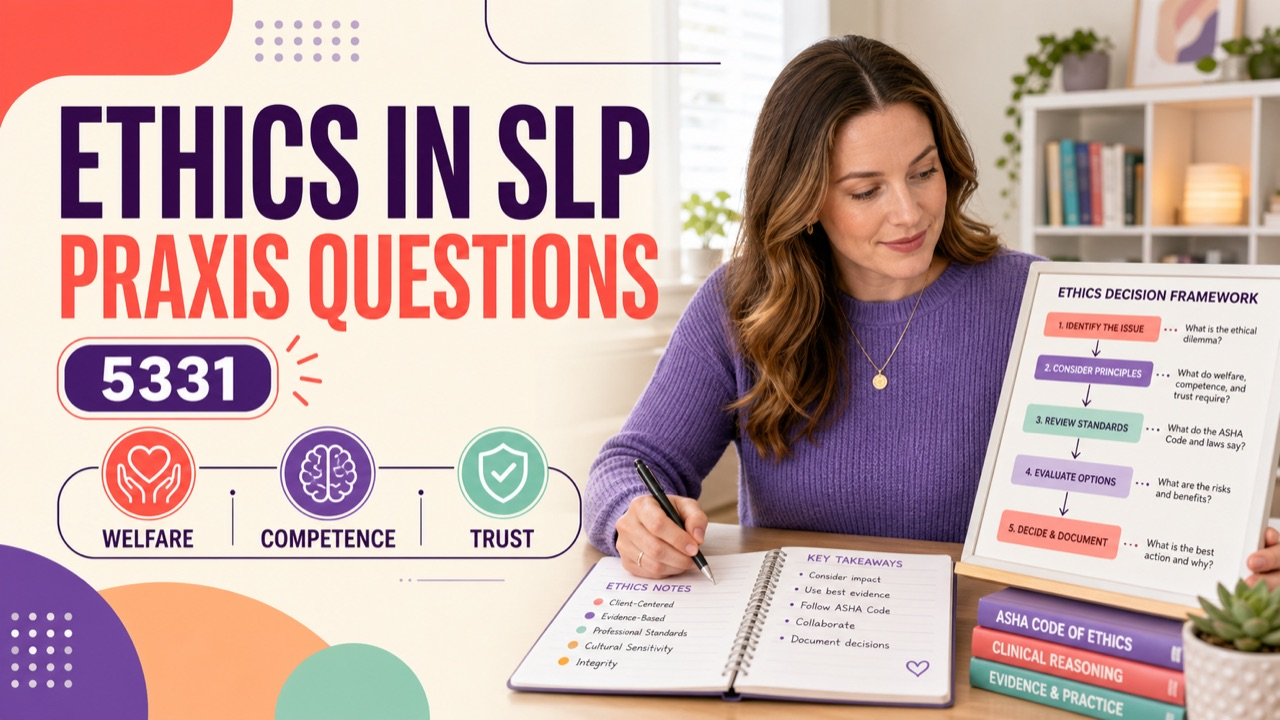
ethics speech language pathology praxis questions are easiest to solve when you connect a professional duty to the person affected, the facts that are known, and the next responsible action. An ethics stem may involve privacy, consent, competence, supervision, public communication, documentation, conflicts of interest, research, or access. The strongest answer is usually the one that protects welfare and preserves an accountable process.
The current ASHA Speech-Language Pathology 5331 content page places professional practice topics such as ethics, collaboration, documentation, culturally and linguistically appropriate service delivery, advocacy, legislation, and evidence-based practice within the study frame. The ASHA Code of Ethics, applicable law, setting policy, and current ETS 5331 information remain the sources to check for real decisions and changing exam context. The maps and A-D questions on this page are original study material, not reproduced test content.
What ethics speech-language pathology Praxis questions are testing
Ethics questions test professional judgment under constraints. The stem may describe a well-intentioned clinician who wants to help quickly, a supervisor who asks for a shortcut, a family member who requests information, or a colleague whose public statement is too broad. Your task is to identify the duty before deciding which action feels most convenient.
| Ethics task | Clue to locate | Reasoning output |
|---|---|---|
| Welfare | Safety, dignity, access, burden, foreseeable harm, and the person’s interests | Protective first action |
| Competence | Education, training, experience, supervision, tools, and role boundaries | Supported scope decision |
| Privacy | Information, authorization, purpose, recipient, channel, and security | Appropriate disclosure path |
| Consent | Proposed action, understandable information, decision authority, questions, and choice | Meaningful participation |
| Public responsibility | Truthful claims, credentials, conflicts, billing, and professional trust | Accurate representation |
| Relationships | Supervision, delegation, collaboration, disagreement, and accountability | Respectful process |
Rewrite the stem as a responsibility sentence. For example, “A volunteer wants the report” becomes “The clinician must determine whether this person is authorized to receive this information.” “The clinic lacks a specialist” becomes “The clinician must protect the client while finding consultation, referral, or an in-scope bridge.” This rewrite keeps the ethical question visible.
Watch for details that change the answer: whether the information is identifiable, whether consent was informed, whether there is immediate risk, whether the clinician has task-specific competence, whether supervision is available, whether a statement is public, and which setting rule or law applies. Ethics reasoning is fact-sensitive, so do not answer from a single keyword alone.
Anchor ethics review to ASHA 5331
The 5331 professional-practice frame is broader than memorizing a list of prohibited behaviors. It asks you to connect ethics with service delivery, counseling, collaboration, documentation, cultural responsiveness, advocacy, legislation, evidence, and the professional role. An ethics decision affects how a service is offered, explained, recorded, supervised, and followed through.
| 5331 connection | Ethics question | Study tag |
|---|---|---|
| Service delivery | Can the person access a service that is appropriate, understandable, and within the clinician’s role? | Welfare and access |
| Documentation | Does the record accurately describe what happened, what was decided, and what remains uncertain? | Accountability |
| Collaboration | Are roles, privacy boundaries, consent, and communication channels clear? | Professional relationships |
| Cultural responsiveness | Could language, dialect, culture, disability, or bias affect the process or conclusion? | Fairness |
| Advocacy | What barrier limits the person’s participation, choice, safety, or communication access? | Client-centered duty |
| Evidence | Are claims calibrated to the evidence, context, person, and known limitations? | Honesty |
Use ASHA’s current Code of Ethics as a framework for professional conduct, then check the setting-specific requirements that govern the scenario. A school, health-care facility, private practice, research project, telepractice arrangement, payer, or state licensing board may impose additional procedures. The correct study answer recognizes the ethical duty without pretending that one page resolves every legal question.
Separate principles, rules, and setting requirements
Principles express the underlying professional responsibility, while rules describe more specific minimally acceptable or unacceptable conduct. A question may give you enough detail to identify the principle but not enough detail to decide a legal outcome. Make that distinction explicit: name the ethical concern, identify the conduct, and then state what fact or policy must be checked.
| Layer | What it contributes | How to use it in a stem |
|---|---|---|
| Principle | The broad duty, such as welfare, competence, public responsibility, or professional relationships | Identify the value at stake |
| Rule | A specific boundary or expectation that clarifies acceptable conduct | Match the behavior to the relevant standard |
| Law or regulation | A jurisdictional requirement that may control consent, privacy, reporting, or licensure | Check the current authority |
| Setting policy | An employer, school, facility, payer, or research procedure | Follow the local process while preserving professional duty |
| Consultation | Guidance when facts are incomplete, risks conflict, or the boundary is uncertain | Ask the right supervisor, compliance resource, or ethics office |
A tempting distractor often names a true value but skips the required process. “Protect privacy” is incomplete if the choice does not check authorization or the secure channel. “Help the client” is incomplete if it ignores competence. “Follow policy” is incomplete if the policy appears to create an access barrier and the clinician has an appropriate advocacy or escalation path.
Use welfare as the first decision filter
When choices conflict, begin with the person served and the foreseeable effect of each option. Consider safety, dignity, autonomy, communication access, burden, delay, privacy, and continuity. Welfare does not mean selecting the fastest intervention or removing every challenge; it means choosing a responsible process that reduces avoidable harm and respects the person’s interests.
Ethical welfare reasoning also includes people who participate in research, education, supervision, or consultation. Ask who receives the service, whose information is involved, who may be affected by the decision, and whose voice is missing. Then identify the smallest protective step that can happen now while the larger question is reviewed.
- Identify the person or group served and the activity that matters to them.
- List the foreseeable benefit, burden, safety concern, privacy risk, and access barrier.
- Check whether the person can understand, participate in, or decline the proposed action.
- Choose an immediate step that protects welfare while preserving options.
- Document the reasoning, consultation, communication, and follow-up.
Work within competence and scope
Professional scope describes the activities associated with a profession; individual competence asks whether this clinician has the education, training, experience, supervision, and current preparation needed for this task. Ethics questions frequently use a capable clinician in one area who is asked to perform a specialized activity outside current preparation. Good intentions do not remove that boundary.
| Competence clue | Question to ask | Responsible direction |
|---|---|---|
| Training | Has the clinician learned the knowledge and procedure needed for this task? | Seek education before independent service |
| Experience | Has the skill been used with this person, context, and level of complexity? | Use consultation and graded support |
| Supervision | Is an appropriately qualified supervisor available and actually involved? | Clarify oversight and document it |
| Specialization | Would another professional or service be better equipped? | Coordinate referral without abandoning the person |
| Change | Has evidence, technology, policy, or the client’s needs changed? | Update preparation and reassess the plan |
Look for an answer that combines transparency with a bridge. The clinician can explain the limit, obtain consultation, arrange a qualified referral, provide an in-scope interim service, and communicate the follow-up plan. A simple refusal may leave the person without support; independent practice without preparation may create a larger risk.
Protect confidentiality and privacy
Privacy questions require more than noticing that a family member or colleague has a helpful purpose. Identify what information is involved, who wants it, why it is requested, what authorization or other basis applies, and how the information will be transferred or stored. Use the minimum appropriate disclosure under the governing requirement rather than treating a broad request as permission to share a full record.
| Privacy field | Decision question | Study response |
|---|---|---|
| Information | Could the report, image, recording, message, or conversation identify a person? | Name the protected content |
| Recipient | Who is requesting access, and what is that person’s role? | Verify identity and authority |
| Purpose | Does the stated purpose match the professional need and permission? | Clarify the reason |
| Channel | Is the device, platform, room, or transmission process appropriate? | Use a secure approved path |
| Amount | What information is necessary for the stated purpose? | Limit the disclosure |
| Record | What was requested, shared, declined, or escalated? | Document the decision |
Do not confuse collaboration with unrestricted disclosure. A team may need shared information for coordinated care, but the clinician still needs role clarity, authorization, secure communication, and a relevant purpose. Students, assistants, interpreters, researchers, billing staff, and supervisors also need clear privacy expectations appropriate to their role.
Make informed consent meaningful
Informed consent is a communication process. The person served or authorized decision-maker should receive understandable information about the proposed assessment, treatment, recording, disclosure, research activity, or service change. The conversation should address purpose, expected outcomes, meaningful risks, alternatives, limits, privacy implications, and the opportunity to ask questions or decline as allowed by the setting.
Accessibility is part of the process. Consider language, literacy, hearing, vision, cognition, communication mode, culture, interpreter use, and the person’s preferred way to participate. A signature can be one record of the process, but it does not replace explanation, understanding, appropriate authority, and a chance to make a meaningful choice.
- Name exactly what the person is being asked to authorize.
- Explain the purpose, options, expected outcomes, meaningful risks, and relevant limits.
- Verify who has decision authority for this person and setting.
- Adapt the discussion so the person can receive and express information.
- Invite questions, record the decision, and revisit consent when the plan changes.
Recognize conflicts and honest representation
A conflict of interest can arise when personal, financial, institutional, family, research, or professional incentives could affect judgment or could reasonably appear to affect it. The exam task is not always to label a person as unethical. First identify the competing interests, disclose or manage the conflict through the appropriate process, protect the person served, and keep decisions tied to documented needs and relevant evidence.
| Conflict clue | Risk | Responsible response |
|---|---|---|
| Financial incentive | A recommendation may benefit the clinician, clinic, vendor, or referrer | Disclose, follow policy, and use person-centered criteria |
| Dual relationship | Personal connection may influence boundaries or access | Clarify roles and seek consultation |
| Marketing claim | Outcome, credential, or service language may mislead the public | Use accurate, supportable wording |
| Research role | Recruitment, consent, data, and professional authority may overlap | Separate roles and follow approved procedures |
| Referral pressure | A payer, physician, school, or employer may push a predetermined answer | State the evidence and protect independent judgment |
Honest representation includes credentials, training, outcomes, service limits, affiliations, and the difference between an educational resource and an individualized clinical service. Avoid language that promises a result, hides uncertainty, or suggests expertise that has not been established. When a claim is public, the responsibility extends to protecting public trust in the profession.
Document ethical reasoning
Documentation makes a professional decision traceable. A useful entry records relevant facts, the person’s preferences or authorization, the concern that required judgment, the consultation or policy reviewed, the action taken, the limitation, and the follow-up. Do not turn the record into speculation or a personal argument. Write what was observed, communicated, decided, and planned.
| Record field | What to capture | Quality check |
|---|---|---|
| Facts | Relevant event, request, setting, participants, and information available at the time | Could another professional follow the sequence? |
| Duty | Welfare, privacy, consent, competence, public responsibility, or relationship concern | Is the ethical issue named? |
| Communication | Explanation, questions, preferences, authorization, disagreement, or refusal | Is the person’s voice visible? |
| Consultation | Supervisor, policy, compliance resource, ethics office, or other appropriate guidance | Was the right pathway used? |
| Action | Disclosure, pause, referral, adaptation, correction, escalation, or in-scope bridge | Is the next step concrete? |
| Follow-up | Responsible person, timing, review point, and changed information | Can continuity occur? |
Avoid documenting only “ethical concern discussed.” That phrase does not tell the next clinician what happened or why the plan changed. Avoid writing a definitive legal conclusion when the facts require consultation. A calibrated record can state the concern, the current action, the uncertainty, and the authority that will be checked.
Provide culturally responsive service
Ethical reasoning includes language, dialect, culture, identity, disability, communication mode, family structure, and the person’s lived context. A procedure that is convenient for the clinic may not provide fair access or valid information for every client. Ask what supports communication, what the person values, and what assumptions could distort assessment, counseling, recommendations, or consent.
| Context clue | Ethics question | Action direction |
|---|---|---|
| Language | Is the person receiving and expressing information in an accessible language or mode? | Arrange qualified language support |
| Dialect | Could a difference be interpreted as a deficit against the wrong variety? | Use appropriate linguistic context |
| Materials | Do examples, instructions, and response demands fit the person’s experience? | Adapt and document the process |
| Interpreter | Are role, privacy, accuracy, and communication boundaries clear? | Prepare and collaborate appropriately |
| Preference | What outcome and communication routine matter to the person and family? | Include shared decision making |
Do not treat cultural responsiveness as avoiding evaluation or lowering the quality of evidence. The ethical move is to support access to the process, interpret findings with appropriate caution, seek expertise when needed, and connect recommendations to meaningful participation. Review the current ASHA Cultural Responsiveness resource when the stem highlights language, culture, or bias.
Handle supervision, delegation, and referral
Supervision questions test responsibility at more than one level. The supervisor needs to match tasks, training, oversight, feedback, and documentation to the supervisee’s role and competence. The person receiving service still needs safe, appropriate care. Delegation is not a transfer of accountability that allows the supervising clinician to stop monitoring the plan.
| Scenario | Question to ask | Responsible action |
|---|---|---|
| Student activity | What is the student prepared to do and what oversight is required? | Set and document supervision |
| Assistant task | Is the task appropriate for the assistant’s role and current training? | Use the approved supervision plan |
| New clinician | Which skills need support, review, or a gradual increase in independence? | Provide feedback and consultation |
| Specialized need | Would another professional lead a part of assessment or service? | Refer and coordinate care |
| Urgent need | What safe action can occur now while qualified support is arranged? | Offer an in-scope bridge and follow up |
The best answer often includes both a limit and a continuity plan. Explain the boundary, seek appropriate supervision or consultation, refer when needed, and tell the person what happens next. “Do it anyway” ignores competence; “send them away” ignores continuity; “pretend it was supervised” violates honest representation.
Apply ethics to billing and access
Billing and access scenarios can feel administrative, but they still affect welfare, honesty, privacy, and fairness. A clinician should not document a service that did not occur, select a misleading code to obtain payment, hide a material limitation, or let a payer’s process erase the person’s communication need. At the same time, the clinician should work through the correct billing, authorization, appeal, or referral pathway.
Separate three questions: what service occurred, what the current rule allows, and what access barrier remains. Record the service accurately, communicate with the appropriate payer or administrator, obtain guidance when the requirement is unclear, and advocate through the available process. Do not solve a reimbursement problem by changing the clinical record or promising coverage.
- Describe the service, duration, purpose, and response accurately.
- Check authorization, coding, documentation, and payer requirements.
- Protect private information during billing communication.
- Explain options and limitations to the person in understandable language.
- Use an appeal, accommodation, referral, or escalation pathway when appropriate.
- Document the barrier, communication, decision, and follow-up.
Use research and public communication responsibly
Ethics applies to research participants, classroom teaching, presentations, social media, websites, and marketing. Describe evidence with its population, design, outcome, context, limitations, and uncertainty. A single study, testimonial, or attractive graphic should not be presented as a universal promise. Protect participant privacy and follow the required review, consent, data, and authorship processes.
| Communication setting | Ethical checkpoint | Safer wording direction |
|---|---|---|
| Website | Are credentials, services, outcomes, and limits represented accurately? | Use clear supportable claims |
| Presentation | Are sources, contributors, examples, and limitations acknowledged? | Separate evidence from interpretation |
| Social media | Could a story, image, or comment identify a person or imply an individual service? | Remove identifiers and protect boundaries |
| Research | Are consent, privacy, recruitment, data handling, and oversight addressed? | Follow the approved process |
| Teaching | Are examples fictionalized or authorized, and are students told the limits? | Label original cases and uncertainty |
When an answer choice uses a strong outcome phrase, ask what evidence supports it and what a reasonable reader would infer. Ethical public communication is not vague communication; it is precise communication that tells the audience what is known, what is uncertain, and what the service can and cannot promise.
Identify the right consultation pathway
Consultation is a professional action, not a sign that the clinician has failed. The right resource depends on the concern. A supervisor may clarify competence or supervision; a privacy or compliance officer may clarify disclosure; an interpreter coordinator may support language access; a licensing board may address jurisdiction; an ethics office may provide professional guidance; and a facility policy may control workflow.
| Uncertainty | First consultation direction | What to bring |
|---|---|---|
| Competence | Qualified supervisor, mentor, or specialty consultant | Training, task, client need, and proposed support |
| Privacy | Privacy officer, compliance resource, or responsible administrator | Information, recipient, purpose, authorization, and channel |
| Consent | Supervisor, policy lead, or appropriate legal and institutional resource | Action, authority, access support, and setting |
| Billing | Payer, compliance, or administrative pathway | Service record, code question, and access impact |
| Ethical conduct | Current ASHA ethics resource or designated professional process | Relevant facts, steps already taken, and unresolved concern |
Before consulting, protect privacy and share only what is necessary. State the question neutrally, distinguish facts from assumptions, identify the immediate risk, and record the guidance received. If a stem asks what to do first, the answer may be to pause an unsafe action and obtain the appropriate consultation rather than to make a final determination alone.
Map an ethics dilemma to a responsible action
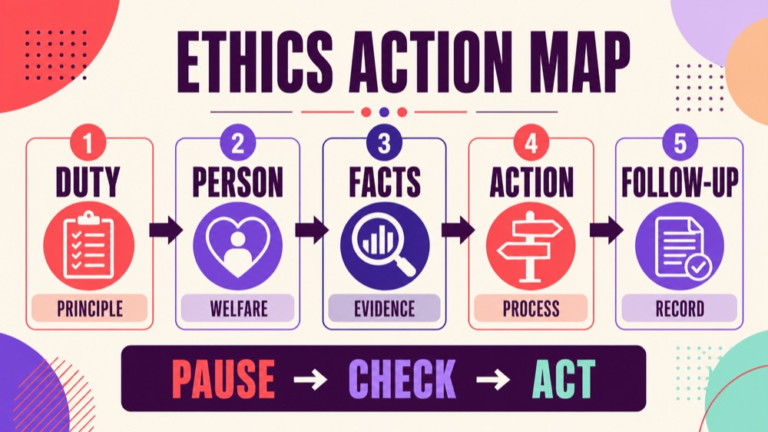
Use a five-field map when a vignette contains several competing values. Start with the governing principle, keep the person visible, separate known facts from assumptions, choose the next action within the clinician’s role, and name the follow-up. This structure converts a broad ethical concern into a sequence that can be evaluated.
| Map field | Margin question | Common error |
|---|---|---|
| Principle | Which duty or professional responsibility is most central? | Choosing convenience before responsibility |
| Person | Who needs welfare, access, privacy, choice, or protection? | Discussing the team while losing the client |
| Facts | What is authorized, documented, observed, and uncertain? | Filling gaps with assumptions |
| Action | What can the clinician do now, and who should be involved? | Skipping the immediate protective step |
| Follow-up | What communication, record, consultation, referral, or review is next? | Ending with advice and no continuity |
Practice the map with one-variable contrasts. Keep the request the same but change the recipient’s authorization; keep the competence gap the same but add qualified supervision; keep the public claim the same but add a clear evidence limitation. The best answer should respond to the changed fact rather than to the emotional tone of the vignette.
Use an ethics principle and action review board
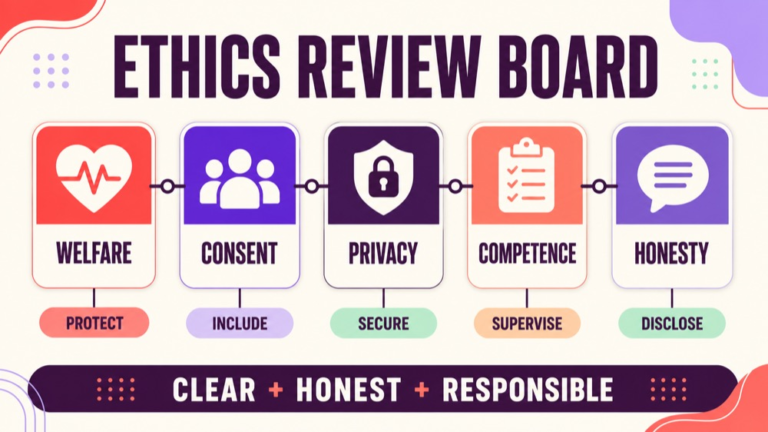
A review board is a compact way to slow down a rapid answer. Fill one card for welfare, consent, privacy, competence, and honesty. For each card, write the relevant fact, the risk, the action that protects the person, and the process that makes the decision accountable. If one card is blank, that may be the missing issue in the stem.
| Board card | Write down | Ask yourself |
|---|---|---|
| Welfare | Benefit, burden, safety, dignity, and participation concern | What protects the person first? |
| Consent | Proposed action, authority, information, questions, and choice | Can the person make a meaningful decision? |
| Privacy | Information, recipient, purpose, authorization, channel, and amount | What disclosure is appropriate? |
| Competence | Training, experience, supervision, referral, and role boundary | Who can take the next task safely? |
| Honesty | Credential, claim, conflict, record, evidence, and uncertainty | What must be stated accurately? |
Do not treat the board as a substitute for current policy or professional consultation. It is a study device that helps you identify the question before you choose the answer. On a timed item, you can run the five cards mentally, then select the option that includes the necessary protection and process without adding unsupported facts.
Question 1: privacy and authorized disclosure
Practice Question 1. An SLP receives a message from a volunteer who says they are helping a student and asks for the student’s evaluation summary. The volunteer is not listed in the record as a member of the educational team, and the message does not include authorization to release information. What is the most responsible next step?
A. Send the complete summary because the volunteer’s purpose appears helpful.
B. Ask the volunteer to forward the request to any family member who can confirm the student’s name.
C. Pause the disclosure, verify the volunteer’s role and authorization through the appropriate process, and share only information permitted for the documented purpose.
D. Post a general summary in the shared group so everyone can decide whether it is relevant.
Correct Answer: C. The request has a potentially helpful purpose, but the recipient’s role and authority are not established. The clinician should protect privacy, verify the relevant process, clarify the purpose, and limit any permitted disclosure to what is appropriate.
Why the Other Options Are Wrong: A treats helpful intent as permission and shares more information than the facts support. B adds an informal confirmation step without verifying the governing authorization. D creates a broad disclosure and removes control over the record. C addresses identity, role, authority, purpose, and amount of information.
Exam Trap: Collaboration does not equal unrestricted disclosure. When the recipient is not clearly part of the authorized team, look for verification and minimum-necessary sharing before any information is released.
Question 2: competence and delegation
Practice Question 2. A clinic asks an SLP assistant to administer a specialized assessment that the assistant has never been trained to use. The supervising SLP is scheduled at another site and will not be available for the appointment. Which response best protects the client and follows responsible supervision?
A. Have the assistant administer the assessment because the clinic needs the results quickly.
B. Cancel the client’s care indefinitely and give no explanation.
C. Stop the unsupported assignment, clarify the assistant’s role and preparation, arrange qualified supervision or referral, and communicate an appropriate next step to the client.
D. Tell the assistant to use the assessment but describe the result as informally collected data.
Correct Answer: C. The task is outside the assistant’s current preparation and lacks available supervision. The responsible response protects the client, clarifies the role, arranges appropriate qualified support, and preserves continuity through communication and follow-up.
Why the Other Options Are Wrong: A prioritizes speed over competence and oversight. B abandons the client without exploring a safe alternative. D changes the label without fixing the unsupported administration. C addresses training, supervision, referral, transparency, and continuity.
Exam Trap: The word “assistant” does not answer the question by itself. Match the task to training, supervision, role, setting requirements, and the client’s needs; then look for a boundary plus a bridge.
Question 3: conflict of interest and public claims
Practice Question 3. An SLP is offered a payment by a device vendor for posting a message that says the vendor’s communication product is the best choice for every client with a communication disability. The SLP has not reviewed evidence for all populations and would not disclose the payment. What is the most responsible response?
A. Publish the message because the product may help some people.
B. Publish the message but replace “every client” with “many clients” without mentioning the payment.
C. Decline or revise the claim through an appropriate disclosure and review process, represent the evidence and limits accurately, and disclose the financial relationship if the communication proceeds.
D. Ask a colleague to publish it so the conflict is no longer attached to the SLP’s account.
Correct Answer: C. The proposed statement is broad, unsupported by the described review, and connected to an undisclosed financial interest. Honest public communication requires accurate claims, appropriate disclosure, and management of the conflict.
Why the Other Options Are Wrong: A ignores the universal claim and financial incentive. B softens one word but still hides the conflict and does not establish evidence. D transfers the appearance of the conflict rather than managing it. C addresses accuracy, limits, disclosure, and professional trust.
Exam Trap: A small wording change does not make an unsupported endorsement responsible. Check both the content of the claim and the relationship that could influence or appear to influence it.
Review common ethics distractors
Ethics distractors often take a genuine professional value and turn it into an incomplete shortcut. A choice may sound compassionate while ignoring consent, sound collaborative while ignoring privacy, or sound cautious while abandoning the client. Name the missing process before you decide that an answer is responsible.
| Distractor pattern | Why it sounds attractive | Correction |
|---|---|---|
| Helpful purpose overrides privacy | The request appears to benefit the person | Verify authority, purpose, channel, and amount |
| Good intention overrides competence | The clinician wants to prevent delay | Seek supervision, consultation, or referral |
| Signature equals consent | The form creates a visible record | Check explanation, understanding, authority, and choice |
| Referral ends responsibility | It avoids unsupported practice | Coordinate and provide an appropriate bridge |
| Public confidence replaces evidence | Strong claims sound persuasive | State support, limits, and uncertainty accurately |
| Policy replaces advocacy | Following the rule feels safest | Use the proper access and escalation process |
| Confrontation solves conflict | It creates an immediate show of action | Gather facts and use a proportionate process |
| Silence protects everyone | It avoids an uncomfortable conversation | Address risk through consultation and documentation |
Use the label “right value, incomplete process” in your notes. That label helps you remember why a distractor is not enough without treating the entire option as unrelated. In timed review, ask which one responsibility the choice protects and which one it leaves exposed.
Build an ethics practice block
A focused ethics block should mix recognition, sequencing, and explanation. Start with the ASHA framework and the setting in the stem. Then complete original vignettes that change one variable at a time: recipient authorization, available supervision, language support, financial relationship, public audience, or immediacy of risk.
- Draw five columns labeled welfare, consent, privacy, competence, and honesty.
- Sort ten prompts by the primary duty before reading the answer choices.
- For each prompt, write the missing fact that would change the decision.
- Complete the three original questions on this page without looking at the rationales.
- Explain the wrong options using the “right value, incomplete process” label.
- Write one next step that preserves client continuity.
- Check the current ASHA Code of Ethics and setting policy for any live professional decision.
Use contrast pairs to prevent memorized slogans. Keep the same privacy request but change the recipient’s documented authority. Keep the same specialized task but add qualified supervision. Keep the same marketing claim but remove the financial relationship and add population-specific evidence. Your reasoning should change only when the governing facts change.
Track ethics reasoning and confidence
Record the duty and action that led to your answer, not only the letter. This makes it easier to see whether you missed authorization, role, access, evidence, or follow-up. A confidence score is useful when it is paired with a reason, such as “I recognized privacy but was unsure about the consultation pathway.”
| Log field | Example entry | What it reveals |
|---|---|---|
| Primary duty | Privacy and authorized disclosure | Whether the governing concern was identified |
| Person affected | Student and authorized caregiver | Whether the client stayed visible |
| Missing fact | Volunteer role and release authority | What should be verified next |
| Action | Pause, verify, and limit the disclosure | Whether the principle became concrete |
| Consultation | Supervisor or privacy process | Whether the right pathway was selected |
| Distractor type | Helpful purpose overrides privacy | Which shortcut to avoid |
| Confidence | 60% before rationale, 90% after explanation | Where review improves transfer |
Revisit low-confidence items even when correct. Write one sentence for the ethical duty, one for the protective action, and one for the follow-up. This turns a question review into a reusable professional reasoning routine instead of a one-time answer check.
Ethics speech-language pathology Praxis questions checklist
Use this checklist before submitting an answer. It is a study aid, not a substitute for the current ASHA Code of Ethics, applicable law, licensing requirements, facility policy, supervision, or professional consultation.
- Did I identify the person served, the professional conduct, and the primary ethical duty?
- Did I consider welfare, safety, dignity, access, autonomy, and foreseeable burden?
- Did I check privacy, authorization, purpose, secure channel, and appropriate amount of information?
- Did I make consent specific, understandable, accessible, and connected to decision authority?
- Did I match the task to education, training, experience, competence, supervision, and scope?
- Did I identify whether a referral, consultation, or in-scope bridge protects continuity?
- Did I consider language, dialect, culture, disability, interpreter use, and communication mode?
- Did I look for a financial, personal, institutional, research, or referral conflict?
- Did I separate a professional principle from setting policy, law, payer, and licensure questions?
- Did I represent credentials, evidence, outcomes, uncertainty, and limitations honestly?
- Did I choose a record and follow-up that make the decision traceable?
- Did I explain why every distractor is incomplete for the facts given?
If you can run the checklist consistently, you are practicing the central ethics sequence: identify the duty, protect the person, make participation possible, stay within role, communicate honestly, document the process, and follow through.
Sources and next steps
For the professional-practice frame, review ASHA’s Speech-Language Pathology 5331 content page. For the ethical framework, read the current ASHA Code of Ethics, which describes principles and rules related to persons served, competence, public responsibility, and professional relationships. The ASHA Ethics Resources page can guide questions about ethics processes and current resources.
For access and interpretation, review ASHA Cultural Responsiveness, Multilingual Service Delivery, and Collaborating With Interpreters. For current exam identity and administration information, use the live ETS Speech-Language Pathology 5331 page and its current preparation resources.
This page’s maps, rationales, and A-D practice questions are original educational material. They are separate from the live ETS test and do not reproduce test material. They are not individualized legal or clinical advice. For a real ethical dilemma, protect privacy, consult the appropriate supervisor or resource, check current requirements, document the process, and follow through with the person served.
For your next review, complete one timed case using principle → person → facts → action → follow-up. Then change one fact, such as authorization, supervision, language access, or financial relationship, and explain why the responsible response changes or stays the same.
Continue your preparation: Explore the SLP Study Center learning resources.