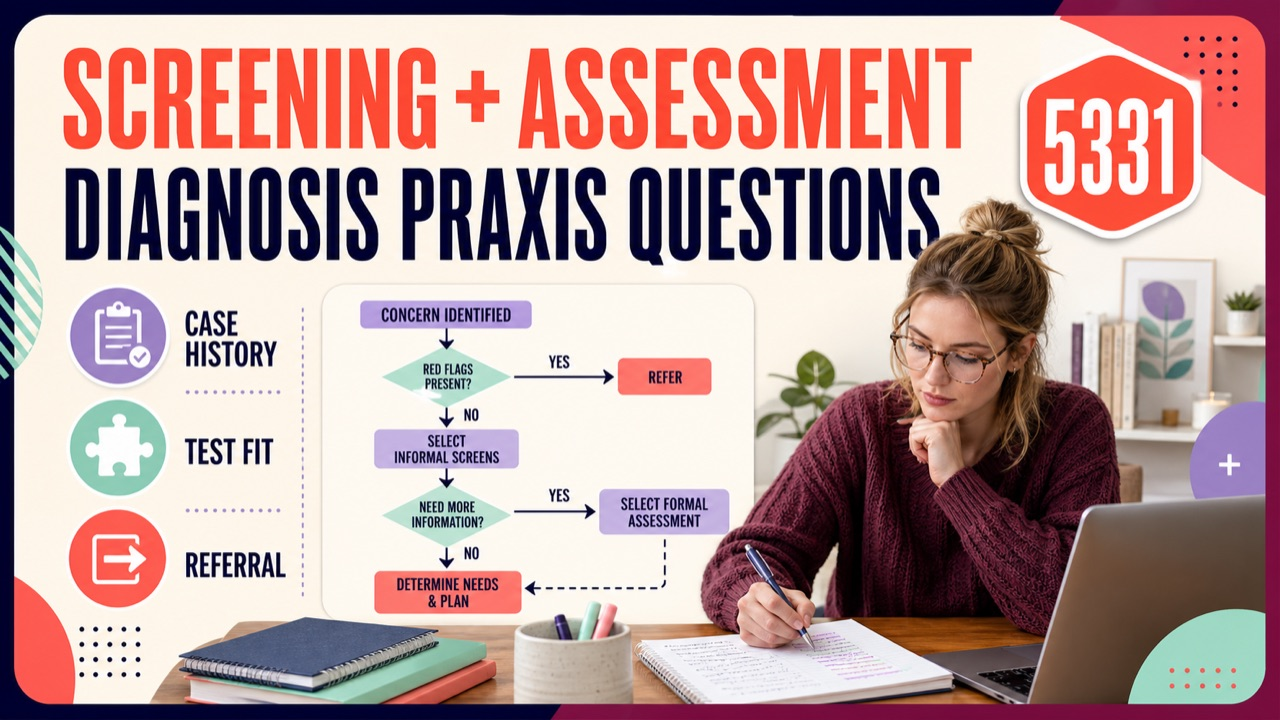
screening assessment diagnosis praxis questions are easier to solve when you identify the clinical stage before choosing an answer. A stem may describe a concern, a referral, a case history, a test result, a language difference, or a treatment decision. The strongest option matches the evidence to the decision being requested and avoids moving from a brief screen to a complete diagnosis without the needed information.
The current ASHA Speech-Language Pathology 5331 content page places screening, assessment, evaluation, and diagnosis in a major exam category. ASHA’s Practice Portal also describes screening as a way to identify a potential need for further assessment rather than a detailed description of every diagnostic feature. Use those live pages, together with the current ETS Speech-Language Pathology 5331 page, for changing exam information. The decision maps and questions below are original study material.
What screening, assessment, and diagnosis questions are testing
A screening, assessment, and diagnosis item may ask you to identify the purpose of a procedure, select a next step, choose a valid instrument, interpret a score, decide whether a referral is needed, or describe a communication disorder from converging evidence. The most familiar test name is not automatically the answer. First identify what the clinician knows, what remains unknown, and which decision the stem requests.
| Question task | Evidence to locate | Review output |
|---|---|---|
| Screening | Concern, brief result, setting, purpose, and reason for follow-up | Potential need and next action |
| Assessment | Case history, samples, observations, test conditions, and relevant factors | Detailed profile |
| Diagnosis | Converging evidence, differential possibilities, and criteria within scope | Supported clinical conclusion |
| Referral | Question outside the current expertise, tool, setting, or medical boundary | Coordinated next step |
| Outcome planning | Functional baseline, goal, context, and observable change | Measure and follow-up plan |
Rewrite the stem as a decision sentence before reading the choices. “What does this screen tell the team?” is different from “Which assessment should be completed?” and different again from “Which interpretation is supported by the full profile?” This rewrite prevents a treatment recommendation, a diagnosis, or a referral from answering a screening question.
Watch for details that change the decision: age, language exposure, dialect, hearing status, onset, setting, education, fatigue, cognition, motor status, response style, cultural context, and the reliability of the available report. These details are not distractions. They determine whether the evidence can be interpreted as intended.
Anchor review to the ASHA 5331 scope
The ASHA 5331 framework groups screening, assessment, evaluation, and diagnosis into one broad content area. It includes developing case histories, selecting appropriate instruments and procedures, assessing factors that influence communication and swallowing, assessing anatomy and physiology, and making referrals. The exam also connects those decisions to foundations, professional practice, treatment planning, and evaluation.
| 5331 lens | Question example | Study tag |
|---|---|---|
| Foundations | What communication or swallowing process is represented by the case? | Concept and mechanism |
| Screening | Does the available brief result suggest a need for further assessment? | Initial decision |
| Assessment | Which history, sample, procedure, or instrument answers the question? | Evidence selection |
| Diagnosis | Which conclusion is supported by the complete pattern? | Differential reasoning |
| Referral | Which professional or service can address the missing domain? | Scope and collaboration |
| Evaluation | How will the plan or outcome be monitored? | Measurement and follow-up |
Map the stem to one primary lens even when it includes several domains. A child’s low score, for example, may invite a discussion of language, hearing, attention, and cultural-linguistic factors, but the question may specifically ask which information should be gathered before interpreting the score. The requested stage controls the answer.
Use ASHA for the professional and clinical framework and ETS for current exam administration. This page provides original educational practice content; it is not a transcript of a live test. Update any dated logistics from the live ETS page rather than from a static study note.
Separate screening, assessment, evaluation, and diagnosis
Screening is a brief procedure that identifies a possible concern and the need for further assessment or referral. Assessment gathers and interprets more detailed information about the person and the communication task. Evaluation is the broader process of integrating history, observation, tools, and clinical reasoning. Diagnosis is a supported conclusion that should follow sufficient evidence and the relevant professional, legal, and setting requirements.
| Stage | Primary question | Boundary |
|---|---|---|
| Screening | Should this person receive more assessment or referral? | It does not describe every feature or severity detail. |
| Assessment | What abilities, needs, factors, and contexts are present? | One test may not answer the whole clinical question. |
| Evaluation | How do the available data fit together? | Interpretation needs appropriate context and quality evidence. |
| Diagnosis | What disorder or clinical conclusion is supported? | Do not label from an isolated score or observation. |
| Referral | Who can address a question beyond the current service? | Referral is a coordinated action, not an admission of failure. |
A common test trap is the answer that sounds more definitive than the data. A failed screen may support further assessment, but it does not automatically supply a full diagnosis. A low standardized score may be important, but interpretation still depends on the tool’s purpose, language, norms, response conditions, and the rest of the profile.
Start with a purposeful case history
A case history is not a formality added after testing. It defines the concern, baseline, timeline, people involved, settings affected, and questions that the assessment must answer. Ask what the person, family, teacher, physician, or other referral source has noticed, when the change began, and how it affects daily communication, learning, work, health, or participation.
| History field | Questions to ask | Why it changes reasoning |
|---|---|---|
| Reason for referral | What decision does the referral source need help making? | It defines the assessment purpose. |
| Timeline | Was the concern developmental, sudden, gradual, or linked to an event? | Onset changes differential possibilities and urgency. |
| Settings | Where does the difficulty appear or disappear? | Context affects generalization and sampling. |
| Communication partners | Who notices the concern and who supports the person? | Collateral information can reveal functional patterns. |
| Language and culture | Which languages, dialects, literacy experiences, and routines are relevant? | Test interpretation must fit the person. |
| Health and development | What medical, hearing, developmental, educational, or neurologic factors matter? | It identifies contributors and referral needs. |
When a question asks for the best next step, choose the history detail that reduces the stem’s uncertainty. If the case contains no information about onset, language exposure, hearing, or the setting in which the concern occurs, a complete answer may begin with that missing history rather than with a more specific label.
Choose assessment instruments and procedures
Choose a tool or procedure by matching its purpose to the clinical question and the person. Consider the construct, age range, language, dialect, sensory and motor access, response demands, setting, time, training requirements, and the type of result it produces. A standardized measure, criterion-referenced task, conversational sample, observation, dynamic probe, or caregiver report may each be useful when matched to the question.
| Clinical question | Evidence option | Selection filter |
|---|---|---|
| Is there a possible concern? | Brief screen or structured observation | Purpose, sensitivity to concern, setting, and follow-up pathway |
| What does the person do in conversation? | Language sample or interaction observation | Partner, context, task, and analysis plan |
| What is the current skill profile? | Standardized or criterion-referenced assessment | Construct, norms, language, age, and access |
| How does the person respond to support? | Dynamic or supported task | Cue, response, learning opportunity, and interpretation |
| What medical or sensory factor contributes? | Referral, record review, or team assessment | Scope, urgency, and professional responsibility |
Do not choose a standardized test simply because its title resembles the referral concern. The instrument must measure the intended construct under conditions that permit meaningful interpretation. If a tool is not designed for the person’s language or response mode, explain what additional evidence or adapted procedure is needed rather than treating the score as a complete answer.
Review validity, reliability, and clinical fit
Validity asks whether the interpretation is supported for the intended purpose and population. Reliability concerns the consistency of measurement under relevant conditions. Clinical fit asks whether the procedure, language, access method, and setting make sense for this person and question. Praxis items may not ask for a definition directly; they may describe a choice that fails one of these filters.
| Review lens | Question to ask | Warning sign |
|---|---|---|
| Construct | What ability or behavior is the procedure meant to measure? | The test result is used to answer a different question. |
| Population | Does the norm or evidence base fit age and relevant characteristics? | Norms are treated as universal across groups. |
| Language | Does the task account for the person’s language and dialect? | Difference is interpreted as disorder without support. |
| Access | Can hearing, vision, motor, attention, or literacy affect the response? | The score reflects access barriers more than the target skill. |
| Reliability | Would the result be reasonably consistent under comparable conditions? | A single unstable observation carries all the weight. |
| Ecology | Does the task relate to the person’s real communication needs? | Clinic performance is assumed to equal daily performance. |
Use the phrase “fit before score.” A score can be precise and still answer the wrong question if the tool, language, or response conditions are mismatched. Conversely, a well-designed sample or observation can add valuable functional evidence when it is collected and analyzed deliberately.
Combine scores, samples, and observation
Strong evaluation reasoning integrates different evidence sources. A standardized score can describe performance under defined conditions. A speech or language sample can show how the person communicates in a meaningful task. Observation can reveal cueing, partner behavior, attention, fatigue, repair, and environmental effects. The clinician’s conclusion should explain how the sources converge, differ, or leave a question unresolved.
| Evidence source | Strength | Question it may answer |
|---|---|---|
| Standardized score | Structured comparison under defined administration | How did performance compare within the tool’s intended framework? |
| Criterion-referenced task | Direct view of selected skills or steps | Which behaviors can the person perform under this condition? |
| Language or speech sample | Functional communication behavior | How does the pattern appear in connected activity? |
| Observation | Context, partner, attention, access, and generalization clues | What changes across settings or supports? |
| Self-report or collateral | Participation, effort, and change outside the clinic | What matters in daily life and when does the concern occur? |
When sources disagree, do not erase the disagreement. Ask whether the task, partner, language, fatigue, response demand, or setting changed. An apparently low score with stronger functional performance may signal a test-fit issue, while a typical score with meaningful daily difficulty may signal limited ecological coverage. The next assessment step should address the discrepancy.
Interpret language, culture, and access factors
Language difference, dialect difference, multilingual development, cultural communication style, hearing status, literacy, vision, motor access, and familiarity with the task can influence test performance. ASHA’s 5331 framework includes culturally and linguistically appropriate service delivery as professional practice. A good practice answer considers whether the assessment is fair and whether the clinician has enough information to distinguish difference from disorder.
- Document the person’s languages, dialects, exposure, proficiency, and communication partners.
- Use qualified interpreters or other appropriate language support when needed.
- Choose tasks and materials that reflect the person’s communication experience and access.
- Interpret errors within the relevant language and developmental system.
- Compare information across settings and partners before making a broad conclusion.
- Explain which evidence supports disorder and which evidence may reflect difference or access.
Do not use the absence of a single English response as a complete language diagnosis for a multilingual person. Do not assume that an interpreter can replace clinical reasoning about the construct being tested. The clinician remains responsible for choosing a valid procedure, interpreting the evidence cautiously, and documenting limitations.
Use differential reasoning without overclaiming
Differential reasoning compares plausible explanations for a communication difficulty. The comparison may involve language, speech sound production, motor speech, fluency, voice, cognition, hearing, social communication, access, education, or medical factors. Begin with the pattern and the timeline, then ask what evidence supports or weakens each possibility.
| Comparison field | Question to ask | Reasoning result |
|---|---|---|
| Pattern | Which tasks, sounds, language domains, or contexts are affected? | Descriptive profile |
| Consistency | Does performance vary by task, cue, partner, or time? | Hypothesis about contributing factors |
| Onset | What was the baseline and what changed? | Developmental or acquired context |
| Access | Could hearing, vision, motor, language, or cognition alter the response? | Assessment limitation or referral |
| Function | How does the concern affect participation and the person’s goals? | Priority and outcome |
Use calibrated language in both study answers and clinical notes: the findings are consistent with, raise concern for, suggest, or require more information. Avoid selecting an option that claims certainty beyond the available evidence. Differential reasoning is a structured comparison, not a contest to find the most dramatic label.
Recognize referral and collaboration boundaries
Some assessment questions require information from another professional or service. Hearing, vision, neurologic status, structural findings, mental health, nutrition, respiratory status, literacy, motor access, or educational programming may affect the communication profile. A referral is appropriate when it addresses a missing question, a safety concern, or a need outside the current clinician’s training or authority.
| Case clue | Collaboration question | Best reasoning move |
|---|---|---|
| Hearing concern | Has hearing been screened or evaluated under suitable conditions? | Coordinate audiologic information before overinterpreting speech or language performance. |
| Sudden change | What medical or neurologic pathway addresses the onset? | Communicate promptly through the setting’s process. |
| Structural or voice concern | Which medical specialist can examine the relevant structure or function? | Refer while documenting the communication finding. |
| Learning or school impact | Which team members can add educational and classroom data? | Connect assessment to the learning context. |
| Access or mobility barrier | Who can address equipment, positioning, or motor access? | Include the relevant support professional. |
Look for options that communicate the concern, document what is known, and identify the next professional or data source. A choice that keeps testing going while ignoring a clear medical or access question is often incomplete. A choice that refers without collecting any relevant SLP information can also skip a necessary step.
Write a descriptive and functional conclusion
A useful conclusion describes the observed pattern, the evidence supporting it, the conditions under which it appeared, the limitations, and the effect on participation. It may state whether the findings support further assessment, a diagnosis within scope, treatment, monitoring, or referral. The conclusion should be understandable to the person and the team, not only to another test-taker.
| Conclusion element | Example question | Why it matters |
|---|---|---|
| Pattern | What did the person do across tasks? | It grounds the conclusion in evidence. |
| Condition | With which partner, language, cue, or setting? | It limits overgeneralization. |
| Impact | What communication or participation activity is affected? | It gives the profile functional meaning. |
| Limitation | What could not be answered by the current evaluation? | It supports transparent next steps. |
| Action | What should happen next and who should be involved? | It connects assessment to care. |
For practice questions, choose the option that balances descriptive precision with functional relevance. A diagnosis without evidence is weak, but a list of scores without an interpretation is also incomplete. The answer should show how the evidence supports the next decision.
Connect assessment to treatment planning
Assessment should inform priorities, goals, procedures, supports, and outcome measures. Begin with the person’s activity and participation needs, then identify the skills and factors that influence that activity. A treatment plan may address speech, language, fluency, voice, cognition, social communication, AAC, feeding, swallowing, or a combination. The plan should match the evidence and the person’s capacity to participate.
| Assessment finding | Planning question | Outcome idea |
|---|---|---|
| Skill weakness in a defined task | What goal and support target the task? | Performance under a stated condition. |
| Partner or environment barrier | What communication partner or setting change is feasible? | Access, repair, or participation across contexts. |
| Language or cultural factor | How should materials and instruction be adapted? | Response and use in the person’s language or routine. |
| Variable performance | What context or cue should be tested and monitored? | Consistency, independence, or generalization. |
| Unanswered medical question | What referral or collaboration must occur first? | Completion and follow-up of the coordinated step. |
A plan should not be selected solely because it is traditional for a diagnostic label. The person’s baseline, goal, response, access, and setting provide the bridge from evaluation to intervention. When the case asks for an outcome, state what will change in a meaningful activity rather than only naming a technique.
Consider ethics, consent, and documentation
Screening and assessment decisions also test professional practice. Explain the purpose and limits of a procedure, seek appropriate consent or assent, protect privacy, document relevant conditions, and communicate results in accessible language. Consider whether the assessment is fair, whether the person can participate, and whether the interpretation could cause harm if a limitation is ignored.
- State why the procedure is being completed and what decision it can inform.
- Document language, access, environmental, and support conditions that affect interpretation.
- Record both strengths and needs, not only below-expectation findings.
- Explain uncertainty and limitations to the person, family, and team.
- Use current policy, supervision, and referral procedures for questions outside scope.
- Protect records and share information through the appropriate professional channel.
In a multiple-choice stem, ethics may appear as a practical choice: use an interpreter, obtain a hearing evaluation, explain a limitation, or stop a procedure when the person cannot safely participate. Select the option that protects the person and preserves the validity of the decision without adding unsupported certainty.
Map screening, assessment, and diagnosis decisions
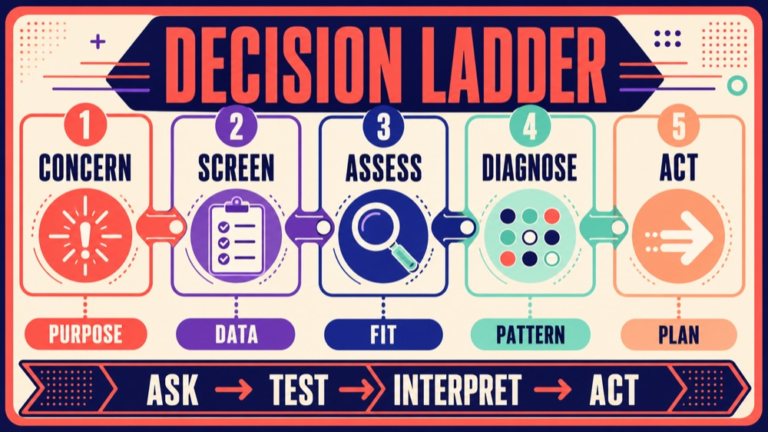
Use the first visual map as a decision ladder: concern, screen, assess, diagnose, and act. Begin with the reason for referral and the person’s functional concern. Use screening to decide whether more information is needed, use assessment to build the profile, and reserve diagnosis for a conclusion supported by converging evidence. Then connect the conclusion to treatment, referral, education, or monitoring.
| Map step | Margin question | Common error |
|---|---|---|
| Concern | What changed and who needs a decision? | Starting with a favorite test. |
| Screen | Does the brief result suggest further assessment? | Calling the screen a complete diagnosis. |
| Assess | What evidence answers the unanswered question? | Ignoring language, access, or context. |
| Diagnose | Which conclusion fits the complete evidence? | Choosing the strongest label from one score. |
| Act | What plan, referral, or outcome follows? | Ending with a label and no functional next step. |
Write the chain concern → screen → evidence → conclusion → action beside each practice item. If an answer jumps from concern to diagnosis, ask what evidence it skipped. If an answer stops at a score, ask whether the stem wants interpretation, referral, or a functional plan.
Use a screening and assessment review board
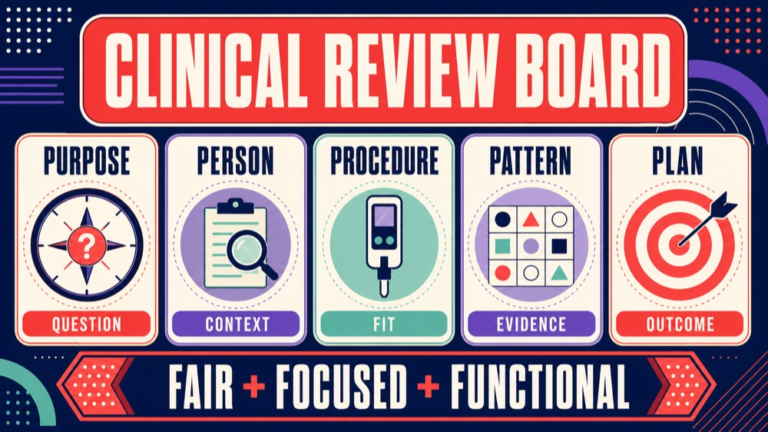
The second visual is a compact board for purpose, person, procedure, pattern, and plan. Place the case facts into those five fields and mark each one as known, observed, or missing. This prevents a test name from taking over the reasoning and makes limitations visible before you choose a diagnosis or recommendation.
| Board field | Write down | Use it to ask |
|---|---|---|
| Purpose | Screening, assessment, diagnosis, referral, or outcome | What decision is requested? |
| Person | Age, language, culture, access, history, and goal | What affects fair interpretation? |
| Procedure | Tool, sample, observation, cue, setting, and material | What does the evidence actually measure? |
| Pattern | Strengths, needs, variability, and functional impact | What converges and what remains uncertain? |
| Plan | Next evidence, referral, support, or outcome | What action matches the stage? |
When the board has a missing person or procedure field, choose the answer that gathers or clarifies it. When the pattern is complete and the stem asks for interpretation, integrate the sources and state a calibrated conclusion. The board is a study tool, not a replacement for current professional standards.
Question 1: screening versus assessment
Practice Question 1. A teacher refers a child after a brief communication screen flags concern. The screen contains no detailed language sample, no hearing information, and no description of the child’s home language. Which next step best matches the information?
A. Assign a language-disorder diagnosis from the screen result and begin treatment.
B. Use the screen as a signal for further assessment, beginning with case history and relevant language, hearing, and communication information.
C. Disregard the screen because a brief procedure cannot contribute to clinical decisions.
D. Select the longest standardized test available without gathering any additional background.
Correct Answer: B. The screen can identify a potential need for further assessment, but it does not provide a complete language profile or account for hearing and language background. A purposeful case history and relevant follow-up information are appropriate before selecting and interpreting more detailed procedures.
Why the Other Options Are Wrong: A moves from a brief concern to a diagnosis without sufficient evidence. C treats screening as useless rather than as an initial decision tool. D skips the information needed to choose a valid procedure and risks measuring background or access factors instead of the intended construct.
Exam Trap: The word “flags” signals a screening result, not a finished evaluation. Mark the missing language and hearing information; those details explain why the next step is a careful assessment process rather than an immediate label.
Question 2: language difference and test selection
Practice Question 2. A multilingual student receives a low score on an English vocabulary measure. The referral note does not state the student’s English exposure, home-language skills, dialect, hearing history, or performance in classroom conversation. What is the most defensible interpretation?
A. The score alone establishes a broad language disorder.
B. The score is irrelevant because multilingual students cannot be assessed.
C. The score is one data point; the clinician should gather language, cultural, hearing, and functional evidence before interpreting the pattern.
D. The student should repeat the same measure until the score enters the expected range.
Correct Answer: C. A single English score cannot answer whether the result reflects language difference, limited exposure, dialect, hearing, access, or a disorder. The clinician should gather a fuller history and functional evidence, use appropriate language support and assessment procedures, and interpret the score within that context.
Why the Other Options Are Wrong: A overinterprets one measure. B falsely treats multilingual assessment as impossible instead of requiring appropriate methods. D confuses repetition with valid assessment and may add practice effects without resolving the interpretation problem.
Exam Trap: The most important clues are the missing background fields, not the low number itself. When a stem highlights language exposure and dialect, look for the answer that protects validity and distinguishes difference from disorder.
Question 3: differential reasoning and referral
Practice Question 3. An adult shows a new change in speech clarity after a medical event. The clinician observes imprecise consonants and reduced loudness, but the referral note does not include hearing status, neurologic follow-up, or a connected speech sample. Which action best fits the available evidence?
A. Choose one motor-speech diagnosis from the two observed features and close the evaluation.
B. Attribute the change to low motivation because the person speaks less during the visit.
C. Gather a fuller history and speech sample, examine relevant factors, and coordinate medical or audiologic referral information as indicated.
D. Begin a general voice program without clarifying the onset, hearing, neurologic, or speech-motor questions.
Correct Answer: C. The observed features are useful clues, but they do not settle the differential. The new onset, missing connected speech sample, hearing status, and medical information should guide further assessment and collaboration. The next step should build the evidence before narrowing the conclusion or treatment plan.
Why the Other Options Are Wrong: A uses two observations as a complete diagnosis. B assigns a motivational explanation without examining communication, medical, or access factors. D selects treatment before the assessment question is clear and may target the wrong domain.
Exam Trap: New onset changes the urgency and referral reasoning. When a stem gives a medical event plus missing neurologic or hearing information, choose the coordinated evidence-gathering option rather than the most specific label.
Review common screening and assessment distractors
Distractors in this domain often sound professional because they name a test, a diagnosis, or a referral. The problem is usually the timing, the evidence, the construct, or the person-context fit. Label the distractor before deciding whether the action could be appropriate later.
| Distractor pattern | Why it sounds attractive | Correction |
|---|---|---|
| Screen equals diagnosis | It turns a brief result into a simple conclusion. | Use screening to decide whether more assessment is needed. |
| Longest test wins | It appears thorough. | Choose the procedure that answers the question and fits the person. |
| Score without context | It provides a clear number. | Check language, norms, access, reliability, and function. |
| Referral without information | It avoids making a decision. | Collect relevant SLP evidence while coordinating the referral. |
| Diagnosis from one feature | It uses a familiar association. | Compare the pattern, timeline, and alternative explanations. |
| Treatment before evaluation | The technique may be useful in another stage. | Match the answer to the action word in the stem. |
Use “right action, wrong stage” as a review label. A test, referral, diagnosis, or treatment can be reasonable in a different case and still be the wrong answer to the specific question asked.
Build a screening and assessment practice block
A focused practice block should move from stage recognition to evidence interpretation. Begin with short classification items, then work through cases that vary the language, setting, onset, or referral question. Finish by explaining why the distractors fail, because that explanation exposes whether you understood the evidence or only recognized a familiar word.
- Draw five columns labeled purpose, person, procedure, pattern, and plan.
- Sort ten prompts into screening, assessment, diagnosis, referral, or outcome evaluation.
- Complete the three original questions on this page before reviewing the rationales.
- Write one case with a missing language or hearing field and identify the next evidence step.
- Write one case in which the same score appears under a different language or access condition.
- Check the current ASHA and ETS pages for source and exam details before final review.
Vary one decision variable at a time. Keep the same score but change the person’s language background; keep the same referral but change the onset; keep the same observation but change the requested stage. Your answer should change only when the evidence or decision changes.
Track clinical reasoning and confidence
Record the reason for an answer, not just the letter. A learner can choose a correct option because it feels cautious, then miss the next item when caution conflicts with the requested stage. A reasoning log shows whether you used purpose, person, procedure, pattern, and plan in the right sequence.
| Log field | Example entry | What it reveals |
|---|---|---|
| Requested stage | Further assessment after screening | Whether you answered the action word. |
| Missing field | Home language and hearing history | What limits interpretation. |
| Strongest evidence | Low English vocabulary score with no exposure history | Whether context shaped the conclusion. |
| Distractor type | Diagnosis from one score | Which pattern to eliminate next time. |
| Referral boundary | New medical onset with missing neurologic information | When collaboration changes the next step. |
| Confidence | 60% before rationale, 88% after explanation | Where review improves transfer. |
Revisit low-confidence items even when correct. Write one sentence explaining the strongest clue and one sentence explaining the evidence or stage that eliminated the distractors. This builds a flexible decision framework instead of a memorized list of test names.
Screening, Assessment, Diagnosis Praxis questions checklist
Use this checklist before submitting an answer. It is a study aid, not a substitute for current professional standards, supervision, consent, or an individualized evaluation.
- Did I identify whether the stem asks about screening, assessment, evaluation, diagnosis, referral, treatment, or outcome?
- Did I define the person, language, culture, access, timeline, setting, and functional goal?
- Did I separate observed data, reported data, test scores, and missing data?
- Did I choose a tool or procedure because of its purpose and fit, not its name?
- Did I consider construct, language, dialect, norms, reliability, access, and ecological relevance?
- Did I integrate scores with samples, observation, self-report, and collateral information?
- Did I distinguish a potential concern from a supported diagnosis?
- Did I recognize when hearing, medical, structural, educational, or access collaboration is needed?
- Did I describe a functional next step and an observable outcome?
- Did I explain why each distractor is wrong for this stage or evidence pattern?
If you can use the checklist consistently, you are practicing the central reasoning sequence: identify the decision, select fair evidence, interpret the pattern, state the boundary, and connect the result to action. That sequence transfers across speech, language, voice, fluency, cognition, AAC, feeding, and swallowing cases.
Sources and next steps
For the exam content frame, review ASHA’s Speech-Language Pathology 5331 content page. For the Practice Portal’s clinical decision-making role, review ASHA’s Practice Portal. For examples of screening and assessment boundaries, review ASHA’s pages on Spoken Language Disorders and Speech Sound Disorders. For current test identity and administration information, use ETS Speech-Language Pathology 5331 and the ETS practice-test page.
This page’s maps, rationales, and A-D practice questions are original educational material. They are separate from the live ETS test and do not reproduce test material. They are not individualized medical advice. Use current clinical standards, supervision, and referral procedures when applying assessment and diagnosis knowledge to real people.
For your next review, complete one timed case using the five-field board: purpose → person → procedure → pattern → plan. Then change one variable, such as language background, onset, setting, or requested stage, and explain why the best answer changes or stays the same.
Continue your preparation: Explore the SLP Study Center learning resources.