feeding and swallowing praxis practice questions are easier to solve when you separate the person’s feeding routine from the physiologic swallowing task. A stem may describe a young child who avoids textures, an infant with a changed suck–swallow–breathe pattern, or an adult whose meal takes longer after illness. The strongest answer identifies the age, task, evidence, requested decision, and functional consequence before selecting a support.
ASHA’s Practice Portal pages describe feeding and swallowing as connected but distinct areas that involve the person, the oral and pharyngeal mechanism, the respiratory and gastrointestinal systems, caregivers, and the environment. Use the current ASHA Pediatric Feeding and Swallowing Practice Portal, ASHA Adult Dysphagia Practice Portal, and ASHA Speech-Language Pathology 5331 content page for the clinical and exam framework. The maps and questions below are original study material.
What feeding and swallowing questions are testing
A feeding and swallowing item may ask you to identify a developmental or medical concern, interpret an oral-motor or airway clue, choose a screening action, select the next assessment step, plan caregiver support, coordinate nutrition, or measure change during a meaningful meal. Feeding includes the broader routine of accepting, preparing, and consuming food or liquid. Swallowing refers to the physiologic movement and protection process within that routine. The stem may test one or both.
| Question task | Evidence to locate | Review output |
|---|---|---|
| Identify a concern | Age, medical history, intake pattern, textures, timing, fatigue, behavior, and airway or nutrition signs | Pattern and missing information |
| Choose screening | Purpose, setting, protocol, caregiver report, and referral threshold | Concern and next step |
| Choose assessment | History, observation, oral mechanism, task conditions, and unanswered questions | Focused evidence plan |
| Plan support | Person’s goal, physiologic need, caregiver capacity, setting, and preferences | Feasible routine support |
| Monitor change | Acceptance, efficiency, safety indicators, assistance, intake, and participation | Functional outcome |
Rewrite the action word before looking at the options. “What should be assessed next?” is not the same as “What support should be implemented?” and neither is the same as “What outcome should be measured?” A choice can be sensible in practice but still answer the wrong stage of the case.
Details that change the decision include age and developmental history, alertness, respiratory status, feeding position, bottle or utensil, texture, pacing, oral acceptance, chewing, cough, vocal change, gastrointestinal report, caregiver strategy, and mealtime participation. Treat those details as a connected pattern rather than as a list of isolated labels.
Anchor review to the ASHA 5331 scope
The current ASHA 5331 content framework includes factors that influence communication, feeding, and swallowing across the lifespan. It also frames the exam through foundations and professional practice; screening, assessment, evaluation, and diagnosis; and planning, implementation, and evaluation of treatment. Feeding and swallowing questions can therefore require both foundational knowledge and applied clinical reasoning.
| 5331 lens | Feeding and swallowing question example | Study tag |
|---|---|---|
| Foundations | Which developmental, structural, neurologic, respiratory, or gastrointestinal factor matters? | System and lifespan |
| Screening | What brief information identifies concern and guides referral? | Initial decision |
| Assessment | Which observation or history detail answers the clinical question? | Evidence and sequence |
| Treatment planning | Which support fits the person, routine, caregiver, and identified need? | Implementation fit |
| Treatment evaluation | How will change be monitored during an actual activity? | Outcome and generalization |
Map the item to one primary lens even when it mentions several systems. An infant case may include respiratory history, bottle flow, alertness, and caregiver concern, while the question asks specifically about the next assessment observation. An adult case may contain nutrition and medical information, while the requested action is a functional treatment outcome. Stage and wording keep the answer focused.
Use ASHA for clinical concepts and ETS for current exam administration details. Search results and third-party study pages can suggest common learner language, but the authoritative framework should control the explanation. The content here is original practice material for U.S. learners and should be reviewed when live source pages change.
Define feeding and swallowing as connected domains
Feeding includes the person’s relationship with food or liquid, appetite, acceptance, sensory responses, self-feeding, utensils, pacing, social routine, and the caregiver or partner interaction. Swallowing includes the coordinated oral, pharyngeal, and esophageal processes that move material and protect the airway. A feeding concern can exist without a primary physiologic swallowing impairment, and a swallowing impairment can affect feeding participation, nutrition, hydration, and enjoyment.
| Domain | What to ask | Study caution |
|---|---|---|
| Acceptance | Does the person approach, tolerate, taste, or reject the material? | Behavior is evidence about the routine, not a complete cause. |
| Oral skill | Can the person manage the utensil, bottle, bolus, chewing, and oral transit task? | Consider sensory, motor, structural, and task factors together. |
| Swallow safety | Are there timing, airway-protection, respiratory, or secretion clues? | Interpret signs in context and through the appropriate pathway. |
| Efficiency | How much time, energy, assistance, and repeated effort does the routine require? | Efficiency is distinct from safety and participation. |
| Participation | What meals, social events, or daily activities does the person want to join? | Include the person’s goal in the plan and outcome. |
When a question uses the word feeding, check whether it is asking about a behavior, a developmental skill, sensory acceptance, caregiver interaction, oral intake, or swallowing physiology. The answer should reflect the information supplied. A blanket label such as picky eating or aspiration can hide the actual decision stage.
Organize the lifespan continuum
Feeding and swallowing questions are often age-sensitive. Infants may require attention to state regulation, nipple flow, suck–swallow–breathe coordination, and growth. Children may have sensory responses, texture progression, oral skill, learned avoidance, caregiver interaction, or school participation concerns. Adults may have acquired dysphagia, medication and meal demands, fatigue, respiratory history, or changes after neurologic or medical events.
| Lifespan lens | Clues a stem may include | Reasoning move |
|---|---|---|
| Infant feeding | State, respiratory coordination, nipple flow, pauses, endurance, and caregiver report | Observe the feeding sequence and coordinate medical or nutrition needs. |
| Child feeding | Texture acceptance, chewing, mealtime stress, growth, routine, and family strategies | Separate skill, sensory, behavior, medical, and relationship factors. |
| Adolescent participation | School meals, independence, peer context, preferences, and self-advocacy | Include autonomy and the setting in functional planning. |
| Adult swallowing | New onset, neurologic or medical history, respiratory change, medication, and meal efficiency | Interpret the pattern and use the appropriate assessment or referral pathway. |
| Older adult routine | Fatigue, dentition, sensory change, support needs, hydration, and social isolation | Connect safety and efficiency to quality of life and team care. |
Age does not provide the answer by itself. It changes the questions you ask and the systems you consider. A child with a feeding aversion and a child with airway signs require different reasoning, even if both refuse a spoon. An adult with long meal duration may need a different evidence plan from an infant whose feeding becomes disorganized during respiratory stress.
Map oral, sensory, and motor readiness
Many feeding stems combine sensory acceptance with oral skill. Look at how the person responds to smell, touch, temperature, taste, texture, utensil, cup, or nipple, then examine what happens after acceptance. Oral readiness may involve posture, lip closure, tongue movement, bolus control, chewing, and the ability to move material through the mouth. The task and the material can reveal different demands.
| Field | Observation question | Reasoning use |
|---|---|---|
| Regulation | Is the person alert, organized, distressed, sleepy, or overloaded? | Decide whether the task condition is suitable for observation. |
| Sensory response | What happens with smell, touch, temperature, taste, or texture? | Separate acceptance from physiologic swallow performance. |
| Posture | Can the person maintain a position that supports the task? | Coordinate seating, mobility, and caregiver support. |
| Oral movement | How are lip closure, tongue movement, chewing, containment, and transit? | Describe the observed skill and material-specific effect. |
| Response to support | What changes after pacing, a pause, a familiar utensil, or a clear cue? | Use supported trials to understand fit within scope. |
Do not treat a refusal as proof of one cause. A person may reject a texture because of sensory response, pain, prior experience, communication difficulty, fatigue, reduced appetite, or a medical issue. The question may be testing whether you gather the right history and observe the routine before recommending a technique.
Read suck–swallow–breathe and airway clues
For infant feeding questions, study the relationship among sucking, swallowing, breathing, state, and recovery. Clues may include stress signals, pauses, changes in color or breathing, coughing, congestion, fatigue, or difficulty coordinating the sequence. For older children and adults, the wording may shift toward cough, wet vocal quality, multiple swallows, respiratory change, or material remaining in the mouth or throat. In every case, timing and context matter.
| Clue | Context questions | Safer interpretation |
|---|---|---|
| Frequent pauses | Are pauses self-initiated, prompted, linked to flow, or accompanied by stress? | Review endurance and coordination within the feeding task. |
| Cough or throat clear | When did it occur, with which material, and is it repeated? | Document the event and interpret it with the broader pattern. |
| Changed breathing | What was the baseline, and what other respiratory signs are present? | Coordinate through the appropriate medical and clinical pathway. |
| Wet vocalization | Was the voice changed before intake, after a swallow, or across the session? | Consider airway-protection concern while gathering more evidence. |
| Fatigue | Does performance change over time, after several bites, or with increased effort? | Compare the beginning and end of the defined task. |
A question may include a sign that deserves immediate communication in a real setting, but the exam task still determines what the answer should state. Choose the option that recognizes the concern, preserves safety, and follows the setting’s protocol or referral chain rather than turning a single clue into a universal conclusion.
Distinguish screening, assessment, and evaluation
Screening is a brief process that identifies whether a concern may be present and whether additional evaluation or referral is indicated. Assessment is a more detailed process that describes the person, task, material, environment, performance, and contributing factors. Evaluation may include clinical and, when indicated, instrumental or interdisciplinary information to answer a focused question. The exact procedure depends on age, setting, scope, medical status, and available protocols.
| Process | Primary purpose | What it does not replace |
|---|---|---|
| Feeding screen | Identify a concern in the routine and guide the next step. | A comprehensive history or assessment. |
| Swallowing screen | Identify clinical signs that may warrant further action. | Detailed physiologic information. |
| Clinical assessment | Describe performance and contributing factors under defined conditions. | Every unanswered question about internal physiology. |
| Instrumental evaluation | Examine selected physiology and response through the indicated pathway. | Goals, preferences, caregiver capacity, and daily context. |
| Team review | Combine medical, nutrition, respiratory, developmental, and SLP information. | Direct observation of the relevant feeding task. |
If the stem asks what should happen after a concerning screen, choose an answer that uses the result to guide assessment or referral. If it asks what the screen can do, avoid a choice that promises a complete diagnosis. If it asks for treatment evaluation, name the routine and the observable change rather than repeating the screening purpose.
Choose history and observation evidence
History gives the feeding or swallowing observation a meaningful baseline. Ask when the change began, what material is involved, which routines are affected, what the person or caregiver notices, and how medical, developmental, sensory, motor, respiratory, gastrointestinal, or emotional factors may contribute. Then observe the task under conditions that match the question and document what is known, observed, and still missing.
- Record the person’s age, developmental or medical history, current supports, and reason for concern.
- Describe the material, utensil, bottle, flow, texture, amount, pace, position, and assistance.
- Observe acceptance, oral preparation, transit, swallow timing, breathing, vocal or respiratory change, and recovery.
- Compare performance across the start and end of the task when endurance or fatigue is relevant.
- Ask what changes with a reasonable cue, pause, positioning adjustment, or environmental support within protocol.
- Identify the unanswered question and the professional or evaluation pathway that can address it.
In a practice item, the best evidence source is the one that resolves the uncertainty. A caregiver interview may be essential when the concern occurs at home. A direct feeding observation may be needed when acceptance and skill are unclear. A medical or instrumental referral may be needed when the question exceeds what the current observation can answer. Sequence matters more than the apparent sophistication of a tool.
Match support to the person’s goal
Support should fit the identified need, the person’s goal, and the routine in which the change matters. Depending on the case, planning may involve pacing, positioning, utensil or bottle adjustments, texture or flow discussion, caregiver education, communication support, sensory preparation, oral skill practice, environmental changes, or coordination with nutrition and medical professionals. The option should include a reason and a way to monitor the response.
| Goal | Planning focus | Possible outcome |
|---|---|---|
| Safe intake | Use the agreed support under a defined task and team protocol. | Observed safety indicators, assistance, and response. |
| Feeding skill | Practice a specific oral or self-feeding step at an appropriate level. | Accuracy, independence, tolerance, or cueing. |
| Efficiency | Reduce unnecessary effort or duration while respecting the person’s state. | Time, pauses, amount completed, and fatigue. |
| Acceptance | Build a predictable, respectful routine around selected materials. | Approach, tolerance, variety, and stress signals. |
| Participation | Support a preferred family, school, community, or medication routine. | Attendance, completion, comfort, and self-report. |
A treatment choice should not be selected merely because it is familiar. Ask whether the case provides the skill target, the person’s ability to participate, the setting, and the outcome. A multistep maneuver may not fit a person who cannot follow its directions, while a caregiver routine may be central when the concern occurs during assisted feeding.
Consider nutrition, hydration, growth, and energy
Feeding and swallowing performance has consequences for nutrition, hydration, growth, medication, energy, and quality of life. For infants and children, growth trajectory, intake adequacy, and caregiver burden may shape the assessment question. For adults, weight change, dehydration, meal duration, appetite, dentition, medication, and respiratory health may be relevant. These fields should be considered alongside, not instead of, direct task evidence.
| Context field | Questions to add | Collaboration cue |
|---|---|---|
| Growth or weight | What has changed, over what period, and how reliable is the measurement? | Coordinate with medical and nutrition professionals. |
| Hydration | What fluids are offered, accepted, accessible, and completed? | Include routine and preference in the plan. |
| Energy | Does the person tire, pause, or lose skill during the task? | Review timing, rest, and task demand. |
| Medication | Is a pill, liquid, or administration routine difficult? | Verify options with pharmacy or medical staff. |
| Caregiver load | What time, equipment, cueing, and training does the routine require? | Choose a plan the support network can use. |
One of the most useful exam filters is to ask whether the answer protects both the clinical goal and the person’s adequate intake or participation. A broad restriction may create new problems if it is not supported by evidence, coordinated with the team, and paired with an alternative plan. The safest answer is also practical and measurable.
Use caregiver and interprofessional collaboration
Feeding often happens with caregivers, teachers, nurses, family members, or aides. Swallowing care may involve physicians, dietitians, occupational therapists, physical therapists, respiratory professionals, pharmacists, nurses, and dental professionals. A question may be testing whether you recognize that the plan must be shared, taught, observed, and adjusted across the people who support the routine.
| Case clue | Collaboration question | Reasoning move |
|---|---|---|
| Caregiver uses rapid prompts | How do pacing, wait time, and response affect the person’s performance? | Observe and coach the interaction rather than blaming either partner. |
| Growth or intake concern | What data should be shared with nutrition and medical staff? | Connect intake, efficiency, and health information. |
| Positioning or equipment need | Who can address seating, mobility, access, or adaptive tools? | Match the problem to the relevant discipline. |
| Respiratory or acute change | Who needs to be notified before continued intake decisions? | Use the setting’s urgent pathway. |
| Family routine conflict | How can the person and family weigh goals, burden, and preferences? | Use respectful shared planning within policy. |
The strongest answer often includes communication, training, and a feedback loop. A recommendation that only tells the caregiver what to do, without explaining the reason or checking whether the routine works, is incomplete. Conversely, a plan that ignores the caregiver’s capacity may be difficult to implement even if the technique is theoretically relevant.
Analyze setting, routine, and environment
The same person may feed differently at home, in a clinic, at school, in a hospital, or in a community dining setting. Noise, time pressure, lighting, seating, utensils, peer presence, caregiver pace, access to water, and the availability of preferred foods can change the task. Praxis questions use these details to test whether you can transfer a clinical observation to the real activity.
| Setting variable | What to ask | Functional implication |
|---|---|---|
| Position | Can the person maintain the posture needed for the task? | Coordinate seating and physical support. |
| Time | Is the routine rushed, prolonged, or scheduled around fatigue? | Measure the task under a realistic window. |
| Noise and distraction | Does attention or regulation change in the environment? | Adjust competing demands and observe the response. |
| Equipment | Are the bottle, cup, utensil, chair, or communication supports available? | Plan for generalization, not only the clinic. |
| Social routine | Who is present and what does participation mean to the person? | Include dignity, autonomy, and preferred roles. |
Environment is part of the evidence, not a side note. If a child eats better with a predictable routine, or an adult tires in a long communal meal, the plan should name the condition and the outcome. Avoid options that assume performance observed in one setting will transfer without checking the actual activity.
Provide culturally and linguistically responsive care
Food and feeding routines carry family history, culture, religion, language, identity, and comfort. A clinician should ask about familiar foods, preparation methods, meal timing, family roles, communication preferences, and the words the person uses to describe a concern. For children, caregiver priorities and family routines are central. For adults, preferred meals and social participation may shape the goal.
- Use qualified language support when the person or caregiver needs communication access.
- Clarify food names, textures, preparation methods, and culturally meaningful routines.
- Check whether literacy, hearing, vision, cognition, or language changes access to education.
- Ask who participates in decisions and how the person expresses agreement or concern.
- Separate a clinical safety question from a difference in preference or routine.
Culturally responsive care improves the quality of the history and the feasibility of the plan. It also prevents a practice question from being reduced to a “compliance” problem when the real issue is that the recommendation does not fit the person’s language, food, family, or schedule. The answer should respect the person while gathering the evidence required for the clinical decision.
Map a feeding question from routine to outcome
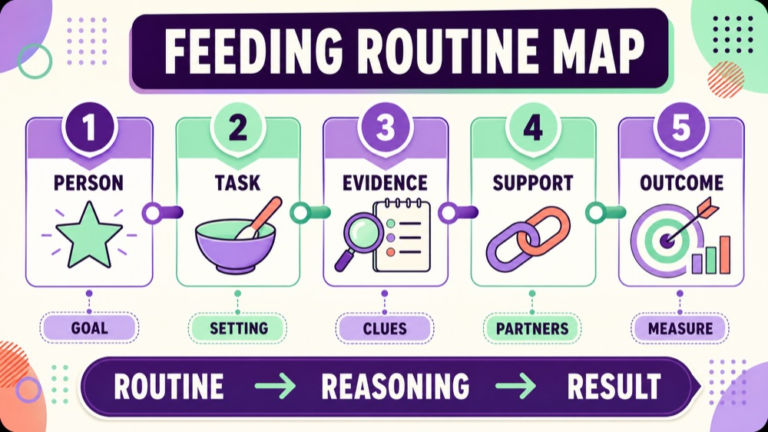
Use the first visual map as a five-step routine: person, task, evidence, support, and outcome. Begin by identifying what the person is trying to do, such as bottle feeding, accepting a new texture, completing a meal, taking medication, or joining a family routine. Then name the evidence that explains the barrier, select a support that fits the stage, and define how the change will be observed.
| Map step | Question to write in the margin | Common error |
|---|---|---|
| Person | What age, goal, history, preference, and support need matter? | Starting with a technique before understanding the person. |
| Task | What material, utensil, position, pace, and setting are involved? | Calling a routine a skill without defining its conditions. |
| Evidence | What is observed, reported, and still unknown? | Using one behavior as a complete explanation. |
| Support | What action fits the need, capacity, and clinical stage? | Choosing a restriction or exercise without a rationale. |
| Outcome | What functional change should be visible in the routine? | Measuring only a clinic score or a vague improvement. |
Write a chain for each item: person → task → evidence → support → outcome. If an option skips a link, ask whether the stem supplies enough information to justify that jump. This chain makes it easier to compare choices that sound helpful but belong to different ages, settings, or stages of care.
Use a feeding and swallowing review board
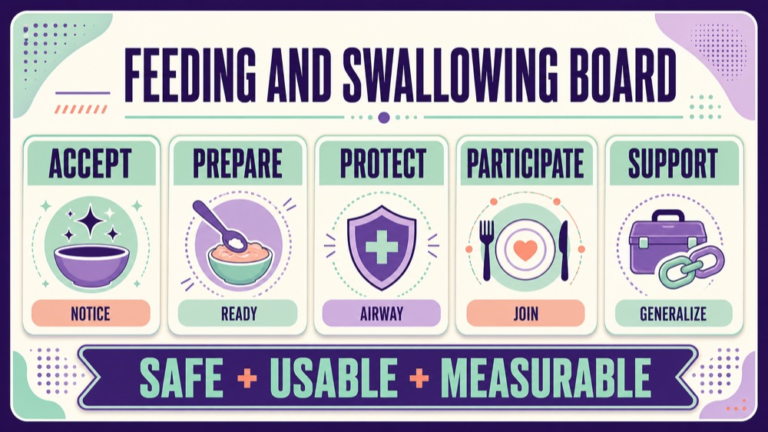
The second visual is a review board with five fields: accept, prepare, protect, participate, and support. Place one case clue in each field and label it as observed, reported, or missing. The board is useful because feeding questions can tempt learners to focus on swallowing physiology while overlooking acceptance, caregiver interaction, or the person’s daily goal.
| Board field | Write down | Use it to ask |
|---|---|---|
| Accept | Approach, sensory response, appetite, distress, or refusal pattern | What happens before the material is taken? |
| Prepare | Posture, utensil, bolus formation, chewing, and oral transit | What oral skill or condition is relevant? |
| Protect | Timing, cough, voice, breathing, secretions, and recovery | What safety concern needs context or referral? |
| Participate | Meal, school, family, medication, independence, or social activity | What routine matters to the person? |
| Support | Caregiver, equipment, environment, nutrition, medical, and communication needs | Who and what will help the plan generalize? |
If the board has a blank field, the answer may need more history, observation, or collaboration. If the fields show a repeated pattern and the question asks for a plan, move to a targeted support and a measurable outcome. The board organizes study reasoning; it does not replace current clinical policy or a complete evaluation.
Question 1: suck–swallow–breathe sequence
Practice Question 1. During a bottle observation, an alert infant begins with coordinated sucking and swallowing but becomes fatigued after several bursts. The caregiver reports longer feeds at home. The infant pauses, recovers, and resumes, with no new respiratory change documented during the observation. What is the best next reasoning step?
A. Change the nipple flow immediately without observing the full feeding pattern or discussing the protocol.
B. Document the change across the feeding, examine state, pacing, flow, endurance, and respiratory context, and coordinate the next assessment step with the appropriate team.
C. Conclude that the infant has a single fixed swallowing disorder based on fatigue alone.
D. Ignore the caregiver report because only the first few bursts observed in the clinic are relevant.
Correct Answer: B. The case describes a change over time and a meaningful home report, but it does not identify one cause. The best reasoning is to examine the full sequence, task conditions, pacing, flow, state, endurance, and respiratory context, then coordinate the appropriate next step. The observation should inform assessment rather than trigger an unsupported change or label.
Why the Other Options Are Wrong: A selects a specific modification before the evidence is complete. C overstates what fatigue alone can establish. D discards collateral information that may reveal the routine’s actual pattern. B integrates direct observation, caregiver report, and the need for coordinated follow-up.
Exam Trap: The first part of a feeding observation may look successful, but performance can change with endurance. Mark every phrase that describes timing or recovery. A question about the next step usually rewards a complete pattern review rather than a quick device or flow decision.
Question 2: mealtime pattern and context
Practice Question 2. A preschool child accepts familiar soft foods but cries when a new mixed texture is presented. The caregiver reports that meals have become stressful, while growth information is not available in the referral note. During a short visit, the child does not take enough material to judge chewing or swallowing. Which action best fits the information?
A. Label the child’s response as a behavioral problem and remove all preferred foods from the routine.
B. Gather developmental, medical, sensory, nutrition, and mealtime history, then plan an observation that can distinguish acceptance from oral skill and swallowing performance.
C. Conclude that the child has a pharyngeal swallowing impairment because the new texture was rejected.
D. Tell the caregiver to insist on the texture until the child finishes a full serving.
Correct Answer: B. The note describes a texture-specific acceptance problem and caregiver stress, but the brief visit did not supply enough evidence about chewing or swallowing. A fuller history and an appropriate observation can separate sensory or learned response, oral skill, medical factors, nutrition, and airway concerns. The plan should protect the relationship and gather the missing information.
Why the Other Options Are Wrong: A uses blame and removes useful baseline information. C equates refusal with a pharyngeal impairment without a swallow observation. D applies pressure without clarifying the cause, the child’s state, or the family’s goal. B is the only choice that respects the evidence gap and the broader feeding context.
Exam Trap: A new texture can test acceptance, oral preparation, swallowing, or all three. Ask what the child actually did with the material. If the material was not accepted, the answer cannot claim that a later physiologic stage was observed.
Question 3: person-centered feeding planning
Practice Question 3. An adult wants to share a weekend family meal after a recent medical event. The person eats slowly, needs occasional help opening containers, and reports that fatigue increases near the end of the meal. The family focuses on finishing quickly, while the person prioritizes staying at the table and choosing familiar foods. Which plan best matches the case?
A. Replace the family meal with a fixed routine chosen by the clinician and omit the person’s preference.
B. Track only the time to finish and treat any assistance as failure of independence.
C. Coordinate a defined meal plan that addresses energy, containers, pacing, partner expectations, preferred foods, and a measurable safety, efficiency, or participation outcome.
D. Ask the family to finish the meal for the person so that the time target is met.
Correct Answer: C. The case includes a valued social routine, fatigue, an access barrier, differing partner expectations, and a preference for familiar foods. A person-centered plan can address those conditions, clarify assistance, and measure what matters in the actual meal. The outcome may combine efficiency with participation and reported comfort rather than using time alone.
Why the Other Options Are Wrong: A removes the person’s goal. B treats assistance as a failure and ignores participation. D prioritizes a time target over the person’s role and choice. C integrates task demands, support, preference, partner behavior, and an observable outcome.
Exam Trap: Person-centered planning is not an invitation to ignore safety or evidence. It means balancing the person’s goal with the observed need, feasible support, team boundaries, and a measure that can be checked in the routine.
Review common feeding and swallowing distractors
Distractors in this topic often confuse feeding behavior with swallowing physiology, ignore age or development, skip the assessment stage, or choose a technique without enough evidence. Mark the distractor type first, then decide whether the underlying action could belong later in the plan.
| Distractor pattern | Why it sounds attractive | Correction |
|---|---|---|
| Refusal equals swallowing impairment | It connects a visible behavior to a familiar clinical topic. | Ask whether the material was accepted and what was actually observed. |
| One age-based answer | It uses a common developmental association. | Use the person’s actual age, history, task, and evidence. |
| Technique before question | The strategy may be useful in another case. | Identify whether the item asks for screening, assessment, planning, or evaluation. |
| Broad restriction without plan | It appears cautious. | Look for evidence, alternatives, team input, and the person’s goal. |
| Caregiver blame | It offers a simple explanation for a difficult routine. | Examine partner behavior, capacity, education, environment, and shared goals. |
| Score without function | It produces an easy number. | Measure change in the activity that matters to the person. |
Use the phrase “right action, wrong stage” when reviewing. A flow adjustment, sensory strategy, referral, caregiver training, or outcome measure may each be useful, but the item’s requested stage determines which one belongs in the answer.
Build a feeding and swallowing practice block
Build a study block that moves from age and system review into case reasoning. Start with a lifespan map, then practice cases that change one variable at a time. Finish by explaining why the distractors fail, because explanation helps you transfer the reasoning when a stem uses different food, setting, or caregiver details.
- Spend five minutes drawing accept, prepare, protect, participate, and support columns.
- Review infant, child, adolescent, adult, and older adult clues without assigning an answer from age alone.
- Complete the three original questions on this page before reading the rationales.
- Write one new case that changes only the material, setting, state, or requested decision.
- Answer the case with person, task, evidence, support, and outcome.
- Check current ASHA and ETS pages for clinical or exam details that may have changed.
Try a contrast set: keep the same cough or refusal clue but change whether the material was accepted, whether the concern is new, whether the person is fatigued, and whether the question asks for screening or treatment evaluation. If your answer changes for the right reason, the map is working.
Track feeding reasoning and confidence
Record why an answer was selected, not only whether it was correct. A learner can choose the correct option because it sounds compassionate or cautious, then miss the next item when the clinical stage changes. A short log helps you see whether you used age, task, evidence, function, collaboration, and sequence in the right order.
| Log field | Example entry | What it reveals |
|---|---|---|
| Lifespan and setting | Preschool home meal | Whether the context changed the evidence plan. |
| Requested stage | Assessment before treatment | Whether you answered the action word. |
| Strongest clue | Texture rejected before chewing could be observed | Whether you separated acceptance from swallowing. |
| Missing evidence | Growth, medical history, and routine observation | What should guide the next step. |
| Distractor type | Pressure or blame without assessment | Which pattern to eliminate next time. |
| Confidence | 55% before rationale, 85% after explanation | Where review improves transfer. |
Revisit low-confidence items even when they were correct. Write a two-sentence explanation: one sentence for the strongest clue and one sentence for the stage or boundary that eliminated the distractors. This practice turns a feeding and swallowing list into adaptable clinical reasoning.
Feeding and Swallowing Praxis practice questions checklist
Use this checklist before submitting an answer. It is a study aid, not a substitute for current clinical supervision, setting policy, or an individualized evaluation.
- Did I identify the person’s age, developmental or medical context, and setting?
- Did I separate feeding acceptance, oral skill, swallowing safety, efficiency, and participation?
- Did I identify the exact material, utensil, bottle, texture, pace, position, and assistance?
- Did I distinguish observed, reported, and missing information?
- Did I consider state, fatigue, respiratory context, nutrition, hydration, and growth when relevant?
- Did I choose the evidence that answers the requested question?
- Did I preserve the difference between screening, assessment, evaluation, planning, and monitoring?
- Did I include caregiver, team, language, cultural, and environmental context?
- Did I connect the support to the person’s goal and define an observable outcome?
- Did I explain why each distractor is wrong for this stage, age, or evidence pattern?
If you can use the checklist consistently, you are practicing the reasoning behind many feeding and swallowing vignettes: identify the routine, interpret the evidence, respect the lifespan context, and select the next action with a measurable functional target.
Sources and next steps
For pediatric feeding and swallowing concepts, review ASHA’s Pediatric Feeding and Swallowing Practice Portal. For adult swallowing concepts, review ASHA’s Adult Dysphagia Practice Portal. For the broad exam frame, use ASHA’s Speech-Language Pathology 5331 content page. For current test identity and administration information, use ETS Speech-Language Pathology 5331 and the ETS practice-test page.
This page’s maps, rationales, and A-D practice questions are original educational material. They are separate from the live ETS test and do not reproduce test material. They are not individualized medical advice. Use current clinical policies, supervision, and interdisciplinary procedures when applying feeding and swallowing knowledge to real people.
For your next review, complete one timed case using the five-link chain: person → task → evidence → support → outcome. Then change one variable, such as texture, fatigue, caregiver pace, or setting, and explain why the best answer changes or stays the same.
Continue your preparation: Explore the SLP Study Center learning resources.