aac praxis practice questions are easier to solve when you identify the communication goal, the system component, the access barrier, and the action the stem requests. A case may include limited speech, motor access needs, literacy concerns, partner breakdowns, a speech-generating device, picture supports, signs, or a multimodal plan. The strongest answer connects the person’s message to the right system and context.
ASHA’s Augmentative and Alternative Communication Practice Portal describes AAC as clinical practice that supplements or compensates for impairments in speech-language production or comprehension, including spoken and written modes. AAC can be aided or unaided, augmentative or alternative, and used with other communication modes. Use current ASHA and ETS pages for changing information, then use the original communication-access map below to review concepts without treating a device or symbol set as the whole answer.
What AAC questions are testing
An AAC item may ask you to define a communication system, identify a barrier, choose assessment data, select access or symbol supports, plan partner training, prioritize a functional goal, or monitor communication outcomes. The presence of a device does not determine the answer by itself. The final request sets the decision stage.
| Question task | What to locate | Review output |
|---|---|---|
| Identify a need | Speech, language, writing, motor, sensory, literacy, or participation barrier | Access profile |
| Choose assessment | Person, system, partner, environment, and communication opportunity | Next data step |
| Select a system | Message needs, symbols, access method, output, vocabulary, and portability | Feature match |
| Plan support | Partner behavior, modeling, prompting, training, and environment | Implementation plan |
| Monitor change | Message access, independence, repair, and participation under a defined condition | Outcome measure |
Rewrite the action word before reading the choices. If the stem asks what should be assessed next, purchasing a device may be premature. If it asks for a functional outcome, the number of symbols selected may be too narrow.
Use details that change the decision: communication intent, current modes, motor access, vision, hearing, literacy, language background, partner skill, setting, message urgency, portability, and response to support. A familiar AAC term should organize evidence, not replace it.
Anchor review to the ASHA 5331 scope
ASHA’s current Speech-Language Pathology 5331 content page includes augmentative and alternative communication within assessment procedures and treatment. The broad exam structure also includes foundations and professional practice, screening, assessment, evaluation and diagnosis, treatment planning, implementation, and treatment evaluation.
| 5331 lens | AAC question example | Study tag |
|---|---|---|
| Foundations | What does AAC supplement or replace, and what components are involved? | Concept and system |
| Assessment | What data show the person’s communication and access needs? | Data source and sequence |
| Differential reasoning | Is the barrier speech, language, motor, sensory, literacy, partner, or environment? | Comparison boundary |
| Treatment planning | What message, partner strategy, and support fit the person? | Function and implementation |
| Treatment evaluation | How will communication access and participation be monitored? | Measure and generalization |
Map the item to one primary lens. A case can contain limited speech, a tablet, a school concern, and a parent who needs training, but the question may ask you to assess motor access or select a partner strategy. The stage and requested domain keep the answer focused.
Use ASHA for clinical concepts and ETS for current exam logistics. Third-party practice pages can show the language learners search, but their labels and wording are not a substitute for responsible source material.
Define AAC as a communication-access practice
For study purposes, AAC is an integrated approach that supplements or compensates for speech-language production or comprehension needs. It includes techniques, tools, and strategies that help a person express thoughts, wants, needs, feelings, and ideas. AAC is not limited to a high-tech device or to one diagnosis.
| Reasoning field | What to ask | Study caution |
|---|---|---|
| Communication purpose | What does the person need to express or understand? | Start with messages, not hardware. |
| Current modes | What speech, writing, gesture, sign, symbols, or device use exists? | Preserve useful modes. |
| System fit | What symbols, access, output, and vocabulary match the person? | Consider change over time. |
| Communication partners | Who needs to understand and support the message? | Train the network. |
| Participation | Which activities and roles require communication access? | Define the setting. |
ASHA describes AAC across the lifespan and notes that intervention can use multiple modalities depending on the environment, listener, and intent of the message. A person may use AAC to supplement speech, replace speech that is not functional in a situation, support writing, or make a repair strategy available.
Underline the communication goal and circle the barrier in a practice item. Then write one sentence that connects the system feature or partner action to that goal.
Separate aided, unaided, augmentative, and alternative approaches
These terms describe different dimensions of an AAC approach. Aided symbols require an external object or device, such as a picture board, letter board, or speech-generating device. Unaided approaches use the person’s body, such as gesture, manual sign, or fingerspelling. Augmentative use supplements existing speech, while alternative use provides a different way to communicate when speech or writing is not functional for the message.
| Dimension | Examples | Question filter |
|---|---|---|
| Aided | Pictures, letters, objects, boards, apps, or speech-generating devices | What external support is available? |
| Unaided | Gesture, manual signs, facial expression, or fingerspelling | What can the person produce with the body? |
| Augmentative | AAC used with speech or writing | What does the system supplement? |
| Alternative | AAC used in place of a mode that is not functional for the message | What communication channel provides access? |
| Multimodal | More than one mode selected by intent, listener, or setting | What combination fits the context? |
Do not turn one dimension into a hierarchy. A low-tech board may be useful in one setting, a device in another, and gesture or speech in a third. The answer should match the person, message, partner, environment, and access method in the stem.
When a choice says the person must use only one mode, check whether the case supports that restriction. In many functional scenarios, the strongest plan preserves flexible multimodal communication.
Organize the AAC system components
Think of an AAC system as more than a display. Review the symbol set, vocabulary, access method, output, language organization, portability, durability, charging or maintenance, partner behavior, and opportunities to communicate. Each component can support or limit the message.
| Component | What to review | Question filter |
|---|---|---|
| Symbols | Pictures, words, letters, objects, signs, or combined representations | What symbol meaning can the person access? |
| Vocabulary | Core, fringe, personal, academic, medical, and social words | Can the system express more than requests? |
| Access | Direct touch, switch, eye gaze, pointing, scanning, or partner-assisted selection | What motor or sensory route fits? |
| Output | Speech generation, text, partner interpretation, display, or sign | How will the listener receive the message? |
| Environment | Positioning, lighting, noise, time, charging, and portability | What conditions support use? |
| Partners | Modeling, wait time, confirmation, repair, and response | What partner behavior is needed? |
A system can be technically available and still be functionally inaccessible if vocabulary, access, output, or partner support does not match the activity. Practice questions often reward the choice that addresses the limiting component rather than adding a more complex device.
Create a system note with one line for each component. Mark what is known, what is missing, and which activity will supply the missing information.
Analyze access and opportunity barriers
AAC assessment looks at both the person and the opportunity to communicate. A missed message may reflect motor access, visual access, vocabulary, device position, partner pace, environmental noise, limited wait time, or a lack of meaningful opportunities. Separate the barrier from the person’s communication intent.
| Barrier type | Example clue | Reasoning move |
|---|---|---|
| Motor access | Touch accuracy, fatigue, range, posture, or switch timing | Modify access and test the change. |
| Sensory access | Vision, hearing, lighting, contrast, or feedback | Make input and output accessible. |
| Language and literacy | Vocabulary, symbol meaning, spelling, or message formulation | Match language support to the goal. |
| Partner behavior | Rapid questioning, taking over, or limited modeling | Train wait time and response. |
| Environment | Noise, positioning, time pressure, or unavailable equipment | Change the opportunity condition. |
Use dynamic trials when the question asks how to understand system fit. Try a reasonable adjustment, record the person’s response, and compare the message outcome. A static observation may hide a barrier that a simple environmental or access change reveals.
When a choice blames motivation without examining opportunity, compare it with the answer that checks access, partner support, and meaningful communication. The latter usually addresses the actual decision stage more directly.
Identify functional messages and partners
Functional AAC planning starts with what the person wants and needs to communicate. Include more than requesting. Messages may involve rejecting, commenting, asking questions, greeting, telling a story, giving information, repairing a misunderstanding, expressing emotion, or participating in a decision.
| Message type | Possible activity | Partner or setting |
|---|---|---|
| Request or reject | Choose an item or stop an activity | Home or classroom partner |
| Comment or connect | Share an opinion or social response | Friend, family, or peer |
| Inform | Describe symptoms, schedule, or a work task | Medical or workplace partner |
| Repair | Clarify a misunderstood message | Any unfamiliar listener |
| Participate | Make a choice or contribute to a group plan | Family, school, work, or community |
Ask who needs to understand the message, what response time is possible, and what supports the person prefers. A plan that increases options for communication partners can matter as much as a vocabulary change.
For each goal, write the message, mode, partner, setting, support, and outcome. Add the expected communication partner response and the amount of help the person prefers. This expanded note makes an answer choice easier to evaluate because it ties a system feature to a real exchange rather than to device activity alone.
Choose assessment evidence across contexts
AAC assessment questions reward a match between the uncertainty and the evidence source. Review the person’s current communication, language and literacy, motor and sensory access, system use, partner network, and environmental opportunities. Use structured tasks and naturalistic observation when the question requires both capacity and participation evidence.
| Uncertainty | Evidence to consider | Why it fits |
|---|---|---|
| Communication need | Interview, observation, message inventory, and partner report | Shows intent and activity priorities |
| Symbol and language access | Symbol comprehension, vocabulary, literacy, and message formulation | Matches language demands |
| Motor or sensory access | Positioning, touch, switch, scanning, eye gaze, vision, and hearing trials | Matches the access route |
| System fit | Dynamic trial with vocabulary, output, portability, and partner support | Shows use under changeable conditions |
| Participation | Naturalistic activity, communication partner observation, and self-report | Shows functional use |
Exposure to symbols or systems before formal assessment can help reveal what the person understands and can use. Record the exposure, task, support, response, and communication outcome instead of presenting a trial as a fixed capability label.
Assessment sequencing matters. Establish the person’s goals and access conditions, examine current modes, trial relevant components, involve partners and other professionals, and connect findings to a functional plan and outcome. A convenient device demonstration is not enough if it does not answer the stem.
Consider language, literacy, and symbol access
AAC systems need to reflect the person’s languages, dialects, literacy, culture, communication roles, and preferred ways of expressing identity. A symbol or vocabulary set that works for one language or family may not carry the same meaning for another. Practice questions may test culturally and linguistically responsive system planning.
| Context field | What to check | Study caution |
|---|---|---|
| Languages | Home, school, work, community, and preferred languages | Do not restrict a person to one language. |
| Literacy | Alphabet knowledge, spelling, reading, and written message demands | Offer appropriate text and symbol paths. |
| Symbols | Meaning, cultural relevance, contrast, and personal vocabulary | Check interpretation with the user. |
| Culture and identity | Names, roles, routines, values, and social conventions | Include the person’s community. |
| Language access | Interpreter, bilingual professional, or partner support | Make assessment understandable. |
Consider a qualified interpreter or bilingual professional when needed and include the person’s communication partners in vocabulary and system planning. A system that respects language and identity is more defensible than a convenient one-language shortcut.
On a practice item, mark whether the barrier is language, literacy, symbol access, motor access, partner behavior, or environment. That distinction helps you choose the next action.
Plan partner support and aided language
Communication partners shape whether an AAC system is available in practice. Partner support may include modeling symbols while speaking, offering wait time, confirming the message, acknowledging all modes, creating opportunities, responding to social communication, and reducing pressure to answer quickly. Training should fit the people and settings involved.
| Partner strategy | What it looks like | Review question |
|---|---|---|
| Model | Use the AAC symbols while providing natural spoken language | Is the partner demonstrating the system? |
| Wait | Allow time for selection, formulation, and repair | Could pace be limiting access? |
| Confirm | Check the intended message without taking over | How is meaning verified? |
| Offer opportunity | Invite comments, choices, questions, and social messages | Is communication broader than requesting? |
| Adapt | Adjust positioning, display, noise, and vocabulary for the activity | What environment supports use? |
Aided language input is one partner approach in which the partner points to AAC symbols while speaking. In a practice question, select the response that supports the person’s language access and participation rather than treating the system as a test the person must pass alone.
Prompting should be planned and faded when appropriate so the person has opportunities for independent communication. Record the prompt level, response, message, and partner condition when monitoring change.
Connect AAC treatment to generalization
AAC intervention should connect system use to meaningful communication. Targets can include vocabulary, language formulation, literacy, social communication, repair, partner interaction, and use of multiple modalities. Naturalistic practice gives the learner a chance to use the system with real partners and purposes.
| Target | Functional practice | Outcome idea |
|---|---|---|
| Vocabulary | Use core and personal words during a routine | Message variety and relevance |
| Language | Combine symbols, words, or letters to share an idea | Message completeness |
| Literacy | Read, spell, or compose a functional message | Written access and independence |
| Repair | Clarify, repeat, point, or switch modes after a breakdown | Successful understanding |
| Partner use | Model, wait, confirm, and respond across settings | Communication opportunity |
ASHA notes that AAC intervention may use multiple modalities and ongoing collaborative decision making, with system changes as communication needs change. A practice plan should specify who will do what, where, with which message, and how the result will be checked.
When a choice focuses on isolated device drills without a partner or activity, compare it with the option that links practice to generalization. The latter usually matches a functional planning question more closely.
Monitor communication and participation outcomes
Outcome measurement should match the goal and condition. Track message access, number or variety of communication functions, repair, partner understanding, response time, independence, system availability, or participation in a chosen activity. Select a small set of measures the person and team can use consistently.
| Outcome field | Prompt | Example |
|---|---|---|
| Message | What did the person communicate? | Asked a question about a schedule. |
| Mode | Which speech, symbol, writing, sign, or device mode was used? | Speech plus device keywords. |
| Support | What partner or environmental support was present? | Wait time and modeling. |
| Access | How independently and efficiently was the system used? | Selected the message with one prompt. |
| Participation | What activity or role was completed? | Contributed during a family plan. |
A device-use count alone may not tell you whether the person communicated what mattered. Define the message, partner, setting, support, and response outcome before collecting data.
Review high-confidence misses and low-confidence correct answers in practice. A correct letter without a rationale may reflect recognition, while a confident miss may reveal confusion about system components, access, or functional outcomes.
Use referral and collaboration boundaries
AAC planning is collaborative. SLPs may work with the person, family, educators, occupational therapists, physical therapists, audiologists, physicians, technology specialists, and other partners. A practice item may ask you to recognize which expertise or referral addresses a barrier.
| Boundary clue | Reasoning move | Answer shape |
|---|---|---|
| Positioning or access | Coordinate with occupational or physical therapy as appropriate | Team-based access trial |
| Hearing or vision | Check sensory access and arrange appropriate evaluation | Accessible system use |
| Unknown medical change | Follow the setting’s medical and referral procedures | Appropriate escalation |
| Device technology | Include knowledgeable technology support and the user | System customization |
| Language access | Coordinate bilingual or interpreter support | Culturally responsive planning |
An answer that recognizes collaboration can be stronger than one that treats AAC as a device-selection task owned by one professional. The response should still name the communication goal and the evidence needed for the next step.
Write the boundary explicitly: what the current trial shows, what it does not establish, and which partner or professional can help reduce uncertainty.
Map an AAC question from person to participation
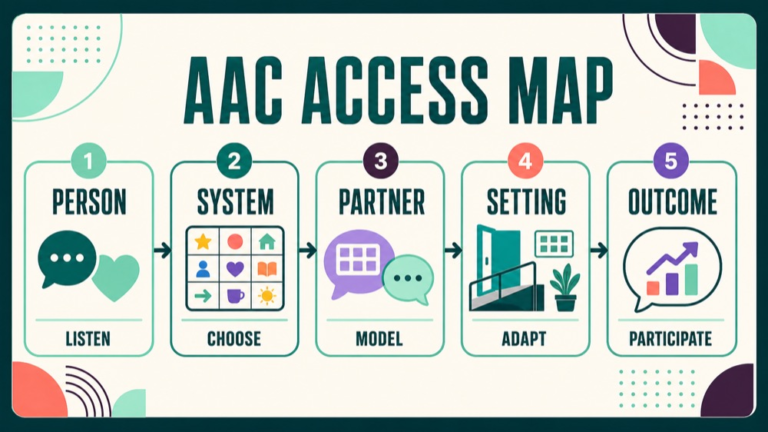
Use the five-step map below when a stem contains a communication need and several system details. First identify the person and message, then examine the system, partner, setting, and outcome. This keeps the review path aligned with the question instead of letting a device feature control the answer.
| Step | Prompt | Example note |
|---|---|---|
| Person | What does the person want to communicate? | Share an idea during a family decision. |
| System | What mode, symbol, access, and output fit? | Device keywords plus speech and gesture. |
| Partner | Who needs training or a response strategy? | Family members use wait and confirmation. |
| Setting | What environment and opportunity matter? | Kitchen conversation with limited noise. |
| Outcome | What will be monitored? | Message access and successful repair. |
Practice the map with a new condition each time. Change the message, language, access route, partner, setting, or support and explain which step should change. Transfer reasoning matters more than memorizing a device category.
Use an AAC system and partner review board
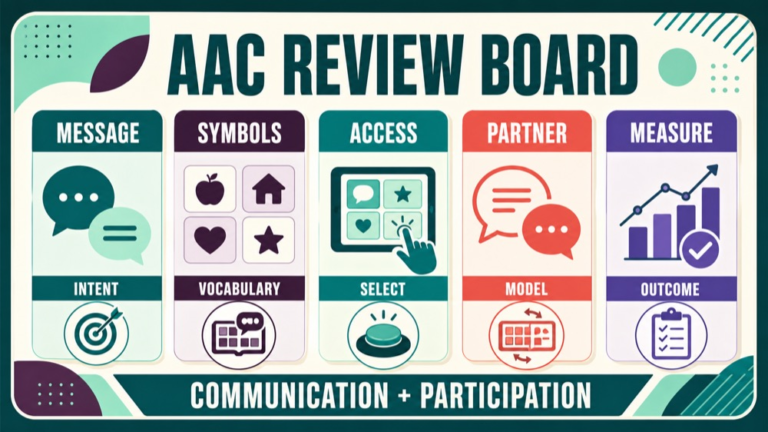
A review board makes AAC planning visible. Put the observed barrier or support in the relevant field, record the communication goal and task, and then write the decision the evidence can answer. Keep a separate participation row so system use does not become the only outcome.
| Review field | Prompt | Example |
|---|---|---|
| Message | What does the person need to express? | Ask a question and add a comment. |
| Symbols | What words, pictures, letters, or signs fit? | Core words and personal vocabulary. |
| Access | How will the person select or produce the message? | Direct touch with adjusted positioning. |
| Partner | What modeling, wait, or confirmation is needed? | Partner models and waits. |
| Setting | What environment supports communication? | Quiet room and reachable system. |
| Decision and measure | What action and outcome fit? | Track message completion and repair. |
Do not fill every cell simply because the board has space. Mark missing evidence and the trial or conversation that would supply it. A clear unknown is more useful than an invented conclusion.
Question 1: system selection
Question 1: A client uses some speech, points to pictures, and wants to add comments during family conversations. The item asks which planning principle should guide the system. Which answer is most appropriate?
- A. Remove the client’s speech and picture modes so the person uses one device for every message.
- B. Build a multimodal plan that preserves effective current modes while adding vocabulary, access, partner, and output supports for the family activity.
- C. Select the most complex device available before observing the person’s messages and access needs.
- D. Limit the system to requesting because comments and social messages are secondary.
Correct Answer: B. The stated goal is participation in family conversation, and the client already uses several modes. A multimodal plan can add useful supports while preserving communication that is working.
Why the Other Options Are Wrong: A imposes an unnecessary single-mode restriction. C chooses hardware before matching the system to the person and activity. D narrows AAC to requesting and ignores social communication.
Exam Trap: The newest or most complex device is not automatically the best answer. Match system features to messages, access, partners, and setting.
Question 2: access assessment
Question 2: A student misses selections on a tablet during desk work but reaches the targets more accurately when the device is stabilized and the display is positioned within a comfortable visual field. The item asks what information should guide the next step. Which answer is strongest?
- A. Conclude that the student does not understand the symbols from the first unstable trial.
- B. Compare access accuracy, positioning, visual conditions, fatigue, display demands, and communication outcomes across supported trials.
- C. Increase the number of symbols immediately without checking the access route.
- D. Require faster selections so the student adapts to the original position.
Correct Answer: B. The change after stabilization and positioning suggests an access condition that needs systematic comparison. The next step should include motor, visual, fatigue, display, and message evidence.
Why the Other Options Are Wrong: A turns an access problem into a language conclusion. C changes vocabulary before examining the access route. D increases time pressure and may further obscure the relevant barrier.
Exam Trap: A missed selection is not automatically a symbol-understanding problem. Check the access conditions before interpreting the response.
Question 3: functional AAC planning
Question 3: A client wants to ask questions and repair misunderstandings during medical visits. The client prefers speech plus a small keyword display, and family members can help with setup and confirmation. Which planning choice best fits the goal?
- A. Measure only the number of device selections in a quiet clinic drill.
- B. Practice medical questions and repair with the preferred multimodal support, train family confirmation, and monitor message access with the medical partner.
- C. Replace speech with a system selected by the clinician without discussing the client’s preference.
- D. Train family members to answer for the client whenever a pause occurs.
Correct Answer: B. The plan connects the message to the medical setting, preserves the client’s preferred mode, includes partner training, and measures functional access and repair.
Why the Other Options Are Wrong: A omits the medical partner and communication purpose. C removes shared planning and multimodal choice. D takes over the message instead of supporting the client’s communication.
Exam Trap: A functional AAC plan includes message, mode, partner, setting, support, and outcome. Device use alone is not the whole goal.
Review common AAC distractors
AAC distractors often confuse device ownership with communication access. A choice may name a sophisticated system but ignore motor positioning, vocabulary, partner training, language, literacy, or the person’s message. Another may measure selections while leaving participation unexamined.
| Distractor pattern | Why it attracts attention | Review test |
|---|---|---|
| Device-first answer | The technology sounds advanced | What message and access need does it solve? |
| Single-mode restriction | The plan sounds tidy | What current modes are useful? |
| Request-only plan | Requests are easy to demonstrate | What social and informational messages matter? |
| Access omission | The display appears available | Can the person reach, see, and select? |
| Partner takeover | The exchange becomes faster | Is the person’s message still being produced? |
| Score-only outcome | The number is easy to collect | What partner, setting, and activity matter? |
Write the closest distractor mismatch in one sentence. It may confuse device presence with system fit, a request with communication competence, a selection error with symbol knowledge, or speed with participation. Specific mismatch language turns a missed item into a reusable rule.
Use the final action word as the last filter. If the item asks what evidence is missing, do not choose a purchase or drill. If it asks for an outcome, include the message, partner, setting, and support condition.
Build an AAC practice block
Use a small block that mixes AAC definitions, system components, access, symbols, language and literacy, partner behavior, functional goals, collaboration, and outcome measurement. Vary messages, partners, settings, modes, and supports when the question supports those comparisons.
| Block part | Example prompt | Review product |
|---|---|---|
| System | What component is described? | System-component note |
| Access | What barrier affects selection or output? | Access comparison |
| Language | What words, symbols, or literacy demand matters? | Vocabulary and language note |
| Partner | What modeling, wait, or confirmation is needed? | Training plan |
| Function | Who needs access to which message? | Participation goal |
| Collaboration | Which partner or professional can reduce uncertainty? | Team action |
| Outcome | How will communication be monitored? | Measure and condition |
Keep the block small enough to review eight to fifteen questions carefully. For each item, record the requested action, the decisive communication clue, the system component, the access condition, the closest distractor, and the functional consequence. This reveals the source of a miss more clearly than a percentage alone.
Create one changed-context prompt after the block. Change the message, partner, language, access route, display, setting, or time pressure and explain which evidence or outcome field should change.
Track AAC reasoning and confidence
An AAC tracker should include the source, date, question task, original answer, confidence, message, mode, system component, access condition, partner, setting, differential boundary, closest distractor, and next action. These fields show whether the miss came from identifying the goal, matching the system, analyzing access, supporting the partner, or planning the outcome.
| Tracker field | Prompt | Example |
|---|---|---|
| Requested action | What did the item ask me to do? | Choose the next access assessment. |
| Message | What did the person need to communicate? | Ask a question and repair. |
| System or mode | What speech, symbol, writing, sign, or device was involved? | Speech plus keyword display. |
| Access condition | What position, input, or support changed? | Stabilized device and visual field. |
| Partner | Who needs a response strategy? | Family member uses wait and confirmation. |
| Next action | What will I practice? | Separate access from symbol knowledge. |
Review high-confidence misses and low-confidence correct answers. A correct letter without a rationale may reflect recognition, while a confident miss may reveal confusion about aided and unaided approaches, system fit, or functional measurement.
Use the ASHA Practice Portal when an AAC concept needs clarification and use the live ETS page for exam details that can change. The tracker supports preparation; it does not replace individualized assessment or qualified professional judgment.
AAC Praxis practice questions checklist
Use this checklist for each small AAC practice set.
- I identified whether the item asked for a definition, screening, assessment, system selection, access trial, referral, treatment planning, partner training, or monitoring.
- I separated the person’s communication goal from the device or display feature.
- I reviewed message intent, current modes, symbols, vocabulary, output, access, portability, and environment.
- I distinguished aided, unaided, augmentative, alternative, and multimodal approaches.
- I checked motor, sensory, language, literacy, cultural, partner, and opportunity conditions.
- I selected evidence that matches the uncertainty instead of choosing the most complex device.
- I recognized when occupational therapy, physical therapy, audiology, vision, medical, technology, interpreter, or other collaboration may be relevant.
- I considered the person’s languages, dialect, culture, literacy, identity, and preferred communication modes.
- I connected the plan to the message, partner, setting, support, and participation goal.
- I included social, informational, repair, and commenting functions rather than requesting alone.
- I explained why the selected answer fits the clinical stage and evidence.
- I named the closest distractor and its specific mismatch.
- I wrote the rationale in my own words without copying protected source material.
- I created one changed-context transfer prompt.
- I specified a communication or participation outcome and the condition under which it will be checked.
The checklist keeps AAC questions connected to communication intent, system fit, access, partners, evidence, and function. The goal is not to select a device from one barrier or score. The goal is to explain what the case supports, what remains uncertain, what action fits, and how the result will be evaluated.
Sources and next steps
Use the ASHA Augmentative and Alternative Communication Practice Portal for AAC definitions, aided and unaided approaches, assessment, functional communication, multimodal use, partner training, literacy, and ongoing system changes.
Use the ASHA Speech-Language Pathology Exam 5331 Content page to map AAC assessment, treatment planning, treatment, and treatment evaluation questions to broad exam areas. Use the live ETS Speech-Language Pathology 5331 page for current exam identity and administration information.
Use the ETS practice-test selector for current preparation options and read each resource’s access terms. For a structured preparation path, see the SLP Study Center Complete Prep resource. On your next study block, answer a small mixed AAC set, build one five-component system card, practice one partner strategy, and write one transfer question with a communication outcome condition.