apraxia of speech praxis practice questions are easier to solve when you identify the planning or programming clue, the speech task, and the action the stem requests. A case may include phonetic distortions, inconsistent errors, groping, false starts, slowed rate, syllable segmentation, or altered stress. The strongest answer connects those clues to repeated task evidence and a clinical stage.
ASHA’s Acquired Apraxia of Speech Practice Portal describes acquired apraxia of speech as a neurologic speech disorder involving impaired planning or programming of phonetic and prosodic processes. It also notes that apraxia of speech commonly co-occurs with dysarthria and aphasia. Use the current ASHA and ETS pages for changing information, then use the original planning map below to review concepts without treating one feature as a complete differential conclusion.
What apraxia questions are testing
An acquired apraxia of speech item may ask you to identify a planning or programming pattern, choose a screening or assessment task, distinguish apraxia from dysarthria or aphasia, select collaboration, plan treatment, or monitor functional communication. The word apraxia does not determine the answer by itself. The final request sets the decision stage.
| Question task | What to locate | Review output |
|---|---|---|
| Identify a pattern | Phonetic distortions, inconsistency, groping, rate, stress, or initiation clues | Planning profile |
| Choose assessment | Automatic, spontaneous, repetition, complexity, and nonword task evidence | Next data step |
| Differentiate | Planning, execution, language, cognition, hearing, or oral-motor evidence | Cautious comparison |
| Plan support | Person’s goal, communication mode, partner, and setting | Functional plan |
| Monitor change | Speech performance and message access under a defined condition | Outcome measure |
Rewrite the action word before reading the choices. If the stem asks what should be assessed next, a treatment technique may be useful later but may not answer the question. If it asks for a functional outcome, one accuracy score may be too narrow.
Use the details that change the decision: onset, etiology context, consistency, word length, syllable complexity, automatic versus generative speech, repetition, cueing, prosody, groping, intelligibility, partner, and response to support. A familiar motor-speech term should organize the evidence, not replace it.
Anchor review to the ASHA 5331 scope
ASHA’s current Speech-Language Pathology 5331 content page places voice, resonance, and motor speech within assessment procedures and treatment. The broad exam structure also includes foundations and professional practice, screening, assessment, evaluation and diagnosis, treatment planning, implementation, and treatment evaluation.
| 5331 lens | Apraxia question example | Study tag |
|---|---|---|
| Foundations | What planning, programming, phonetic, or prosodic process is described? | Concept and speech motor control |
| Assessment | What task adds evidence about consistency or complexity effects? | Data source and sequence |
| Differential reasoning | Which pattern is supported and what remains uncertain? | Comparison boundary |
| Treatment planning | What goal, support, or activity fits the person? | Function and implementation |
| Treatment evaluation | How will speech and communication access be monitored? | Measure and generalization |
Map the item to one primary lens. A case can contain a stroke history, inconsistent word errors, groping, and a family communication goal, but the question may ask you to choose a task comparison or a functional support. The stage and requested domain keep the answer focused.
Use ASHA for clinical concepts and ETS for current exam logistics. Third-party practice pages can show the language learners search, but their labels and question wording are not a substitute for responsible source material.
Define acquired apraxia of speech
For study purposes, acquired apraxia of speech is a speech-motor planning and programming question. The person may know the intended message and have adequate strength for some movements, yet have difficulty organizing accurate phonetic and prosodic speech movements. The profile is interpreted through a constellation of signs, task comparisons, co-occurring conditions, and functional impact.
| Reasoning field | What to ask | Study caution |
|---|---|---|
| Planning or programming | What changes in sequencing or phonetic organization? | Do not use one sign as a complete answer. |
| Speech behavior | Are errors distorted, inconsistent, or effortful? | Compare repeated productions. |
| Prosody | What happens to rate, stress, rhythm, or intonation? | Sample connected speech. |
| Co-occurring domains | Are dysarthria, aphasia, cognition, or oral apraxia also present? | Keep the evidence layers distinct. |
| Participation | How does speech access affect the person’s roles? | Include the partner and setting. |
ASHA distinguishes acquired apraxia of speech from childhood apraxia of speech and describes acquired cases in adults. When a practice item uses the word apraxia without specifying the population, read the surrounding clues and do not import a childhood framework into an adult acquired-speech question.
Underline the planning or programming clue and circle the requested action. Then write one sentence that links the two. That separation prevents a familiar term from taking over the reasoning.
Read phonetic and prosodic clues
Common AOS study clues include phonetic distortions, distorted substitutions or additions, reduced speech rate, prosodic abnormalities, inconsistent errors, prolonged sounds, syllable telescoping, false starts, restarts, sound or syllable repetitions, and visible groping. These signs are not unique to AOS, so the item is often testing whether you consider the constellation and the task.
| Clue | What to compare | Review boundary |
|---|---|---|
| Phonetic distortion | Accuracy and type of error across repeated attempts | Do not equate imprecision with one disorder. |
| Inconsistent error | Same word, different attempts, and different contexts | Document the task and target. |
| Groping | Visible search, initiation, and effort before speech | Interpret with other findings. |
| Prosodic change | Stress, rhythm, rate, pauses, and pitch variation | Include connected speech. |
| Complexity effect | Word length, syllable structure, and sentence demand | Compare graded tasks. |
A single sign can raise a planning question, but it does not settle the differential. Choose the answer that gathers comparable evidence when the stem asks what should happen next. When the stem asks you to identify an observed feature, name the feature without expanding beyond the evidence.
Use a four-part note: sign, target, task, and comparison. For example, record a distorted consonant on a multisyllabic word, then note whether the same target changed across repetition or cueing.
Compare consistency, complexity, and task effects
Task effects are central to apraxia reasoning. Automatic speech such as counting or familiar phrases may differ from spontaneous or novel speech. Real words may differ from nonwords, and sound accuracy may change as word or sentence complexity increases. The item may use these contrasts to test planning and programming rather than simple articulation accuracy.
| Comparison | What it can show | How to record it |
|---|---|---|
| Automatic versus generative | Difference between familiar sequences and novel production | Note the prompt and response. |
| Repeated word attempts | Consistency, error type, and self-correction | Compare target by target. |
| Real word versus nonword | Effect of lexical familiarity and phonetic planning demand | Keep length and structure visible. |
| Short versus long word | Effect of syllable and sequencing complexity | Use graded complexity. |
| Supported versus unsupported | Response to modeling, cueing, or extra time | Name the support and result. |
Do not make a task comparison meaningless by changing several variables at once. A useful practice note says what changed, what stayed constant, and what speech behavior changed. That logic helps you choose a better answer when distractors differ only in evidence quality.
If a stem says automatic speech is easier, keep that observation in the profile and look for the choice that compares it with generative, repeated, or more complex tasks. If it asks for treatment planning, connect the comparison to a target and communication activity.
Separate apraxia from related communication domains
AOS commonly co-occurs with dysarthria and aphasia. It may also appear with nonverbal oral apraxia, limb apraxia, weakness, or swallowing-related motor planning concerns. The test item may include several observations but ask you to identify one domain or choose a next step. Keep the layers distinct while allowing for co-occurrence.
| Domain | Clues to review | Question filter |
|---|---|---|
| Apraxia of speech | Planning or programming, phonetic distortion, inconsistency, groping, and prosody | What changes across speech tasks? |
| Dysarthria | Weakness, range, speed, coordination, tone, or subsystem execution | What movement or subsystem is affected? |
| Aphasia | Word retrieval, comprehension, syntax, semantics, reading, writing, or discourse | What language process is affected? |
| Oral apraxia | Programming nonspeech oral movements | Is the task speech or nonspeech? |
| Cognition or hearing | Attention, memory, awareness, auditory input, or feedback | Could access alter the observation? |
An articulation error can occur in more than one profile, and slow speech can have more than one explanation. Read the entire case and identify the requested decision before selecting a label.
Use a two-line note: describe the speech behavior, then name the alternative domain or evidence that still needs consideration. This makes a differential answer cautious and clinically useful.
Distinguish screening from comprehensive assessment
Screening asks whether further assessment or referral is indicated. Comprehensive assessment characterizes speech production, oral-motor structure and function, planning and programming, co-occurring communication conditions, and participation impact. Practice questions often test the difference between identifying a need and establishing a fuller profile.
| Stage | Primary purpose | Answer shape |
|---|---|---|
| Screening | Listen for relevant signs and determine the need for follow-up | Brief task and referral decision |
| Case history | Understand onset, medical history, baseline, roles, and concerns | Context and priorities |
| Comprehensive speech assessment | Compare production, planning, programming, oral-motor, and prosodic evidence | Profile and differential |
| Functional assessment | Examine intelligibility, comprehensibility, efficiency, and participation | Activity and partner outcome |
| Evaluation | Check response to intervention or support | Defined measure and condition |
If the question asks whether more assessment is needed, do not answer with a full treatment plan. If it asks how to characterize AOS, a single brief screen may not supply enough evidence. Match the breadth of the answer to the stage.
Document hearing, vision, positioning, motor access, interpreter needs, and communication supports that could alter the task. An accessible procedure gives the speech evidence a more defensible foundation.
Choose assessment evidence across tasks
Assessment questions reward a match between the uncertainty and the evidence source. If the uncertainty concerns planning, compare speech tasks that vary in length, complexity, familiarity, repetition, and cueing. If it concerns functional communication, include the listener, topic, setting, and support conditions that matter to the person.
| Uncertainty | Evidence to consider | Why it fits |
|---|---|---|
| Planning or programming | Automatic, spontaneous, repetition, syllables, words, phrases, and sentences | Shows task and complexity effects |
| Phonetic accuracy | Repeated targets, distorted substitutions, additions, and self-correction | Shows error consistency and type |
| Prosody | Rate, pauses, stress, rhythm, pitch, and connected speech | Matches prosodic demand |
| Co-occurring language | Comprehension, naming, discourse, reading, and writing tasks | Separates language from speech planning |
| Participation | Conversation sample, partner report, self-report, and activity observation | Shows communication in context |
Pair structured tasks with a speech sample when the question asks about real-world communication. Review the purpose, task demand, language background, access, listener, and response format before deciding what a result means.
Assessment sequencing matters. Establish the case history and access conditions, screen the relevant domains, sample speech planning and production, interpret patterns with appropriate collaboration, and then connect findings to goals and monitoring. A familiar procedure is not automatically the best next step.
Analyze intelligibility, comprehensibility, and efficiency
Listener outcomes are related but not identical. Intelligibility concerns how much of the speech signal a listener understands. Comprehensibility includes speech and nonspeech context, and efficiency concerns the rate at which an intelligible or comprehensible message is communicated. An item may ask you to connect one outcome to a functional setting.
| Outcome | What to ask | Example condition |
|---|---|---|
| Intelligibility | How much of the speech is understood? | Unfamiliar listener in quiet. |
| Comprehensibility | How do topic, gesture, facial expression, or context help? | Familiar partner with a topic card. |
| Efficiency | How quickly can the person communicate an accessible utterance? | Short workplace update. |
| Naturalness | How do rate, stress, rhythm, and effort sound? | Connected conversation. |
| Participation | What communication role or activity is affected? | Family decision-making exchange. |
A percentage without its listener, task, and condition is incomplete information. Ask who listened, what the topic was, what supports were available, and whether the person used repair or another communication mode.
When the stem gives a participation goal, favor an outcome that reflects access in that activity. A clinic measure can be useful, but the question may require a bridge from speech performance to the person’s real communication role.
Consider progressive and poststroke boundaries
Acquired apraxia of speech can occur after stroke, traumatic brain injury, tumor, surgery, or a progressive neurologic condition. A question may use onset and time course to shape the planning or referral decision. Keep the cause and course in view without treating them as a replacement for speech evidence.
| Case clue | Reasoning move | Study boundary |
|---|---|---|
| Poststroke onset | Review baseline, recovery context, and co-occurring language or motor-speech findings | Use current status and task evidence. |
| Traumatic injury or surgery | Consider change over time and the broader neurologic picture | Coordinate with the care team. |
| Progressive course | Plan periodic reassessment and communication supports | Address current participation needs. |
| New associated symptoms | Follow medical referral and team procedures | Do not force a speech-only answer. |
| Stable long-term profile | Compare functional performance and support needs | Define the outcome condition. |
For progressive conditions, a plan may include maintenance, compensatory strategies, AAC access, partner training, and periodic review as communication needs change. For a practice item, choose the answer that matches the time course and stated priority.
Do not use one time point to describe a trajectory. Record the date, task, support, communication partner, and outcome so later comparisons have a clear reference.
Use referral and collaboration boundaries
SLPs play a central role in screening, assessment, diagnosis, and treatment of AOS, while etiology and co-occurring needs may require collaboration. Practice questions may include hearing, vision, neurologic, physical, occupational, psychological, swallowing, or language concerns. Recognize the professional action that fits the case.
| Boundary clue | Reasoning move | Answer shape |
|---|---|---|
| Unknown etiology | Coordinate with the appropriate medical team | Referral and collaborative interpretation |
| Hearing or vision concern | Check access and arrange appropriate evaluation | Accessible assessment |
| Language concern | Screen or assess receptive and expressive language | Co-occurring profile |
| Swallowing or oral-motor concern | Follow evaluation and referral boundaries | Team-based next step |
| AAC need | Provide timely access and train the person and partners | Participation support |
An answer that recognizes collaboration can be stronger than one that forces every observation into AOS. The response should still name the speech question that can be addressed and the information that needs another discipline or procedure.
Write the boundary explicitly: what the current task shows, what it does not establish, and what next evidence would reduce uncertainty. This is useful for both exam reasoning and responsible clinical documentation.
Connect speech planning to function
Functional planning begins with the person’s communication priorities. A speech-motor practice target may support a larger goal such as greeting a family member, participating in a work call, ordering at a café, communicating with a medical team, or using AAC when speech access is limited. The practice answer should connect the target, partner, setting, support, and outcome.
| Planning field | Prompt | Example |
|---|---|---|
| Person’s goal | What message or activity matters? | Tell a family member about a schedule change. |
| Speech target | What word, phrase, or prosodic behavior supports it? | Practice a meaningful two-word phrase. |
| Partner and setting | Who is involved and under what conditions? | Familiar partner at home. |
| Support | What cue, mode, or partner strategy is acceptable? | Modeling, extra time, and a keyword card. |
| Outcome | How will access be checked? | Message understood with planned repair. |
Use the person’s preferred communication modes and document how supports affect access. A plan can include speech practice, pacing, modeling, gesture, writing, AAC, communication partner training, environmental changes, or other supports when those options serve the stated goal.
When an answer choice focuses only on a clinic accuracy score, ask whether the stem supplies a participation condition. If it does, favor the plan that preserves message access and choice while still defining measurable speech behavior.
Consider language, cultural, and access context
Speech planning and assessment must be interpreted in relation to the person’s language background, dialect, culture, communication roles, hearing, vision, literacy, and access conditions. The speech task should be conducted in the language or languages used by the person when appropriate, with sensitivity to cultural and linguistic diversity.
| Context field | What to check | Study caution |
|---|---|---|
| Language and dialect | Speech patterns, language use, and community norms | Separate difference from disorder. |
| Communication role | Family, work, school, medical, and community demands | Connect goals to real interactions. |
| Task access | Hearing, vision, positioning, motor access, and response time | Make the task accessible first. |
| Interpreter or partner | Who can support accurate communication? | Use qualified language access. |
| Response preference | Speech, writing, gesture, AAC, or multimodal support | Include the person’s choice. |
Consider a qualified interpreter or bilingual professional when needed and choose speech targets that reflect meaningful communication. An assessment choice that respects language and access is more defensible than a convenient monolingual or partner-free shortcut.
On a practice item, mark whether the main issue is speech planning, dialect or accent, task access, unfamiliar content, or a mismatch between the measure and the person’s background. That distinction is a reusable reasoning rule.
Map an apraxia question from evidence to function
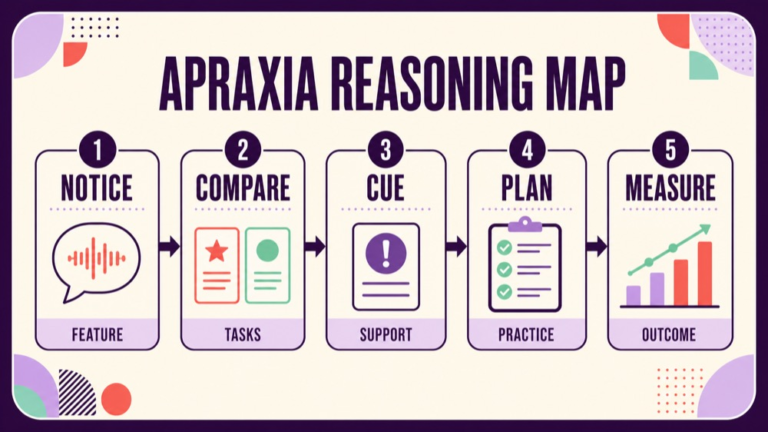
Use the five-step map below when a stem contains several speech-planning findings. First name the pattern, then identify the task, comparison, plan, and outcome. This keeps the review path aligned with the question instead of letting one striking sign control the answer.
| Step | Prompt | Example note |
|---|---|---|
| Pattern | What speech behavior is described? | Errors vary across repeated multisyllabic attempts. |
| Task | What demand is creating the comparison? | Generative speech versus automatic speech. |
| Evidence | What would reduce uncertainty? | Compare complexity, cueing, and co-occurring domains. |
| Plan | What activity and support fit? | Practice a meaningful message with partner support. |
| Outcome | What will be monitored? | Message access and efficient repair. |
Practice the map with a new condition each time. Change word length, response mode, communication partner, language, cueing, or setting and explain which step should change. Transfer reasoning matters more than memorizing a fixed label list.
Use an apraxia planning-and-programming review board
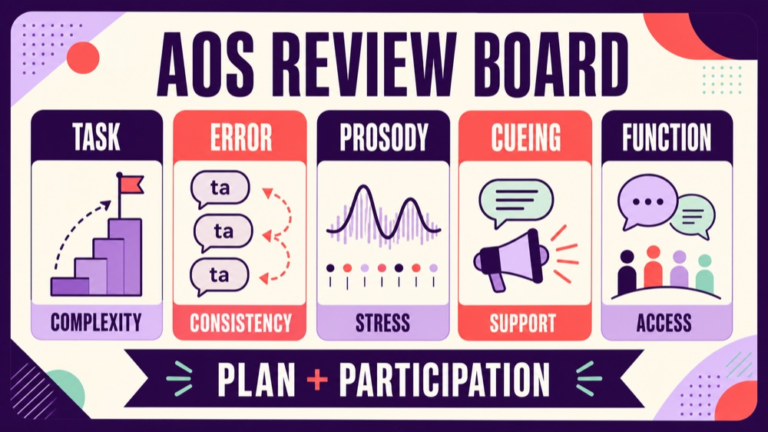
A review board makes the AOS profile visible. Put the observed behavior in the relevant field, record the task and support, and then write the decision the evidence can answer. Keep separate rows for co-occurring domains and participation so a planning observation does not disappear from the plan.
| Review field | Prompt | Example |
|---|---|---|
| Phonetic accuracy | What errors occur and how do they vary? | Distortions and substitutions vary by attempt. |
| Consistency | What happens across repeated targets? | One word changes across productions. |
| Prosody | What happens to rate, stress, or rhythm? | Equal stress and segmented syllables. |
| Complexity | What happens as length or structure increases? | Longer words require more attempts. |
| Cueing | What support changes performance? | Modeling and extra time support initiation. |
| Decision and outcome | What action and participation result fit? | Compare partner understanding in a target setting. |
Do not fill every cell simply because the board has space. Mark missing evidence and the task that would supply it. A clear unknown is more useful than an invented conclusion.
Question 1: task effect and consistency
Question 1: A speaker produces a familiar counting sequence accurately but has variable sound errors and visible searching movements on a novel multisyllabic word. The item asks what the student should examine next. Which answer is most appropriate?
- A. Conclude that the counting result rules out a speech-motor planning problem.
- B. Compare repeated productions across automatic, generative, and graded-complexity tasks while recording error type, prosody, and cueing response.
- C. Attribute the novel-word errors to weakness without examining consistency or movement.
- D. Use the single difficult word as the full basis for a final differential label.
Correct Answer: B. The contrast between automatic and novel speech, variable errors, searching movements, and word complexity calls for comparable task evidence. Recording prosody and support keeps the interpretation broader than one target.
Why the Other Options Are Wrong: A treats automatic speech as a complete exclusion. C assumes execution without the needed movement evidence. D makes a broad conclusion from one complex word.
Exam Trap: A task contrast is useful only when you preserve the demands and compare the speech behavior systematically. Look for the answer that gathers evidence across conditions.
Question 2: differential reasoning
Question 2: A client has slowed speech and imprecise consonants. Repeated productions are consistent, strength and range are reduced, and the case also notes mild word-finding difficulty. Which next step best supports responsible interpretation?
- A. Label the pattern as apraxia solely because speech is slow.
- B. Compare motor-execution findings with language tasks and planning indicators, documenting which observations belong to each domain.
- C. Attribute every communication difficulty to dysarthria because articulation is affected.
- D. Exclude language assessment because the client can produce some clear words.
Correct Answer: B. Consistency, reduced strength and range, and imprecise consonants support a motor-execution question, while word finding requires language evidence. Planning indicators should be checked rather than assumed.
Why the Other Options Are Wrong: A uses rate alone to assign a planning label. C treats language behavior as speech execution. D assumes a few clear words represent the full language profile.
Exam Trap: A case can contain co-occurring domains. Choose the answer that separates evidence and identifies what still needs sampling.
Question 3: functional speech planning
Question 3: A client wants familiar family members to understand a short daily update. Speech is more accessible with a model, extra response time, and a written keyword card. Which planning choice best matches the goal?
- A. Use an isolated accuracy score as the sole outcome and remove the supports used at home.
- B. Practice the meaningful update with the preferred supports, include partner confirmation and repair, and monitor message access in the home routine.
- C. Require rapid independent speech even when it reduces the client’s ability to share the message.
- D. Select a communication mode without discussing the client’s preference or family context.
Correct Answer: B. The plan connects a speech target to the person’s stated activity, preserves supports that help access, includes the partner, and defines a functional outcome.
Why the Other Options Are Wrong: A removes the condition that supports access and omits the real activity. C makes speed more important than message access. D removes shared planning and does not address the family context.
Exam Trap: A functional AOS plan includes the message, partner, setting, support, and outcome. A technically tidy drill is not enough when the stem gives a participation goal.
Review common apraxia distractors
Apraxia distractors often place a true speech observation in the wrong domain or make a broad conclusion from one task. Slow speech may attract an AOS answer even when the case emphasizes weakness and consistent errors. A distorted sound may attract a diagnosis without the repeated and task-based evidence needed to interpret it.
| Distractor pattern | Why it attracts attention | Review test |
|---|---|---|
| One-feature label | The sign is vivid | What other signs and task comparisons are present? |
| Automatic-task shortcut | The familiar sequence is accurate | What happens in generative or complex speech? |
| Execution-planning mix-up | Both can affect articulation | What do strength, range, consistency, and sequencing show? |
| Language omission | The speech signal is prominent | Are comprehension or word-finding clues present? |
| Screening-treatment mix-up | The technique sounds practical | What stage does the stem request? |
| Clinic-only outcome | The score is easy to collect | What partner and setting matter? |
Write the closest distractor mismatch in one sentence. It may confuse planning with execution, speech with language, screening with comprehensive assessment, or a clinic score with participation. Specific mismatch language turns a missed item into a reusable rule.
Use the final action word as the last filter. If the item asks what evidence is missing, do not choose the most familiar treatment activity. If it asks for an outcome, include the activity and communication condition that make the result meaningful.
Build an apraxia practice block
Use a small block that mixes planning clues, consistency, phonetic distortion, prosody, complexity, screening, comprehensive assessment, differential reasoning, functional planning, and evaluation. Vary automatic versus generative speech, word length, response mode, listener, setting, and support when the question supports those comparisons.
| Block part | Example prompt | Review product |
|---|---|---|
| Planning clue | What sign raises the planning question? | Feature note |
| Consistency | What changes across repeated attempts? | Target comparison |
| Complexity | When does accuracy or effort change? | Graded-task note |
| Prosody | What happens to rate, stress, or rhythm? | Prosody profile |
| Differential | Which explanation is supported and what is missing? | Boundary statement |
| Function | Who needs access to which message? | Participation goal |
| Outcome | How will speech or access be monitored? | Measure and condition |
Keep the block small enough to review eight to fifteen questions carefully. For each item, record the requested action, the decisive speech clue, the task condition, the missing evidence, the closest distractor, and the functional consequence. This reveals the source of a miss more clearly than a percentage alone.
Create one changed-context prompt after the block. Change word length, task familiarity, communication partner, language, background noise, message, or cueing support and explain which evidence or outcome field should change.
Track planning reasoning and confidence
An AOS tracker should include the source, date, question task, original answer, confidence, speech feature, consistency, task complexity, automatic or generative condition, cueing, differential boundary, closest distractor, and next action. These fields show whether the miss came from noticing the sign, comparing tasks, separating domains, selecting evidence, or planning the outcome.
| Tracker field | Prompt | Example |
|---|---|---|
| Requested action | What did the item ask me to do? | Choose the next assessment step. |
| Speech feature | What was observed? | Distorted and variable multisyllabic attempts. |
| Task condition | What demand changed? | Generative speech versus counting. |
| Consistency | What happened across repetitions? | Target error varied by attempt. |
| Boundary | What is not established by the sample? | Co-occurring language needs more evidence. |
| Next action | What will I practice? | Compare planning and execution clues. |
Review high-confidence misses and low-confidence correct answers. A correct letter without a rationale may reflect recognition, while a confident miss may reveal a task-effect or differential distinction that needs to be rebuilt from the case and responsible source.
Use the ASHA Practice Portal when an acquired apraxia concept needs clarification and use the live ETS page for exam details that can change. The tracker supports preparation; it does not replace individualized assessment or qualified professional judgment.
Apraxia of speech Praxis practice questions checklist
Use this checklist for each small acquired apraxia of speech practice set.
- I identified whether the item asked for a feature, screening, assessment, differential reasoning, referral, treatment planning, or monitoring.
- I separated planning and programming clues from execution, language, cognition, hearing, and participation clues.
- I compared phonetic accuracy, distortions, inconsistency, groping, initiation, rate, stress, rhythm, and connected speech.
- I recorded automatic versus generative speech, word length, complexity, repetition, cueing, and response mode.
- I distinguished acquired apraxia of speech from childhood apraxia, dysarthria, aphasia, and nonspeech oral apraxia.
- I selected evidence that matches the uncertainty instead of choosing every possible procedure.
- I recognized when hearing, vision, neurologic, swallowing, language, or other collaboration may be relevant.
- I considered language, dialect, cultural context, communication mode, and the person’s preferred outcomes.
- I connected the plan to the partner, setting, message, support, and participation goal.
- I explained why the selected answer fits the clinical stage and evidence.
- I named the closest distractor and its specific mismatch.
- I wrote the rationale in my own words without copying protected source material.
- I created one changed-context transfer prompt.
- I specified a speech or participation outcome and the condition under which it will be checked.
The checklist keeps apraxia questions connected to planning, programming, evidence, boundaries, and function. The goal is not to assign a broad explanation from one distorted sound, slow rate, or difficult word. The goal is to explain what the case supports, what remains uncertain, what action fits, and how the result will be evaluated.
Sources and next steps
Use the ASHA Acquired Apraxia of Speech Practice Portal for planning and programming features, task comparisons, co-occurring conditions, assessment, collaboration, treatment, AAC, and functional participation.
Use the ASHA Speech-Language Pathology Exam 5331 Content page to map motor speech, assessment, treatment planning, and treatment evaluation questions to broad exam areas. Use the live ETS Speech-Language Pathology 5331 page for current exam identity and administration information.
Use the ETS practice-test selector for current preparation options and read each resource’s access terms. For a structured preparation path, see the SLP Study Center Complete Prep resource. On your next study block, answer a small mixed AOS set, compare automatic and generative speech, build five task-effect cards, and write one transfer question with a functional outcome condition.