Fluency disorders Praxis practice questions are easier to reason through when you separate the speech behavior from its impact, context, and requested clinical action. A stem may describe repetitions, prolongations, blocks, rapid or irregular speech, avoidance, or communication frustration. The decisive clue is often what the question asks you to assess, explain, plan, or monitor.
ASHA’s Stuttering, Cluttering, and Fluency Practice Portal frames fluency as continuity, smoothness, rate, and effort in speech production. It also distinguishes stuttering and cluttering while emphasizing that people can experience social, academic, vocational, emotional, and functional effects. Use the live ASHA and ETS pages for changing information, then use the original review system below to organize your practice.
What fluency questions are testing
A fluency item may ask you to identify a speech behavior, select a screening or assessment step, interpret a pattern, choose a functional treatment priority, or evaluate change. The word fluency is only the topic label. The final action tells you whether the answer should describe evidence, explain a distinction, plan a next step, or define a measure.
| Question task | What to locate | Review output |
|---|---|---|
| Identify a behavior | Type, frequency, duration, rate, effort, or related behavior | Behavior note |
| Choose assessment | Missing speech, self-report, context, or impact evidence | Next information step |
| Interpret a pattern | Converging data across tasks and settings | Cautious interpretation |
| Plan support | Speaker priority, communication goal, and setting | Functional plan |
| Monitor change | Observable behavior, participation, and return condition | Outcome measure |
Start by rewriting the request in plain language. If the stem asks what should be assessed next, a fluency technique may be relevant later but may not answer the current question. If the stem asks about functional impact, a count of disfluencies alone may be too narrow.
Use the case details that change the decision. A speech sample, a self-report, a family observation, a classroom presentation, a workplace call, and a response to support each answer a different question. Do not let one familiar term replace the complete evidence pattern.
Anchor review to the ASHA 5331 scope
ASHA’s current Speech-Language Pathology 5331 content page organizes broad exam areas around foundations and professional practice, screening, assessment, evaluation and diagnosis, and planning, implementation and evaluation of treatment. Fluency questions can therefore test knowledge of speech behaviors, assessment sequence, impact, collaboration, treatment planning, or progress evaluation.
| 5331 lens | Fluency question example | Study tag |
|---|---|---|
| Foundations | What speech behavior or fluency concept is described? | Definition and distinction |
| Screening and assessment | What information should be gathered next? | Evidence and context |
| Diagnosis and interpretation | What conclusion does the pattern support? | Boundary and uncertainty |
| Treatment planning | What priority and activity fit the person? | Function and collaboration |
| Treatment evaluation | How should progress be checked? | Measure and setting |
Map the question to one primary lens before reviewing answer choices. A case can contain several relevant facts, but the requested action still has a stage. This prevents a treatment idea from winning a question that is asking for an assessment procedure.
Use ASHA for clinical framing and ETS for current exam logistics. Practice resources may use different labels or groupings, so translate their wording into the broad 5331 lens rather than memorizing a competitor’s page structure.
Separate speech behavior from fluency impact
ASHA describes a fluency disorder as an interruption in speech flow that can affect communication effectiveness, efficiency, and willingness to speak. This means that a review answer should distinguish what can be observed from what the speaker or communication partner experiences. Both parts can matter, and the question may emphasize one.
| Evidence layer | Questions to ask | Example note |
|---|---|---|
| Speech behavior | What happens in the speech stream? | Sound repetitions or silent blocks occur. |
| Physical response | Is there tension or a related movement? | Effort rises during some moments. |
| Internal response | What does the speaker report or anticipate? | Speaking situations are avoided. |
| Listener response | How do other people react? | Turn-taking becomes rushed or uncomfortable. |
| Participation | What communication activity is affected? | Class discussion or phone use is limited. |
A lower visible frequency does not by itself describe lower impact. Covert strategies can reduce what an observer hears while increasing word substitution, avoidance, or internal effort. When a question includes self-report or participation details, treat those details as evidence rather than decoration.
Do not make the reverse mistake either. One difficult speaking moment does not establish a broad fluency disorder. Review duration, variability, settings, speech behaviors, speaker perspective, and functional consequences before choosing a conclusion.
Compare stuttering and cluttering clues
Stuttering and cluttering can overlap, but practice questions often provide a pattern that points you toward the most relevant comparison. Stuttering-like disfluencies may include sound or syllable repetitions, prolongations, blocks, and excess physical tension. Cluttering can involve a perceived rapid or irregular rate, many nonstuttering-like disfluencies, irregular pauses, over-coarticulated speech, and reduced clarity.
| Clue cluster | What to examine | Reasoning caution |
|---|---|---|
| Stuttering-like moments | Repetitions, prolongations, blocks, tension, and reactions | Look across tasks and speaker experience. |
| Cluttering-like pattern | Rate, irregular pauses, revisions, and over-coarticulation | Perceived rate and intelligibility also matter. |
| Overlap | Whether both patterns appear in the same speaker | Do not force one label from one excerpt. |
| Context change | What increases or decreases the behavior? | Variability is part of the evidence. |
| Clinical question | What decision does the stem request? | Answer the task, not only the label. |
Rate alone is not enough to explain every rapid-sounding sample. Ask whether speech is irregular, whether pauses or syllable boundaries are difficult to follow, whether the speaker notices the problem, and whether listener understanding changes. These details help distinguish a useful assessment question from a premature label.
Keep a comparison note with three fields: observed pattern, missing evidence, and requested action. This keeps a real definition from becoming an overconfident diagnosis shortcut.
Read overt, covert, and related behaviors
ASHA’s fluency guidance describes overt stuttering as openly observable and covert stuttering as involving attempts to hide or conceal stuttering through avoidance or escape. Related behaviors can include physical movements, facial changes, unexpected sounds, word substitutions, fillers, circumlocution, or other efforts that change the speaking event.
- Mark overt behavior when the speech interruption is directly observable in the sample.
- Mark covert behavior when the speaker reports concealment, avoidance, or substitution that hides the expected word or sound.
- Mark secondary behavior when a movement or sound accompanies a moment of stuttering without assuming its intent.
- Mark escape behavior when the action occurs during a moment and appears intended to end it.
- Mark avoidance behavior when the action occurs before the expected moment and changes what the speaker chooses to say.
- Ask the speaker how the behavior feels and what communication goal was affected.
Timing and intent matter. A blink, filler, or word change cannot be classified responsibly from appearance alone. The same visible action may be related, avoidant, or an escape behavior depending on when it occurs and what the speaker is trying to do.
For practice, annotate the sample without judging the speaker. Record the observable event, then add speaker report and setting information when supplied. A good answer preserves the distinction between description and interpretation.
Choose assessment evidence across contexts
ASHA notes that fluency symptoms can vary by environment and that comprehensive evaluation should include speech samples across situations and tasks, self-report, reactions, and adverse impact. The correct assessment answer therefore often broadens the evidence rather than relying on one clinic conversation or one numerical count.
| Evidence source | What it can add | Review caution |
|---|---|---|
| Background and onset | History, change over time, family or prior treatment information | History guides assessment but does not replace current data. |
| Speech samples | Type, frequency, duration, rate, intelligibility, and variability | Sample task, partner, and context. |
| Self-report | Anticipation, effort, avoidance, goals, and communication experience | Do not infer internal experience without asking. |
| Partner or caregiver report | Variability and participation across daily settings | Connect report to observed activities. |
| Functional observation | Communication effectiveness in school, work, home, or community | Define the demand and available support. |
| Response to support | What changes with pausing, rate adjustment, or another agreed support | Use alongside the complete pattern. |
If the question asks for a comprehensive fluency assessment, choose an answer that samples relevant speech behaviors and the speaker’s experience across meaningful contexts. A single isolated task may miss variability or covert impact.
If the question asks for one narrow feature, stay narrow. For example, a question about rapid and irregular speech may need rate, pausing, intelligibility, and related behaviors, while a question about participation may prioritize self-report and real-world observation.
Include speaker, listener, and setting impact
Fluency questions often become difficult when a learner treats impact as an optional extra. A person may report frustration, reduced willingness to speak, or avoidance even when the clinic sample contains few overt moments. Another speaker may show frequent disfluency without wanting the clinician to make fluency the only goal.
| Context field | Question to ask | Study note |
|---|---|---|
| Speaker priority | What communication change matters to the person? | Use the person’s goal to frame planning. |
| Listener response | What reactions affect the interaction? | Consider education and advocacy needs. |
| Setting | Where is communication difficult or successful? | Sample more than one relevant demand. |
| Participation | Which activity is limited? | Describe the task, partner, and consequence. |
| Support | What helps access or confidence? | Record the condition and response. |
Use functional language in your review note. Instead of writing that the speaker has poor fluency, write that the speaker avoids a presentation, uses substitutions during phone calls, or reports effort when answering in a group. The second description gives the next decision something concrete to address.
ASHA identifies counseling, education, collaboration, advocacy, and functional outcomes as part of the SLP role. A practice answer that includes the speaker’s priorities and communication participation is often more complete than an answer focused only on speech counts.
Consider language and cultural context
Fluency assessment should be culturally and linguistically relevant. A multilingual speaker may show different fluency patterns across languages or speaking situations, and awareness of stuttering or cluttering can vary across individuals and cultures. The practice question may be testing whether you gather language history and collaborate with appropriate partners before interpreting a difference.
- Record which languages are used, understood, and produced and how often each is used.
- Ask where the fluency concern was noticed and which partners or tasks were involved.
- Distinguish language-encoding difficulty, second-language learning, and fluency behaviors in the context supplied.
- Use qualified collaboration or interpretation when the clinician lacks the language access needed for fair assessment.
- Connect the concern to communication participation rather than assuming that one language sample represents every setting.
Do not treat a difference from a monolingual comparison as sufficient evidence of a fluency disorder. The responsible answer adds language exposure, dialect, speaker perspective, and functional context before making a broader interpretation.
Keep the same boundary when reading a question about culture or listener expectations. Cultural communication norms can affect how a behavior is noticed and described, but the answer still needs evidence about the speaker’s own experience and communication goals.
Map a fluency question from evidence to plan
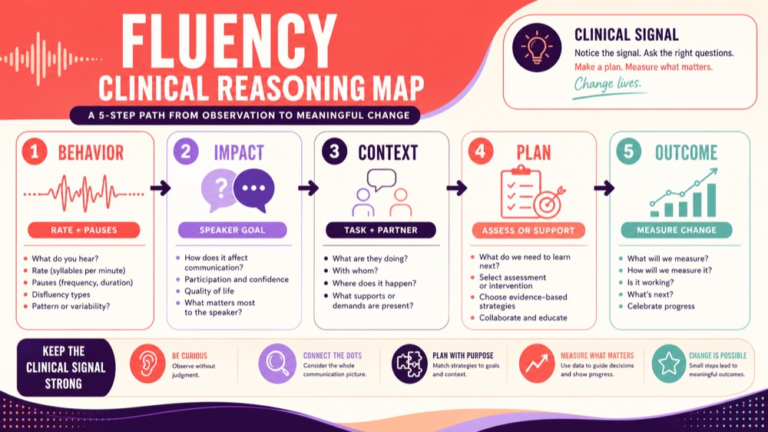
Use a five-field map for fluency questions: speech evidence, speaker impact, context, plan, and outcome. Start with what was observed or reported, connect it to the communication activity, choose the next stage-appropriate action, and define how the result will be checked.
| Map field | Prompt | Example review note |
|---|---|---|
| Speech evidence | What behavior or pattern is present? | Repetitions increase during group speaking. |
| Impact | What does the speaker or partner experience? | The speaker avoids volunteering. |
| Context | Where, with whom, and for what purpose? | Class discussion with peer listeners. |
| Plan | What action fits the question and stage? | Gather samples and speaker priorities. |
| Outcome | How will change be observed? | Participation with a defined support condition. |
The map protects against two common errors. One is jumping from a visible behavior to a broad diagnosis. The other is choosing a technique without knowing what the speaker wants to change. If evidence or impact is missing, the plan may be to gather it before selecting an intervention target.
Change one field for transfer practice. Keep the behavior the same but change the setting, partner, or participation goal, then state whether the assessment, support, or outcome measure should change. This turns a memorized rationale into flexible reasoning.
Use a behavior-impact-context review board
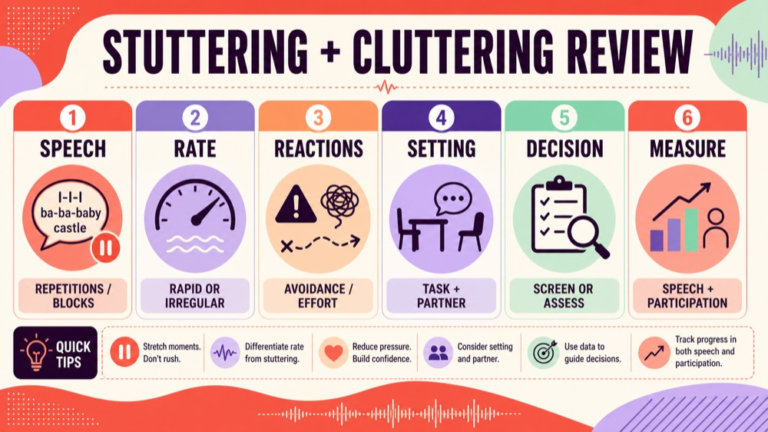
A review board separates what happened in speech from what it means for the speaker and what decision the case supports. Place the observable behavior in the first column, then add speaker response, listener or setting context, clinical stage, and measurement. This structure is useful when a stem contains several competing clues.
| Board column | Write | Check |
|---|---|---|
| Behavior | Type, rate, pauses, effort, or related actions | What was directly observed? |
| Speaker impact | Feelings, anticipation, avoidance, or communication goal | What did the speaker report? |
| Context | Partner, task, language, setting, and listener response | Where does the pattern change? |
| Decision | Screen, assess, interpret, plan, or monitor | What does the final request ask? |
| Measure | Observable speech or participation result | What return condition will be checked? |
Use the board after answering a mixed set. Group misses by behavior identification, assessment sequence, speaker impact, cultural context, treatment planning, or outcome evaluation. The group with the most misses becomes the next small study block.
Keep your notes in your own words. The board is a reasoning tool, not a place to reproduce flashcard wording, screenshots, or protected question-bank material. A concise behavior-impact-context summary is enough to create an original transfer item.
Question 1: fluency screening and assessment
Question 1: A school-age child shows sound repetitions and occasional blocks during a brief clinic conversation. The caregiver reports that the child avoids answering in class, but the practice item provides no information about speaking in other settings, the child’s reactions, or the pattern over time. Which next step best adds responsible fluency evidence?
- A. Count the disfluencies in the brief conversation and treat that count as the complete clinical picture.
- B. Gather speech samples across relevant tasks and settings while asking about the child’s and caregiver’s observations, reactions, and communication priorities.
- C. Tell the child to slow down and end the assessment once the speech sounds smoother.
- D. Conclude that the child has no fluency concern because the conversation was short.
Correct Answer: B. The case already includes observable behaviors and a participation concern, but important context and speaker-experience evidence are missing. Samples across meaningful tasks plus child and caregiver perspectives can clarify variability, impact, and the next stage-appropriate decision.
Why the Other Options Are Wrong: A narrows the assessment to one count and ignores participation. C gives a technique before the missing evidence and priorities are understood. D treats a brief sample as representative without examining settings, reactions, or change over time.
Exam Trap: A fluency assessment is not reduced to the number of disfluencies in one conversation. When the stem supplies impact or variability clues, include them in the assessment plan.
Question 2: covert fluency impact
Question 2: A college student reports avoiding class presentations and substituting words before speaking, yet produces few overt stuttering-like moments during a relaxed clinic interview. Which interpretation and assessment action best fit the information?
- A. Assume that the low clinic frequency means the communication impact is negligible.
- B. Explore the student’s self-report and avoidance, then sample speech in relevant tasks or settings to examine overt and covert features.
- C. Diagnose a separate language disorder from word substitutions without additional context.
- D. Remove presentations from the student’s goals because avoidance means the task is not clinically relevant.
Correct Answer: B. The student’s report is direct evidence about communication experience, and a relaxed interview may not reproduce the demand that triggers avoidance. A broader assessment can examine speech behavior, context, internal response, and participation without treating one sample as the whole picture.
Why the Other Options Are Wrong: A confuses fewer observable moments with lower impact. C assigns a broad interpretation to one behavior without checking intent, context, or the fluency pattern. D removes a stated participation concern instead of using it to guide assessment and planning.
Exam Trap: Covert strategies can hide the behavior an observer expects to count. When a speaker reports avoidance or substitution, assess the experience and relevant contexts rather than dismissing it.
Question 3: cluttering features and planning
Question 3: An adult’s conversation is perceived as rapid and difficult to follow. The sample includes irregular pauses, revisions, collapsed syllables, and reduced intelligibility, but the case does not yet describe the speaker’s awareness or goals. Which next review action is most appropriate?
- A. Label the pattern from the perceived rate alone and skip further context.
- B. Examine rate, pausing, speech clarity, related disfluencies, speaker perspective, and functional communication needs before selecting a plan.
- C. Treat every rapid speech sample as stuttering and focus only on sound repetitions.
- D. Choose a fixed speech-rate target without identifying the communication setting or desired outcome.
Correct Answer: B. The cluster suggests a fluency question involving rate, irregularity, intelligibility, and related behaviors, but the missing speaker perspective and functional context still matter. A complete review supports a plan that is connected to the person’s communication needs and measurable outcome.
Why the Other Options Are Wrong: A makes perceived rate a diagnosis shortcut. C ignores the pattern described and narrows the review to a different behavior cluster. D selects a target before knowing the setting, the speaker’s priority, or how change will be evaluated.
Exam Trap: Do not let one salient clue, such as rapid speech, replace the full pattern. Read the associated behaviors and the unanswered context questions before choosing the next action.
Review common fluency distractors
Fluency distractors often contain a true term placed at the wrong stage or stripped of context. A speech count may be relevant but insufficient for impact. A technique may be useful but premature. A rapid rate may be a clue but not a complete interpretation. Identify the mismatch rather than simply memorizing the correct letter.
| Distractor pattern | Why it attracts attention | Review test |
|---|---|---|
| Single-count shortcut | The number feels objective | What contexts and impacts are missing? |
| Clinic-only sample | The setting is easy to control | Would the behavior vary elsewhere? |
| Technique too early | The action sounds practical | Are priorities and evidence established? |
| Rate-only label | Rapid speech is memorable | What pauses, clarity, and related behaviors appear? |
| Speaker-experience omission | Internal impact is less visible | What does the person report or avoid? |
Write the nearest distractor mismatch in one sentence. It might ignore covert impact, confuse screening with comprehensive assessment, choose an intervention before clarifying the goal, or treat a language or cultural difference as fluency evidence without context.
Then state the decisive clue in your own words. The best rationale explains why the selected answer fits the requested stage, evidence pattern, and speaker priority.
Build a fluency practice block
Use a small block that mixes definitions, assessment, interpretation, planning, and evaluation. Include stuttering-like behaviors, cluttering-like features, speaker impact, context variability, multilingual considerations, and collaboration when the question supports them.
| Block part | Example prompt | Review product |
|---|---|---|
| Behavior | Which speech feature is described? | Observable behavior note |
| Assessment | What evidence should be gathered next? | Source and setting plan |
| Impact | What communication activity is affected? | Speaker-priority note |
| Planning | What action fits the goal and stage? | Functional rationale |
| Evaluation | How will change be monitored? | Measure and return condition |
| Boundary | What conclusion is not supported yet? | Caution statement |
Keep the block small enough to review eight to fifteen questions carefully. For each item, record the requested action, the evidence that controls the decision, the closest distractor, and the missing information that would change your answer.
Create one transfer prompt after the block. Change the speaking partner, task, language, setting, or support and explain which evidence or outcome field must be updated. Transfer practice checks whether you understood the reasoning instead of recognizing familiar wording.
Track reasoning and confidence
A fluency tracker should record the source, date, question task, original answer, confidence, behavior pattern, context, speaker impact, closest distractor, and next action. These fields make a score more useful because they show whether the miss came from definition, evidence selection, interpretation, planning, or evaluation.
| Tracker field | Prompt | Example |
|---|---|---|
| Requested action | What did the item ask me to do? | Choose the next assessment step. |
| Behavior | What was observed or reported? | Blocks and word avoidance in class. |
| Context | Where does the pattern appear? | Presentation with peer listeners. |
| Confidence | How certain was I before feedback? | Two choices remained. |
| Distractor | Why was the nearest option weaker? | It used one clinic count only. |
| Next action | What will I practice? | Compare impact evidence across settings. |
Review high-confidence misses and low-confidence correct answers. A correct letter without a rationale may reflect recognition, while a confident miss may reveal a rule that needs to be rebuilt from the case evidence and the requested action.
Use the ASHA Practice Portal when a fluency concept needs clarification, and keep exam-administration details tied to the current ETS page. The study tracker supports learning; it does not replace professional judgment or individualized assessment.
Fluency disorders Praxis practice questions checklist
Use this checklist for each small fluency-disorders practice set.
- I identified whether the item asked for behavior identification, screening, assessment, interpretation, treatment planning, or monitoring.
- I mapped the item to a broad 5331 lens and wrote the final request in my own words.
- I separated observable speech behavior from speaker impact, listener response, and participation.
- I compared stuttering-like and cluttering-like clues without forcing a label from one excerpt.
- I looked for overt, covert, secondary, avoidance, or escape behaviors and considered timing and intent.
- I selected evidence across relevant tasks, settings, partners, and communication demands.
- I included self-report and caregiver or partner information when the case supports it.
- I considered language exposure, dialect, cultural context, and qualified collaboration.
- I explained why the selected answer fits the stage and the evidence.
- I named the closest distractor and its specific mismatch.
- I wrote the rationale in my own words without copying protected source material.
- I created one changed-context transfer prompt.
- I specified an observable speech or participation outcome and return condition.
- I rechecked changing exam and professional information with the responsible source.
The checklist keeps fluency questions connected to evidence, speaker priorities, and function. The goal is not to assign a broad label from one behavior or count. The goal is to explain what the case supports, what remains unclear, what action fits, and how the result will be checked.
Sources and next steps
Use the ASHA Stuttering, Cluttering, and Fluency Practice Portal for current clinical framing, signs, impact, roles, assessment, and intervention considerations. Use the ASHA Speech-Language Pathology Exam 5331 Content page to map the topic to broad exam areas.
Use the live ETS Speech-Language Pathology 5331 page for current exam identity and administration information, and the ETS practice-test selector for current preparation options. Read each resource’s access terms and do not treat third-party flashcards as official exam material.
For a structured preparation path, see the SLP Study Center Complete Prep resource. On your next study block, answer a small mixed fluency set, build three behavior-impact-context cards, and create one changed-setting transfer question with a measurable review outcome.