Speech sound disorders Praxis practice questions are easier to use when you organize them around a clinical decision rather than a list of terms. Ask what the speech pattern is, what evidence supports the interpretation, how the concern affects communication, which next step fits the stage, and how an outcome would be checked. That sequence turns a selected-response item into a compact reasoning exercise.
ASHA’s Speech-Language Pathology (5331) content page includes speech sound production within the treatment topics and places it inside a broader exam that also covers foundations, assessment, diagnosis, treatment planning, and evaluation. ASHA’s Speech Sound Disorders: Articulation and Phonology Practice Portal provides the clinical frame for the distinctions and treatment phases below. Use the live ETS and ASHA pages for changing exam or professional information.
What speech sound questions are testing
Speech sound questions may test content knowledge, but many also test how you move from a case detail to a responsible clinical decision. The item may ask you to identify a pattern, choose the next assessment step, prioritize a target, select a treatment phase, or evaluate progress. Start by naming the action in the final request.
| Question task | What to locate | Review output |
|---|---|---|
| Identify a pattern | Distribution, consistency, and sound class | Pattern statement |
| Choose assessment | Missing evidence and context | Next information step |
| Prioritize a target | Stimulability, impact, and client factors | Target rationale |
| Choose treatment phase | Current production level and carryover | Phase decision |
| Evaluate progress | Measure, setting, and outcome | Monitoring plan |
A strong review note says what the stem supplied, what it did not supply, and why the chosen answer fits the stage. That prevents a familiar treatment label from pulling you past an unanswered assessment question.
Keep clinical reasoning separate from memorized developmental lists. A question can include an age or sound detail, but the answer may depend on intelligibility, context, consistency, stimulability, or the stated goal. Read the whole case before choosing a rule.
Anchor review to the ASHA 5331 scope
The ASHA 5331 content page groups the exam into foundations and professional practice, screening assessment evaluation and diagnosis, and planning implementation and evaluation of treatment. Speech sound production appears within the treatment topics, but a speech sound item can draw on more than one category.
| 5331 lens | Speech sound question example | Study tag |
|---|---|---|
| Foundations | Typical performance, communication factors, or development | Knowledge and context |
| Assessment | What information should be gathered? | Evidence and sequence |
| Diagnosis | What pattern is supported by the data? | Interpretation boundary |
| Treatment planning | What target or phase fits now? | Goal and implementation |
| Treatment evaluation | How should progress be monitored? | Measure and outcome |
Use the live ASHA and ETS pages for current scope and administration details. Your practice set may use a different label or order, so map the resource’s topic to the broad lens in your tracker. This makes review transferable across study sources.
Do not assume a question is only about articulation because one sound is named. Look for the decision being requested. A single consonant can appear in an assessment, target selection, generalization, or culturally responsive service question.
Record the lens beside every important miss. The lens gives you a better next action than a vague note that says speech sounds were difficult.
Distinguish articulation, phonology, and motor cues
ASHA describes speech sound disorders as difficulties involving perception, motor production, phonological representation, or phonotactic rules, and notes that one child can show more than one error type. A practice question may ask you to distinguish a sound-specific production issue from a broader pattern or from a motor or neurological concern.
| Review lens | Case clue to examine | Do not skip |
|---|---|---|
| Articulation | Specific sound production and placement | Context and stimulability |
| Phonology | Pattern across sounds or word positions | Distribution and contrast |
| Perception | Ability to hear or distinguish contrasts | Hearing and access considerations |
| Motor production | Movement, consistency, and speech control | Relevant history and differential scope |
| Phonotactics | Permissible sound sequences in the language | Language and dialect context |
Use the information actually supplied. If the stem gives only a single production sample, be cautious about a broad conclusion. If it gives a repeated pattern across contexts, that distribution may carry more weight. If it mentions neurological or structural factors, identify whether the question is asking you to use a different clinical frame.
On a practice card, write the clue that separates the top two interpretations. That clue may be consistency, sound class, word position, perceptual access, or the presence of a relevant condition. The comparison is often more valuable than the label alone.
Start with the assessment question
When a speech sound item asks what to do next, begin with the missing evidence. Ask whether the case includes a speech sample, hearing information, language or dialect context, stimulability, intelligibility, functional impact, and relevant history. Then choose the next step that reduces the uncertainty named in the stem.
| Evidence area | Question to ask | Why it can matter |
|---|---|---|
| Speech sample | What errors occur and where? | Shows distribution and patterns |
| Hearing | Is auditory access relevant? | Supports interpretation of sound learning |
| Stimulability | Can the sound be elicited with support? | Informs target planning |
| Intelligibility | How does the issue affect listeners? | Connects data to function |
| Context | Does performance change by task or setting? | Shows functional demands |
| Language and dialect | Is the pattern expected in the speaker’s system? | Protects fair interpretation |
A distractor may sound clinically sophisticated but still be premature if the key assessment information is missing. Your review should name the missing evidence and explain why the chosen step comes before treatment or a broad conclusion.
Use a sequence sentence: first gather the information that resolves the question, then interpret the pattern, then select targets or intervention. Some items will provide enough data to move farther down that sequence; do not move ahead simply because a treatment name is familiar.
Collect speech sample and context
A speech sound practice question becomes clearer when you separate the sample from the context in which it was collected. Note whether the data came from imitation, single words, connected speech, conversation, reading, or a structured task. Also note the communication partner, language or dialect, and demands of the setting when the stem provides them.
| Sample detail | Review prompt | Possible interpretation |
|---|---|---|
| Task | What did the speaker have to do? | Task demand may affect production |
| Position | Where does the sound occur? | Distribution can narrow patterns |
| Consistency | Does the error repeat? | Helps separate pattern types |
| Support | Was a model or cue available? | Shows response to support |
| Listener | Who needs to understand the message? | Connects to function |
| Language system | What linguistic context applies? | Protects difference from disorder |
Do not write a practice answer that assumes every sample represents every speaking situation. A structured word list and connected conversation can reveal different demands. If the question asks about functional communication, look for data beyond a single elicited response.
When an item omits a key sample detail, treat the omission as part of the reasoning. The best answer may be a targeted next assessment step rather than a diagnosis or treatment choice.
Use intelligibility and functional impact
Speech sound questions often include an impact clue. The issue may affect listener understanding, classroom participation, workplace communication, peer interaction, or confidence in a specific context. Link the data to the stated functional goal instead of ranking targets by a memorized list alone.
| Impact clue | Question to ask | Study implication |
|---|---|---|
| Reduced listener understanding | Which errors affect the message most? | Connect target selection to intelligibility |
| Context-specific difficulty | Where does the breakdown occur? | Plan functional sampling |
| Participation concern | What activity is limited? | Choose a meaningful outcome |
| Family or client priority | What matters to the person? | Include person-centered factors |
| Improved structured production | Does carryover occur? | Check generalization |
Use the impact clue to compare two plausible answers. One option may focus on a sound that is easy to elicit, while another addresses a pattern with a larger effect on intelligibility. The better answer depends on the case details and the question’s goal.
Keep the functional target specific. Instead of writing improve communication, describe the listener, task, setting, or message outcome that the item names. Specific language makes the next assessment or treatment step easier to justify.
Consider multilingual and dialect context
A clinically responsible review asks whether a speech pattern is consistent with the speaker’s language or dialect before labeling it disordered. ASHA’s Practice Portal includes multilingual considerations and emphasizes culturally and linguistically appropriate service delivery. In a practice item, look for the language system, exposure history, and comparison standard supplied by the stem.
| Context field | Review question | Responsible action |
|---|---|---|
| Language exposure | Which languages does the person use? | Gather relevant history |
| Dialect | Is the feature expected in the dialect? | Do not equate difference with disorder |
| Assessment language | Was the tool appropriate for the speaker? | Check validity and access |
| Interpreter or collaborator | What support improves communication? | Plan collaboration |
| Functional impact | What is the actual participation concern? | Keep the goal person-centered |
Do not make a broad judgment from an unfamiliar form alone. The practice answer should identify the information needed to interpret the pattern fairly and to distinguish language difference, dialect variation, and disorder-related difficulty.
For exam review, write the boundary in your own words: compare speech to the relevant linguistic system and use appropriate evidence before assigning a disorder interpretation. This is a clinical reasoning principle, not a shortcut for every case.
Choose targets with evidence
Target selection can involve relevance to the client and family, stimulability, visibility, severity, and impact on intelligibility. In a question, the best target is the one that fits the information and goal provided, not merely the sound that appears most familiar in a study list.
| Target factor | Prompt | How to use it in review |
|---|---|---|
| Client relevance | Does the target matter in daily communication? | Connect to participation |
| Stimulability | Can support elicit a closer production? | Consider learning readiness |
| Impact | Which error affects intelligibility? | Prioritize functional benefit |
| Visibility | Can the articulatory movement be seen? | Consider cueing access |
| Pattern structure | Does the target address a broader pattern? | Use phonological reasoning |
| Client factors | What age, severity, setting, and preferences matter? | Individualize the plan |
If the stem gives a clear target-selection factor, use it. If it gives several, rank them according to the goal and clinical stage. A target can be useful for one client and less suitable for another because the surrounding evidence changes.
Review a target question by writing why the nearest distractor is less fitting. It may ignore intelligibility, disregard stimulability, or select a target without addressing the named functional concern.
Plan establishment, generalization, and maintenance
ASHA describes treatment for speech sound disorders as moving through establishment, generalization, and maintenance. Establishment focuses on eliciting and stabilizing the target, generalization supports carryover at increasingly challenging levels, and maintenance supports durable, more automatic production with self-monitoring and self-correction. Use the case stage to select the phase.
| Phase | Case signal | Review action |
|---|---|---|
| Establishment | Target production is not stable with support | Choose elicitation and stabilization work |
| Generalization | Target is present in structured practice but not broader use | Increase linguistic or contextual challenge |
| Maintenance | Production needs automaticity and self-monitoring | Check durability and self-correction |
| Evaluation | Progress claim lacks a defined measure | Specify outcome and context |
Do not jump to generalization when the target is not yet established, and do not call structured accuracy maintenance without evidence of stability over time and context. The question’s stage and outcome language should control the choice.
Record what would count as progress. It may be accuracy in a defined context, listener understanding, carryover into conversation, or successful self-correction. A measure should match the goal and the phase being tested.
Map a speech sound question from pattern to plan
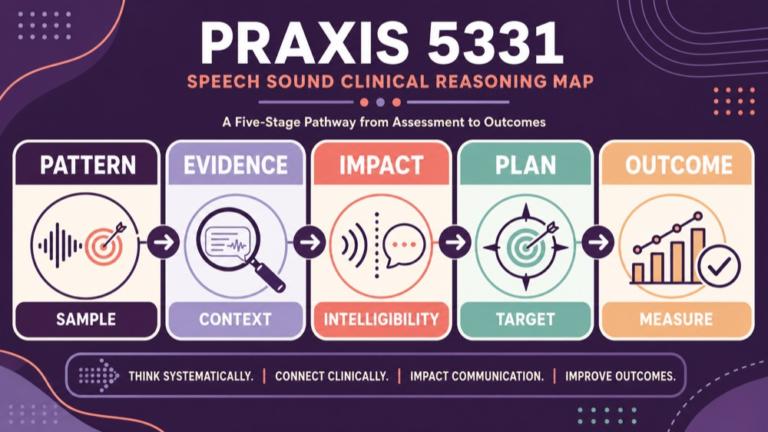
Use a five-part map when a question moves from speech sample to intervention. First name the observed pattern, then identify the evidence that supports the interpretation, connect it to intelligibility or participation, choose a target or next assessment step, and name how you would check the result.
| Map field | Prompt | Example note |
|---|---|---|
| Pattern | What happens across sounds or contexts? | Final consonants are omitted in connected speech. |
| Evidence | Which data support the pattern? | Sample includes words and conversation. |
| Impact | What communication outcome is affected? | Listeners miss word endings. |
| Plan | What step fits the stage? | Choose a target and structured practice. |
| Outcome | How will change be checked? | Sample carryover in a relevant setting. |
The map keeps the answer tied to the case. If the stem gives only a screening observation, the plan may be additional assessment. If it gives established target production with limited carryover, the plan may focus on generalization. The same topic can produce different answers at different stages.
Use a single changed detail to practice transfer. Change the setting, listener, word position, or level of support, then ask whether the answer should change. Explain which field in the map was affected.
Use an assessment-to-treatment review board
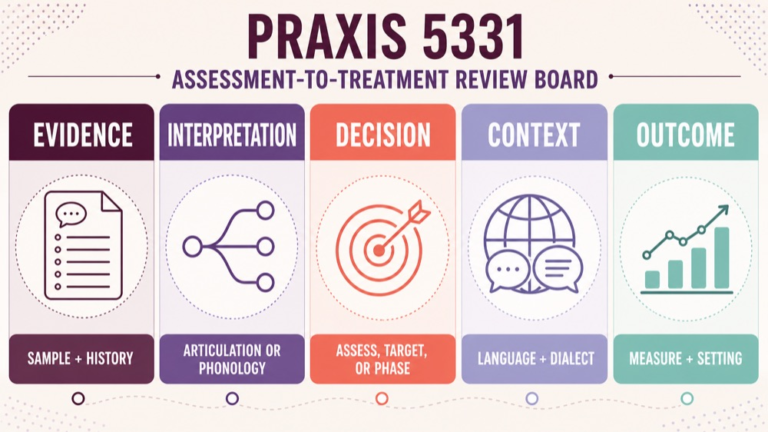
A review board helps you sort speech sound questions by the kind of reasoning they require. Put the case evidence on the left, the clinical decision in the center, and the outcome check on the right. Add a context note so the board does not treat a decontextualized sound list as the whole case.
| Board column | Write | Check |
|---|---|---|
| Evidence | Sample, pattern, context, and relevant history | Is the data sufficient? |
| Interpretation | Articulation, phonology, perception, or motor lens | What supports the lens? |
| Decision | Assessment, target, phase, or measure | Does it answer the task? |
| Context | Language, dialect, listener, and setting | Is interpretation fair? |
| Outcome | Measure and return condition | Can the change be checked? |
Use the board after a mixed question set. Group misses by evidence, interpretation, decision, context, or outcome. Then choose the next practice block from the group with the clearest repeated need.
Keep the board original and concise. It should capture your reasoning without reproducing protected question text or screenshots from a paid resource.
Question 1: assessment and pattern
Question 1: A child produces several consonants accurately in single words but omits final consonants in connected speech, and listeners often miss the ends of words. The question asks what review conclusion is best supported before choosing treatment.
- A. The single-word sample settles the concern, so connected speech is not needed.
- B. The connected-speech pattern and intelligibility impact should be examined as part of the assessment and treatment decision.
- C. Begin maintenance work because any accurate single-word production indicates stable carryover.
- D. Choose the most visible sound without considering the stated listener impact.
Correct Answer: B. The case includes a difference between structured single words and connected speech plus a listener impact. The review should preserve both the pattern and the functional consequence before selecting a phase or target.
Why the Other Options Are Wrong: A removes the context where the concern appears. C confuses isolated production with carryover and maintenance. D ignores the functional evidence. The best conclusion uses the broader sample and the stated impact.
Exam Trap: Structured accuracy can look stronger than functional communication. Check the speaking context and listener outcome before assigning a treatment phase.
Question 2: treatment sequence
Question 2: A learner can produce a target sound with a clinician cue during structured trials but does not use it in phrases or conversation. Which treatment-phase reasoning best fits?
- A. Focus on generalization and gradually increase linguistic or contextual challenge while monitoring carryover.
- B. Label the sound maintenance-ready because it appeared once with support.
- C. Stop measuring production because a single supported response is enough evidence.
- D. Remove the target from practice because structured success cannot guide planning.
Correct Answer: A. The target appears established with support but has not yet generalized to broader levels. The review should connect the phase to carryover and increase challenge in a planned way.
Why the Other Options Are Wrong: B treats one supported response as durable automatic production. C removes the outcome information needed to guide treatment. D discards useful evidence. The phase decision follows the difference between structured production and broader use.
Exam Trap: Establishment, generalization, and maintenance describe different treatment stages. Match the phase to the level and stability of production described.
Question 3: dialect and ethical reasoning
Question 3: A multilingual client uses a sound pattern that differs from the clinician’s expected form, but the case does not describe the client’s languages, dialect, exposure, or functional impact. Which next step is most responsible?
- A. Label the pattern disordered because it differs from the clinician’s familiar form.
- B. Gather relevant language and dialect information and examine functional communication before interpreting the pattern.
- C. Begin a target drill based only on the unfamiliar sound.
- D. Ignore the pattern and skip any assessment because difference is never relevant.
Correct Answer: B. The case lacks information needed for a fair interpretation. Relevant language, dialect, exposure, and functional data should be considered before assigning a disorder interpretation or treatment target.
Why the Other Options Are Wrong: A and C treat difference as sufficient evidence. D goes too far in the opposite direction by ruling out assessment. The responsible action gathers context and connects decisions to functional impact.
Exam Trap: The absence of context is itself a clue. A sound difference cannot be interpreted responsibly without considering the speaker’s linguistic system and communication needs.
Review common speech sound distractors
Speech sound distractors often contain a true clinical phrase placed in the wrong stage, context, or scope. Review the closest alternative instead of labeling it simply wrong. Ask whether it ignores the language system, skips assessment, chooses a target without impact data, or confuses establishment with generalization.
| Distractor pattern | Why it attracts attention | How to test it |
|---|---|---|
| Familiar treatment | The name is easy to recognize | Check stage and goal |
| Single data point | One accurate response seems decisive | Check context and repetition |
| Developmental shortcut | A memorized age fact feels efficient | Read the functional case |
| Dialect assumption | Clinician norm is treated as universal | Check linguistic context |
| Outcome omission | Action sounds reasonable | Ask how progress is measured |
Write the mismatch in one sentence. The closest choice is weaker because it applies a generalization activity before the target is stable, or because it interprets a difference without language and dialect context. That sentence becomes a reusable rule for the next set.
Use the question’s requested action as the final filter. If it asks for the next assessment step, a treatment target may be clinically reasonable later but still fail the task now.
Build a speech sound practice block
Use a small practice block with mixed task types. Include one pattern-identification item, one assessment item, one target-selection item, one treatment-phase item, and one outcome-monitoring item. Review each item by the same pattern-to-plan map.
| Block part | Example prompt | Review product |
|---|---|---|
| Pattern | What error distribution is described? | Pattern statement |
| Assessment | What evidence is missing? | Next information step |
| Target | Which factor supports selection? | Target rationale |
| Phase | Is production established or generalized? | Phase explanation |
| Outcome | What would you measure next? | Outcome and context |
Keep the block short enough to review carefully. Eight to fifteen questions can reveal whether the difficulty is a content gap, a sequence problem, or a context-reading issue. Increase volume after your explanations become specific.
Use new or original changed cases for transfer. Repeating the same letter can show recall, but it does not show whether you can use the pattern-to-plan reasoning when the setting or goal changes.
Track the reasoning, not only the letter
A speech sound review tracker should include the original answer, confidence, task, key evidence, clinical lens, closest distractor, and next action. Add the source and date. These fields let you see whether repeated misses come from content, assessment sequence, functional context, treatment phase, or outcome selection.
| Tracker field | Question | Example |
|---|---|---|
| Task | What did the item ask? | Choose the next treatment phase. |
| Evidence | Which clue controlled? | Target appears only with cueing. |
| Lens | What clinical frame applies? | Establishment versus generalization. |
| Distractor | Why was the nearest choice weaker? | It treated one response as carryover. |
| Next action | What will I practice? | Five phase-comparison items. |
Review high-confidence misses and low-confidence correct answers. A correct letter without a rationale can hide a fragile association, while a confident miss can reveal a rule that needs to be rebuilt from the evidence.
Keep source verification visible when a clinical fact is unclear. ASHA’s Practice Portal provides a useful reference boundary, but individual cases still require appropriate professional judgment and context.
Speech sound disorders Praxis practice questions checklist
Use this checklist for each small set.
- I identified the requested action before looking for a familiar treatment name.
- I mapped the item to a 5331 lens: foundations, assessment, diagnosis, treatment, or evaluation.
- I recorded the speech sample, context, and relevant history supplied by the stem.
- I distinguished articulation, phonology, perception, motor, and phonotactic clues when relevant.
- I checked hearing, language, dialect, and access context before interpreting a pattern.
- I connected target selection to impact, stimulability, relevance, and client factors.
- I matched establishment, generalization, or maintenance to the production stage.
- I named the closest distractor and the exact reason it was weaker.
- I connected the decision to intelligibility, participation, or the stated functional goal.
- I named how progress would be measured and in what context.
- I reviewed high-confidence misses and low-confidence correct answers.
- I wrote the rationale in my own words without copying protected source material.
- I created one changed-case transfer prompt.
- I used clear, compressed images and lazy loading on the study page.
The checklist keeps speech sound questions anchored to evidence and function. Your goal is not to memorize a single treatment word for every sound. Your goal is to explain why the selected action fits the pattern, stage, context, and outcome.
Sources and next steps
Use the ASHA Speech-Language Pathology Exam (5331) Content page for the current content categories and topic list. Use the ASHA Speech Sound Disorders: Articulation and Phonology Practice Portal for professional clinical framing, assessment considerations, target selection, treatment phases, and multilingual context.
Use the live ETS Speech-Language Pathology (5331) page for current exam identity, format, duration, question count, and changing test information. Use the ETS practice-test selector to identify current preparation options and read each resource’s access terms.
For a structured preparation path, see the SLP Study Center Complete Prep resource. On your next session, choose one speech sound lens, complete a small mixed block, write three pattern-to-plan cards, and test one changed context.