
Starting an slp praxis practice test for beginners can feel like opening a very large file with no obvious first page. The solution is to make the first test small, labeled, and reviewable. You do not need to know every topic before you begin. You need a calm condition, a record of what happened, and a plan for turning the result into the next study action.
The current ETS Speech-Language Pathology (5331) page describes a computer-delivered selected-response exam with 132 questions and 150 minutes. Use the live ETS page for changing test information. ASHA preparation guidance supports using the exam content and your strengths and weaknesses to shape preparation. This guide translates that starting point into a beginner-friendly first test and first week.
What a first practice test can tell you
A first practice test is a starting measurement, not a verdict. It can show which topics feel familiar, which question tasks feel confusing, how confidence compares with results, and where reading time disappears. Those observations are more useful when you record the conditions under which they appeared.
| First-test question | What to notice | Useful record |
|---|---|---|
| What felt familiar? | Topics answered with a clear rationale | Domain and confidence |
| What felt confusing? | Stem, term, sequence, or choice comparison | Repair category |
| What took time? | Reading, deciding, or returning | Pacing note |
| What changed? | Answers changed after rereading | Original and final choice |
| What needs a source check? | Unclear clinical or professional fact | Question and responsible source |
Expect an uneven first result. A broad exam reaches across several areas, and a beginner may have strong knowledge in one domain but little recent retrieval in another. A mixed score does not tell you which action to take until you sort the items by reason.
Use the first test to learn how the resource is written. Practice providers can differ in length, wording, explanations, and topic labels. Record the provider and set so you do not compare a short supported quiz with a timed mixed block as though they were the same event.
Start with a study question such as, Can I identify the task and controlling clue in a mixed set? That question gives the first session a manageable finish line.
Check the current 5331 reference
Before choosing a practice set, confirm that you are studying for the current Speech-Language Pathology (5331) exam. ETS is the responsible source for current test identity, administration information, format, question count, duration, and preparation links. Use the live page when details matter, because logistics and resource listings may change.
| Reference | Beginner use | What to record |
|---|---|---|
| ETS 5331 page | Confirm the exam and current overview | Page title and access date |
| ETS practice selector | Find subject-specific preparation options | Resource and terms |
| ASHA preparation guidance | Shape content-based study planning | Strengths and weaknesses |
| Practice provider | Use questions and explanations | Provider, set, and license status |
Keep current exam facts separate from beginner advice. The live ETS page can tell you the listed format and duration; it cannot determine whether your first session should be ten or twenty questions. That choice belongs to your starting condition and review time.
Do not build a plan from a search snippet alone. Use the responsible page for changing details and label third-party resources according to what they provide. A clear source note helps you understand what your practice result does and does not represent.
If you encounter a different number or time in an older guide, do not blend the two versions into one rule. Note the discrepancy and recheck the current source before changing your tracker.
Choose a beginner-friendly practice source
A beginner-friendly source makes the question purpose, answer explanation, and access condition clear. It does not have to promise an easy experience. It should give you enough information to complete a small block and enough explanation to review what happened.
| Source feature | Beginner question | Why it helps |
|---|---|---|
| Subject match | Does it identify SLP or 5331? | Protects relevance |
| Answer review | Does it explain why choices fit or fail? | Supports learning |
| Flexible length | Can I start with a short block? | Protects review time |
| Clear access | Do I understand the terms? | Supports responsible use |
| Topic labels | Can I sort results by domain? | Guides the next block |
| New practice | Can I test a changed case later? | Checks transfer |
Use the ETS practice-test selector to identify current options, then read the resource details before beginning. A free item set may be helpful for a first look, while a structured product may provide a larger explanation system. Choose based on the work you need the resource to do.
Do not collect several practice banks before you have reviewed one small set. More questions can create more noise when your process is still forming. Start with one resource, learn your review routine, and add another source only when you can interpret the conditions.
Keep your own notes in an original format. A paraphrased concept, a decision rule, and a changed-case prompt are enough to preserve learning without copying protected question text or redistributing screenshots.
Set up your first beginner practice test
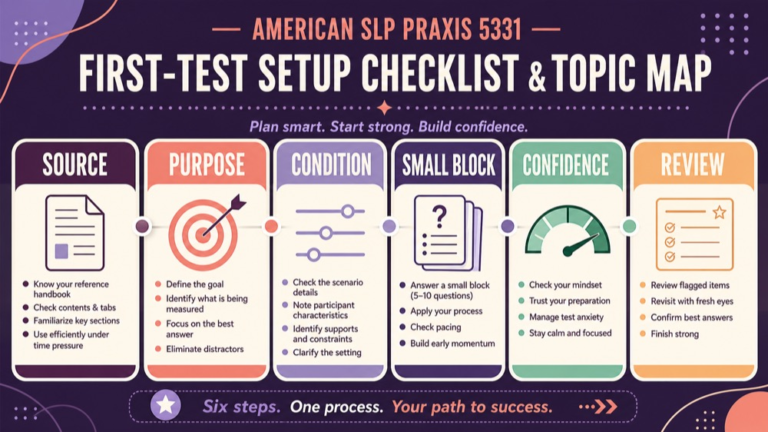
Set up the first session so the test measures a useful starting point. Choose a quiet window, gather the allowed materials, open one set, and decide whether the purpose is orientation or independent baseline work. Write the condition before answering the first item.
| Setup field | Beginner entry | Reason |
|---|---|---|
| Purpose | Orientation, baseline, or learning | Defines interpretation |
| Set size | 10–20 questions | Leaves room for review |
| Timing | Untimed or light timed | Separates knowledge from pace |
| Support | Closed notes or listed support | Preserves condition |
| Confidence | High, medium, or low before feedback | Shows calibration |
| Environment | Location, interruptions, and fatigue | Explains context |
If you are completely new to the subject or the testing interface, call the first session orientation. Learn where to read the stem, select an answer, flag an item, and return to a review list. If you already know the interface, use the same short size as an independent baseline.
Keep the first block small enough to finish the review on the same day. A beginner can learn more from ten carefully reviewed items than from a full run followed by no explanation work. The first goal is a repeatable routine.
Save the original responses before opening rationales. Mark whether each response was certain, uncertain, or a guess. Those labels give the review a useful starting point.
Use a small first block
A small first block reduces the chance that fatigue will hide the reason for an error. Ten to twenty mixed questions can introduce the style, reveal a few topic signals, and leave enough time to examine the choices. Increase the block only after you can complete the review process consistently.
| Block size | Good beginner purpose | Review output |
|---|---|---|
| 5–10 items | Learn the interface and note task types | Task words and questions |
| 10–20 items | Build a first mixed profile | Domain and confidence tags |
| 20–40 items | Practice a focused topic slice | Rationale cards |
| 40+ items | Later endurance or mixed practice | Pacing and fatigue notes |
Do not confuse a short set with low effort. A useful review asks what the stem requested, which clue controlled the decision, why one option fit, and why the closest alternative was weaker. That work can take longer than answering the item.
Use a timer for the whole block when you want a pacing observation, but do not force full exam speed on the first learning session. You can add timing after the task and rationale routine becomes familiar.
End the block with one sentence: I need to learn more about content, question task, sequencing, or pacing. That sentence tells you what to do next.
Record confidence before feedback
Confidence helps beginners separate knowledge from recognition. Before checking the answer, mark high when you could defend the choice, medium when two options remain plausible, and low when the selection is a guess. Use the same definitions across sessions.
| Result and confidence | What it may suggest | Beginner response |
|---|---|---|
| Wrong, high | A rule felt reliable but was mismatched | Compare the closest choice |
| Wrong, low | Content or clue was missing | Build a short concept card |
| Correct, low | Recognition or guessing may have helped | Explain without notes |
| Correct, high | Process is becoming stable | Check a changed case |
| Changed answer | Rereading shifted the decision | Record the controlling clue |
Do not treat low confidence as failure. It tells you where an explanation, retrieval prompt, or additional example can make the next decision clearer. Beginners need permission to record uncertainty honestly because it makes study time easier to target.
Review confidence after the rationale, not only the score. A beginner may select the right letter for an unhelpful reason. If you cannot explain the closest distractor, keep the item in the review group even when the score was correct.
Use one simple tracker rather than several apps. A date, source, condition, result, confidence, domain, and next action are enough to begin.
Map topics without panic
After the first block, sort items into broad content areas and decision skills. The list may include foundations, assessment, diagnosis, treatment, communication, swallowing, fluency, hearing, development, or professional practice, depending on the source. Keep the labels broad at first and add detail only when a repeated pattern appears.
- Write the resource topic label and your broader domain label.
- Mark the question task: identify, choose, prioritize, compare, or apply.
- Record the clue that should have controlled the choice.
- Note whether the problem was content, sequence, context, or pacing.
- Choose one next action that can be completed in a short block.
- Keep the number of items in the sample beside the pattern.
| Beginner pattern | Likely next step | Evidence of progress |
|---|---|---|
| Many unfamiliar terms | Vocabulary and concept retrieval | Own-word definitions |
| Known topic, wrong task | Read the final request first | Accurate task restatements |
| Two choices remain | Use a fit and sequence comparison | Closest-distractor reason |
| Good accuracy, slow pace | Short timed reading block | Flag and return notes |
| Mixed misses across settings | Changed-case practice | Transfer explanation |
A first sample can suggest a pattern without defining your ability. Keep the item count visible and look for repetition before assigning a large study project. One confusing question may need one source check rather than a new textbook.
Use your profile to choose a narrow next block. Beginners often benefit from fixing one process at a time: reading the task, marking evidence, comparing choices, or recalling a concept. A narrow target is easier to practice and observe.
Review the task and the closest choice
Answer explanations become useful when they show why the best option fits the requested action and why the closest distractor does not. Start with your original response, rewrite the task in your own words, and identify the smallest clue that changed the decision.
| Review prompt | Beginner note | Why it matters |
|---|---|---|
| What is being asked? | One sentence with the action word | Prevents a related answer |
| What is the key evidence? | One controlling case detail | Links stem to choice |
| Why does the best option fit? | Task, stage, goal, and context | Builds a rule |
| Why is the closest option weaker? | One specific mismatch | Sharpens comparison |
| What will I do next? | Lesson, retrieval, or new case | Creates an action |
Write the rationale in your own words rather than copying the provider explanation. If the explanation uses a clinical fact you do not understand, record the question and check an appropriate professional or official source before turning it into a study rule.
Review the four answer choices as a set. A distractor can be a reasonable action in a different stage or setting. The key is to describe why it is less fitting for the details in the stem, not to label it as universally bad.
Keep the review card short enough to use again. The purpose is to make the decision visible and retrievable, not to create a second copy of the resource.
Build a beginner pacing routine
Pacing can be practiced in small steps. The current ETS 5331 page lists 132 questions and 150 minutes; use the live page for current information. That average is a planning reference, not a requirement to spend the same amount of time on every item.
| Pacing step | Beginner behavior | Practice format |
|---|---|---|
| Read | Identify the final request before options | Untimed stem summaries |
| Decide | Compare the best two options | Short focused block |
| Flag | Mark unclear or time-heavy items | Light timed block |
| Return | Use a planned review window | Timed mini-simulation |
| Check | Protect time for unanswered items | Longer mixed block |
Begin with a light clock rather than a full simulation. For example, set a block time, record when you reach the halfway point, and note how many items you flagged. This gives you pacing information without turning the first lesson into an endurance test.
Use a flag-and-return rule. If the task is unclear, two choices remain plausible, or a source check would take too long, mark the item and continue. Practice returning later instead of letting one question determine the rhythm of the block.
Review accuracy and pace together. If your speed rises while your task restatements disappear, slow down enough to protect the decision process. A useful routine makes the next item easier to approach.
Use a beginner-friendly first-week loop
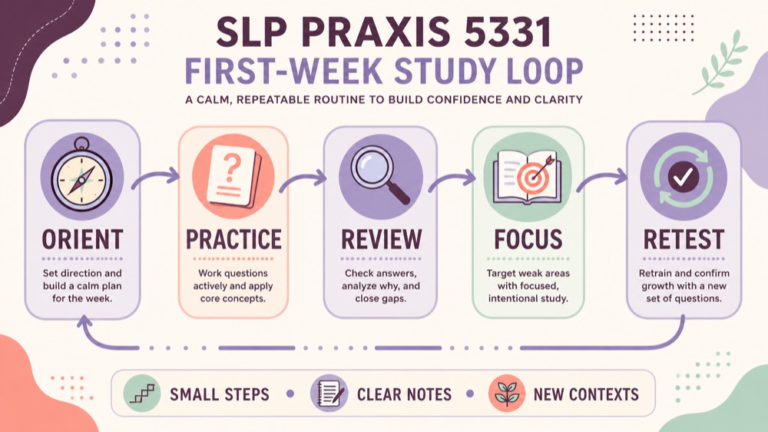
A first week can follow a simple loop: orient, answer a small baseline, review, study one repair, practice a changed case, and return to a mixed block. The loop gives beginners a clear sequence without requiring a full-length test every day.
| Day or session | Focus | Finish line |
|---|---|---|
| 1 | Confirm source and learn the interface | Complete five to ten items |
| 2 | Review task, evidence, and choices | Create three rationale cards |
| 3 | Study one repeated domain or skill | Explain one rule in your own words |
| 4 | Answer changed-case items | Complete one transfer check |
| 5 | Use a light timed block | Record pace and flag behavior |
| 6 or 7 | Take a new mixed mini-set | Choose the next repair |
Adjust the days to your schedule. The order matters more than the calendar: start with orientation, preserve original responses, review the decisions, target one pattern, add a clock, and then check the pattern in new items.
Do not use the week to chase a perfect percentage. Use it to learn how you work. A beginner who can explain three decisions and identify the next topic has a better planning signal than a beginner who completed a long set but cannot locate the source of the misses.
Keep the visual study page light as well. Use clear, compressed images with intrinsic dimensions and lazy loading for body visuals so the page remains quick while the learner reads questions and notes.
Question 1: choosing the first condition
Question 1: A learner has never used a Praxis-style online question set and wants to begin preparing for Speech-Language Pathology (5331). Which first session gives the clearest starting information?
- A. Complete a full-length timed set while checking notes after every item.
- B. Complete a small mixed set, record the source and support condition, and save answers before reading explanations.
- C. Read every available study guide before answering any question.
- D. Choose one answer pattern at random so the first score stays low.
Correct Answer: B. A small mixed set introduces the interface and question style while preserving enough review time. Recording support and saving original answers make the result easier to interpret.
Why the Other Options Are Wrong: A mixes orientation, measurement, and explanation into one condition. C postpones useful evidence about how the learner approaches questions. D removes the learning value of the session. The beginner-friendly option starts small and records context.
Exam Trap: A first practice session does not need to imitate every condition at once. Match the test condition to the purpose you wrote before beginning.
Question 2: reading a beginner score
Question 2: A beginner earns 70% on a short mixed practice block, but most correct answers were low-confidence guesses and the learner cannot explain the closest distractor. What is the best next action?
- A. Treat the percentage as proof that no further review is needed.
- B. Review the low-confidence items, rewrite the task and evidence, and practice a few changed cases.
- C. Take a much longer timed set immediately without recording confidence.
- D. Delete all correct items from the tracker.
Correct Answer: B. The score does not describe the quality of the reasoning by itself. Low confidence and weak distractor explanations identify a useful review target before increasing length or speed.
Why the Other Options Are Wrong: A ignores the uncertainty behind the correct letters. C adds fatigue before the process is clear. D removes information about calibration. The best next step turns uncertain results into rationale and transfer practice.
Exam Trap: A correct letter can come from recognition or guessing. Record confidence and explanation quality so the review sees more than the percentage.
Question 3: using practice material responsibly
Question 3: A beginner finds a paid practice set in a group chat and wants to upload the screenshots to a shared public folder for easier studying. Which action is most responsible?
- A. Upload the images because the folder is for education.
- B. Use an authorized access path, write personal paraphrases, and create original changed-case practice.
- C. Crop out the provider name before sharing the same screenshots.
- D. Share only the answer letters from the images.
Correct Answer: B. Authorized access and original notes preserve the learning goal without redistributing protected material. A changed-case prompt can test the concept without copying the source.
Why the Other Options Are Wrong: A assumes educational intent settles the permission question. C removes attribution but not reproduction. D can still distribute material derived from the paid set. The responsible action respects the resource terms and keeps the new study asset original.
Exam Trap: A private or student-focused location does not automatically define sharing permission. Check the source terms and build your own review cards.
Study one domain at a time
Once the first profile is clear, choose one domain or one decision skill for focused practice. Beginners often gain more from a narrow, explainable block than from jumping between every topic in one evening. Keep a neighboring topic in reserve for a later mixed check.
| Target | Focused activity | Completion rule |
|---|---|---|
| Vocabulary | Define terms in your own words | Explain five terms without notes |
| Sequence | Order case actions and justify stage | Explain three choices |
| Context | Change setting or partner in a case | State what evidence changes |
| Comparison | Name why the nearest distractor is weaker | Write five mismatch sentences |
| Retrieval | Answer before opening notes | Recall one rule next day |
Use the practice resource’s topic labels as a starting point, but add your own repair tag. The same domain can contain content and process mistakes. A stable tag helps you choose the right activity next time.
Keep the focused block short enough to review. Eight to fifteen items can be sufficient when each important miss becomes a rationale card or a changed-case prompt. More volume can wait until the routine is stable.
Move from untimed to timed work
Untimed work is useful for learning the task, evidence, sequence, and rationale. Timed work is useful for practicing the same decisions with a clock and a return routine. Move between conditions gradually so you know what changed.
| Step | Condition | Question to answer |
|---|---|---|
| 1 | Untimed, closed notes | Can I identify the task and evidence? |
| 2 | Untimed, explanation review | Can I explain the closest choice? |
| 3 | Light timed, short block | Can I keep the routine with a clock? |
| 4 | Timed, mixed block | Can I flag and return? |
| 5 | Longer simulation | Can I manage pace and fatigue? |
Do not interpret a timed miss as pure content weakness. Note whether the answer changed because you rushed, skipped a detail, or ran out of time. That distinction selects the next repair.
Use the same review card across conditions. When the structure stays stable, you can compare whether the problem was knowledge, reading, confidence, or timing.
Use explanations as teaching tools
Explanations are most useful when they teach a decision boundary. Ask what the item wanted, which evidence controlled, why the best option fit, why the closest option was weaker, and what changed case would test the rule. This turns passive reading into active review.
| Explanation step | Beginner prompt | Output |
|---|---|---|
| Restate | What action is requested? | One-sentence task |
| Locate | Which clue matters most? | Evidence phrase |
| Compare | Why is the nearest choice weaker? | Mismatch sentence |
| Transfer | What detail could change the answer? | New-case prompt |
| Retrieve | Can I explain it tomorrow? | Return check |
Use responsible sources for facts that shape clinical understanding. If an explanation conflicts with your course material or seems incomplete, note the uncertainty and verify it before writing a broad rule. The goal is a reliable learning record, not a confident sentence built on a guess.
Keep the provider wording out of your personal study asset when a paraphrase will do. Your own task summary, rule, and new example give you a more active way to retrieve the concept.
Repeat with new contexts
A beginner needs both repetition and variation. Repetition builds familiarity with the process; variation tests whether the process works when the setting, goal, communication partner, or stage changes. Use a new item or an original changed-case prompt after reviewing the first answer.
| Variation | What it tests | Review question |
|---|---|---|
| Setting | Context transfer | Which evidence changes? |
| Goal | Functional alignment | Does the best option change? |
| Stage | Sequence | What belongs now? |
| Partner | Communication demands | What support is relevant? |
| Time condition | Pacing and workflow | Can I flag and return? |
Change one meaningful feature at a time. If every detail changes, a beginner may not know which clue controlled the answer. A focused variation makes the learning signal easier to read.
Space the return. Review the rationale in the first session, retrieve the rule without notes later, and apply it in a mixed block after that. Keep the original answer hidden until the new response is recorded.
SLP Praxis practice test for beginners checklist
Use this checklist before, during, and after the first few practice sessions.
- I checked the current ETS 5331 page and recorded the access date.
- I chose a source that identifies the subject and explains its access terms.
- I wrote one purpose for the block: orientation, baseline, learning, pacing, or retest.
- I recorded set length, timing, support, environment, and interruptions.
- I saved original answers and confidence before checking feedback.
- I tagged each important item by domain and decision skill.
- I reviewed the task, evidence, best fit, and closest distractor.
- I wrote rationales in my own words.
- I created one changed-case prompt from a repeated pattern.
- I used a small block before attempting longer endurance work.
- I practiced a flag-and-return routine before full simulation.
- I scheduled a next study action with a clear finish line.
- I kept personal notes separate from copied or shared source material.
- I used responsive, compressed images and lazy loading on the study page.
The checklist keeps the first test friendly without making it passive. You are learning the exam content, the question process, and your own study conditions at the same time. Keep the next action small enough to complete and specific enough to review.
Sources and next steps
Use the live ETS Speech-Language Pathology (5331) page for current exam identity, selected-response format, duration, question count, and changing test information. Use the ETS practice-test selector to locate current preparation options and read each resource’s access terms.
Use ASHA Praxis preparation guidance when organizing a beginner plan around exam content and strengths and weaknesses. The setup routine, first-week loop, trackers, and practice questions in this article are original educational guidance. Verify changing details on the live responsible source.
For a structured preparation path, see the SLP Study Center Complete Prep resource. For your first session, choose one small mixed block, write the condition, preserve your original answers, and review three decisions before choosing the next study action.