
Learning how to use slp praxis practice tests starts with giving every test a job. One practice test can establish a baseline, a short domain set can teach a concept, a timed block can reveal pacing, and a later mixed set can check transfer. Treating every test as a score-only event creates a pile of numbers without a clear next move.
The current ETS Speech-Language Pathology (5331) page describes a computer-delivered selected-response exam with 132 questions and 150 minutes. Use the live ETS page for changing test information. ASHA preparation guidance recommends using exam content, preparation materials, practice questions, and strengths and weaknesses to shape study. The plan below turns those principles into a repeatable cycle.
What practice tests are for
A practice test is useful when it answers a study question. You may want to know whether the broad blueprint feels familiar, whether a domain needs a focused lesson, whether reading speed is affecting decisions, or whether a rule transfers to a changed case. Name that purpose before opening the test so the result has a clear interpretation.
| Purpose | Best test format | Useful output |
|---|---|---|
| Baseline | Mixed set under ordinary conditions | Domain, confidence, and pacing profile |
| Learning | Short untimed domain block | Rationale and concept notes |
| Application | Changed-case questions | Transfer decision |
| Pacing | Timed block with a visible clock | Time per item and flagging habits |
| Simulation | Full-length practice run | Endurance and process notes |
| Retest | New mixed set after review | Evidence that the repair travels |
The purpose changes what you record. For a baseline, capture the condition before you begin. For a learning block, write why each option fits or fails. For a simulation, note fatigue, breaks, pacing, and unanswered items. A score without those conditions is difficult to compare later.
Use practice tests to make study decisions, not to forecast an official result. A commercial set, a class set, an original item set, and an ETS resource can differ in wording and scope. Label the source, keep claims proportional, and verify changing exam details with the responsible source.
Check the current exam reference first
Before building a plan, confirm the current Speech-Language Pathology (5331) reference. ETS is the source for current test identity, administration information, format, question count, and duration. The ETS practice-test selector helps you locate current preparation options, while each provider controls the terms and content of its own resource.
| Reference | Use it for | Record in your plan |
|---|---|---|
| ETS 5331 page | Current exam details and preparation links | Access date and page title |
| ETS practice selector | Subject-specific preparation options | Resource name and access terms |
| ASHA preparation page | Study planning and practice guidance | Strengths, weaknesses, and chosen actions |
| Study resource | Questions and explanations | Provider, set, and license status |
Do not build your entire pacing plan from an old screenshot or a remembered number. Exam information can change, and practice resources may use a different item count or time setting. Put the date beside any administration note so you know when to recheck it.
Keep official information separate from your personal method. The exam page does not tell you which review card to use, and a commercial resource does not define the live test. Your plan can connect those pieces without presenting a study preference as an exam rule.
Use the current content outline to organize your domains. If a resource labels a topic differently, map it to the broader content area in your tracker and keep the original resource label in a note. This makes your results easier to compare across providers.
Choose a baseline test condition
A baseline is most useful when the condition is recorded and repeatable. Choose a mixed practice set that touches several domains, then decide whether the first run is untimed, lightly timed, or timed. If you are starting after a long gap, untimed work can reveal knowledge and reading patterns before a clock adds a second problem.
| Baseline field | Example entry | Why it matters |
|---|---|---|
| Source | Provider, set, or original item bank | Different sets make different claims |
| Length | 20, 40, or full-length block | Shows scope of the sample |
| Timing | Untimed, light timed, or timed | Separates knowledge from pace |
| Support | Closed notes or reference allowed | Defines the result condition |
| Confidence | High, medium, or low before feedback | Shows calibration |
| Fatigue | Fresh, moderate, or tired | Explains performance context |
Answer independently before reading explanations when the goal is measurement. Mark an answer as correct, incorrect, guessed, or changed. If you use notes or pause frequently, record that support instead of treating the result as a clean baseline.
Choose a manageable first block. A 20-item set can show patterns without consuming the entire study session, and a longer set can come later when you need endurance information. The right baseline is large enough to reveal a pattern and small enough to review carefully.
Save the raw result before correcting it. Your first answer, confidence, and time are study evidence. Once you read the explanation, you cannot recreate that exact starting condition from memory.
Build a domain starting profile
After the baseline, sort results by domain and by decision behavior. A wrong answer may reflect missing content, a missed task word, weak evidence selection, poor sequencing, or an overconfident distractor choice. Use both dimensions so your next block addresses the reason for the error rather than only the topic label.
- Record the content domain named by the resource or your own map.
- Mark whether the answer was correct, incorrect, guessed, or changed.
- Rate confidence before feedback with one consistent scale.
- Write the controlling clue or note that you missed.
- Name the closest distractor and its mismatch.
- Choose a small repair action for the next study block.
| Profile pattern | Likely study need | Next test design |
|---|---|---|
| Low score, low confidence | Build the concept and vocabulary | Short untimed lesson block |
| Low score, high confidence | Check the decision rule | Contrast and changed-case items |
| High score, low confidence | Strengthen rationale retrieval | Explain before checking notes |
| High score, slow pace | Practice reading and flagging | Short timed mixed block |
| Domain cluster of misses | Target the repeated concept | Focused domain set |
Do not let one percentage decide the profile. Look for repeated patterns across at least a few items, and keep the sample size visible. A small set can suggest a study question without establishing a broad conclusion.
Use confidence to find hidden work. Correct answers with low confidence may need a rationale card, while incorrect answers with high confidence may need a changed case that tests the rule. This profile is more actionable than a single total score.
Keep one short note about what worked. If you read the final request first, flagged uncertain items, or used a domain checklist successfully, preserve that habit in the next block.
Set a realistic pacing target
Pacing should support careful reading and a complete response process. The current ETS page lists 132 questions and 150 minutes; use the live page for current information. As a planning reference, that works out to a little over one minute per question on average, but an average is not a command to spend identical time on every item.
| Pacing note | What to measure | Study response |
|---|---|---|
| Reading time | Time before choosing an option | Practice stem summaries |
| Decision time | Time comparing the final choices | Use a two-option comparison |
| Flagged time | Items sent to a review list | Set a return rule |
| Transition time | Time lost between items | Use a consistent click-and-note routine |
| End-of-block time | Time left for review | Protect a final check window |
Measure your own block rather than chasing a universal pace. A learner who reads slowly but reaches a stable rationale may need reading practice, while a learner who moves quickly and changes answers repeatedly may need a deliberate comparison routine. Both are pacing issues with different repairs.
Use a simple flag rule. Mark an item when the stem is unclear, two choices remain plausible, or the decision requires a fact check. Then move on and return according to the block plan. Do not let one difficult item consume the time meant for several answerable items.
Review pacing together with accuracy. Faster work is not useful if the controlling evidence disappears. The goal is a repeatable process that leaves enough time to answer, flag, and check the set.
Use one question set for one purpose
Before a practice block begins, write one sentence describing its job. A set can be used for retrieval, application, pacing, review, or simulation, but trying to measure all five at once makes the result harder to understand. You can use the same broad resource across several sessions when the conditions and questions are labeled clearly.
| Session purpose | Instruction before starting | Record after finishing |
|---|---|---|
| Retrieve | Answer before notes | Confidence and recall gap |
| Apply | Explain the changed case | Rule transfer |
| Review | Read rationale and compare choices | Repair card |
| Pace | Use a clock and flag rule | Time by item group |
| Simulate | Match the planned conditions | Endurance and workflow |
Write the purpose on the first line of your tracker. When you return to the result, you will know whether a low score indicates content work, a timing problem, or a condition that included too much support.
Separate answer collection from answer teaching. In a retrieval block, collect the original responses first and review later. In a learning block, it is reasonable to check a rationale immediately, but label that session as explanation-led rather than comparing it with an independent test.
Use a new set or a changed case when you want evidence of transfer. Repeating the identical item can show recall, but it does not tell you whether the reasoning works when the surface details change.
Build a practice-test study ladder
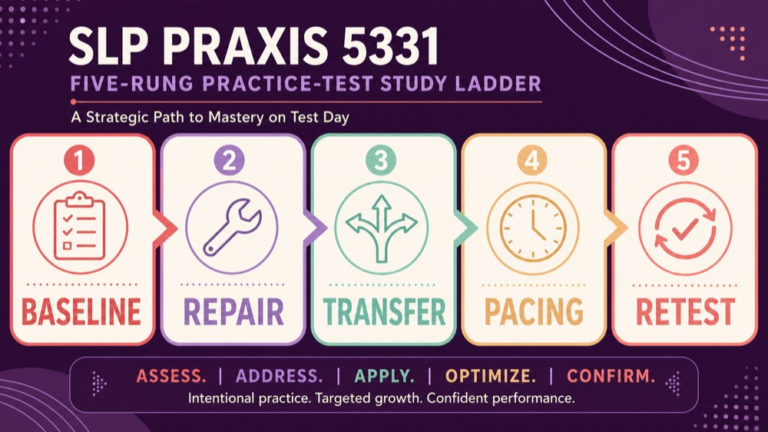
A study ladder gives practice tests a sequence. Begin with a baseline, move to one targeted repair, add a changed-case check, then use timed work and a later mixed retest. The ladder keeps you from jumping straight from one score to another without repairing the decision process in between.
| Ladder rung | Question it answers | Completion evidence |
|---|---|---|
| 1. Baseline | What is visible under this condition? | Source, score, confidence, and timing record |
| 2. Repair | What concept or process needs work? | Own-word rule and example |
| 3. Transfer | Does the rule work after one detail changes? | Changed-case explanation |
| 4. Pace | Can I use the rule with a clock? | Flag and return notes |
| 5. Retest | Does the pattern hold in a mixed set? | New-item rationale |
Stay on a rung long enough to collect evidence, but do not wait for a perfect feeling. One focused repair block and one transfer check can be enough to move toward timed practice. If the same pattern returns, step back to the repair rung and simplify the concept.
Use different questions for the retest when possible. A new item with a changed setting or goal is more informative than remembering the earlier letter. Keep the old card for comparison, not as the answer key for the new block.
The ladder also protects motivation. Every rung has a visible finish line: record, explain, transfer, pace, or retest. That makes a large exam feel like a set of manageable study decisions.
Run a domain-focused block
Use domain-focused practice after the baseline identifies a repeated need. Select a small topic slice, write the decision rule you want to test, and choose a block size that leaves time for review. For example, you might focus on distinguishing assessment sequencing from treatment selection, then deliberately include cases with similar vocabulary.
| Block element | Example | Why include it |
|---|---|---|
| Target | Assessment sequence | Defines the content and skill |
| Contrast | Clarification versus intervention | Creates a decision boundary |
| Set size | 8–15 items | Leaves time for explanation |
| Output | Three rationale cards | Turns answers into study material |
| Transfer | One changed setting | Checks application |
Do not isolate the domain so completely that every item announces its topic. After a short focused block, mix in one or two neighboring topics and ask whether you can recognize the tested skill without a heading. This protects transfer into a mixed practice test.
Keep the review narrow. Choose the missed concept, the controlling clue, and the next action. If a question opens a large textbook topic, record it for a separate lesson rather than letting one explanation consume the block.
Use the same domain tag in your tracker across providers. The wording can vary, but a stable tag lets you see whether a pattern belongs to content, sequence, context, or pacing.
Review answer choices and rationales
Answer review should explain the relationship between the task, evidence, and option. First record what you selected and how confident you were. Then identify the best option, the closest distractor, and the specific mismatch. A rationale that only says one choice is correct does not teach the boundary between choices.
| Review field | Prompt | Example output |
|---|---|---|
| Task | What exactly was requested? | Choose the next information step. |
| Evidence | Which clue controlled? | Performance changed by setting. |
| Best fit | Why does this option respond now? | It clarifies the named uncertainty. |
| Closest distractor | What could make it tempting? | It is useful later but premature now. |
| Next action | What will I do with the rule? | Practice two changed settings. |
Use official or professional sources to check clinical facts that matter to understanding. The practice question and rationale can be original, while the factual basis should be responsibly verified. Record the source and date when a claim may change or when the explanation does not settle your uncertainty.
Review correct answers that were guesses and incorrect answers that felt certain. Confidence adds information about calibration. A repeated high-confidence miss may call for a decision-boundary exercise, while a repeated low-confidence correct answer may call for retrieval practice.
Keep personal notes in your own words and do not reproduce protected question text or screenshots. A paraphrased stem, concept rule, distractor mismatch, and changed-case prompt are enough to build a useful review card.
Turn test results into a next-block plan
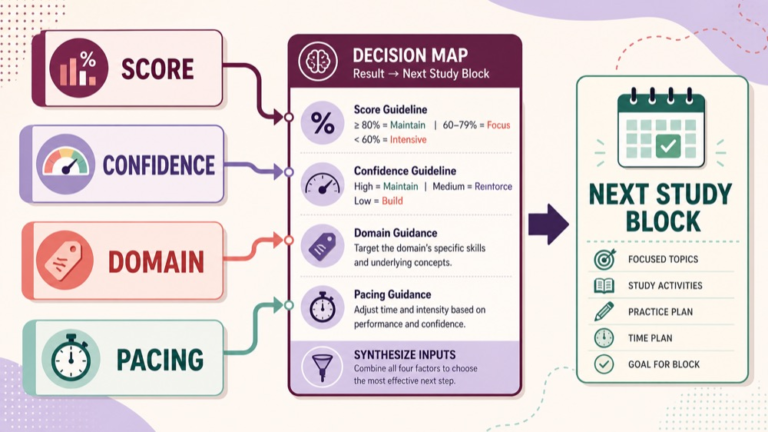
A test result becomes useful when it selects the next block. Combine domain, answer status, confidence, and pacing into one short decision. For example, a cluster of high-confidence misses in a treatment sequence under ordinary timing calls for sequence review and changed-case items, not simply another full-length test.
| Observed pattern | Next block | Finish line |
|---|---|---|
| Missed one concept repeatedly | Short lesson plus eight focused items | Explain the rule and one contrast |
| Correct but uncertain | Retrieval cards without notes | Give a rationale from memory |
| Accurate but slow | Two timed mini-blocks | Use the flag and return rule |
| Fast with many changes | Deliberate stem-and-choice routine | Record why an answer changed |
| Mixed domain misses | New mixed set with domain tags | Identify the repair pattern |
Write the next block before the score fades from attention. Include the target, set size, condition, review output, and return date. A plan that says study more is difficult to start and impossible to audit.
Use a small completion rule. You may finish when you can explain three missed items, transfer one rule to a changed case, or complete two short timed blocks with a stable flag routine. Completion is evidence of a study action, not a promise about a future score.
Let the next test change one meaningful variable. Move from untimed to timed, from one domain to mixed, or from familiar examples to a changed setting. Changing one variable makes it easier to interpret what the new result means.
Question 1: baseline interpretation
Question 1: A learner completes a mixed SLP Praxis practice set with notes open, records a high percentage, and does not mark confidence or time. What is the best use of this result?
- A. Treat the percentage as a direct forecast of the official result.
- B. Record it as a supported baseline and run a later independent block with confidence and timing notes.
- C. Stop studying because the result settles every domain.
- D. Discard the result because supported practice has no learning value.
Correct Answer: B. The result can still show which material felt familiar, but open notes and missing condition data limit its interpretation. A later independent block with the same recording fields creates a more useful comparison.
Why the Other Options Are Wrong: A overstates what one supported percentage can tell you. C treats a broad sample as complete evidence. D ignores the learning value of explanation-led work. The right review preserves the result and labels its condition.
Exam Trap: A high percentage can look precise while the testing condition remains unclear. In your study tracker, record support and confidence before comparing results.
Question 2: pacing and flagged items
Question 2: During a timed practice block, a learner spends several minutes on one uncertain item and then rushes through the final questions. Which next action best targets the pacing problem?
- A. Spend even longer on the next uncertain item to make the decision certain.
- B. Use a flag-and-return rule, record the time point, and practice short timed blocks before another full simulation.
- C. Remove all difficult questions from future practice.
- D. Choose the longest answer choice whenever the clock is low.
Correct Answer: B. The issue is not simply difficulty; it is the decision to let one item consume time needed for the rest of the block. A flag-and-return routine can be practiced in shorter blocks before endurance work.
Why the Other Options Are Wrong: A repeats the time leak. C removes the very decisions that need practice. D substitutes a wording shortcut for evidence and task fit. The useful repair preserves difficult items while controlling the return process.
Exam Trap: Pacing is a workflow skill as well as a reading skill. Review where time disappeared and what rule would have protected the remaining questions.
Question 3: responsible practice-source use
Question 3: A student wants to combine a paid practice provider’s full question set with a classmate’s shared answer screenshots in one public study folder. Which action best supports responsible preparation?
- A. Upload the screenshots because the folder is intended for students.
- B. Use the provider through its authorized access, keep private notes in original wording, and share only material permitted by the terms.
- C. Remove the provider name and post the screenshots as personal study notes.
- D. Post only the answer letters so the source text is not visible.
Correct Answer: B. The study plan can include licensed practice, personal paraphrases, and original changed-case items without redistributing protected material. Source boundaries are part of responsible practice.
Why the Other Options Are Wrong: A assumes a student purpose resolves permission. C removes attribution but does not change reproduction. D can still redistribute material derived from the provider. The responsible option keeps access and notes within the source terms.
Exam Trap: A convenient folder does not decide whether sharing is permitted. Review the resource terms and create original study prompts instead of copying the source.
Use a timed full-length simulation
A full-length simulation is a later rung in the plan, not the only form of practice. Use it after you have a pacing routine, a flag rule, and a way to review missed items. Match the intended condition as closely as your study environment allows, then record interruptions and fatigue instead of hiding them.
| Simulation note | Record | Why it helps |
|---|---|---|
| Start condition | Time, location, materials | Shows preparation context |
| Clock checkpoints | Item range and remaining time | Shows pace changes |
| Flag count | Items deferred and returned | Shows workflow |
| Breaks | Planned and unplanned | Explains time and fatigue |
| End review | Unanswered, changed, and uncertain | Creates the next block |
Do not review every item with equal depth after a full run. Start with high-confidence misses, repeated domain errors, and items that consumed unusual time. Then sample confident correct answers to check whether the rationale was sound.
Use the simulation to test process, not to imitate an official score report. Practice resources can differ from the live exam. Your most useful output is a set of specific study actions and pacing observations.
Leave recovery time after the simulation. Endurance information is valuable only if you can distinguish fatigue from an unlearned concept and then choose a manageable repair.
Use untimed mode for learning
Untimed practice is appropriate when the goal is to understand the task, locate evidence, compare options, and rewrite a rationale. Removing the clock can make the decision boundary visible. It should not become the only condition if you also need to practice screen workflow and pacing.
| Untimed behavior | Useful question | Later timed bridge |
|---|---|---|
| Read twice | What wording changed the task? | One deliberate first read |
| Use notes | Which concept did I retrieve? | Recall before checking |
| Compare choices | Why is the nearest option weaker? | Two-option contrast under time |
| Write a rationale | What rule transfers? | One-sentence rationale |
| Study a topic | What is the decision boundary? | Mixed neighboring topics |
Label untimed work honestly in the tracker. It is a learning condition, not a failed simulation. When the rule becomes clearer, move one variable at a time toward timed work.
Use brief notes rather than a complete textbook rewrite. The practice question should lead to a concept card, an example, a distractor mismatch, and a next retrieval prompt. This keeps the learning block connected to future test conditions.
Schedule repeats without memorizing
Repeating a practice test can be useful for checking process, but an identical score can be inflated by remembering the items. Space the return and add new questions, changed cases, or a mixed neighboring domain. The goal is to see whether the reasoning remains available outside the original set.
| Return stage | Use | Evidence to collect |
|---|---|---|
| Same session | Read the rationale and repair the card | Task, evidence, and distractor |
| Next study day | Retrieve the rule without notes | Own-word explanation |
| Later week | Answer a changed-case item | Transfer decision |
| Next mixed block | Use the rule among neighboring topics | Recognition and application |
| Later simulation | Recheck pacing and endurance | Workflow notes |
Keep old answers hidden during a retest. If you need to review the original explanation, do it after your new response is recorded. This preserves the difference between recognition and retrieval.
Do not force a retest before the repair is understood. A quick repeat can show whether you remember the letter, while a spaced changed-case check tells you whether the rule is usable.
Keep a lightweight score tracker
A tracker should be easy enough to maintain after every block. Use one row per session and add a small number of item-level notes for the most informative questions. Too many fields can turn the tracker into a second assignment, while too few fields make the result hard to interpret.
| Column | Example | Use |
|---|---|---|
| Date and source | Provider, set, and access date | Compare like with like |
| Purpose | Baseline, learning, pace, or simulation | Interpret the result |
| Condition | Timing, support, and interruptions | Preserve context |
| Result | Correct, wrong, guessed, changed | Find calibration patterns |
| Domain tag | Content area and repair type | Choose the next block |
| Next action | Eight items plus one transfer case | Create a finish line |
Use a simple score for the purpose of the session. A percentage can summarize a block, but it cannot replace the condition, confidence, and domain notes. Keep the raw count so you can see whether a percentage came from a small or large set.
Track trend lines cautiously. A change may reflect different resource difficulty, a new condition, fatigue, or a familiar repeated set. Your notes explain the number and help you choose the next test purpose.
How to use SLP Praxis practice tests checklist
Use this checklist before and after each practice block.
- I checked the current ETS 5331 reference and recorded the access date.
- I named one purpose: baseline, learning, application, pacing, simulation, or retest.
- I recorded the source, set length, timing, support, and interruptions.
- I wrote my original answer and confidence before checking feedback.
- I tagged the domain and the decision skill behind each important miss.
- I reviewed the task, decisive evidence, best fit, and closest distractor.
- I used a flag-and-return rule during timed work.
- I separated repeated-item recall from new-item transfer.
- I chose one repair action for the next study block.
- I set a small completion rule and return date.
- I kept personal notes in my own words.
- I respected provider access and sharing terms.
- I used lightweight, responsive images and lazy loading on the study page.
- I rechecked changing exam information with the responsible source.
The checklist keeps practice tests connected to learning. You do not need to take a full-length test every day. You need a cycle that records the condition, explains the decisions, repairs one pattern, and checks that pattern in a new context.
Sources and next steps
Use the live ETS Speech-Language Pathology (5331) page for current exam identity, selected-response format, duration, question count, and changing test information. Use the ETS practice-test selector to identify current preparation options and read the terms of each resource.
Use ASHA Praxis preparation guidance when organizing practice around exam content and strengths and weaknesses. The study ladder, tracker, and practice questions in this article are original educational guidance. Verify changing details on the live responsible source.
For a structured preparation path, see the SLP Study Center Complete Prep resource. For your next session, choose one purpose, run one manageable block, review the most informative items, and schedule the next rung before you close the tracker.