
Learning how to review slp praxis practice questions is different from checking the answer key. A useful item review reconstructs what the stem asked, identifies the evidence that controlled the decision, explains why the best option fit, and names why the closest distractor was weaker. It ends with one transfer prompt or study action.
The current ETS Speech-Language Pathology (5331) page describes a computer-delivered selected-response exam with 132 questions and 150 minutes. Use the live ETS page for changing test information. ASHA preparation guidance supports practice questions and plans shaped by strengths and weaknesses; the item-level method below gives you a repeatable way to use each question as study evidence.
What item-level review should produce
An item-level review should produce a usable decision rule, not only a corrected answer. The rule might tell you to clarify the goal before choosing a measure, to consider setting when performance changes, or to compare the closest distractor by stage and scope. A useful rule can be tested in another question with a changed detail.
| Review output | Question | Example record |
|---|---|---|
| Task | What did the stem ask? | Choose the next information step. |
| Skill | What decision was being tested? | Assessment sequencing. |
| Evidence | Which clue controlled? | Performance differs by setting. |
| Rationale | Why does the best option fit? | It reduces the named uncertainty. |
| Distractor | Why is the closest option weaker? | It chooses action before clarification. |
| Transfer | Where else can I use the rule? | Changed communication setting. |
Review wrong answers, guesses, and correct answers that you cannot explain. A correct letter can still rest on a fragile recognition pattern. Adding confidence and rationale quality to your item review reveals which decisions deserve another look.
Keep the process proportional. A short practice block does not require a long essay for every item. Use a compact card for routine items and a fuller note for a high-confidence miss, a repeated pattern, or a concept that remains unclear after explanation.
End with an action that can be observed. Write five new items in which the setting changes, explain the closest distractor, or retrieve the concept tomorrow without notes. The action makes the review more than a retrospective comment.
Confirm the question source and condition
Before reviewing an item, record where it came from and how you answered it. The source may be an official preparation product, a commercial study guide, a classroom set, or an original practice item. The condition may be independent, explanation-led, timed, untimed, or supported. These details affect what the review can tell you.
| Condition field | Examples | Why record it |
|---|---|---|
| Source | Provider, set, or original item. | Item style and explanation differ. |
| Mode | Independent or supported. | Feedback changes interpretation. |
| Timing | Untimed, light timed, or timed. | Pace can affect reading. |
| Notes | Brief scratch notes or full reference. | Shows available support. |
| Result | Correct, wrong, or changed answer. | Defines the review priority. |
| Confidence | High, medium, or low. | Reveals hidden uncertainty. |
Confirm that the practice material is relevant to Speech-Language Pathology (5331) or label it as broader SLP review. Do not attach a precise claim about the live exam to a resource whose purpose and scope are unclear.
If the resource permits a personal export, save only what you need. Otherwise, paraphrase the case and record the concept in your own words. A good review card preserves your reasoning without reproducing protected question text or redistributing screenshots.
When the explanation seems incomplete, mark the uncertainty instead of writing a confident rule. Verify the underlying concept with a responsible professional or official source, then update the card with the source and date.
Read the stem before the options
Start the review with the stem, not the correct answer. Read the final request and identify its action word: choose, identify, determine, prioritize, gather, recommend, or explain. Then summarize the case in a short sentence that includes the goal, context, and stage when they matter.
| Stem feature | Review prompt | Why it matters |
|---|---|---|
| Final request | What must I choose now? | Prevents answering a related question. |
| Goal | What outcome is named? | Connects choice to function. |
| Context | Where and with whom? | Shows transfer demands. |
| Stage | What is already known? | Protects sequence. |
| Contrast | What changes across conditions? | Identifies controlling evidence. |
If you start with the answer key, your memory can rewrite the original decision. Record your chosen letter and confidence first when the practice condition was independent. Then review why the decision moved toward or away from the correct option.
Use a one-sentence task restatement. For example, the item asks what information would clarify a setting-specific communication concern. This sentence gives you a reference point for evaluating every option.
Do not highlight every phrase. Mark the smallest set of details that changes the decision. A single setting contrast or stage cue can be more useful than a page full of color.
Identify the tested skill
After restating the task, name the decision skill. The topic may be assessment, treatment, anatomy, language development, fluency, swallowing, hearing, or professional practice, but the question can test a narrower action. Naming the skill helps you choose the right repair.
| Skill category | Item-level question | Repair type |
|---|---|---|
| Task recognition | Did I answer the requested action? | Read the final request. |
| Evidence selection | Which clue should control? | Mark one decisive detail. |
| Sequence | What belongs at this stage? | Order the steps. |
| Clinical application | Does the choice fit goal and context? | Use a changed case. |
| Option comparison | Why is one better than another? | Name the mismatch. |
| Professional judgment | What boundary or collaboration matters? | Verify the responsible source. |
Use the skill category in the review card even when you also record a content domain. A miss in assessment may be a sequence issue, while a miss in treatment may be a transfer issue. The topic tells you where the item lives; the skill tells you what to practice.
If you cannot name the skill, compare the options and ask what relationship separates them. The answer may involve a measure versus an intervention, acquisition versus generalization, or current evidence versus an assumption.
Keep categories stable across sessions. A consistent tag system makes it possible to notice repeated behaviors and choose a study block that addresses the pattern.
Mark the decisive evidence
Evidence is the detail that gives one option more weight than the others. It can be a setting, a communication partner, a developmental stage, a symptom pattern, a safety concern, a stated goal, or a professional constraint. Write the evidence in your own words and connect it directly to the chosen option.
| Evidence type | Question to ask | Example relationship |
|---|---|---|
| Setting | Where does the problem occur? | Clinic success does not settle workplace use. |
| Goal | What outcome is named? | Participation guides functional measurement. |
| Stage | What has been established? | Clarify information before selecting treatment. |
| Pattern | What changes across tasks? | Context may be part of the concern. |
| Boundary | What action is permitted or responsible? | Use legitimate study access. |
One decisive clue is enough for most cards. If several clues matter, rank them. Which detail would make you change the answer? That detail belongs at the top of the evidence field.
Compare your original evidence with the rationale. You may have noticed a clue but given it too little weight. That is different from failing to see it. The distinction tells you whether to practice evidence ranking or basic case reading.
Use a changed-case prompt to check the evidence boundary. Ask what would happen if the setting, goal, or stage changed. The answer should change only when the controlling evidence changes.
Compare options by fit and sequence
Reviewing the correct option is only half the work. Compare it with the closest distractor using task fit, evidence fit, sequence, context, and scope. A distractor may be appropriate in another situation while still being weaker for the item in front of you.
| Comparison lens | Correct option | Closest distractor |
|---|---|---|
| Task fit | Answers the exact request. | Answers a related request. |
| Evidence fit | Uses the controlling clue. | Ignores or overweights a clue. |
| Sequence | Fits the current stage. | Comes too early or too late. |
| Context | Matches goal and setting. | Uses an easier unrelated setting. |
| Scope | Stays within the stated role. | Overreaches or skips needed collaboration. |
Write the mismatch as a complete sentence. The closest option is weaker because it chooses an intervention before the uncertainty is clarified. The closest option is weaker because it measures clinic accuracy when the goal is workplace participation. Specific language creates a reusable decision rule.
If the item is content-heavy, also ask whether the distractor uses a true statement in the wrong context. This is a common source of uncertainty in selected-response questions. A true fact can still fail the task if its timing, purpose, or setting does not fit.
Do not use answer length, technical vocabulary, or a familiar phrase as your comparison method. Return to the requested action and the evidence that the stem supplied.
Use confidence to prioritize review
Confidence makes the review queue more intelligent. High-confidence misses deserve close attention because an incorrect rule felt reliable. Low-confidence correct answers deserve a brief check because the result may have come from guessing or recognition. Medium-confidence answers can be reviewed when they match a repeated pattern.
| Result | Confidence | Review priority |
|---|---|---|
| Wrong | High | High: inspect the rule and evidence. |
| Wrong | Low | Medium: identify the missing knowledge or clue. |
| Correct | Low | Medium: verify the rationale and transfer. |
| Correct | High | Light: confirm the evidence and move on. |
| Changed answer | Any | High: record what changed the decision. |
Use a simple confidence scale before feedback. High can mean you could defend the choice, medium can mean two options remain plausible, and low can mean the answer is a guess. Define the scale once and use it consistently.
Review confidence calibration across a block. If high-confidence misses cluster around one task type, prioritize that task. If low-confidence correct answers become more explainable after review, the strategy is building a more stable process.
Do not punish uncertainty. Uncertainty is information about where a rationale, source check, or changed-case practice can help. The goal is to make the next decision clearer.
Rewrite the rationale in your own words
A rationale should connect the task, evidence, and option. Rewrite it as a short explanation that you could use to teach the decision to a study partner. Then add one sentence about the closest distractor. The rewrite shows whether you understand the boundary or are only repeating the provider’s wording.
| Rationale part | Prompt | Useful sentence starter |
|---|---|---|
| Task | What was requested? | The item asks for… |
| Evidence | What controls the decision? | The key clue is… |
| Fit | Why does the answer respond? | This option fits because… |
| Distractor | Why is the alternative weaker? | The closest choice misses… |
| Transfer | What change could alter the answer? | If the setting changed… |
Keep the rewrite accurate and concise. If you need a long paragraph to defend the answer, the decision boundary may not be clear. Return to the stem, find the controlling clue, and ask which option answers the exact request at the stated stage.
Use source verification for concepts that affect clinical understanding. The item review can be original while the clinical fact is checked against an appropriate professional or official source. Record the source date for facts that can change.
Turn the rewrite into a retrieval prompt. Cover the answer and ask what the setting contrast, goal, or stage would require. This creates a small study tool from one reviewed question without copying the original resource.
Use the six-field question review card
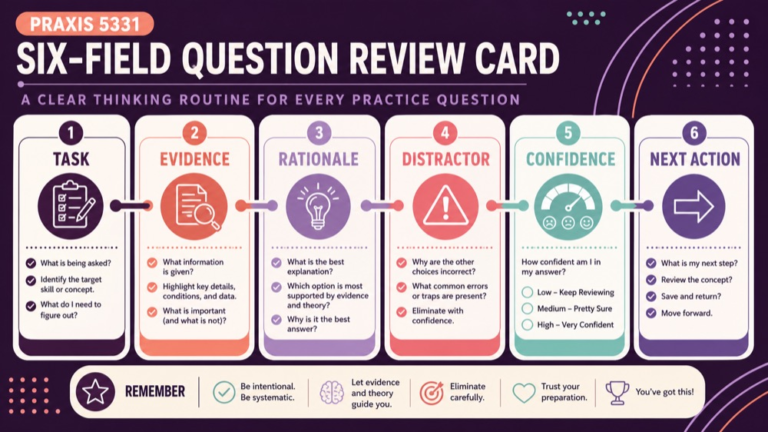
The six-field card gives each practice question a compact review path: task, tested skill, evidence, answer, closest distractor, and next action. Add confidence and condition as small header fields. Use the card after independent answering or while reviewing an explanation-led block.
| Card field | Write | Finish when |
|---|---|---|
| Task | Exact request in your words. | The action is clear. |
| Tested skill | Sequence, evidence, application, or boundary. | The repair category is named. |
| Evidence | Controlling clue. | The clue connects to the choice. |
| Answer | Best option and confidence. | Original decision is recorded. |
| Distractor | Closest alternative and mismatch. | The weakness is specific. |
| Next action | Study block or transfer prompt. | A return check is scheduled. |
Use one card for a routine item and a fuller card for a repeated or high-confidence error. A six-field structure is enough to keep the reasoning visible without making review too slow to sustain across a practice set.
Place the answer and confidence before the rationale when the condition was independent. Place the source and date at the top. These small habits preserve the difference between what you originally knew and what the explanation supplied.
Review a stack of cards by tested skill. If several cards say sequence, build a sequence block. If several say context, create changed-setting cases. The card creates the raw material for a targeted study plan.
Build a question-to-study transfer map
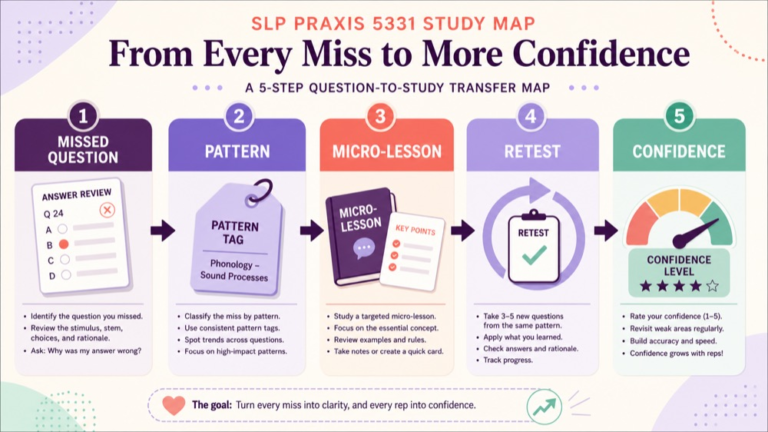
A transfer map connects one reviewed item to the next study experience. Start with the original decision, write the rule, change one meaningful case feature, and choose a small practice block. Finish by scheduling when you will revisit the result.
| Map step | Prompt | Example output |
|---|---|---|
| Original item | What decision did I make? | Selected a next information step. |
| Rule | Why did the best option fit? | Clarify the uncertainty before acting. |
| Changed case | What feature will vary? | School setting instead of home. |
| Practice block | How will I test the rule? | Five new case questions. |
| Return check | When will I review it? | Next study day. |
Change one feature at a time. If you change the client, setting, goal, and stage together, the result may not reveal which detail controlled the answer. A focused changed case tests transfer more clearly.
Use the map for content and process. A content map may move from a concept definition to a case application. A process map may move from a missed task phrase to five items that require naming the requested stage. A screen map may move from long notes to a brief timed block.
Keep the map separate from the original question text. Your own paraphrase, rule, and changed case are enough to practice the reasoning. This also gives you a clean personal study asset that does not depend on sharing protected material.
Question 1: reviewing a context clue
Question 1: A practice item describes a student who follows directions accurately during a quiet individual task but misses parts of directions during noisy group work. The question asks what information should be gathered before selecting the next evaluation step. Which review conclusion best fits?
- A. The quiet task settles the issue, so the group setting can be ignored.
- B. The setting contrast is decisive, so performance should be compared under relevant quiet and group demands.
- C. Treatment should begin before the group demand is examined.
- D. The correct choice should be the option with the most technical vocabulary.
Correct Answer: B. The stem supplies a meaningful contrast between individual and group conditions. Reviewing the item should preserve that evidence and connect it to the requested information-gathering step before choosing an intervention or dismissing the functional concern.
Why the Other Options Are Wrong: A removes the group evidence. C selects treatment before clarifying the evaluation question. D uses wording as a shortcut instead of task and evidence fit. The best review note names the setting contrast and the next information step.
Exam Trap: A successful performance in one condition can pull attention away from the condition where the concern appears. In review, write the context contrast before you compare the options.
Question 2: reviewing a treatment goal
Question 2: A client uses a communication strategy during a structured clinic drill but does not use it during workplace meetings. The stated goal is participation in meetings. Which review action best tests whether the treatment reasoning transfers?
- A. Repeat only the clinic drill and remove the workplace goal.
- B. Create a workplace-like practice case and measure strategy use in the functional setting.
- C. Decide that the strategy is ineffective in every context.
- D. Add more clinic repetitions without changing the setting.
Correct Answer: B. The review should connect the strategy to the stated participation goal and examine the setting where the goal matters. A workplace-like case can reveal partner, task, or environmental demands that are not present in the clinic drill.
Why the Other Options Are Wrong: A and D repeat the condition that already showed limited transfer. C makes a broad conclusion from a setting difference. The correct action changes the relevant context while keeping the functional goal visible.
Exam Trap: Acquisition and generalization are different review targets. When the stem names a participation setting, include that setting in the transfer check.
Question 3: reviewing a study boundary
Question 3: A learner wants to share screenshots from a paid practice resource in a private class folder because the explanations are useful. Which review action best supports responsible preparation?
- A. Upload the screenshots because the folder has limited access.
- B. Paraphrase the concept in a personal review card and use licensed access for the resource.
- C. Remove the provider name and upload the same images.
- D. Share only the answer letters from the screenshots.
Correct Answer: B. A personal paraphrase, an original transfer case, and licensed access preserve the learning function without reproducing or redistributing protected material. The review card can capture the reasoning boundary without copying the resource.
Why the Other Options Are Wrong: A treats privacy as permission. C removes attribution but does not resolve reproduction. D still shares material derived from the paid resource. The responsible action keeps the review original and uses an authorized access path.
Exam Trap: The convenience of a digital folder does not decide the permission question. Review the proposed study action for source boundaries as well as learning value.
Review right answers and uncertain choices
Do not limit item review to incorrect letters. A correct answer chosen with low confidence, a changed answer, or an answer selected from a familiar phrase can reveal a weak process. Add a light card so you can verify the evidence and build confidence from explanation rather than luck.
| Correct-answer signal | Card question | Next move |
|---|---|---|
| Low confidence | What evidence supports the answer? | Write the decisive clue. |
| Changed answer | What caused the change? | Record the new evidence. |
| Familiar wording | Would a changed case alter the choice? | Create a transfer item. |
| Fast selection | Did I read the final request? | Repeat a deliberate read. |
| Unclear rationale | Can I explain the closest distractor? | Verify and rewrite. |
This approach keeps the review balanced. A score can stay stable while the quality of your explanations improves. That is useful evidence because it shows that your decisions are becoming more defensible, not merely more familiar.
Use a smaller amount of detail for well-explained high-confidence correct items. The goal is to protect review time for the choices that can teach you the most about task, evidence, and transfer.
Group questions by repair pattern
After creating individual cards, group them by the repair they require. The groups may include task recognition, evidence selection, sequence, content retrieval, application, distractor comparison, transfer, or screen workflow. Grouping helps you choose the next block without rereading every card from the beginning.
| Repair group | Practice design | Completion evidence |
|---|---|---|
| Task recognition | Name the request before options. | Five task restatements. |
| Evidence selection | Mark one controlling clue. | Clue-to-answer link. |
| Sequence | Order stages in new cases. | Stage justification. |
| Content retrieval | Explain the rule before notes. | Own-word explanation. |
| Application | Change setting or goal. | New-case decision. |
| Distractor comparison | Name the closest mismatch. | Specific elimination reason. |
Choose one group for the next study block. A broad card stack can make you feel behind, while one repair group gives you a manageable target. Keep the remaining cards visible but do not try to fix every category at once.
Use the original cards to choose the difficulty of the new block. Start close to the original decision, then add one changed feature. If the transfer result is weak, simplify the change and rebuild the rule before increasing volume.
Schedule spaced item review
Return to reviewed items across time. The first review checks explanation. A later review checks retrieval. A third review checks transfer. Spacing the same reasoning pattern prevents the answer card from becoming a one-session memory and gives you more information about what remains usable.
| Return point | Question | Record |
|---|---|---|
| Same session | Can I state the rationale? | Rule and distractor. |
| Next day | Can I retrieve the rule without notes? | Own-word recall. |
| Later week | Can I apply it to a changed case? | Transfer result. |
| Next cycle | Does it hold in a mixed set? | Task and domain tag. |
Do not reread the full explanation before every return. Attempt the task, evidence, and rule first. Then check the card for accuracy. The attempt gives you a better view of what remained available.
Use a simple calendar or study tracker. Mark the card’s repair group, return date, and transfer result. A small schedule is easier to maintain than a large spaced-repetition system that requires constant data entry.
Use a short review session
An item-level review session can be short and focused. Choose a small set of cards, complete the six fields, group the repairs, and schedule the next check. The session should end with a decision about the next practice block rather than an endless search for more questions.
- Minute 1: label the source, condition, and review purpose.
- Minutes 2–5: reconstruct the task, tested skill, evidence, answer, and confidence.
- Minutes 6–10: compare the correct option with the closest distractor.
- Minutes 11–15: rewrite the rationale and create one changed case.
- Minutes 16–20: group cards, choose a repair block, and schedule a return.
Adjust the clock to your schedule. The important sequence is reconstruct, explain, transfer, and act. If a concept requires deeper reading, place that source review in a separate block so the item card remains clear.
Keep your study screen light. Use compressed, appropriately sized visuals and lazy-load body images on the page so the online review itself does not create unnecessary browser delay. The page should support attention for the questions and notes.
How to review SLP Praxis practice questions checklist
Use this checklist for each question or small batch.
- I recorded the source, set, date, item count, and 5331 relevance.
- I labeled independent, supported, timed, untimed, or explanation-led conditions.
- I recorded my original answer and confidence before checking feedback.
- I restated the final request in my own words.
- I named the tested skill or repair category.
- I identified the smallest decisive evidence clue.
- I explained why the best option fit the task, stage, goal, and context.
- I explained why the closest distractor was weaker.
- I reviewed high-confidence misses and low-confidence correct answers.
- I rewrote the rationale without copying protected resource text.
- I created one changed-case transfer prompt.
- I chose one next block with a completion rule.
- I scheduled a return check.
- I checked changing exam information against the live responsible source.
The checklist keeps item review active and practical. You do not need to create a long essay for every question. You need enough information to see the decision, repair the rule, and test it again in a new context.
Sources and next steps
Use the live ETS Speech-Language Pathology (5331) page for current exam identity, selected-response format, duration, question count, and changing test information. Use the ETS practice-test selector to identify current preparation options and read the terms of each resource.
Use ASHA Praxis preparation guidance when organizing practice questions around strengths and weaknesses. The review method in this article is original educational guidance: reconstruct the task, identify evidence, compare the closest distractor, rewrite the rationale, and test one transfer case.
For a structured preparation path, see the SLP Study Center Complete Prep resource. The next time you finish a practice set, choose one question card, one repair group, and one changed case. That small chain is enough to turn an answer key into a study decision.