
An slp praxis practice test strategy should tell you what to do before, during, and after a practice set. Start with a baseline, choose a skill to build, use active retrieval and clinical reasoning, review rationales, and then change one part of the plan based on evidence. More questions are not automatically a better strategy when the review process is missing.
The current ETS Speech-Language Pathology (5331) page describes a computer-delivered selected-response exam with 132 questions and 150 minutes. Use the live ETS page for changing test information. ASHA preparation guidance supports a plan shaped by your strengths and weaknesses, while the system below gives you a practical way to turn that guidance into repeatable study decisions.
What a practice-test strategy should solve
A strategy is a sequence of choices, not a collection of motivational phrases. It should help you decide what to practice, how to answer, when to review, and how to use the result. If the plan only says take more tests, it leaves the most important decisions undefined and makes it difficult to learn from a miss.
| Strategy question | Useful decision | Evidence to save |
|---|---|---|
| What is the goal? | Recall, reasoning, transfer, pacing, or review. | Purpose label. |
| What is the baseline? | Current performance under a named condition. | Raw result and error pattern. |
| What should change? | One task, content, or workflow behavior. | Target repair. |
| How will I practice? | Short block, mixed set, or timed rehearsal. | Mode and item count. |
| How will I know? | A changed case or comparable retest. | Transfer result. |
Choose a primary strategy goal for each block. A content-learning block can include explanations, while an independent benchmark should delay feedback. A pacing block should record where time accumulates, while a transfer block should change the case setting or goal. Matching the mode to the goal makes the result easier to interpret.
Build the strategy around the decisions the question asks you to make. SLP Praxis preparation can involve foundations, assessment, diagnosis, treatment, professional practice, and clinical application. The strategy should move you from recognition to evidence-based option comparison instead of encouraging a single memorized phrase.
Use a small number of repeatable rules. A plan that requires ten different apps, color codes, and daily measurements may look organized but can compete with study time. A source, a question block, an error log, and a scheduled review can support a strong cycle when you use them consistently.
Start with the current source and purpose
Begin with the current ETS Speech-Language Pathology (5331) page. Use it to verify the subject, current format, question count, duration, and preparation links. The page currently lists 132 questions and 150 minutes for a computer-delivered selected-response exam, but administration details belong to the live source and should be checked again near your test date.
Use the ASHA Praxis preparation guidance to frame a plan around your knowledge and weaknesses. The live ETS Speech-Language Pathology Praxis prep course page describes a full-length Praxis-style test and rationale review features. Read each resource’s stated purpose before assigning it a role in your plan.
- Confirm the subject: label the material as Speech-Language Pathology (5331) or broader SLP review.
- State the purpose: choose learning, independent retrieval, clinical reasoning, transfer, pacing, or simulation.
- Set the review rule: decide whether explanations are immediate, batched, or delayed.
- Record the condition: write source, item count, device, timing, and support.
- Keep the source boundary: use ETS for current test information and legitimate preparation access for study material.
This first step prevents a common strategy error: using an online resource for a purpose it was not designed to measure. A short quiz can teach a concept. It may not tell you how you will work through a long mixed set under a time condition.
Build a baseline before choosing tactics
A baseline is a clearly labeled practice observation before you change the plan. It does not need to be a full-length test. Choose a manageable set, answer under a defined condition, record the result, and tag each miss or uncertainty. The baseline gives you a starting point for deciding which strategy layer deserves attention.
| Baseline field | Example | Why it matters |
|---|---|---|
| Items | 30 mixed selected-response items. | Shows the sample size. |
| Mode | Independent, delayed review. | Shows the support level. |
| Result | Correct items and percentage. | Provides a local signal. |
| Confidence | High, medium, or low per item. | Shows hidden uncertainty. |
| Errors | Task, evidence, content, sequence, or distractor. | Points to the repair. |
| Timing | Untimed or light timed. | Separates pace from knowledge. |
Do not choose a tactic because it is popular or because one result feels uncomfortable. Look for repeated evidence. If the baseline shows that you know the content but miss the requested stage, a task-reading and sequence strategy may be more useful than more notes. If you cannot explain the core concept, focused retrieval and source review deserve priority.
Use confidence as a second baseline. High-confidence misses can reveal an overbroad rule. Low-confidence correct answers can show that you are guessing. Tracking both prevents the percentage from hiding the stability of the underlying process.
Repeat the baseline only when you can keep the source, item count, mode, and review rule reasonably stable. A different source or topic mix can be valuable, but label it as a separate observation instead of forcing it into one trend line.
Use active retrieval for content
Active retrieval means attempting to produce an answer or explanation before looking at the source. For SLP study, that can include defining a concept in your own words, sorting a clinical sequence, predicting the best measure, or explaining why a distractor is weaker. The attempt exposes what you can use, not only what looks familiar on a page.
| Retrieval task | Prompt | Useful check |
|---|---|---|
| Definition | What does the concept mean? | Plain-language explanation. |
| Contrast | How are two options different? | Decision boundary. |
| Sequence | What comes before the next action? | Stage and purpose. |
| Application | Where would the rule change? | Changed case. |
| Distractor | Why is the closest option weaker? | Specific mismatch. |
Use short retrieval prompts before opening a rationale or textbook. If your explanation is incomplete, mark the missing piece. Then verify it with a responsible source and rewrite the rule in your own words. This creates a link between the attempted answer and the correction.
Alternate retrieval formats. A spoken explanation may reveal a gap that a recognition quiz hides. A quick handwritten sequence may show whether you can order the steps. A selected-response block then tests whether you can apply the rule when plausible distractors are present.
Do not turn retrieval into a demand for perfect wording. The goal is an accurate, usable relationship between the task, evidence, and action. If you can state the concept plainly and use it in a changed case, the strategy is producing useful evidence.
Use clinical reasoning for case items
Clinical case questions often become easier to review when you separate the case from the answer choices. First identify the stated goal, setting, stage, and communication concern. Then ask what information is available, what uncertainty remains, and what the question is requesting. Only after that should you compare the options.
| Reasoning layer | Question | Common strategy error |
|---|---|---|
| Goal | What outcome or participation need is named? | Replacing it with an easier clinic target. |
| Context | Where and with whom does performance occur? | Ignoring setting differences. |
| Stage | What has already been established? | Choosing a later action too early. |
| Evidence | Which detail changes the decision? | Choosing by topic alone. |
| Action | What does the item ask you to choose now? | Listing every possible action. |
Use a task-and-evidence sentence before options. For example, the task is the next information step; the evidence is performance changes across settings. This sentence makes the decision target visible and reduces the pull of an attractive intervention that does not answer the request.
When reviewing a clinical case, identify the closest distractor rather than only the obviously wrong options. The closest choice often shares the same topic but misses the goal, stage, or context. Naming that mismatch gives you a portable reasoning rule.
Practice transfer by changing one feature of the case. If the best answer changes, explain the new evidence. If it remains the same, explain what stayed controlling. A strategy that survives a changed case is more useful than a phrase memorized from one item.
Distribute practice across the week
Distributed practice gives you multiple opportunities to retrieve and apply a rule across time. Instead of putting every topic into one long weekend block, assign short focused sessions and return to the same decision pattern later. The schedule should leave room for review, sleep, and adjustment rather than filling every available hour with new questions.
| Day type | Primary work | Evidence to carry forward |
|---|---|---|
| Learn | Focused concept retrieval. | Rule and example. |
| Apply | Case-based selected response. | Evidence and option comparison. |
| Review | Rationales and error tags. | Repair action. |
| Transfer | Changed setting or goal. | What changed and why. |
| Time | Light-timed block. | Pacing friction. |
Return to difficult material after a gap rather than rereading it immediately until it feels smooth. A later retrieval attempt tells you whether the rule remained available. If it did not, shorten the content set, add an explanation, or create a better transfer prompt.
Distribute topics as well as formats. A week can include a focused foundation block, an assessment sequence block, a treatment transfer block, and a mixed set. Keep the error log categories consistent so you can see whether the same process issue appears across domains.
Use a realistic weekly volume. A smaller number of reviewed items can provide more strategy evidence than a large unreviewed set. The plan should protect the time needed to explain answers and write the next action.
Move from single-domain to mixed sets
Focused sets are useful for learning a pattern. Mixed sets are useful for practicing selection when the topic is not announced in advance. Move between them deliberately. If you start with only mixed questions, a content gap and a switching problem may look identical. If you stay with one topic too long, you may not practice recognizing which reasoning frame the new item requires.
| Set type | Best use | Review question |
|---|---|---|
| Single concept | Build a new rule. | Can I explain the rule? |
| Single domain | Practice related decisions. | What evidence separates options? |
| Two-domain blend | Practice controlled switching. | What task category is this? |
| Mixed set | Practice recognition and selection. | What is requested now? |
| Changed-case set | Test transfer. | What detail changes the answer? |
Use a progression that matches your baseline. Start with a focused set when the rule is new, blend two nearby topics when the rule is becoming usable, and add mixed sets once you can explain the decisions. The exact item count can vary; the strategy logic should remain visible.
Review the switching errors separately. If you choose a treatment action for an assessment question, the problem may be category recognition rather than missing treatment knowledge. Add a short task-identification warm-up before the next mixed block.
Keep the mixed set honest. Do not preview the topic labels if your goal is to practice recognizing the task, but do record the labels afterward for review. This creates a useful separation between answering and analyzing.
Schedule explanations and rationales
Rationales should be scheduled as part of the strategy, not treated as optional cleanup. An explanation can clarify why one option fits and why the closest alternative fails. Your job is to convert that explanation into a rule, a changed case, and a future question to ask yourself.
| Review moment | Best use | Output |
|---|---|---|
| After one item | Learn a new concept. | Short rule and example. |
| After a small batch | Compare related decisions. | Pattern across items. |
| After the set | Protect independent retrieval. | Error log and priority. |
| Next day | Retrieve the repair. | Recall without the source. |
| Later in the week | Test transfer. | Changed case and result. |
When the resource supplies immediate feedback, decide whether that matches your purpose. Immediate feedback is useful for teaching. For an independent baseline, record the answer first and wait to open the explanation until the block ends. Do not mix these conditions without labeling them.
Rewrite the rationale in plain language. A useful version identifies the task, the controlling evidence, and the reason the distractor is weaker. If the rationale does not explain the clinical boundary, verify the concept with a responsible source and note the remaining uncertainty.
Use explanations to create retrieval prompts. Instead of rereading why the next evaluation step fits, ask yourself what detail would make a different step appropriate. The prompt turns passive review into strategy practice.
Build a strategy board
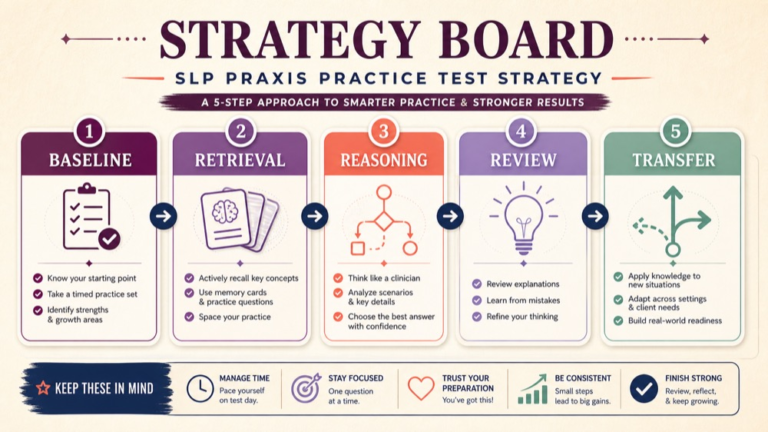
A strategy board keeps the plan visible without making it complicated. Use five connected areas: baseline, retrieval, reasoning, review, and transfer. Each area should have one action and one piece of evidence. The board can be a page in a notebook, a simple document, or a small spreadsheet.
| Board area | Action | Evidence |
|---|---|---|
| Baseline | Complete a labeled practice block. | Result, confidence, and error tags. |
| Retrieval | Produce the rule before checking. | Own-word explanation. |
| Reasoning | Connect task, evidence, and option. | Closest distractor mismatch. |
| Review | Study the repeated repair. | Focused block completion. |
| Transfer | Change one case feature. | New answer and reason. |
Put the current priority at the top of the board. If the main issue is sequence, do not fill the board with unrelated vocabulary tasks. If the issue is screen fatigue, write the setup change and its test condition. The board should make the next useful action obvious.
Keep a separate source area for current ETS and ASHA links. This prevents study observations from being mixed with changing administrative facts. A strategy board is a learning tool, not a substitute for the official information used for registration or score decisions.
Review the board once or twice per week. Remove completed actions, keep the rules that transferred, and replace vague goals with a new checkable block. A board that never changes is a schedule, not an evidence-informed strategy.
Use an error loop to adjust the plan
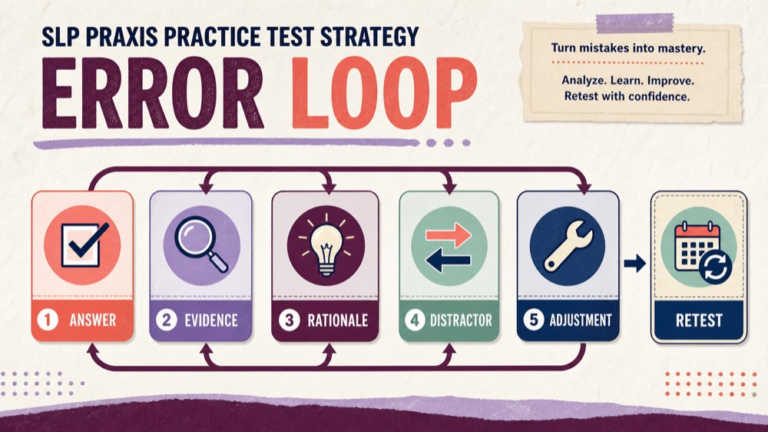
Use an error loop when a practice result does not tell you what to do next. Start with the answer you selected, identify the evidence, explain the rationale, compare the distractor, and choose one adjustment. Then retest the adjustment in new or changed items.
| Loop step | Prompt | Adjustment example |
|---|---|---|
| Answer | What did I choose and how confident was I? | Record the original decision. |
| Evidence | Which detail should control? | Mark setting, goal, or stage. |
| Rationale | Why does the best option fit? | Write a rule in your own words. |
| Distractor | Why is the closest option weaker? | Name the mismatch. |
| Adjustment | What will I change next? | Choose a small repair block. |
Use the loop for repeated errors, not just isolated discomfort. One difficult item may be ambiguous or outside the strength of the source. A repeated pattern across several items deserves a strategy change. Record the number of observations so the response stays proportional.
Adjust one variable at a time when possible. Change the reading routine, not the source and the timing and the device all in the same block. A single change makes it easier to identify what helped or what still needs work.
Finish the loop with a return date. For example, review the sequence today, answer five new cases tomorrow, and use one changed case later in the week. The return date keeps the strategy moving from insight to evidence.
Question 1: strategy and baseline data
Question 1: A learner completes one mixed online practice set and misses several items, but the learner did not record confidence, timing, or the exact task in each stem. Which strategy step should come first?
- A. Add a much larger question bank without changing the record.
- B. Complete a clearly labeled baseline block that records task, confidence, condition, and error type.
- C. Choose a new study method because the first percentage was uncomfortable.
- D. Memorize every answer letter from the completed set.
Correct Answer: B. A labeled baseline supplies the information needed to choose a strategy. Without task, confidence, condition, and error data, the learner cannot tell whether the misses reflect content, sequencing, distractor comparison, timing, or the online setup.
Why the Other Options Are Wrong: A increases volume without improving the evidence record. C makes a broad change from one incomplete observation. D encourages answer recognition without clinical reasoning. The baseline step creates a more useful starting point.
Exam Trap: A practice result is easier to use when the condition is visible. When the prompt describes missing context around a score, choose the step that makes the next decision measurable.
Question 2: strategy and retrieval practice
Question 2: A learner can recognize a definition in notes but cannot explain it when a case changes the communication setting. Which practice strategy best addresses the problem?
- A. Reread the same definition until it feels familiar.
- B. Retrieve the concept in own words, apply it to a changed case, and review the rationale.
- C. Remove all case questions and study definitions only.
- D. Use the answer key before attempting each new item.
Correct Answer: B. Own-word retrieval followed by a changed-case application tests whether the concept can guide a decision beyond recognition. Rationale review can then correct the rule and clarify the boundary between the best option and its distractor.
Why the Other Options Are Wrong: A may strengthen familiarity without showing usable retrieval. C removes the application that exposed the gap. D replaces retrieval with support before the decision. The better strategy links recall, application, and explanation.
Exam Trap: Distinguish recognizing information from producing and applying it. If the item gives a transfer problem, choose a strategy that requires retrieval before feedback and use in a new context.
Question 3: strategy and source boundaries
Question 3: A study group suggests sharing screenshots from a paid preparation course so everyone can use the rationales. Which strategy choice best protects a legitimate study plan?
- A. Upload the screenshots because the group is small.
- B. Use licensed access and create original paraphrases or self-written transfer cases.
- C. Remove the provider name and distribute the screenshots.
- D. Share the screenshots only after changing the file name.
Correct Answer: B. Licensed access and original notes preserve the learning function without redistributing protected material. A self-written transfer case can test the same reasoning boundary while keeping the study strategy legitimate.
Why the Other Options Are Wrong: A treats group size as permission. C removes attribution but does not resolve reproduction. D changes a label rather than the underlying use. The responsible strategy keeps preparation useful and respects the resource boundary.
Exam Trap: Online convenience does not remove professional and licensing considerations. When the strategy involves sharing material, identify whether the proposed action is authorized before choosing it.
Protect focus and manage digital distractions
An online strategy can fail because the study environment keeps changing. Before a block, decide whether you are working independently, using a permitted reference, reviewing immediately, or practicing delayed recall. Close unrelated tabs, silence nonessential alerts, and record interruptions that affect the result.
| Distraction signal | Strategy response | Record |
|---|---|---|
| Notifications | Silence or move the device. | Whether an alert occurred. |
| Open references | Define the support condition before starting. | Reference used or not. |
| Long notes | Limit notes to task, clue, confidence. | Note method. |
| Browser friction | Test the platform and controls first. | Technical issue. |
| Fatigue | Use a planned break or smaller block. | Time of day and break. |
Do not use a focus tactic as a substitute for a content decision. If the concept is missing, a quiet desk will not supply it. If the content is strong but scrolling breaks your reading, a browser or screen adjustment may be the correct next experiment.
Keep the environment comfortable and accessible. Record text size, device, and any adjustment used for comparable sessions. A consistent setup is not about copying a testing appointment; it is about knowing which conditions shaped your practice evidence.
Use one visible start cue and one end cue. Write the purpose before the first item, then close the block with an error-log review. This boundary keeps online study from stretching into unfocused browsing.
Add timed practice as a later layer
Timing is one part of a strategy, not the entire strategy. Add light timing after you can read the task, identify the evidence, and compare options without needing constant support. A timer should expose a pacing behavior you can change, such as lengthy notes or repeated reconsideration.
| Pacing issue | Likely cause | Strategy adjustment |
|---|---|---|
| Slow stem reading | Task is not identified early. | Read the final request and mark the clue. |
| Slow comparison | Closest distractor lacks a mismatch. | Write one reason it is weaker. |
| Slow recall | Concept is not retrievable. | Use a focused retrieval block. |
| Slow notes | Recording is too detailed. | Use three short phrases. |
| Late fatigue | Block length exceeds the current condition. | Use smaller blocks and planned pauses. |
Protect reading quality while you build pace. Skipping the final request can make a set faster while preserving the same error. Shorten the block, use a gentle time cue, and check whether the core reasoning routine remains intact.
Record whether the timer was visible, when you paused, and where the delay occurred. The time number is more useful when connected to a behavior. It can then guide a focused experiment instead of creating generalized worry.
Use longer rehearsals after several shorter blocks produce complete review notes. A long session can test attention and workflow, but it should not be the first response to an unexplained low result.
Adjust the strategy with evidence
Strategy adjustment works best as a small experiment. State the pattern, select one change, choose a comparable block, and define what you will inspect afterward. This keeps the plan flexible without making every session a completely different test.
| Observed pattern | One strategy change | What to compare |
|---|---|---|
| High-confidence task misses | Restate the final request before options. | Task tags and rationale quality. |
| Content recall gap | Use retrieval before source review. | Own-word explanation. |
| Setting-transfer gap | Practice a changed case. | Evidence that changes the choice. |
| Distractor confusion | Name one closest mismatch. | Comparison time and accuracy. |
| Screen fatigue | Shorten the block or adjust setup. | Late-block errors and pace. |
Compare behavior as well as percentage. If a percentage changes but you still cannot explain the rationale, the strategy may be creating familiarity rather than flexible reasoning. If the percentage stays similar while the explanation becomes clearer, the plan may be building a useful foundation.
Use a return condition for each experiment. Keep the source and item length similar when testing a process change. If the variable is a different case setting, keep the answer routine and review rule stable. Clear experiments make the next adjustment easier.
Do not abandon a strategy after one difficult block. Check the condition, the sample size, the item mix, and the review quality. A small outlier can be information, but it should not automatically replace a plan that has not been observed consistently.
Build a seven-day strategy plan
A seven-day plan can combine baseline, retrieval, clinical reasoning, mixed practice, and review without making every session a full test. Use the sequence as a framework and adjust the item count to your schedule. Keep the purpose and evidence fields consistent.
- Day 1: verify the current ETS source, define the purpose, and complete a labeled baseline block.
- Day 2: use active retrieval for the strongest repeated content or sequence gap.
- Day 3: answer a focused case set and review the task, evidence, rationale, and distractor.
- Day 4: create changed cases that test transfer across settings, goals, or communication partners.
- Day 5: use a two-domain or mixed block to practice identifying the task category.
- Day 6: add light timing if the reading routine is stable and record the pacing friction.
- Day 7: repeat a comparable baseline block and adjust one strategy variable for the next cycle.
Reserve enough time for rationales. If a set takes the whole session and leaves no review, reduce the item count. A plan that ends with an error category and next action gives you a stronger base for the following day.
Keep current administration notes separate from the strategy board. The official source tells you about the test; your tracker tells you how one chosen practice condition went. Both matter, but they answer different questions.
At the end of the week, choose one stable element and one variable for the next cycle. For example, keep the answer routine and device stable while changing the case context. This makes transfer visible and keeps the plan manageable.
SLP Praxis practice test strategy checklist
Use this checklist before and after each strategy block.
- I confirmed the material is relevant to Speech-Language Pathology (5331) or labeled it as broader SLP study.
- I stated the purpose: learning, retrieval, reasoning, transfer, pacing, or review.
- I recorded source, item count, device, timing, support, and feedback timing.
- I set a baseline or connected the block to a clearly labeled prior observation.
- I attempted retrieval before opening the explanation when the purpose required independent work.
- I identified the task, decisive evidence, stage, goal, and context.
- I explained why the best option fit and why the closest distractor was weaker.
- I tagged the error as task, evidence, content, sequence, distractor, transfer, screen, or pacing.
- I chose one small strategy adjustment rather than changing every variable at once.
- I created a changed case or transfer prompt.
- I scheduled a return check with a completion rule.
- I verified changing administration information with the responsible official source.
- I used legitimate material and did not redistribute protected questions or screenshots.
A checklist makes the strategy repeatable without making it rigid. Use the same core routine, then let the evidence decide whether the next emphasis should be retrieval, clinical reasoning, mixed selection, screen workflow, or timing.
Sources and next steps
Use the live ETS Speech-Language Pathology (5331) page for current subject identity, selected-response format, duration, question count, and changing test information. Use the ETS preparation-course page for the features and terms of that source-controlled product.
Use ASHA Praxis preparation guidance when building a plan around strengths and weaknesses. The strategy in this article is original educational guidance: label the condition, retrieve before feedback when appropriate, connect task to evidence, review the closest distractor, and test one adjustment in a changed case.
For a structured preparation path, see the SLP Study Center Complete Prep resource. Start your next block with one purpose, one source, one measurable repair, and enough review time to turn the result into the next decision.