
An slp praxis practice test score can help you decide what to study next, but the number needs context. Record whether the session was a learning block, an independent set, or a longer timed rehearsal. Then pair accuracy with confidence, pacing, domain pattern, and rationale quality. A score is a starting signal for review, not a promise about a future result.
The current ETS Speech-Language Pathology (5331) page describes a computer-delivered selected-response exam with 132 questions and 150 minutes. Score requirements and administrative details can change, and ETS notes that passing scores may vary by state or agency. Use the live ETS and ASHA pages for current requirements that apply to your path.
What a practice test score can tell you
A practice score summarizes performance on one set of items under one set of rules. It can help you notice a pattern, such as repeated misses on treatment sequencing or a drop in accuracy after a long screen session. It cannot, by itself, explain the cause of the pattern or reproduce every feature of a live administration.
| Score signal | What it may show | What to add |
|---|---|---|
| Percent correct | Performance on this item set. | Source, difficulty, and condition. |
| Confidence | How certain each decision felt. | High-confidence misses. |
| Pacing | Where time accumulated. | Reading, recall, or comparison note. |
| Domain pattern | Where errors cluster. | Content and task tags. |
| Rationale quality | Whether the rule is usable. | Transfer example. |
Think of the number as a dashboard light. A low result may invite a content review, but it may also reflect an unfamiliar format, unclear explanations, screen fatigue, or an unplanned open-reference condition. A higher result can still contain high-confidence misses that deserve attention. The explanation behind the score matters more than the score alone.
Use the same score language every time. Write raw correct, percent correct, scaled score if the provider supplies one, and target requirement as separate fields. This prevents a raw percentage from being mistaken for an official scaled score or a practice benchmark from being treated as a state requirement.
Confirm which score you are reading
Online resources may display several numbers. A result might be the number correct, a percentage, a category percentage, a provider-created readiness label, or a scaled score. Before comparing two results, identify what each number represents and whether the item set, form, and timing condition are comparable.
| Label | Meaning to verify | Safe comparison |
|---|---|---|
| Raw correct | Number of scored items answered correctly. | Compare only with the same scored-item basis. |
| Percent correct | Correct items divided by scored items. | Use for a local practice trend. |
| Scaled score | Provider-reported score on its reporting scale. | Use the provider’s explanation and form context. |
| Domain result | Performance within a topic grouping. | Use to choose a review priority. |
| Readiness label | A resource’s own interpretation. | Read its definition before relying on it. |
If a practice platform reports a readiness color or pass-like label, treat it as a feature of that platform. Ask what item pool, scoring rule, and target it uses. A branded label is not automatically the same as an official score report.
Save a screenshot or export of the result for your own record only when the resource permits it. Otherwise, write a short original summary. The point is to preserve your study evidence without copying protected question content or sharing material outside its allowed use.
When a number is unclear, do not fill the gap with an assumption. Find the provider’s scoring explanation or ask the responsible organization. A clear note that says percentage reported by practice platform is better than a falsely precise conversion.
Check current 5331 scoring information
For current test identity and format, begin with the ETS Speech-Language Pathology (5331) page. It currently lists 132 questions and 150 minutes for the computer-delivered selected-response exam. Use the live page when your administration date is near because delivery and scheduling details can change.
For score reporting and passing-score boundaries, read the ETS scores page. ETS states that passing scores vary by state or agency, so do not copy a single number into a general study article as if it applied to every candidate. Check the state, licensing, school, or certification requirement that actually governs your path.
The ASHA Praxis scores page provides certification-related score information and currently lists a Speech-Language Pathology (5331) entry. Use it together with the applicable requirement and confirm the live page before making a registration or readiness decision.
- Identify the authority: use ETS for current test and score-reporting information.
- Identify the requirement: check the state, agency, or certification path that applies to you.
- Record the date: score pages and requirements should be treated as time-sensitive.
- Separate practice data: keep a provider percentage in your study tracker, not in the official requirement field.
- Link the source: save the responsible page beside the number you are using.
This source discipline protects you from a frequent score mistake: using a remembered passing number while ignoring the current requirement or the difference between a practice set and an official report.
Separate raw correct from scaled score
Raw correct and scaled score answer different questions. Raw correct tells you how many items on a particular scored set you answered correctly. A percentage expresses that result relative to the number of scored items. A scaled score is a reported value created under the testing program’s scoring system. Do not assume that one fixed raw percentage maps to one fixed scaled score on every form or provider.
| Number | Use it for | Do not use it for |
|---|---|---|
| Correct items | Checking a local item-level result. | Claiming an official score. |
| Percent correct | Comparing similar practice blocks. | Replacing a state requirement. |
| Scaled result | Reading an official or provider report as defined. | Reverse-engineering without a source. |
| Target score | Planning toward a stated requirement. | Assuming it is identical everywhere. |
For a local practice trend, calculate percentage consistently. Use the same denominator rule and record whether unanswered, experimental, or unscored items were included. If the provider changes the item pool or scoring display, begin a new comparison line rather than blending incompatible results.
When you need to understand an official score report, use the explanation supplied by ETS or the relevant certification organization. The practice tracker can show what happened in your study session; it should not invent an official conversion table.
This distinction also improves motivation. If your percentage moves, you have evidence that your performance on that practice condition changed. You still need the error log to know whether the change came from stronger content, better task reading, a different item mix, or more familiar material.
Compare your score with your target carefully
A target is useful only when you know whose target it is. It may be a state requirement, an agency requirement, a certification-related requirement, a personal practice goal, or a provider-created benchmark. Put the source and date next to the target so an old number does not quietly guide a current decision.
| Target type | Source to check | Study use |
|---|---|---|
| State or agency requirement | Current responsible authority. | Administrative planning. |
| Certification information | Current certification organization page. | Credential planning. |
| Practice benchmark | Practice provider definition. | Local study signal. |
| Personal goal | Your schedule and error history. | Motivation and pacing. |
| Trend goal | Your consistent tracker. | Measure a repair over time. |
Compare like with like. A ten-item teaching quiz should not be placed beside a long delayed-review block as if their percentages had the same meaning. If you do keep both, label them by mode and use each for its intended purpose.
Do not use a target to erase the reasoning evidence. A result above a personal benchmark can still contain a high-confidence clinical error. A result below a benchmark can reveal that your task routine is sound while one content domain needs focused review.
When the target is unclear, pause the administrative comparison and continue with local learning analysis. You can still classify errors, review rationales, and plan a repair while you verify the current requirement from the responsible source.
Record the condition behind each score
Every practice score should have a condition label. Record the number of items, source, content mix, device, review timing, timing rule, outside support, and interruptions. The record does not need to be complicated; it needs enough detail to explain why two results may not be comparable.
| Condition field | Example entry | Why it matters |
|---|---|---|
| Source | Provider and set name. | Item style and explanation may differ. |
| Mode | Independent, learning, or timed. | Support changes the meaning. |
| Length | 20-item mixed block. | Attention and fatigue vary. |
| Review | Delayed until the block ended. | Feedback timing affects decisions. |
| Device | Laptop, comfortable zoom. | Screen friction can affect pace. |
| Interruption | One ten-minute connection issue. | Context belongs in interpretation. |
Use a consistent template. The goal is not to track every detail of your day, but to preserve the variables most likely to affect reading, attention, and review. A short note such as independent, 30 mixed items, delayed review, laptop, no outside support is already more informative than a bare percentage.
If you changed several conditions, call the result exploratory. Do not force it into the main trend line. Exploratory sessions can be useful for testing a new browser, note method, or break plan, but they should be labeled so they do not distort the comparison.
Over time, the condition record can reveal a practical issue. If accuracy drops only after long screen blocks, your next action may involve fatigue management and block design. If accuracy stays low across short supported sets, a focused content review may deserve priority.
Use percent correct for diagnosis, not prediction
Use a practice percentage to ask better questions about your study process. Which item types were missed? Did confidence match accuracy? Did the error occur before or after a timing cue? Could you explain the correct option and the closest distractor after feedback? These questions turn a number into information you can act on.
| Pattern | Interpretive question | Possible next block |
|---|---|---|
| High percentage, weak rationale | Was the answer recognized rather than reasoned? | Explain choices without answer labels. |
| Lower percentage, strong rationale | Is one domain carrying most misses? | Review that domain with new items. |
| Fast and inaccurate | Did screen scanning skip the task? | Restate the final request. |
| Slow and accurate | Where did comparison expand? | Practice closest-distractor elimination. |
| Unstable scores | Did source or condition change? | Repeat a stable baseline block. |
This is a diagnostic use of study evidence, not a clinical diagnosis and not a prediction of an official result. Keep the claim narrow: the session suggests a study behavior to test. Then test that behavior with new, legitimately accessed items and record whether the pattern changes.
Review both wrong and right answers. A wrong answer identifies an outcome, while a correct answer with low confidence may expose an unstable rule. Write one sentence for the rationale and one sentence for the distractor that was closest.
Do not chase a higher percentage by selecting only familiar topics. A balanced trend is more informative when the source and mode are clearly labeled. Mix targeted repair blocks with periodic varied sets so you can see whether a rule transfers outside the original topic.
Read domain patterns
Domain results can help you choose where to spend study time, but labels differ by resource. A provider may group items by foundations, assessment, treatment, or a narrower topic map. Use the grouping supplied by that resource and do not assume that its category percentages are an exact copy of the live exam blueprint.
| Domain signal | Follow-up question | Review focus |
|---|---|---|
| Foundations cluster | Is the gap vocabulary or professional reasoning? | Define the rule and apply it. |
| Assessment cluster | Did you choose the next information step? | Sequence evidence and evaluation. |
| Treatment cluster | Did the plan match the goal and context? | Connect action to function. |
| Mixed-domain misses | Is switching between topics the friction? | Use a short mixed block. |
| One-topic spike | Was the item count too small? | Repeat before changing the plan. |
Look for repeated reasoning patterns inside a domain. For example, assessment misses may all involve choosing a test before clarifying the referral question. Treatment misses may involve selecting a drill without considering transfer. The domain tells you where to look; the item-level rationale tells you what to repair.
Use a minimum amount of evidence before changing your whole plan. One small set can be noisy. Repeat the same category with a different, legitimate source or a new item block and compare the error tags. A stable pattern deserves a stronger response than a single outlier.
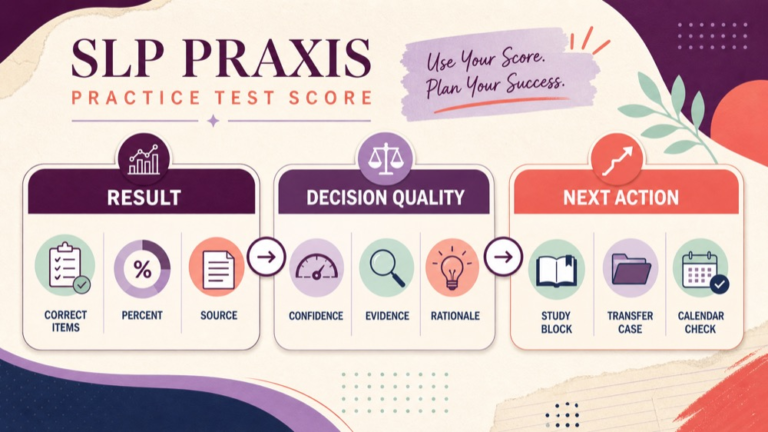
Build a three-part score dashboard
A useful score dashboard has three connected views: the result, the decision quality, and the next action. The result can be raw correct or percentage. Decision quality includes confidence, evidence, and rationale. The next action states what you will practice and what changed case or condition will test the repair.
| Dashboard view | Fields | Example question |
|---|---|---|
| Result | Items, correct, percentage, source. | What happened in this set? |
| Decision quality | Confidence, evidence, rationale. | Could I explain the choice? |
| Condition | Mode, time, device, interruptions. | What shaped the result? |
| Pattern | Domain and error tag. | What repeats? |
| Action | Next block and transfer check. | What will I test next? |
Keep the dashboard on one page or one spreadsheet row per session. Do not make the tracker so elaborate that you stop using it. A few consistent fields create a better trend than a detailed system used only once.
Review the dashboard at the end of the week, not after every single item. Item-level review belongs in the error log. The dashboard is for seeing whether the same repair appears across sessions and whether the practice condition is becoming more stable.
Use color sparingly if you build a visual tracker. A color can mark a review priority, but it should not imitate an official pass/fail badge. Let the written rationale and source link carry the meaning.
Review missed and guessed items
Score review should include every miss and every guessed correct answer that you cannot explain. Use a five-column loop: answer, evidence, rationale, distractor, and next action. This format keeps the review focused on the relationship between the task and the selected option.
| Review column | Write | Why it belongs |
|---|---|---|
| Answer | Letter, result, and confidence. | Shows the original decision. |
| Evidence | Decisive case detail or missing clue. | Protects careful reading. |
| Rationale | Why the best option fits. | Creates a reusable rule. |
| Distractor | Closest alternative and mismatch. | Improves comparison. |
| Next action | Small study or timing experiment. | Creates follow-through. |
Start with high-confidence misses when you have limited time. They may reveal an overgeneralized rule or a tendency to choose an attractive intervention before identifying the task. Follow with low-confidence correct answers so that you do not mistake recognition for stable reasoning.
Write the rationale in your own words and protect the resource boundary. A score review is not a reason to reproduce commercial questions in a shared folder. Paraphrase the concept, create your own changed case, and use licensed access when you need to revisit the original explanation.
Finish each row with a measurable repair. Instead of study assessment, write answer five new assessment items by naming the requested information before comparing options. The next session then has a purpose that can be checked without depending on the original item.
Question 1: score interpretation
Question 1: A learner completes a 20-item online practice set with 16 correct answers. The set was untimed, explanations were opened after each item, and two answers were changed after reading the rationales. What is the most appropriate interpretation?
- A. The 80% result is an official scaled score.
- B. The result is a learning-mode percentage that should be labeled with its support condition.
- C. The result establishes that the learner will meet every current requirement.
- D. The result should be compared directly with a delayed-review timed block.
Correct Answer: B. The learner can record 16 of 20 correct, or 80%, but the set included immediate explanation access and answer changes. It is useful evidence from a supported learning condition, not an official scaled score or a directly comparable timed benchmark.
Why the Other Options Are Wrong: A confuses a local percentage with a reported scaled score. C turns one supported result into a broad future claim. D ignores the difference in mode and timing. The correct interpretation preserves the number while keeping its condition visible.
Exam Trap: Look for the condition behind the number. If feedback or answer changes occurred, label the result as learning evidence before using it in a trend comparison.
Question 2: score review and study action
Question 2: A learner’s practice percentage is stable across three mixed sets, but most high-confidence misses involve choosing treatment before clarifying the functional communication goal. Which next action is most useful?
- A. Take larger mixed sets without reviewing the missed decisions.
- B. Build a short original block that asks for the goal or next information before treatment selection.
- C. Change the target requirement because the percentage did not rise immediately.
- D. Remove all treatment items from future practice.
Correct Answer: B. The repeated high-confidence pattern identifies a specific reasoning repair. A focused block can rehearse goal clarification and sequence, then use changed cases to check transfer. The stable percentage alone does not tell you to increase volume or remove a domain.
Why the Other Options Are Wrong: A adds volume without addressing the repeated cause. C changes an administrative or personal target instead of the reasoning process. D removes useful practice rather than repairing the treatment-selection sequence. Each alternative avoids the evidence in the error log.
Exam Trap: A score trend is less actionable than a repeated error tag. When the same decision pattern appears, choose the smallest new practice block that tests that pattern.
Question 3: score requirement source
Question 3: A learner finds a practice article that says one SLP Praxis passing number applies to everyone. The learner is preparing in a state with its own licensing process. What should the learner do first?
- A. Use the article’s number because it is easier to remember.
- B. Verify the current requirement with the responsible state, agency, certification, or official score source.
- C. Convert the practice percentage into that number using a fixed formula.
- D. Treat a high practice percentage as permission to skip official score research.
Correct Answer: B. ETS states that passing scores can vary by state or agency, so the learner should verify the requirement that governs the actual path. A practice percentage and an official score requirement should remain separate until the responsible source defines their relationship.
Why the Other Options Are Wrong: A repeats an unverified generalization. C invents a fixed conversion that may not reflect the testing program’s reporting method. D uses practice performance to replace administrative research. The source check comes before a readiness conclusion.
Exam Trap: When a question names a state or agency context, prefer the current responsible source over a generic remembered number. The source boundary is part of the decision.
Decide what to study next
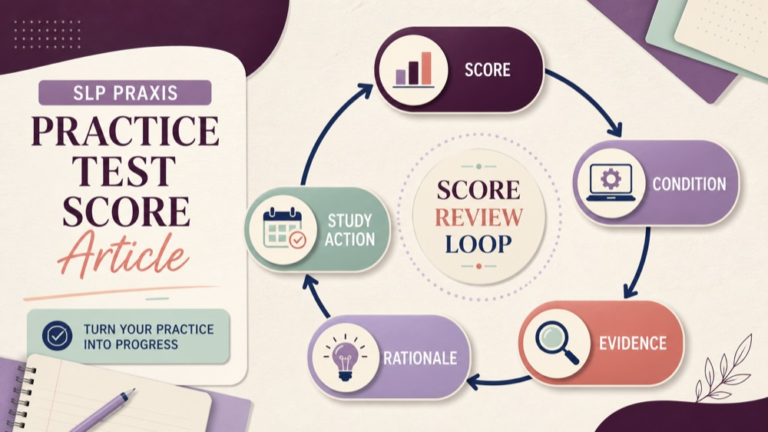
Choose the next study action from the strongest pattern, not from the most alarming number. If the score is low because the item format is unfamiliar, begin with task reading and rationale review. If the score is adequate but confidence is poor, practice explaining decisions. If one domain repeatedly carries misses, build a focused block before returning to mixed work.
| Evidence | Priority | Next action |
|---|---|---|
| Repeated task mismatch | Reading sequence. | Restate the final request in new items. |
| Repeated content gap | Focused knowledge. | Review one source and create a transfer case. |
| Repeated sequence error | Clinical reasoning order. | Sort assessment, interpretation, and action. |
| Distractor confusion | Option comparison. | Explain the closest mismatch. |
| Timing friction | Screen workflow. | Use a smaller timed block with brief notes. |
Set a completion rule for the next block. Five items with five written evidence clues may be more useful than fifty items with no review. A completion rule gives the score work a clear boundary and keeps the study plan realistic for the week.
After the repair, use a changed case. Change the setting, goal, communication partner, or stage while keeping the reasoning relationship visible. If you can apply the rule to the changed detail, the repair is becoming more flexible than a memorized answer.
Use score trends across weeks
A trend needs repeated comparable observations. Choose a baseline mode, source type, item length, and review rule, then keep those stable for a short cycle. You can add exploratory sessions, but label them separately. This creates a main line for comparison without wasting the information from different study experiments.
| Trend question | Keep stable | Change intentionally |
|---|---|---|
| Did the repair help? | Source type and item count. | Error pattern targeted. |
| Did pacing change? | Reading routine and device. | Light time cue. |
| Did transfer hold? | Answer and review method. | Case setting or goal. |
| Did confidence become accurate? | Confidence scale. | New item set. |
| Did fatigue matter? | Block length and break plan. | Time of day. |
Review the direction and the explanation together. A percentage can rise because the topics became familiar, while a stable error tag remains. A percentage can dip on a harder set while your rationale quality improves. The trend is more useful when it includes the behavior you intended to change.
Use rolling notes rather than a single dramatic comparison. Three or four clearly labeled sessions can show a pattern that one high or low result cannot. If the source or format changes, begin a separate line and explain the reason.
Build a score review meeting
If you study with a partner, tutor, or cohort, use the score review to discuss decisions rather than compete over percentages. Bring the condition label, the score fields, two high-confidence misses, two low-confidence correct answers, and one next action. This keeps the conversation concrete and protects different learners from being reduced to one number.
- State the condition: name source, item count, mode, timing, and support.
- Share the result: report raw correct and percentage, and label any provider-specific score.
- Show the pattern: identify domain, task, sequence, or screen-friction errors.
- Explain the rationale: describe the best answer and closest distractor in your own words.
- Choose the repair: agree on one small block and one transfer check.
- Set the return point: decide when the new evidence will be reviewed.
A review partner should ask what the question demanded and what evidence controlled the choice. The conversation should not turn into an attempt to reconstruct protected questions or exchange unauthorized screenshots. Original paraphrases and legitimate resources are enough to discuss the reasoning.
After the meeting, write one sentence that captures the rule you will carry forward. Then complete the action while the decision is still specific. A score discussion without a follow-up block becomes another form of passive review.
Build a seven-day score review plan
A one-week score plan can combine measurement with repair. Keep the first day for source and condition checks, the middle days for targeted reasoning, and the final day for a comparable review block. The plan should generate evidence about one change, not force a new benchmark every day.
- Day 1: verify the current score requirement source and define the baseline condition.
- Day 2: complete a short independent set and record raw correct, percentage, confidence, and errors.
- Day 3: review high-confidence misses and write the rule behind each repair.
- Day 4: complete a focused block on the strongest repeated task or domain pattern.
- Day 5: use changed cases to test whether the rule transfers.
- Day 6: complete a light-timed block if pacing is part of the concern.
- Day 7: repeat the baseline condition and compare the rationale pattern, not only the percentage.
Adjust the workload to your schedule and energy. A shorter block with complete review is still valid study evidence when it is labeled clearly. If the score changes, ask which condition changed and whether the error log supports the interpretation.
At the end of the week, select one priority for the next cycle. Keep the current official requirement in its own source-linked field, and keep practice observations in the study dashboard. This simple separation prevents the tracker from becoming an unofficial score report.
SLP Praxis practice test score checklist
Use this checklist whenever you record an online practice result.
- I identified the resource, set, date, and Speech-Language Pathology (5331) relevance.
- I recorded raw correct and percentage separately.
- I labeled any provider-created scaled score or readiness label.
- I wrote the mode: learning, independent, delayed review, timed, or simulation.
- I recorded item count, device, review timing, and interruptions.
- I recorded confidence before checking explanations.
- I reviewed high-confidence misses and low-confidence correct answers.
- I tagged errors by task, evidence, content, sequence, distractor, screen, or pacing.
- I explained the correct answer and the closest distractor in my own words.
- I chose one small next block with a completion rule.
- I planned one changed-case transfer check.
- I verified current score requirements with the responsible official source.
The checklist keeps a score in its proper role. It can point toward a better study decision, but it should not replace the official requirement, a source-linked score report, or an honest review of how the answers were produced.
Sources and next steps
Use the live ETS Speech-Language Pathology (5331) page for current exam identity, format, duration, question count, and preparation links. Use the ETS scores page for score-reporting information and the reminder that passing scores can vary by state or agency.
Use the current ASHA Praxis scores page for certification-related score information, and consult ASHA preparation guidance when building practice around strengths and weaknesses. Verify the live pages before relying on a score requirement or administration detail.
Next, choose one legitimate practice set, record its condition, complete the block, and review the score with an error log. For a structured preparation path, see the SLP Study Center Complete Prep resource. Keep the official score requirement separate from your practice trend, and let the trend guide one specific study action.