An slp praxis test bank can support preparation when you know what the bank is designed to do. Some resources are built for short drills, some for explanations and review, and some for a full practice run. Compare scope, format, rationale quality, and practice mode before adding a bank to your plan.
The current ETS Speech-Language Pathology (5331) page describes a computer-delivered selected-response test with 132 questions and 150 minutes. Use the live ETS page and your account for changing details. ASHA preparation guidance also supports practice questions, timed work, and a plan shaped by individual strengths and weaknesses.
What a test bank is designed to do
A test bank is a collection of selected-response practice items organized for repeated use. Its value depends on the purpose behind the collection. A drill bank may emphasize quick retrieval, while a review bank may emphasize detailed explanations and a simulation bank may emphasize a sustained practice condition.
| Bank purpose | What it should provide | How to use it |
|---|---|---|
| Drill | Short sets with a clear topic or task. | Warm-up or focused repair. |
| Review | Answers, rationales, and distractor contrast. | Learning from decisions. |
| Transfer | Cases that vary setting, goal, or stage. | Test a reasoning rule. |
| Simulation | A consistent full or extended practice condition. | Check stamina and pacing. |
| Tracking | Results that can be sorted by domain or error. | Choose the next set. |
Do not judge every bank by one score. A resource can be useful for a narrow task without representing a full test experience. Label the bank by purpose before interpreting results, and record the practice condition beside any percentage or completion count.
Use legitimate preparation resources and original educational material. A test bank should help you develop adaptable reasoning, not encourage reliance on secure or unverified content. Keep the source role clear whenever you add a new set.
Confirm the current 5331 source
Begin with the current ETS Speech-Language Pathology (5331) page. Use it to confirm the subject identity, current delivery and timing information, broad content direction, question count, duration, and preparation links. The page currently lists 132 questions and 150 minutes for a computer-delivered selected-response exam, so date your administration note.
Use the ETS practice-test page to search for current preparation material by subject. The official 5331 Form 1 page is a useful example of a source-controlled practice product. Use ASHA’s Praxis preparation guidance to shape a plan around practice, timing, and strengths and weaknesses.
- Confirm the subject: label Speech-Language Pathology (5331).
- Record the source: add provider, title, date, and link.
- Mark the mode: identify drill, review, transfer, or simulation.
- Separate logistics: use ETS for current delivery and appointment information.
- Note the boundary: distinguish official products from independent practice banks.
A current official practice product and an independent question bank can serve different roles. Do not combine their claims into one label. Your notes should show which resource controls a fact and which resource supplies practice.
Evaluate test-bank quality before choosing a set
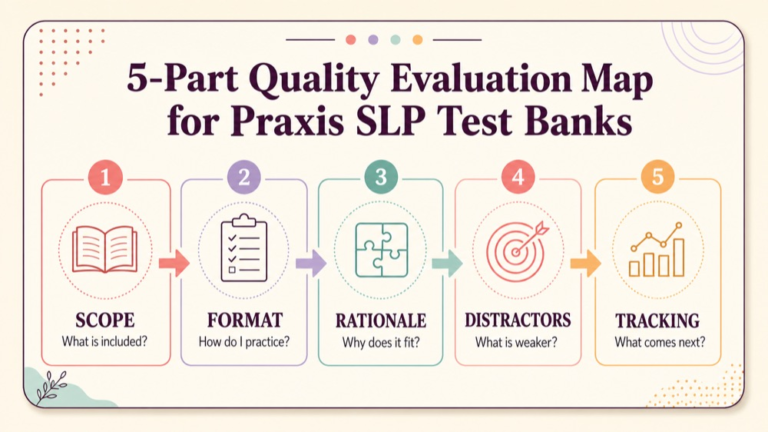
Use a quality screen before you commit to a test bank. Check whether the resource states its subject and scope, offers readable items, explains the correct answer, addresses close distractors, and lets you choose a practice condition. The screen takes less time than rebuilding a plan around a poor fit.
| Quality area | Helpful signal | Question to ask |
|---|---|---|
| Scope | 5331 identity and content direction are stated. | What is included? |
| Format | Selected-response structure is clear. | How will I practice? |
| Rationale | Correct choice is explained in context. | Why does it fit? |
| Distractors | Close alternatives are discussed. | What makes them weaker? |
| Tracking | Results can be reviewed by pattern. | What will I do next? |
Look for a clear distinction between current administration information and educational practice content. A page may mention the exam while still offering independent questions. That distinction does not make the practice useless; it tells you how to interpret its claims.
Try a small sample before building a large schedule. Read several questions, inspect the explanations, and see whether the option set requires reasoning rather than recognition of a repeated phrase. A sample can reveal the bank’s intended use.
Check scope and domain coverage
Check whether the bank gives you a useful mix of content areas. The ETS 5331 materials describe broad areas including foundations and professional practice, screening and evaluation, and treatment planning, implementation, and evaluation. Use those shelves to inspect coverage without assuming that a small bank mirrors future test distribution.
| Coverage shelf | Look for questions about | Review lens |
|---|---|---|
| Foundations and professional practice | Role, collaboration, ethics, responsibility. | Context and boundaries. |
| Screening and evaluation | Information, measures, interpretations. | Evidence and sequence. |
| Treatment planning | Goals, methods, supports, function. | Purpose and fit. |
| Implementation | Partners, setting, cues, adaptations. | Usability and transfer. |
| Treatment evaluation | Response, progress, generalization. | Comparison and next step. |
Count reasoning tasks as well as topics. A bank can mention many diagnoses but still give little practice with next-step, measurement, or professional-response decisions. Add a task tag to each set so you can identify what the item is truly asking you to do.
If a bank has a narrow focus, use it deliberately. A focused set can support a short repair block. Pair it with another source or domain later in the week when you need broader coverage.
Check format and practice conditions
Read how the test bank presents questions. A bank may offer one item at a time, a batch with immediate feedback, a review mode, or a timed set. Each mode changes what you can learn from the result, so record the mode when you review performance.
| Condition | Best use | Record |
|---|---|---|
| Immediate feedback | Learn a new concept or comparison. | Rationale and distractor. |
| Answer-later batch | Practice task reading and commitment. | Confidence and time. |
| Timed mini-set | Check pace on a defined target. | Slow step and accuracy. |
| Mixed-domain set | Practice switching between shelves. | Domain and task tags. |
| Full simulation | Practice sustained attention. | Breaks, pacing, and review. |
Use immediate feedback during learning, not as your only practice mode. Seeing an explanation after every item can help build a rule, but it may reduce the opportunity to commit independently. Alternate conditions as your purpose changes.
Keep the time condition realistic for the specific block. Do not use a mini-set percentage as if it were a full simulation result. The bank is giving you a measurement under a chosen condition; interpret it within that boundary.
Judge explanations and distractors
A strong test-bank explanation identifies the requested task, uses the decisive evidence, and explains why the best alternative is weaker. It may also note what would change the answer. This kind of explanation supports transfer beyond the wording of one item.
| Explanation check | Weak signal | Useful signal |
|---|---|---|
| Task | Repeats a definition. | Returns to the final request. |
| Evidence | Lists facts without applying them. | Names the clue that changes the decision. |
| Sequence | Calls every option equally possible. | Explains stage and prerequisites. |
| Distractor | Says other answers are wrong. | Names the closest mismatch. |
| Transfer | Depends on exact wording. | States a conditional rule. |
When an explanation is incomplete, write your own limited note and mark the source accordingly. Do not expand one unclear item into a broad clinical rule. Verify important content against an authoritative source or use a better-supported item for review.
Ask whether the explanation supports your next action. If it tells you that an option is wrong but does not show how to notice the mismatch, your study note should add that missing comparison. The bank becomes more useful when you improve the record instead of passively accepting its labels.
Match the test bank to the practice mode
Use one test bank in different modes only when you label each mode. Begin with focused drills, move to explanation-rich review, then use a mixed or timed block. A full simulation belongs after you have a reason to test pacing and sustained attention.
| Mode | Question selection | Primary outcome |
|---|---|---|
| Focused drill | One domain or task tag. | Find a narrow gap. |
| Rationale review | Items with close options. | Improve comparison. |
| Transfer block | Changed settings or goals. | Test adaptability. |
| Timed mini-set | Mixed items with a limit. | Locate pacing friction. |
| Simulation | Extended consistent format. | Check stamina and process. |
After a full practice run, review by error type rather than simply restarting another full run. Mark missed task, evidence, sequence, content, or comparison decisions. The next block should target the repeated issue you can actually repair.
Use the same bank again only if the review purpose is clear. Repeating familiar items can show retrieval, but it can also create recognition. Add altered cases or a different source when you need to test transfer.
Use a test bank without overcounting scores
Scores are observations under conditions, not a complete description of readiness. Keep the raw result, but add the mode, domain mix, confidence pattern, and rationale quality. These notes explain whether the result reflects knowledge, reading, pacing, or familiarity with the item set.
| Result note | What it may show | Follow-up |
|---|---|---|
| High score, low confidence | Recognition or cautious reasoning. | Try a changed case. |
| Low score, clear rationales | Knowledge gap with usable process. | Study the narrow concept. |
| Mixed score, task errors | Stem-reading problem. | Practice final requests. |
| Slow pace, good review | Process needs efficiency. | Use timed mini-sets. |
| Unstable explanations | Source may not support review. | Verify or switch resources. |
Compare results within the same condition before comparing different modes. A timed mixed set and an immediate-feedback domain drill answer different questions. The bank becomes a better diagnostic tool when the conditions are named.
Do not make an administration promise from a practice score. Use the official ETS source for current test information and use the bank to identify what you can practice next.
Question 1: evaluation sequence
Question 1: A child has difficulty following directions during a noisy classroom routine, but performance is stronger in a quiet one-to-one activity. A practice item asks what information should be gathered before selecting a focused plan. Which answer best fits the task?
- A. Choose an intervention target based only on the quiet one-to-one performance.
- B. Observe and compare communication performance across the two relevant conditions.
- C. Conclude that the classroom concern is unrelated because one setting is successful.
- D. Assign a long-term schedule before clarifying the classroom demand.
Correct Answer: B. Comparing performance across the relevant conditions addresses the evidence supplied by the item and can clarify how noise, language load, or group demands affect the decision. It gathers information before the plan is narrowed.
Why the Other Options Are Wrong: A ignores the classroom condition named in the stem. C treats one successful setting as a complete explanation. D selects logistics before the functional demand is understood. The alternatives either narrow too early or skip the information step.
Exam Trap: When a stem contrasts two settings, the contrast is part of the evidence. Choose the option that investigates the difference before assuming that the stronger setting represents every context.
Question 2: functional treatment fit
Question 2: An adult uses a communication strategy accurately during a structured clinic task but does not use it during a workplace meeting. The stated goal is participation in meetings. Which next practice decision best matches the goal?
- A. Add more clinic repetitions without observing the workplace demand.
- B. Practice and measure the strategy in a relevant workplace-like interaction.
- C. Replace the participation goal with a clinic-only accuracy goal.
- D. Decide that the strategy has failed without examining the context difference.
Correct Answer: B. A workplace-like interaction can reveal which partner, task, or environmental demands affect use of the strategy. Measuring performance in the relevant context keeps the practice decision tied to participation rather than assuming that structured accuracy transfers automatically.
Why the Other Options Are Wrong: A repeats the clinic condition without addressing the stated setting. C changes the goal to fit the easiest measurement. D treats a context difference as proof of failure. Each alternative misses the need to examine functional transfer.
Exam Trap: Separate acquisition from generalization. If the item names a functional goal and a setting contrast, favor the option that brings measurement and support into the context that matters.
Question 3: source and professional boundaries
Question 3: A study group wants to copy a commercial test bank into a shared document so every member can use it. The group says the document is only for exam preparation. Which response best fits responsible preparation?
- A. Copy the full bank because the group has an educational purpose.
- B. Decline to reproduce the bank and use original notes or a licensed access option.
- C. Remove the publisher’s name and share the questions anonymously.
- D. Share only the answer letters while keeping the question wording private.
Correct Answer: B. Declining to reproduce material without permission and suggesting original notes or licensed access respects the resource boundary while preserving a practical study path. Educational intent does not establish permission to copy a commercial bank.
Why the Other Options Are Wrong: A treats purpose as permission. C removes attribution but does not change the reproduction issue. D still distributes material derived from the bank. A responsible response identifies the boundary and offers a legitimate alternative.
Exam Trap: Distinguish helpful intent from authorized action. Professional-practice items often reward a response that protects the boundary and keeps collaboration possible.
Review test-bank results by error type
After a set, classify the result before choosing more questions. A missed item can reflect content, task reading, evidence selection, sequence, option comparison, or pacing. The classification tells you which part of the test bank to use next.
| Error type | Review clue | Next test-bank use |
|---|---|---|
| Content | You cannot explain the concept. | Focused domain drill. |
| Task reading | Your answer solves another request. | Untimed stem set. |
| Evidence | You missed the decisive clue. | Rationale review with marking. |
| Sequence | Your choice belongs later. | Next-step comparison set. |
| Comparison | You know both options but cannot contrast them. | Close-distractor block. |
| Pacing | Time ran out during otherwise clear work. | Timed mini-set. |
Use a primary label even when two issues overlap. “Sequence primary, content secondary” gives you a first repair while preserving the nuance. This prevents a vague result such as “I need more practice” from controlling the next week.
Review high-confidence misses first when time is limited. They can reveal a rule that feels familiar but is being applied too broadly. Review low-confidence correct answers next to make sure recognition is supported by an explanation.
Combine drills, review, and simulation
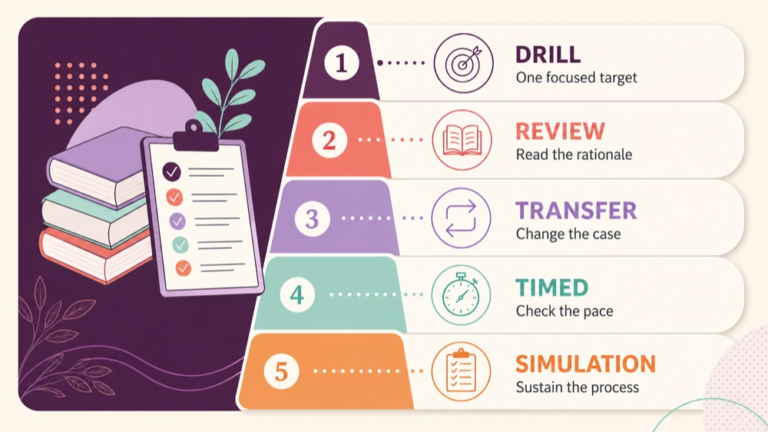
A test bank can support a layered plan. Use drills to isolate a target, review mode to understand the rationale, transfer items to test the rule, and simulation to check how the process holds under sustained work. The layers should connect through the error tags you record.
- Drill: choose one domain or task and find the gap.
- Review: read explanations and compare close options.
- Transfer: answer a changed case without the key.
- Timing: run a small mixed block and track the slow step.
- Simulation: use an extended set when pacing and stamina are the question.
Do not use simulation every day. A full set can show a broad pattern, but it may not provide enough time to repair each error in the same session. Alternate longer checks with short, explanation-rich work.
Keep official source notes next to the plan but separate from practice scores. If test information changes, update the source note. If a reasoning pattern repeats, update the practice plan.
Create a test-bank selection checklist
Use this checklist before adopting a test bank for regular study.
- The bank clearly names Speech-Language Pathology (5331) or is labeled as general practice.
- The source role and date are easy to identify.
- The item format matches the selected-response practice condition I need.
- The bank offers a useful mix of content areas or states its narrow focus.
- Each answer includes a rationale that returns to the task and evidence.
- The closest distractors receive a specific explanation.
- I can choose drill, review, transfer, timed, or simulation conditions.
- Results can be recorded by domain and reasoning task.
- The resource does not ask me to rely on copied or purported secure content.
- I can name what I will do next after using the bank.
A checklist does not require a perfect resource. It helps you assign the right role. A narrow but clear bank may be excellent for a repair block. A broad but thin bank may be more useful for a warm-up than for clinical review.
Plan a week with one test bank
One test bank can support a week when the mode changes with the purpose. Begin with a domain scan, complete a rationale-rich set, test a changed case, and use a small timed block. End by deciding whether the resource remains a good fit for the next cycle.
| Day | Mode | Record |
|---|---|---|
| 1 | Domain scan | Coverage and task tags. |
| 2 | Focused drill | Decisive clue and confidence. |
| 3 | Rationale review | Correct fit and distractor. |
| 4 | Transfer set | Changed case result. |
| 5 | Mixed set | Switching and error type. |
| 6 | Timed mini-set | Pace and slow step. |
| 7 | Weekly review | Next source or repair. |
Adjust the cycle to your schedule. The structure matters more than the exact day count: use the bank for a stated purpose, review the reasoning, and let repeated patterns determine the next block.
Use the live ASHA 5331 content page to compare your broad domain tags with the responsible outline. Use ETS for current test information and the test bank for your own practice observations.
Sources and next steps
Use the live ETS Speech-Language Pathology (5331) page for current exam identity, format, duration, question count, and changing test information. Use the ETS practice-test selector and the official Form 1 page to understand source-controlled preparation options, and use ASHA preparation guidance for planning.
Next, screen one test bank with the quality checklist, choose a practice mode, and complete a small set before committing to a larger schedule. Record domain, task, rationale quality, distractor type, and next action so the resource earns its place in your plan.
For a structured preparation path, see the SLP Study Center Complete Prep resource. Keep current administration details tied to ETS, and use the test bank as a labeled practice tool whose results inform your next study decision.