
Using slp praxis practice questions by topic can make review more focused when each topic set has a clear decision purpose. Build small clusters around speech, language, fluency, voice, swallowing, AAC, motor speech, or assessment, then keep task and evidence notes beside the topic label.
The current ETS Speech-Language Pathology (5331) page describes a computer-delivered selected-response test with 132 questions and 150 minutes. Use the live ETS page and your account for changing details. ASHA preparation guidance also supports practice questions, timed work, and a plan shaped by individual strengths and weaknesses.
What topic-based practice questions can show
A topic label tells you what content the question mentions, but it does not fully describe the decision. Add the task, relevant evidence, decision type, closest distractor, confidence, and condition. Those layers show whether the problem is topic retrieval, application, sequence, interpretation, or comparison.
| Review layer | Example | What it adds |
|---|---|---|
| Topic | Fluency or swallowing. | Chooses a content cluster. |
| Task | Choose the next assessment step. | Defines the requested action. |
| Evidence | Finding that changes the plan. | Shows what matters in the case. |
| Decision type | Retrieval, sequence, or application. | Identifies the reasoning behavior. |
| Condition | Untimed, timed, or supported. | Shows how the practice setting shaped the result. |
Topic-based practice is a study organization method, not a substitute for the current ETS description of the test. Use the live responsible source for subject identity, broad scope, question count, duration, delivery, and changing administration details. Use your topic notes to plan learning.
Sort an item by the topic that best explains the decision, not simply the most memorable word. A case may mention language while asking about assessment design. Another may mention swallowing while asking for professional communication. The final task sentence should guide the primary tag.
Confirm the current 5331 source before building topic sets
Begin with the current ETS Speech-Language Pathology (5331) page. Use it to confirm subject identity, current delivery and timing information, broad content direction, question count, duration, and preparation links. The page currently lists 132 questions and 150 minutes for a computer-delivered selected-response exam, so date the note you keep.
Use the ETS practice-test page to locate current resources by subject. Read descriptions carefully before turning a resource into a topic set. A mixed practice source may be more useful for transfer, while a focused set can support a specific repair.
- Verify the subject: confirm Speech-Language Pathology (5331).
- Record the source: note provider, title, date, and format.
- Label the role: mark learning, review, short timing, or simulation.
- Map the topic: use task and evidence as well as content words.
- Protect originality: use legitimate preparation material rather than purported secure content.
For planning principles, review ASHA’s Praxis preparation guidance. Keep its study recommendations separate from current ETS administration information. A dated source record helps you update changing facts without rebuilding your topic map from scratch.
Create topic clusters without losing the task
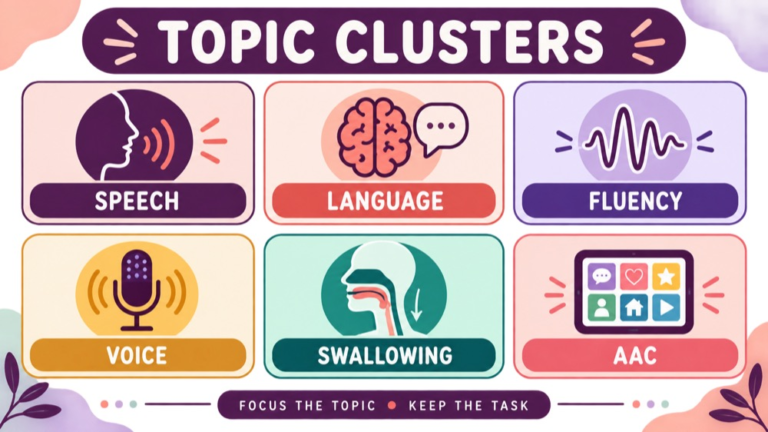
Begin with broad topics, then add a decision tag within each cluster. Speech sound questions might involve development, assessment, or intervention. Language questions might involve comprehension, expression, literacy, or discourse. The topic names organize the set; the task and evidence explain what you are practicing.
| Topic cluster | Possible subtopics | Decision tags |
|---|---|---|
| Speech and motor speech | Articulation, phonology, dysarthria, apraxia. | Pattern, assessment, treatment fit. |
| Language | Receptive, expressive, discourse, literacy. | Development, measure, functional target. |
| Fluency | Speech behavior, participation, counseling context. | Assessment, goal, communication support. |
| Voice and resonance | Quality, use, contributing conditions. | Observation, referral, intervention planning. |
| Swallowing | Safety, function, assessment, collaboration. | Information, sequence, professional response. |
| AAC and access | Feature use, partners, activity demands. | Context, implementation, participation. |
Keep a topic cluster narrow enough to produce a pattern and broad enough to support transfer. A set of only one repeated fact may measure recall, while a set that mixes every possible issue may make the next repair unclear. Use a few related subtopics and a shared review record.
Label the topic after reading the stem. If you choose the topic before reading, the label can pull you toward a familiar rule. Read the requested task, mark the evidence, and then decide which topic best organizes the decision.
Build a topic set for speech and motor speech
Speech and motor speech practice can include pattern recognition, assessment purpose, differential reasoning, treatment fit, and functional transfer. Keep those decision types separate within the topic cluster. A question about a speech pattern may ask for interpretation, while another may ask what information should be gathered first.
| Subtopic | Review prompt | Evidence to record |
|---|---|---|
| Speech sound pattern | What pattern is described? | Observed contrasts and context. |
| Assessment | What decision will the measure support? | Purpose and missing information. |
| Motor speech | Which subsystem or feature is relevant? | Pattern, task, and functional impact. |
| Treatment fit | What action matches the target and condition? | Target, cueing, and activity. |
| Transfer | What changes outside the structured task? | Conversation, setting, or partner demand. |
Use contrastive cases to avoid memorizing one presentation. Change the communication context, target, or task while preserving the reasoning principle. Then explain why the same answer would or would not fit the changed case.
When an option names a familiar technique, return it to the question’s purpose. A true technique may still be the wrong answer if the stem asks for assessment information, professional communication, or the next stage in planning.
Build a topic set for language and fluency
Language and fluency topics often require attention to communication context, participation, development, and functional goals. Build sets that include both concept questions and cases. Review the relationship among the observed behavior, the communication demand, the requested decision, and the option that fits.
| Topic area | Question to ask | Useful review signal |
|---|---|---|
| Receptive language | What type of comprehension demand is described? | Task and level of support. |
| Expressive language | What functional language outcome is needed? | Target and communication purpose. |
| Discourse and literacy | What context or structure shapes performance? | Sample, audience, and task demand. |
| Fluency | What participation or communication concern is present? | Setting, partner, and client goal. |
| Development | What evidence supports the interpretation? | Pattern and developmental context. |
Use a topic set to compare similar-looking decisions. A language sample may be relevant to several tasks, but the stem can ask for the next information, interpretation, or treatment target. The rationale should explain why the selected action matches the requested stage.
Fluency review benefits from context notes because speech behavior and participation can vary by setting and partner. Keep the question focused on the information supplied and the decision requested. Do not turn one context into a broad conclusion about every speaking situation.
Build a topic set for voice swallowing and AAC
Voice, swallowing, and AAC questions often include safety, access, collaboration, and functional context. Build topic sets that ask what information is known, what remains unknown, and which next action fits the professional role. The topic label should support the reasoning without replacing it.
| Topic | Core review lens | Record beside the answer |
|---|---|---|
| Voice | Quality, use, contributing context, and appropriate next step. | Observed feature and purpose of action. |
| Swallowing | Safety, function, information, and collaboration. | Risk clue and sequence. |
| AAC | Access, partner support, activity, and participation. | Context and implementation condition. |
| Resonance | Pattern, communication impact, and information needs. | Evidence versus inference. |
Keep professional boundaries visible in the record. If a case asks what information should be gathered or who should be involved, do not jump directly to a technique or device feature. Explain how the missing information changes the next responsible decision.
Use fresh cases that change the setting or participation demand. A support that fits one activity may need adjustment in another. The transfer check should ask what detail changed the choice and why, not simply whether the same answer was remembered.
Use a topic-to-task review grid
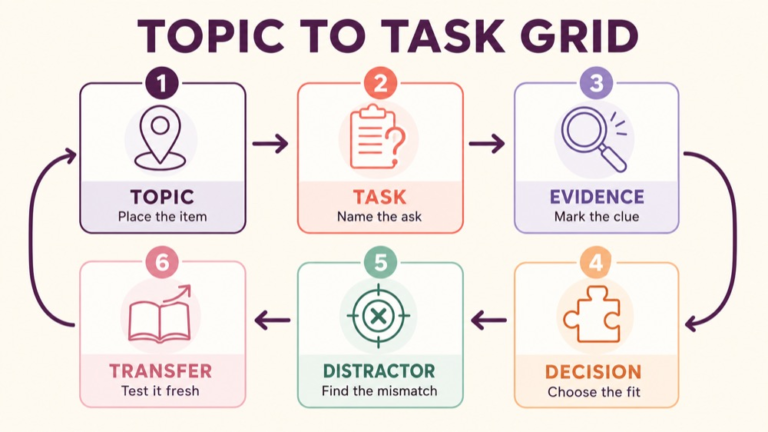
A shared topic-to-task grid helps you compare questions across clusters. Record the topic, task, evidence, decision type, option fit, closest distractor, confidence, condition, and next repair. The grid prevents a topic score from hiding a repeated reasoning behavior.
| Grid field | Example | Interpretation |
|---|---|---|
| Topic | AAC and access. | Content cluster for review. |
| Task | Choose the next information. | Requested action. |
| Evidence | Partner and activity demands. | Clue that changes fit. |
| Decision type | Context and sequence. | Reasoning behavior. |
| Distractor | Feature selected too early. | Closest mismatch. |
| Transfer | Changed activity and partner. | Fresh check. |
Use the same fields in every topic set. This makes it possible to see whether “assessment” is a weakness across speech and language or whether one specific topic creates the problem. The grid is useful because it preserves both content and reasoning.
Review uncertain correct answers alongside misses. If the topic is correct but the rationale is thin, schedule a transfer item. If the rationale is strong but the answer was slow, schedule a light timing comparison. Different evidence should produce different repairs.
Separate topic retrieval from clinical application
A learner may recognize a topic term but still struggle to use it in a case. Test retrieval by stating the principle without options. Test application by changing the setting, target, partner, or requested stage. Test sequence by ordering the information and action. Keep the result attached to the topic label.
| Pattern | What to test | Next practice |
|---|---|---|
| Term unavailable | Can I state the principle? | Plain-language rule and delayed recall. |
| Term known, case fit weak | Can I apply it to changed details? | Contrastive fresh cases. |
| Action related, stage wrong | Can I order the decision? | Sequence cards and rationale. |
| Topic correct, distractor wins | Can I name the mismatch? | Closest-option comparison. |
| Reasoning stable, pace slow | Does timing change the record? | Small light-timing block. |
Do not expand the topic list when the real issue is application. More labels will not repair a missing connection among evidence, task, and choice. Use a focused fresh case and record the relationship that changed the decision.
Topic-based practice should end with a decision about what to do next. Choose retrieval, application, sequence, distractor analysis, transfer, or timing. That final label turns the question set into a study action rather than a pile of categories.
Try three original topic-based questions
The following items are original educational examples created for this article. They are not copied from ETS and are not presented as secure test material. Each item has a topic label, but the answer depends on the task and evidence in the case. Answer first, then review the rationale.
Question 1: Language topic and assessment task
Scenario: A student follows short classroom directions but loses track when directions include several steps and unfamiliar vocabulary. The question asks what information should be gathered before selecting a language assessment task. Which response best fits?
Correct Answer: B. Why This Answer Is Correct: The task asks for information before selecting an assessment task. Direction type, vocabulary, supports, and context describe the information gap and help define the next measure or sample. B keeps the language topic connected to purpose and setting.
Why the Other Options Are Wrong: A starts treatment before the assessment purpose is clear. C makes a broad interpretation from limited details. D chooses a measure because it is familiar rather than because it answers the classroom question. B is the option that gathers evidence for the next language assessment decision.
Question 2: Swallowing topic and professional sequence
Scenario: A client reports coughing with some meals, and the question asks what should be clarified before recommending a change in eating routine. Which response is strongest?
Correct Answer: B. Why This Answer Is Correct: The stem asks for clarification before a recommendation. Foods, consistencies, timing, positioning, and associated symptoms describe the pattern and provide information for the next decision. B respects the sequence and keeps the swallowing topic tied to evidence.
Why the Other Options Are Wrong: A recommends a change without defining the pattern. C assumes a cause the stem has not established. D begins treatment before the relevant information is gathered. B is the only option that directly addresses the information requested before planning.
Question 3: AAC topic and functional transfer
Scenario: A learner uses a communication device during a one-to-one drill but rarely uses it during group projects. The question asks what should be checked to guide the next implementation goal. Which response best fits?
Correct Answer: B. Why This Answer Is Correct: The case contrasts structured and group conditions. B examines the functional variables that can guide the next implementation goal: roles, partners, access, vocabulary, and opportunities. It connects the AAC topic to transfer and participation rather than assuming the one-to-one result will generalize.
Why the Other Options Are Wrong: A leaves the group condition unexplained. C removes access without examining the barrier. D chooses a feature before understanding the activity demand. B gathers evidence about the changed context and creates a targeted next decision.
Repair a topic pattern with a small study block
Match the study block to the topic and decision type. A language retrieval issue may need a short concept contrast. An assessment sequence issue may need ordered steps. An AAC transfer issue may need changed activity conditions. The topic chooses the examples, while the error label chooses the repair.
| Pattern | Small repair | Fresh evidence |
|---|---|---|
| Speech pattern retrieval | State the rule and contrast two patterns. | New case classified with evidence. |
| Language measure fit | Link tasks to different assessment purposes. | Measure chosen for the requested decision. |
| Fluency context | Compare partner and setting demands. | Functional concern matched to context. |
| Swallowing sequence | Order information before recommendation. | Changed case handled in sequence. |
| AAC transfer | Compare structured and group conditions. | Implementation goal fits the activity. |
Write a success signal before the block begins. It might be a correct task restatement, a relevant evidence note, a sequence explanation, or a functional transfer plan. A defined signal makes the repair easier to inspect than a general promise to study the topic longer.
Keep the repair small enough to review completely. One focused topic block can identify more than a large mixed set when the current question is why a decision failed. Return to mixed practice after the repair has a fresh supporting check.
Use mixed practice after topic review
Topic sets provide concentration; mixed sets test recognition and transfer. After a topic repair, remove the topic label and mix related lanes. Ask whether you can identify the topic, task, evidence, and decision without being told which folder to open.
| Practice format | Purpose | Record |
|---|---|---|
| Single topic | Repair a focused content or reasoning issue. | Topic, task, and error label. |
| Related topic pair | Compare close concepts. | Boundary and distractor mismatch. |
| Mixed topic set | Practice recognizing the decision from the stem. | Topic selection and task fit. |
| Long simulation | Inspect stamina after review is stable. | Late-session process and content notes. |
A mixed miss can mean the topic was not recognized, the task was not recognized, or the repaired rule did not transfer. Use the record to tell those possibilities apart. Do not send every mixed miss back to every topic folder.
Keep volume proportional to review quality. More questions are not automatically more evidence when the rationale and distractor records are missing. Use enough items to see a pattern, then pause to design the next check.
Add timing after topic reasoning is clear
Timing introduces a process variable that can change topic recognition, reading, and comparison. First make the topic reasoning visible without pressure. Then use a small timed block with the same review grid to see whether the clock changes the decision or only the speed.
| Stage | Condition | What to compare |
|---|---|---|
| Topic learning | Focused topic, time open. | Concept, task, evidence, and fit. |
| Topic transfer | Changed case details, no clock. | Application and boundary. |
| Mixed review | Topic labels hidden. | Recognition and task fit. |
| Light timing | Small set with a flexible boundary. | Rereads, skips, and confidence. |
If the error appears only under timing, record a process hypothesis and use a shorter comparison. If the same topic and decision issue appears without a clock, keep the content repair active. The difference between conditions helps you choose the next study action.
Use the same task and evidence fields in every stage. The clock should be a condition you inspect, not a reason to discard the topic map. Consistent records make the next change easier to evaluate.
Avoid topic-review traps
- Sorting by a memorable word instead of the requested task.
- Treating a topic label as an explanation for a missed answer.
- Using one fact to represent an entire clinical topic.
- Adding more topic folders when the real issue is application.
- Ignoring context, partner, or functional demand.
- Repeating one wording until familiarity replaces transfer.
- Practicing one topic only and losing mixed recognition.
- Making a large plan from one unusual question.
- Comparing targeted and mixed results without condition labels.
- Using practice results as official score information.
- Using a practice page for changing appointment or administration details.
- Studying purported secure content rather than legitimate preparation material.
The correction is a topic-to-task chain: name the topic, restate the question, mark the evidence, identify the decision type, compare the closest option, choose a repair, and test it with fresh wording. The topic should organize practice without replacing clinical reasoning.
SLP Praxis practice-questions-by-topic checklist
Use this checklist with slp praxis practice questions by topic:
- Did I confirm Speech-Language Pathology (5331) through the current ETS page?
- Did I record the practice source, date, and condition?
- Did I choose a topic based on the decision and evidence?
- Did I restate the task before comparing options?
- Did I identify the relevant clue and functional context?
- Did I tag retrieval, application, sequence, interpretation, or transfer?
- Did I record confidence and any support or timing condition?
- Did I explain the closest distractor mismatch?
- Did I choose a small topic-specific repair?
- Did I test the repair with changed wording or setting?
- Did I return to mixed practice after targeted review?
- Did I keep practice evidence separate from official score and logistics claims?
Topic-based practice is useful when the labels lead to better decisions. Build a focused cluster, keep the task and evidence visible, test the rule on a fresh case, and use mixed practice to check whether the repair transfers.
Sources and next steps
Use the current ETS Speech-Language Pathology (5331) page for subject identity, format, duration, question count, broad content direction, and preparation links. Search the ETS Praxis practice-test page for current subject options. Review ASHA’s Praxis preparation guidance for preparation materials, practice questions, timed work, and using strengths and weaknesses to guide review.
Continue your preparation: Explore the SLP Study Center learning resources after you choose a topic repair and a fresh mixed-practice check.