
Using slp praxis practice questions by domain can turn a broad question bank into a study map. Instead of treating every miss as the same, sort the decision into foundations and professional practice, assessment and evaluation, or treatment planning and evaluation, then review the evidence and task within that lane.
The current ETS Speech-Language Pathology (5331) page describes a computer-delivered selected-response test with 132 questions and 150 minutes. Use the live ETS page and your account for changing details. ASHA preparation guidance also supports practice questions, timed work, and a plan shaped by individual strengths and weaknesses.
What domain-based practice questions can show
Domain labels help you see where a question belongs, but they do not explain why an answer was missed. Add task, evidence, decision type, sequence, distractor, and practice condition to the domain label. Together, those fields show whether the problem is concentrated in a content lane or follows a reasoning behavior across lanes.
| Review layer | Example | What it adds |
|---|---|---|
| Domain | Assessment and evaluation. | Places the question in a study lane. |
| Task | Choose the next information. | Defines the requested action. |
| Decision type | Sequence or interpretation. | Describes the reasoning behavior. |
| Evidence | Detail that changes the plan. | Shows what supports the choice. |
| Condition | Untimed, timed, or supported. | Shows how the practice setting shaped the result. |
A domain map is a planning tool, not an administrative promise about the test. Use the current ETS material for subject identity, format, timing, question count, broad scope, and changing logistics. Use your own records to decide which study lane needs attention next.
Sort a question by the decision it tests rather than by a single word in the stem. A case that mentions treatment may still ask for assessment information. A case that mentions a diagnosis may ask for a professional response. Let the requested task and the content lane work together.
Confirm the current 5331 source before mapping domains
Begin with the current ETS Speech-Language Pathology (5331) page. Use it to confirm the subject identity, current delivery and timing information, broad content direction, question count, duration, and preparation links. The page currently lists 132 questions and 150 minutes for a computer-delivered selected-response exam, so date your notes when you save those details.
Use the ETS practice-test page to find current resources by subject. Read the description before assigning a set to a domain lane. Some resources may mix content areas, while others may be designed for a single concept or format.
- Verify the subject: confirm Speech-Language Pathology (5331).
- Record the source: note provider, title, date, and format.
- Label the practice role: mark learning, review, short timing, or simulation.
- Map with care: use the question task and evidence, not only a keyword.
- Protect originality: use legitimate preparation material rather than purported secure content.
For preparation principles, review ASHA’s Praxis preparation guidance. Keep its study guidance separate from current ETS administration details. A dated source note helps you update the administrative record without changing the learning map unnecessarily.
Build a three-domain practice map
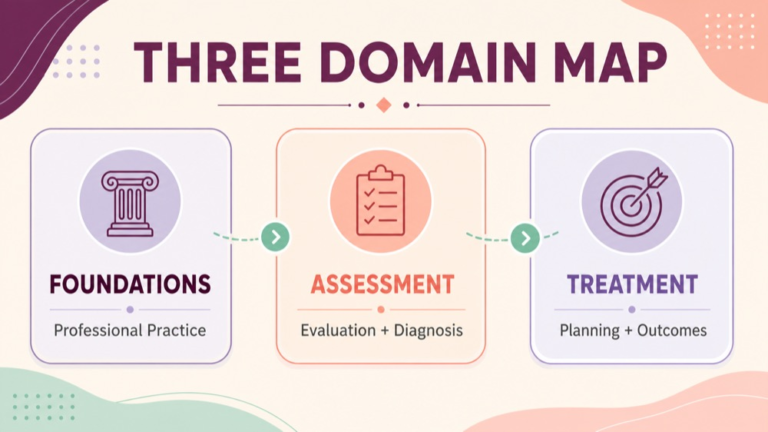
Use three broad lanes to organize review: foundations and professional practice; screening, assessment, evaluation, and diagnosis; and planning, implementation, and evaluation of treatment. These labels follow the broad direction of current preparation materials while leaving room for the specific task and evidence in each question.
| Domain lane | Questions to emphasize | Reasoning lens |
|---|---|---|
| Foundations and professional practice | Roles, responsibilities, communication, ethics, and service context. | Match the response to the professional setting and responsibility. |
| Assessment and evaluation | Screening, information gathering, interpretation, diagnosis, and measurement purpose. | Match evidence and measure to the decision. |
| Treatment planning and evaluation | Targets, implementation, cueing, functional fit, and outcome review. | Match action, target, condition, and next check. |
Use the map as a folder structure rather than a rigid wall between topics. Some questions naturally connect two lanes. Record the primary lane that best matches the requested decision and a secondary lane only when it adds useful context.
Within each lane, add a decision-type tag such as retrieval, interpretation, sequence, measure selection, treatment fit, or professional response. The tag makes the map more useful because it shows whether the same reasoning behavior is weak in several content areas.
Study foundations and professional practice
Foundations and professional practice questions often ask you to connect a role, responsibility, setting, or service decision to the information in the case. Review the context before choosing an answer. Ask who is responsible, what concern is present, what information is available, and what response fits the professional situation.
| Review focus | Prompt | Useful evidence |
|---|---|---|
| Role | What responsibility is being described? | Person, setting, and decision boundary. |
| Service context | What communication or access need is present? | Functional impact and participation. |
| Professional response | What action addresses the concern appropriately? | Information, collaboration, documentation, or referral. |
| Scope | What does the case support at this stage? | Known facts and missing information. |
A related option may sound responsible but still miss the task. For example, a question may ask what information should be gathered before a decision, while an option proposes a later action. Label that as a sequence or task mismatch instead of treating the whole foundation lane as a knowledge gap.
Keep professional practice review tied to the context described. Avoid turning one memorized statement into a broad response rule. Ask what the case establishes, what remains unknown, and which action fits the role and setting at this point in the process.
Study assessment, evaluation, and diagnosis
Assessment questions often depend on purpose, evidence, sequence, and interpretation. Before comparing measures, identify what decision the information will support. Then ask whether the case has supplied the history, context, behavior, or baseline needed to choose the next step.
| Assessment lens | Question to ask | Review note |
|---|---|---|
| Purpose | What decision will the information support? | Connects method to the question. |
| Context | Where and with whom does the pattern occur? | Defines functional conditions. |
| Evidence | What was observed or reported? | Separates data from inference. |
| Sequence | What should be known before the measure or interpretation? | Places the step in order. |
| Interpretation | What conclusion fits the supplied details? | Limits unsupported overreach. |
Use a two-line review: “The stem asks for…” and “The relevant evidence is…” Then compare the options. This routine can expose why a familiar measure or label was attractive even though the question requested an earlier information-gathering step.
When a question involves diagnosis, keep the interpretation within the case evidence and the requested task. A finding can be important without supporting a larger conclusion. Record what the information can support now and what would require additional evidence.
Study treatment planning, implementation, and evaluation
Treatment questions often require fit among the functional target, client condition, cueing or support, activity, and outcome review. Start by naming the target and the context. Then ask whether the proposed action would address that target under the conditions described by the stem.
| Treatment lens | Prompt | Useful evidence |
|---|---|---|
| Target | What behavior or functional outcome is being addressed? | Specific skill and participation goal. |
| Condition | What support, task, or setting is described? | Level of cueing and activity demands. |
| Action | What response matches the target? | Technique linked to purpose. |
| Evaluation | What would show a meaningful change? | Observable response or functional measure. |
A treatment technique can be associated with a disorder and still be a weak answer when it does not match the stated target. Review the function of the action, not only its name. If the option belongs to a later step, record the sequence boundary that makes it premature.
For implementation questions, note whether the case asks for a target, a cue, an activity, a generalization condition, or an outcome check. Those are related but distinct decisions. A strong domain review keeps them separate so the next repair targets the right layer.
Use one reasoning record across every domain
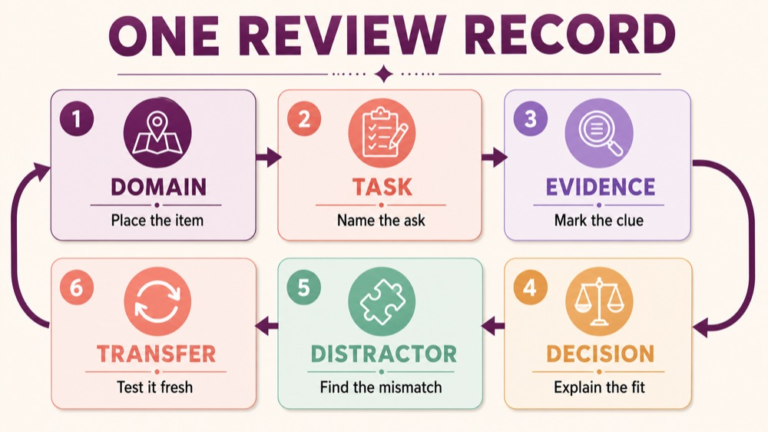
Use the same record in all three lanes so comparisons remain meaningful. Write the domain, task, evidence, choice, confidence, closest distractor, error label, and next repair. A shared record shows whether a problem stays inside one domain or follows a reasoning behavior across domains.
| Record field | Example | Why it travels across lanes |
|---|---|---|
| Domain | Assessment and evaluation. | Places the item in the map. |
| Task | Choose the next step. | Defines the requested action. |
| Evidence | Missing context affects the choice. | Identifies the decision clue. |
| Choice | Option B, uncertain. | Shows confidence and attraction. |
| Distractor | Related measure, wrong sequence. | Explains the close comparison. |
| Repair | Compare three fresh sequence cases. | Creates the next check. |
Keep the domain label and the error label separate. “Treatment, sequence mismatch” is more useful than “treatment weakness.” The first label identifies the content lane; the second identifies the reasoning behavior that needs a targeted repair.
Use confidence as another layer. A correct answer with low confidence may need transfer. A wrong answer with high confidence may need a rule boundary. A late miss may need a process comparison. The record becomes useful when each signal leads to a different question.
Compare content lane with decision type
After several practice blocks, make a simple cross-tab of domain and decision type. This can show whether the same reasoning problem appears in different content lanes. It can also show whether one lane needs more content retrieval while another needs application or sequence practice.
| Pattern | Interpretation to test | Next block |
|---|---|---|
| One lane, several task types | Content lane may need broader review. | Targeted concept and case set. |
| One task across all lanes | Reasoning behavior may be the common issue. | Mixed task-recognition practice. |
| One sequence type late in sessions | Process and content may interact. | Untimed sequence check, then light timing. |
| Correct but uncertain across lanes | Rules may need transfer. | Fresh cases with changed details. |
Look for repeated evidence before making a large plan change. One memorable miss can be a useful note, but it is not the same as a cluster. Use a fresh comparison item to see whether the same label holds outside the original wording.
Keep the map readable. If every item receives several competing labels, choose a primary domain and primary decision type, then save secondary observations in a note. A clear map is easier to use during weekly planning and easier to revise as evidence changes.
Try three original domain-based questions
The following items are original educational examples created for this article. They are not copied from ETS and are not presented as secure test material. Each item represents a different domain lane. Answer first, then record task, evidence, closest distractor, and confidence.
Question 1: Foundations and professional practice
Scenario: A school team asks for help because a student’s communication supports are used inconsistently across classes. The question asks what should be clarified before recommending a service change. Which response best fits the task?
Correct Answer: B. Why This Answer Is Correct: The stem asks what should be clarified before a service change. Needs, demands, current supports, and responsibilities define the context and information gap. B keeps the response within a professional planning step rather than moving directly to a recommendation or removal.
Why the Other Options Are Wrong: A proposes a change before the situation is understood. C makes a broad interpretation from a support-use pattern. D removes a support without examining why use differs across settings. B matches the task and creates information for a responsible next decision.
Question 2: Assessment and evaluation
Scenario: A client reports difficulty being understood during group conversation but communicates clearly in a quiet room. The question asks what information should guide the next assessment step. Which answer is strongest?
Correct Answer: B. Why This Answer Is Correct: The contrast between settings suggests that context and communication demands are important evidence. B gathers information that can guide the next assessment decision. It answers the information-gathering task without jumping to a measure, treatment, or broad interpretation.
Why the Other Options Are Wrong: A selects a measure before its purpose is defined. C begins treatment before the assessment question is clarified. D makes a larger conclusion from limited information. B uses the setting difference as evidence and preserves the order requested by the stem.
Question 3: Treatment planning and evaluation
Scenario: A client can produce a target sound in a structured drill but has difficulty using it in conversation. The question asks which next practice condition best checks functional transfer. Which response fits?
Correct Answer: B. Why This Answer Is Correct: The case shows success in a structured condition and difficulty in conversation. B changes the practice condition to a functional communication task while keeping the target visible. Recording the response creates an outcome check that addresses transfer.
Why the Other Options Are Wrong: A repeats the condition that already showed success and does not test transfer. C treats structured performance as proof that the functional issue has resolved. D changes the problem label instead of checking the stated target in conversation. B aligns activity, goal, condition, and evaluation.
Turn domain misses into targeted repairs
Choose the repair from the combination of domain and decision type. A foundations sequence miss may need role-and-responsibility ordering. An assessment application miss may need purpose-to-measure contrasts. A treatment transfer miss may need changed conditions and outcome notes. The domain tells you where to practice; the error label tells you how.
| Domain and issue | Repair action | Fresh evidence |
|---|---|---|
| Foundations, role mismatch | Compare responsibilities across two settings. | Role matched to context. |
| Assessment, purpose mismatch | Link three measures to different decisions. | Measure selected for purpose. |
| Assessment, sequence error | Order information, measure, and interpretation steps. | Changed case handled in order. |
| Treatment, target mismatch | Match action to functional target and condition. | Technique linked to the stated goal. |
| Treatment, transfer issue | Move from structured to functional task. | Target recorded in a new condition. |
Write one success signal before beginning. It might be a correct role match, a purpose explanation, a sequence rationale, or a functional outcome note. A defined signal keeps the repair from becoming another broad study session with no clear result.
Use fresh material for the check. If you repeat the original item, familiarity can make the repair look stronger than it is. Change the surface details while keeping the decision relationship stable enough to inspect.
Balance targeted and mixed practice
Targeted practice gives a weak lane or decision type concentrated attention. Mixed practice checks whether the reasoning transfers when the domain is not announced in advance. Use both, but label the purpose of each block so a mixed miss does not become an unexplained total.
| Practice format | Use it for | Record |
|---|---|---|
| Single-domain block | Repair a concentrated content or reasoning issue. | Domain, task, and error pattern. |
| Two-domain contrast | Test one decision type in different lanes. | Shared reasoning behavior. |
| Mixed block | Practice choosing the lane from the stem. | Domain recognition and task fit. |
| Long simulation | Inspect stamina after reasoning is stable. | Late-session process and content notes. |
Start with a targeted block when a pattern is clear. Move to mixed practice after the repair has a fresh supporting check. If the mixed result changes, inspect whether the issue is domain recognition, task recognition, or the added switching demand.
Keep question volume proportional to review quality. A smaller set with full domain and rationale notes can be more useful than a large set where every item receives only a lane label. The map is meant to improve decisions, not increase sorting work for its own sake.
Add timing after the domain map is clear
Timing adds another variable to domain review. First make sure you can identify the lane, task, evidence, and reasoning issue without pressure. Then use a small timed block to see whether speed changes domain recognition, option comparison, or confidence.
| Stage | Condition | What to compare |
|---|---|---|
| Targeted learning | One domain, time open. | Content rule and task fit. |
| Mixed learning | Several domains, time open. | Lane recognition and transfer. |
| Light timing | Small mixed set with a flexible boundary. | Rereads, skips, and explanation quality. |
| Long practice | Use after review records are stable. | Stamina and cross-domain pacing. |
If errors appear only under timing, record a process hypothesis and return to a shorter comparison. If the same domain and decision issue appears without a clock, keep the content repair active. This separation prevents a broad timed score from hiding the cause.
Use the same reasoning record across conditions. The clock should change the condition, not the fields you use to interpret the answer. Consistent notes make the next study choice easier to justify.
Avoid domain-review traps
- Assuming a keyword in the stem identifies the domain by itself.
- Treating the domain label as an explanation for the miss.
- Using a broad content lane to hide a task or sequence error.
- Assigning every assessment miss to measurement knowledge.
- Assigning every treatment miss to intervention vocabulary.
- Ignoring professional context because a clinical term feels more familiar.
- Practicing one lane only and losing mixed-task recognition.
- Making a large plan from one unusual item.
- Comparing targeted and mixed scores without labeling conditions.
- Using practice results as official score information.
- Using a practice page for changing appointment or administration details.
- Studying purported secure content rather than legitimate preparation material.
The correction is a layered map: identify the domain, restate the task, mark the evidence, name the decision type, compare the closest distractor, choose a repair, and check it with fresh wording. That structure keeps a domain review specific enough to guide the next block.
SLP Praxis practice-questions-by-domain checklist
Use this checklist with slp praxis practice questions by domain:
- Did I confirm Speech-Language Pathology (5331) through the current ETS page?
- Did I record the practice source, date, and condition?
- Did I place the item in a primary domain lane?
- Did I restate the task before choosing an answer?
- Did I identify the evidence that changes the decision?
- Did I tag retrieval, interpretation, sequence, measure, treatment, or professional response?
- Did I record confidence and any timing or support condition?
- Did I explain the closest distractor mismatch?
- Did I compare the lane with the decision type?
- Did I choose a domain-specific repair?
- Did I test the repair with fresh wording?
- Did I balance targeted and mixed practice?
- Did I keep practice evidence separate from official score and logistics claims?
Domain-based practice works best when the map stays connected to reasoning. Use the lane to choose the study area, use the task and evidence to understand the decision, and use a fresh check to decide whether the repair transfers.
Sources and next steps
Use the current ETS Speech-Language Pathology (5331) page for subject identity, format, duration, question count, broad content direction, and preparation links. Search the ETS Praxis practice-test page for current subject options. Review ASHA’s Praxis preparation guidance for preparation materials, practice questions, timed work, and using strengths and weaknesses to guide review.
Continue your preparation: Explore the SLP Study Center learning resources after you map the three lanes and choose the next targeted repair.