
An untimed slp praxis practice test gives you room to see how you are thinking before the clock becomes another variable. It can reveal whether you understand the task, can identify the strongest evidence, and can explain why nearby options do not fit the scenario.
The current ETS Speech-Language Pathology (5331) page describes a computer-delivered selected-response test with 132 questions and 150 minutes. Use the live ETS page and your account for changing details. ASHA preparation guidance also points learners toward practice questions, timed work, and a plan shaped by individual strengths and weaknesses.
What an untimed SLP Praxis practice test can reveal
Untimed work is not a shortcut around exam preparation. It is a controlled way to inspect the decisions that a rushed session can hide. When the clock is removed, you can ask whether the stem task was understood, whether the selected evidence was relevant, and whether the explanation transfers to a new scenario.
| Signal | What to record | Useful interpretation |
|---|---|---|
| Task recognition | How you restated the question. | Check whether the requested action was clear. |
| Evidence use | Details that changed the decision. | Separate relevant clues from background information. |
| Distractor analysis | Why each nearby option was weaker. | Test comparison rather than answer familiarity. |
| Confidence | Stable, uncertain, or unresolved. | Choose a follow-up that matches the uncertainty. |
An untimed correct answer is useful when you can explain the route to it. If you needed repeated searching, copied a phrase, or chose a familiar term without connecting it to the task, label the result honestly. The label helps you design better practice without turning one percentage into a broad conclusion.
Use untimed practice to make a hidden step visible. That step might be identifying the assessment purpose, choosing a sequence, interpreting a clinical pattern, or deciding which information belongs in the next action. Once the step is visible, you can practice it in smaller blocks.
Confirm the current 5331 source before studying
Begin with the current ETS Speech-Language Pathology (5331) page. Use it to confirm the subject identity, current delivery and timing information, broad content direction, question count, duration, and preparation links. The page currently lists 132 questions and 150 minutes for a computer-delivered selected-response exam, so date your note because live details can change.
Use the ETS practice-test page to identify current resources by subject. Read each resource description before assigning it a role. A short sample, an untimed learning set, and a longer simulation can serve different purposes even when they use similar vocabulary.
- Verify the subject: confirm Speech-Language Pathology (5331).
- Record the source: note provider, title, date, and format.
- Label the condition: distinguish untimed learning, short timed work, and simulation.
- Separate logistics: use ETS for current administration and appointment information.
- Protect originality: study legitimate preparation material rather than purported secure content.
For preparation principles, review ASHA’s Praxis preparation guidance. Keep its study recommendations separate from the current ETS administration record. Using each source for its stated role makes your notes easier to update when a resource or test detail changes.
Choose what untimed practice is supposed to teach
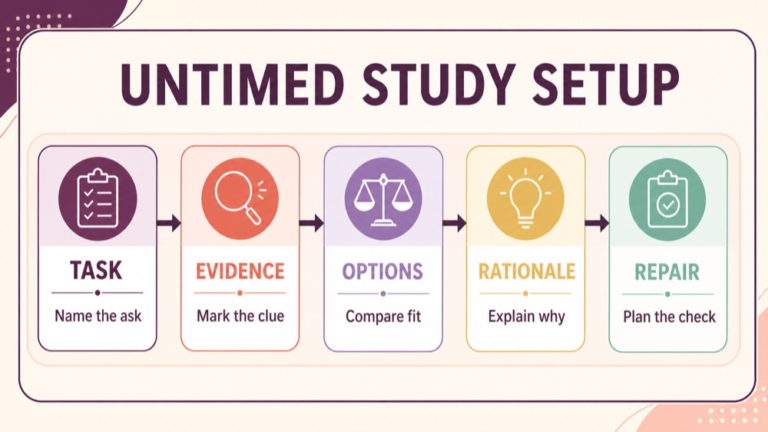
Write one learning purpose before opening the question set. You might be practicing how to identify the requested task, connect evidence to an assessment decision, sequence treatment planning, or compare two plausible options. An untimed session becomes easier to review when the purpose is specific enough to produce observable notes.
| Learning purpose | Prompt to use | Evidence of progress |
|---|---|---|
| Task recognition | What action is the stem requesting? | A concise restatement before the options. |
| Evidence selection | Which detail changes the decision? | Relevant clue linked to a choice. |
| Sequence | What comes before the proposed action? | Order explained with a purpose. |
| Distractor comparison | Why is the nearest alternative weaker? | A specific mismatch, not a vague label. |
| Transfer | Would the reasoning survive changed details? | Fresh scenario handled without copying wording. |
Choose one primary purpose and one secondary note. Trying to improve every reasoning behavior in one sitting can produce a busy record with no clear next move. A narrow purpose also makes it easier to compare two question sets from different sources.
Give yourself permission to pause for the reason, not for endless searching. If you need a reference, record what you checked and return to the stem. The goal is to learn which evidence supports the decision, not to collect an explanation that you cannot reproduce later.
Set up a clean untimed session
A useful untimed session has stable materials, a defined stopping point, and a record that separates independent reasoning from reference-supported learning. Put the source title and date at the top of the page. Hide answer explanations until you have written a first decision and a short rationale.
| Session element | Suggested setup | Why it matters |
|---|---|---|
| Question range | One clinical lane or a small mixed set. | Keeps the learning purpose visible. |
| Answer record | Choice, confidence, evidence, and rationale. | Shows more than right or wrong. |
| Reference rule | Check after a first independent attempt. | Protects the baseline reasoning record. |
| Stopping point | End after a defined number or review block. | Prevents fatigue from blurring the notes. |
Use a modest set when you are learning a decision type. A smaller set with complete explanations can be more informative than a large set where every answer receives only a quick mark. The appropriate size depends on the question source, your energy, and the repair you plan to run afterward.
Record the conditions honestly. If you searched before choosing, discussed the item with a peer, or saw an explanation that changed the route, use a separate label. That does not invalidate the session; it tells you which part of the reasoning is independent and which part still needs rehearsal.
Read the task before reading the distractors
Many selected-response stems include a clinical story, several details, and a final sentence that defines the requested action. Read for the task before allowing a familiar option to set the direction. Restate the requested action in your own words, then identify the evidence needed to support that action.
| Stem task | Question to ask | Common repair |
|---|---|---|
| Choose an assessment step | What decision will the information support? | Link measure to purpose and missing evidence. |
| Choose a treatment action | What target and condition are described? | Connect action to functional need and cueing. |
| Interpret a finding | Which pattern is supported by the details? | Separate the finding from an unsupported label. |
| Choose next information | What remains unknown after the stem? | Prioritize the information that changes the plan. |
The task sentence should control the comparison. If an option names a familiar test, technique, or diagnosis, place it back beside the requested action. Familiarity can make an option feel fluent without showing that it addresses the actual decision described in the stem.
When the task is unclear, write two possible restatements and compare them with the final sentence. If one restatement requires information the stem does not request, set it aside. This small pause can reduce later rereading because the comparison has a defined target.
Use an evidence-first answer record
For each item, record the selected option, one supporting detail, one reason the closest alternative is weaker, and your confidence. This format keeps the review anchored to the stem. It also makes an uncertain correct answer visible instead of allowing the answer key to end the learning process.
| Field | Example note | Review question |
|---|---|---|
| Task | Choose the next assessment information. | Did my choice answer this task? |
| Evidence | Detail that changes the clinical decision. | Is the detail relevant or decorative? |
| Choice | Selected option plus confidence. | Was the confidence supported? |
| Closest distractor | Option that could fit another task. | What exact mismatch weakens it? |
| Next action | Fresh item, concept review, or sequence drill. | What will test the repair? |
Keep the supporting detail concise but specific. A note such as “it sounds clinical” does not give you a reusable rationale. A note such as “the question asks for information before treatment, so this choice gathers the missing baseline” gives you a decision rule that can be tested with different wording.
Confidence is a learning signal rather than a grade. Stable confidence with a wrong answer may indicate a flawed rule. Uncertain confidence with a correct answer may indicate a rule that needs more transfer. Both patterns deserve a next action, though the action may differ.
Review all four options, not only the key
After checking the answer, return to the options and classify the mismatch for each distractor. It may belong to the wrong sequence, wrong population, wrong purpose, too broad a claim, or a detail that the stem never supplied. Naming the mismatch creates a more durable review note than copying the key.
- Wrong task: the option could be reasonable for a different question.
- Wrong sequence: the action belongs later or earlier in the process.
- Missing evidence: the option assumes a detail that was not established.
- Overreach: the option makes a larger claim than the stem supports.
- Weak fit: the option is related but does not address the central decision.
Use one mismatch category per distractor when possible. If two categories apply, record the primary one first and explain the second in a sentence. The purpose is not to create a taxonomy for its own sake; it is to make your comparison language precise enough for a fresh item.
Review the closest distractor with extra care. The obviously unrelated choices rarely explain a difficult miss. The nearby option often reveals whether you confused purpose with procedure, finding with diagnosis, or a possible action with the next appropriate action.
Separate retrieval from clinical reasoning
Some items ask you to retrieve a concept, while others ask you to use a concept within a case. Untimed review can help you tell those tasks apart. If you knew the concept after a brief cue but could not apply it to the stem, your next block should include transfer. If the concept itself was missing, begin with focused retrieval before adding more cases.
| Pattern | What it may suggest | Next study block |
|---|---|---|
| Concept absent | Term or principle was not available. | Short retrieval notes with self-explanation. |
| Concept known, application weak | Case details did not connect to the rule. | Contrast two fresh scenarios. |
| Application sound, confidence low | Reasoning works but feels unstable. | Repeat with changed wording and delayed review. |
| Reasoning sound, pace slow | Process is accurate but not yet efficient. | Add a small timed block after untimed confirmation. |
Do not label every miss as a knowledge gap. A learner can know a definition and still choose the wrong action because the stem requested a different stage of the process. Write the task, evidence, and sequence before deciding which content needs review.
Likewise, do not treat a slow but accurate explanation as a failure. It is information about efficiency. First make the reasoning reproducible, then shorten the record to the few cues that support the same decision under a light time limit.
Review the reason for every option
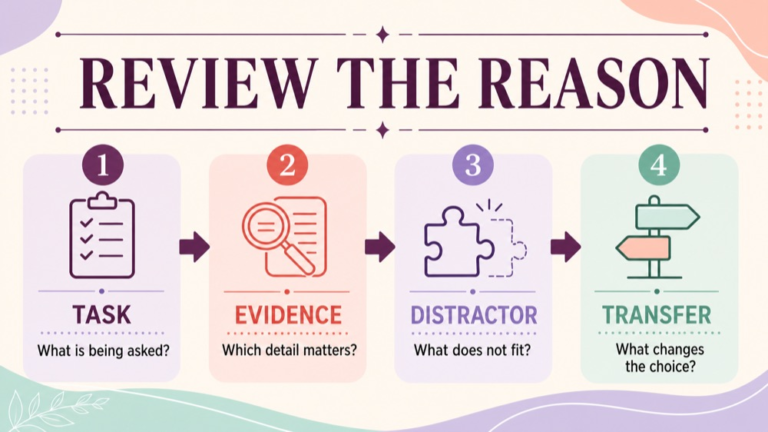
A complete review moves from the question task to the relevant evidence, then to the selected option and its nearest distractor. Finish by naming the next study action. This path turns an answer explanation into a reusable process that can survive a new population, setting, or wording pattern.
- Task pass: restate the requested decision in one sentence.
- Evidence pass: underline the details that change the decision.
- Option pass: explain the key and classify the closest distractors.
- Transfer pass: write how a changed detail could change the choice.
- Repair pass: select a fresh item or short concept drill.
For example, an assessment question may include a functional complaint, a brief history, and a request for the next information to gather. Your review should identify which detail creates the information gap, why the chosen step closes that gap, and why a later treatment decision is premature.
Review correct answers that felt uncertain. They can show where your reasoning was incomplete even though the choice matched the key. A short transfer item with changed details is a useful way to test whether the explanation belongs to the principle rather than to one familiar sentence.
Try three original untimed reasoning questions
The following items are original educational examples created for this article. They are not copied from ETS and are not presented as secure test material. Answer each one before reading the rationale, then record the task, evidence, closest distractor, and confidence.
Question 1: Identify the next information
Scenario: A client reports that speech is harder to understand during group conversation than during a quiet one-to-one exchange. The question asks what information should be gathered first to guide the next assessment step. Which response best matches that task?
Correct Answer: B. Why This Answer Is Correct: The task asks for information that clarifies when and how the communication breakdown occurs. Settings, partners, and patterns can shape the next assessment decision, while the other choices move to treatment, diagnosis, or measurement before the information gap is defined.
Why the Other Options Are Wrong: A begins treatment before the assessment purpose is established. C makes a label from limited information. D selects a measure because it is familiar rather than because it answers the stated question. B keeps the first step connected to context and observable breakdowns.
Question 2: Distinguish a principle from a procedure
Scenario: A learner can define a treatment principle but chooses a technique that does not match the stated functional target. During untimed review, what is the most useful next action?
Correct Answer: B. Why This Answer Is Correct: The scenario shows retrieval of the principle but difficulty applying it to the target. Contrasting fresh cases keeps the principle stable while changing the functional details, which tests whether the learner can connect the action to the purpose.
Why the Other Options Are Wrong: A rehearses retrieval without repairing application. C adds pressure before the reasoning route is clear. D removes the decision type that needs transfer. B creates a focused comparison that can show which target detail changes the technique choice.
Question 3: Explain the closest distractor
Scenario: An answer choice is clinically related to the case but belongs to a later stage of planning than the stem requests. How should you record that option during review?
Correct Answer: B. Why This Answer Is Correct: A distractor can be related yet still fail the requested sequence. Naming the mismatch preserves the distinction between a possible later action and the next action supported by the stem. That distinction can transfer to new cases.
Why the Other Options Are Wrong: A confuses clinical relevance with task fit. C loses the reasoning clue contained in the nearest distractor. D changes the evidence instead of analyzing it. B records the precise reason the related option is weaker for this question.
Convert uncertainty into a study action
After review, choose one action that directly tests the uncertainty. A missing concept may need a short retrieval card and self-explanation. A sequence confusion may need a before-and-after comparison. A distractor problem may need two close options with explicit mismatch notes. An application problem may need fresh cases with changed details.
| Uncertainty label | Targeted action | Fresh check |
|---|---|---|
| Definition unclear | Write a plain-language rule and one contrast. | Recall the rule after a delay. |
| Purpose unclear | Restate three stems before viewing options. | Choose the requested action. |
| Sequence unclear | Order steps and explain the information each adds. | Handle a changed scenario. |
| Distractor unclear | Classify the nearest mismatch. | Explain why a related choice is weaker. |
| Pace unclear | Run a short timed block after untimed review. | Keep the same reasoning record with a light clock. |
Keep the next action small enough to finish and specific enough to inspect. “Study assessment” is too broad to show whether the repair worked. “Compare three next-step stems and name the missing information before viewing options” gives you a result that can be reviewed.
Use a fresh check rather than rereading the same explanation. New wording prevents familiarity from doing all the work. The change can be modest: switch the setting, alter one relevant detail, or ask for a different step in the same decision pathway.
Add the clock after the reasoning is visible
Untimed practice and timed practice are connected stages rather than competing identities. Begin with enough untimed work to describe the decision rule. Then introduce a light time boundary for a small block while keeping the same task, evidence, and distractor record. This shows whether efficiency changes the reasoning.
| Stage | Condition | What to compare |
|---|---|---|
| Untimed learning | Time open, explanation delayed. | Task, evidence, and option rationale. |
| Light timing | Small set with a flexible checkpoint. | Rereads, hesitation, and explanation quality. |
| Mixed timed work | Different lanes under one short condition. | Whether the process transfers across content. |
| Long simulation | Use only after a clear review plan exists. | Stamina and pacing patterns. |
Do not use a long simulation to diagnose every unresolved problem at once. If the untimed reasoning record is incomplete, a full clocked run can produce a large pile of ambiguous misses. Build the smallest comparison that answers the next question you have about your process.
When speed changes an answer, record what changed: task recognition, evidence selection, option comparison, or confidence. That note tells you whether the next session should return to untimed reasoning or continue with a smaller timed block.
Build a review ladder from simple to complex
A review ladder lets you move from recognition to transfer without jumping straight into the most demanding condition. Start with a plain concept, place it in a short stem, compare close options, and then use a mixed case that asks for a sequence or next action. Each rung should have a visible success signal.
- Recall: state the principle in plain language.
- Recognize: identify the relevant clue in a short stem.
- Apply: select an action that fits the target and condition.
- Contrast: explain why the closest distractor is weaker.
- Transfer: solve a fresh case with changed details.
- Time: repeat a small set with a measured boundary.
Move down one rung when the record shows that the previous rung is unstable. Move up when the explanation is reproducible, not merely when the answer happens to be correct. This approach keeps the study block aligned with the evidence you collected rather than with a vague feeling about readiness.
Keep the ladder flexible across the three broad content areas described by the current ETS material. A learner may need retrieval in foundations, transfer in assessment, and sequence practice in treatment planning. The same review structure can serve each lane while the examples and sources remain specific.
Use breaks and source labels responsibly
Record breaks, interruptions, reference checks, and discussions because they change the condition of an untimed session. These details do not make the session useless. They tell you whether the result represents independent reasoning, supported learning, or a blend that needs a second check.
- Independent first pass: record the answer and rationale before checking help.
- Reference-supported pass: note the source and the concept it clarified.
- Peer discussion: write the reasoning you could reproduce alone.
- Break or interruption: mark where the condition changed.
- Fresh follow-up: test the repaired idea with changed wording.
Use the source label in your notes so you do not compare a supported answer with an independent answer as though they came from the same condition. A clean record makes progress easier to see and helps you choose the right next practice format.
For changing test administration information, use the responsible live source. Preparation pages and third-party practice products can support learning, but they should not replace current ETS instructions about registration, delivery, timing, or appointments.
Avoid common untimed practice traps
- Removing the clock without choosing a learning purpose.
- Searching for an explanation before making an independent first pass.
- Recording only right or wrong and losing the rationale.
- Copying the answer key without explaining the closest distractor.
- Calling a sequence mismatch a missing concept.
- Calling every slow decision a knowledge gap.
- Repeating the same wording until familiarity replaces transfer.
- Using one large session to repair several unrelated patterns.
- Comparing supported and independent results without labeling the conditions.
- Treating a practice percentage as an official scaled score.
- Using a preparation page for changing appointment or administration details.
- Studying purported secure content rather than legitimate preparation material.
The correction is a visible chain: name the task, record the evidence, compare the options, label the uncertainty, choose a small repair, and test that repair with fresh wording. Untimed practice becomes more valuable when each session leaves a clear next decision.
Untimed SLP Praxis practice-test checklist
Use this checklist with an untimed slp praxis practice test:
- Did I confirm Speech-Language Pathology (5331) through the current ETS page?
- Did I record the source, date, and practice condition?
- Did I choose one primary learning purpose?
- Did I restate the task before comparing options?
- Did I record the evidence that changed my decision?
- Did I explain why the closest distractor was weaker?
- Did I label independent, reference-supported, and discussed answers?
- Did I review uncertain correct answers?
- Did I identify retrieval, application, sequence, or distractor uncertainty?
- Did I choose a small repair action?
- Did I test the repair with fresh wording or a changed detail?
- Did I add time pressure only after the reasoning record was visible?
- Did I keep practice evidence separate from official score and logistics claims?
The purpose of untimed work is not to stay away from pacing. It is to make the reasoning route clear enough that a later clocked block can test efficiency rather than confusion. Keep the record specific, repeat the repair with fresh material, and let the next condition answer one focused question.
Sources and next steps
Use the current ETS Speech-Language Pathology (5331) page for subject identity, format, duration, question count, broad content direction, and official preparation links. Search the ETS Praxis practice-test page for current subject options. Review ASHA’s Praxis preparation guidance for preparation materials, practice questions, timed work, and using strengths and weaknesses to guide review.
Continue your preparation: Explore the SLP Study Center learning resources after you finish the untimed answer record and select the next repair block.