
Praxis SLP questions are easier to learn from when you use a repeatable reading method. Instead of asking only whether an answer was right, ask what the item wanted you to decide, which evidence mattered, and why the closest alternative was less fit for that context.
The current ETS Speech-Language Pathology (5331) page describes a computer-delivered selected-response test with 132 questions and 150 minutes. Use the live ETS page and your account for changing details. ASHA preparation guidance also recommends practice questions, topic-area review, timed work, and a plan based on your strengths and weaknesses.
Why a method matters for Praxis SLP questions
A question bank is a set of observations, not a complete explanation of your preparation. A result can reflect concept knowledge, familiarity with wording, ability to interpret a scenario, pacing, or a mixture of those factors. A consistent method helps you separate them.
| What you notice | Question to ask | Record to keep |
|---|---|---|
| Correct answer | Could I explain the choice from the stem? | Deciding evidence and confidence. |
| Incorrect answer | Was the issue concept, task, evidence, or process? | One repair action. |
| Changed answer | What did rereading reveal? | Reading cue or task wording. |
| Close distractors | What makes one option more fit here? | Contrast between two choices. |
Use a practice set for the job it can support. A short set may reveal a terminology or decision gap. A longer block may let you rehearse pacing and review behavior. Neither needs to carry conclusions outside its conditions.
Confidence deserves its own label. “Confident correct” is different from “correct by elimination” or “correct after changing the answer.” Those records can look identical in a percentage but need different follow-up work.
Confirm the current 5331 source
Start with the current ETS Speech-Language Pathology (5331) page. Use it to confirm the subject identity, current delivery and timing information, broad content direction, and official preparation links. The page currently lists 132 questions and 150 minutes for a computer-delivered selected-response exam. Date your source note because details can change.
Search results may mix official study materials with commercial banks, flashcards, sample questions, university guides, and short quizzes. Read what each resource says it is designed to do. The appearance of a resource in search does not settle the accuracy or scope of every explanation.
- Check the subject: confirm Speech-Language Pathology (5331), not another Praxis subject.
- Label the format: note whether the resource is a bank, sample, drill, quiz, or simulation.
- Read the rationale: check whether the explanation addresses the selected choice and the closest alternative.
- Record the scope: note which broad decisions appear and which are not represented.
- Separate logistics: use the current ETS source for appointment, delivery, identification, and changing administrative details.
- Protect originality: use original learning examples and avoid purported live or confidential content.
For planning principles, review ASHA’s Praxis preparation guidance. For current practice-test options, use the ETS practice-test page. Keep those source roles visible in your notes.
Use a three-step read for every Praxis SLP question
Use three passes: read the task, identify the evidence, compare the choices. This is short enough for a timed block and detailed enough for later review.
- Read the task: circle the action word in your own notes: identify, interpret, choose, sequence, evaluate, or measure.
- Identify the evidence: underline the setting, goal, performance detail, time course, or missing information that controls the decision.
- Compare the choices: select the option that fits the task and evidence, then test it against the closest alternative.
Do not add a fourth task that the stem did not request. If the item asks what information to gather first, do not leap to a treatment plan. If it asks which outcome matches a functional goal, do not choose a measure only because its name is familiar.
After the set, add a transfer line. Change one detail in the scenario and ask whether the answer should remain the same. If the answer changes, name the changed evidence. If it remains the same, explain which principle carried across.
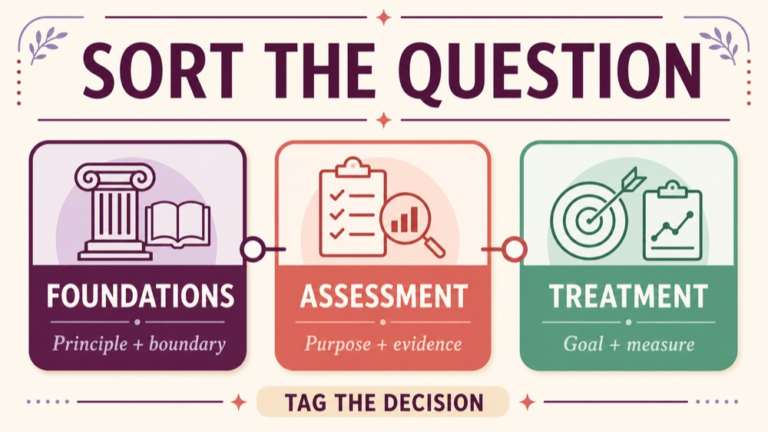
Sort questions by decision, not by topic word
Clinical vocabulary can make an item look more specific than it is. A question may mention a test, a treatment activity, a classroom, or a communication partner while actually asking for sequence, interpretation, or a professional boundary. Tag the decision first.
| Decision label | Useful prompt | Typical evidence |
|---|---|---|
| Principle | What idea or boundary controls the response? | Definition, contrast, role, and context. |
| Assessment sequence | What should be clarified or gathered for the stated purpose? | Referral question, missing information, and order. |
| Interpretation | What does the described pattern support? | Performance, history, setting, and limits. |
| Treatment plan | What plan fits the target and context? | Goal, activity, support, and implementation. |
| Measurement | What observation shows meaningful change? | Functional behavior, criterion, and time point. |
Use a primary label and, when helpful, a secondary label. An assessment question can require a foundation distinction. A treatment question can require measurement reasoning. The purpose of the labels is to explain the reasoning, not to force every item into a single box.
When you finish a set, compare the distribution of decision labels with your study plan. If your practice contains many principle items but few measurement or sequence items, add a targeted block. Do not assume a total question count describes the range of decisions.
Build a fast question record
Use one line per important item. A compact record prevents you from rereading the entire bank and gives you a clear next action.
| Field | Example | Purpose |
|---|---|---|
| Task | Choose the next assessment step. | Defines the job. |
| Lane | Assessment and evaluation. | Shows the content container. |
| Evidence | Referral purpose and missing context. | Supports the choice. |
| Confidence | Correct but uncertain. | Flags fragile recognition. |
| Closest alternative | Why it would fit in another context. | Builds contrast. |
| Next check | Changed setting, same task. | Tests transfer. |
Classify the reason for a miss in plain language:
- Concept gap: the principle or distinction was not available.
- Task miss: the stem asked for a different action than the one you answered.
- Evidence miss: a controlling detail was overlooked or over-weighted.
- Distractor pull: a plausible option was not compared with the selected choice.
- Process issue: timing, rereading, interruption, or answer-change behavior affected the result.
These are study labels, not clinical conclusions. Their value is practical: they help you choose an appropriate repair instead of sending every error into a broad “review more” list.
Handle foundations and professional-practice items
Foundations items may test terminology, underlying knowledge, communication context, professional role, or a boundary. Read for the distinction the stem is making. Then ask whether the answer applies to the setting and role described.
- State the concept without using the answer choices.
- Identify the condition or boundary that matters.
- Compare the selected answer with the closest alternative.
- Write one example in a different context.
If your note says “study foundations,” make it more actionable. Write “distinguish the principle from its tempting shortcut in two settings” or “explain the term, its boundary, and one example without notes.” A narrow task is easier to complete and verify.
Watch for answers that sound polished but do not address the requested action. If the stem asks for the principle, an elaborate plan may move past the evidence. If it asks for the next step, a definition may be true but incomplete for the question.
Handle assessment and evaluation items
Begin assessment questions with the referral purpose. Ask what decision the information should support, what is already known, and what missing detail could change the sequence. Then distinguish among screening, evaluation, measure selection, interpretation, and follow-up.
| Read first | Ask | Review signal |
|---|---|---|
| Purpose | What decision is needed? | The answer addresses a different decision. |
| Context | Where does performance matter? | The answer ignores the setting or partner. |
| Known evidence | What does the stem already establish? | The answer repeats a fact without using it. |
| Missing evidence | What could change the next step? | The answer assumes a conclusion too early. |
A measure named in a stem is not automatically the answer. The question may be testing why the measure is appropriate, what should happen before it, or how its result should be interpreted. Tag the action requested by the stem and explain what evidence supports it.
For a transfer check, alter the referral purpose or setting while keeping the core reasoning visible. This shows whether you can apply the sequence instead of recalling a familiar order.
Handle treatment and measurement items
Treatment questions are easier to compare when you connect the goal, activity, support, and outcome. Ask what functional performance is expected to change and whether the answer gives a way to observe that change.
| Element | Question | Evidence |
|---|---|---|
| Goal | What meaningful behavior is targeted? | Functional context and target. |
| Activity | How does the activity address the target? | Practice demand and rationale. |
| Support | What cue, partner, or setting shapes performance? | Conditions of the plan. |
| Outcome | What observation shows change? | Measure, criterion, and time point. |
When a choice measures worksheet completion or drill count, ask whether it also observes the functional goal. Process data can be useful, but it may not answer a question about meaningful performance. The distinction is often the reason one option is stronger than another.
Create a new scenario by changing the partner, setting, level of support, or communication demand. Then decide which element should change. A transfer task keeps you focused on the relationship among goal, intervention, and observation.
Review the evidence behind each answer
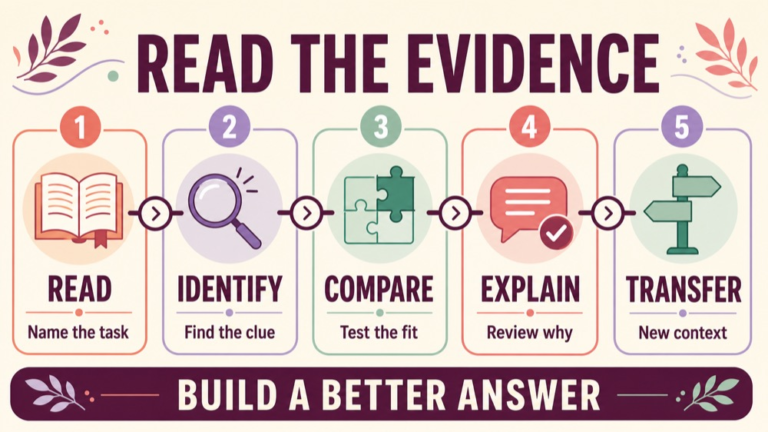
Answer review should make the evidence visible. Use the sequence task, evidence, answer, distractor, boundary. The boundary is the detail that could make another option appropriate in a different context.
- Task: write the question’s requested action.
- Evidence: record the stem detail that carries the decision.
- Answer: explain why the selected choice fits both.
- Distractor: name the closest alternative and its missing fit.
- Boundary: state what context change could alter the response.
Use this method for correct answers as well as misses. Correct answers reached by recognition may still need a transfer check. Correct answers with a clear rationale can be marked as more stable, while a new scenario may reveal a boundary you had not noticed.
Keep the rationale proportional. A short item may need three sentences; a concept gap may need a definition, contrast, example, and source note. The target is an explanation you can use again, not a copied answer key.
Try three original Praxis SLP questions
The following questions are original study examples created for this article. They are not copied from ETS and are not presented as live test material. Answer before reading the rationale, then identify the task, lane, deciding evidence, and closest distractor.
Question 1: Clarify the assessment task
Scenario: A referral says that a student has difficulty participating in class discussion, but it does not describe the student’s communication partners, classroom demands, or when the difficulty occurs. What is the strongest next move?
Correct Answer: B. Why This Answer Is Correct: The missing context may change the purpose, sequence, and interpretation of assessment. Clarifying the demand and referral purpose makes the next information-gathering step more useful.
Why the Other Options Are Wrong: A moves into treatment too soon. C discounts information that can affect measure choice and interpretation. D treats a broad label as a complete functional description. B matches the task to the evidence that is still needed.
Question 2: Align the outcome with the goal
Scenario: A client’s goal is to use a communication strategy during a workplace conversation. Which outcome record best matches the goal?
Correct Answer: B. Why This Answer Is Correct: The observation occurs in a context related to the functional goal and records the target behavior. It links the outcome to the communication demand.
Why the Other Options Are Wrong: A and C measure activity or completion without directly observing the functional target. D gives scoring convenience priority over goal alignment. B keeps the goal and observation connected.
Question 3: Repair answer recognition
Scenario: You choose a foundations answer correctly but explain it only by saying that it is “the best clinical option.” What should you do next?
Correct Answer: B. Why This Answer Is Correct: The answer mark is not the unresolved issue; the explanation is. Task, principle, and distractor comparison show whether the choice came from the stem rather than from a general phrase.
Why the Other Options Are Wrong: A strengthens recognition without testing explanation. C discards useful evidence about a fragile skill. D accepts a vague statement without matching it to the question. B creates a clear repair and transfer task.
Turn errors into fresh practice
Choose the repair from the error label and connect it to the next fresh practice check. Use the label to decide whether you need retrieval, comparison, explanation, or a process rehearsal before you open another resource or change the study plan.
| Error label | Repair | Fresh check |
|---|---|---|
| Concept gap | Write a definition, contrast, boundary, and example. | Retrieve without notes. |
| Task miss | Restate the question before reading choices. | Use a different action word. |
| Evidence miss | Underline facts that support or limit each option. | Change one fact and reassess. |
| Distractor pull | Compare the two closest choices. | Defend why one is less fit. |
| Process issue | Run a short block with a clear skip rule. | Compare pacing and reread notes. |
Select two or three priority patterns for the next cycle. A broad list can create activity without showing which skill changed. Make each repair observable: “explain why the closest alternative is weaker in three changed scenarios” is clearer than “review assessment.”
Use a delay before transfer when possible. Immediate repetition can show memory for the explanation. Fresh wording later gives stronger evidence about application.
Use timing without misreading the result
The current ETS page lists 132 questions and 150 minutes. Use that official scale to understand the exam context, then label smaller practice blocks honestly. Untimed explanation work, a short clocked set, and a longer simulation measure different behaviors.
- Learning mode: pause to study explanations and update the question record.
- Timed mode: protect the clock and record skips, rereads, interruptions, and answer changes.
- Transfer mode: use new wording after a delay.
- Coverage mode: count decision labels and lane representation.
Keep a practice percentage separate from an official score or a licensing requirement. A local result reflects one source under one set of conditions. Use the current responsible source for official reporting and changing requirements.
If timing is the issue, make the next action process-specific. Practice reading the final task sentence, set a move-on rule, or rehearse returning to marked items. If a content gap is the issue, repair the concept before extending the clock.
Avoid common Praxis SLP question traps
- Using a generic question bank without checking Speech-Language Pathology (5331) alignment.
- Choosing the most familiar clinical term instead of answering the requested task.
- Counting question volume without tagging decision types.
- Treating an uncertain correct answer as fully secure.
- Repeating identical wording and calling recognition transfer.
- Accepting a polished rationale that does not identify the deciding evidence.
- Using a practice percentage as an official scaled result.
- Relying on a practice page for changing appointment or identification requirements.
- Copying purported live or confidential content into public notes.
- Adding another resource before testing the repair from the previous set.
The fix is a small loop: identify the task, find the evidence, compare the closest alternative, label the boundary, and write a fresh check. That loop keeps practice focused on reasoning.
Praxis SLP questions checklist
Use this checklist with a set of Praxis SLP questions:
- Did I confirm the Speech-Language Pathology (5331) subject through the current ETS page?
- Did I identify the resource format and its intended study job?
- Did I restate the task before choosing an answer?
- Did I sort the item into a primary decision label?
- Did I record the evidence that controlled the choice?
- Did I label my confidence separately from correctness?
- Did I compare the closest distractor?
- Did I record timing, environment, breaks, and interruptions?
- Did I classify the miss as concept, task, evidence, distractor, or process?
- Did I choose a small repair action?
- Did I test the repair with changed wording after a delay?
- Did I keep practice evidence separate from official score and logistics claims?
The purpose of Praxis SLP questions is not to collect answer letters. It is to build a record of decisions you can explain, boundaries you can recognize, and fresh scenarios you can handle when the wording changes.
Sources and next steps
Use the current ETS Speech-Language Pathology (5331) page for subject identity, format, duration, question count, content areas, and official preparation links. Search the ETS Praxis practice-test page for current subject options. Review ASHA’s Praxis preparation guidance for preparation materials, practice questions, timed work, and using strengths and weaknesses to guide review.
Continue your preparation: Explore the SLP Study Center learning resources after you have completed the question record and selected the next fresh check.