
Speech language pathology praxis practice questions are most valuable when you use them to practice decisions, not just answer recognition. A strong question record shows what the stem asked, which evidence controlled the choice, why the closest alternative was weaker, and how you will test the same principle with new wording.
The current ETS Speech-Language Pathology (5331) page describes a computer-delivered selected-response test with 132 questions and 150 minutes. Use the live ETS page and your account for changing details. ASHA’s preparation guidance also points candidates toward practice questions, topic-area review, timed work, and a plan built around individual strengths and weaknesses.
What these practice questions are meant to teach
Question banks can support several different skills. One item may check retrieval of a concept, another may ask you to interpret a pattern, and a third may ask you to choose a sequence or measure. If you record all three as one undifferentiated score, you lose the information that tells you what to study next.
| Question job | What the stem may ask | Review note |
|---|---|---|
| Retrieve | Recognize a definition, distinction, or professional principle. | Write the principle and one boundary. |
| Interpret | Use client, setting, history, or performance evidence. | Underline the fact that changed the choice. |
| Sequence | Choose what information or action should come next. | Name the purpose before naming the step. |
| Measure | Match a goal or question to an observation or outcome. | Connect the measure to the functional target. |
| Transfer | Apply the same idea in a changed scenario. | Write a new stem after reviewing the answer. |
Before you start a set, choose its job. An untimed concept set can help you learn the language. A short timed set can show how reading and triage behave under a clock. A mixed set can show whether you can switch among lanes. Each result is useful when its conditions and purpose stay visible.
Use confidence labels as well as answer labels. “Correct and explained,” “correct but uncertain,” “incorrect with a clear misconception,” and “rushed or misread” are different records. They call for different repairs, so keep them separate in your notes.
Confirm the current 5331 boundary
Use the current ETS Speech-Language Pathology (5331) page as the control point for the subject identity, current format information, broad content scope, and official preparation links. The page currently lists 132 questions and 150 minutes for a computer-delivered selected-response exam. Date the source note because details and resource availability can change.
Search results for practice questions can combine official material, commercial study products, flashcards, university guides, sample questions, and short quizzes. A result page can show search intent, but it does not make every answer explanation equally authoritative. Read the resource description and keep its role clear.
- Confirm the subject: verify that the set is intended for Speech-Language Pathology (5331).
- Identify the format: label it as a question bank, sample, drill, quiz, or longer simulation.
- Check the explanation: see whether it explains the selected answer and the closest alternatives.
- Map the task: record whether the item asks for a principle, interpretation, sequence, plan, or measure.
- Mark the boundary: separate study advice from current ETS or appointment information.
- Protect originality: avoid purported live or confidential content and use original learning examples.
ASHA’s Praxis preparation guidance can help you think about preparation materials, practice questions, timing, and topic-area strengths and weaknesses. Use that guidance for planning, and use the live ETS source for current test identity and changing logistics.
Sort practice questions by the decision they ask
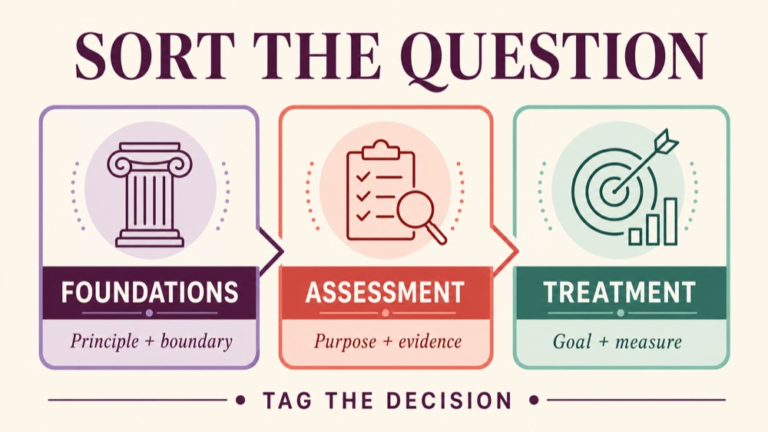
Sort each question by the decision requested rather than the most noticeable clinical noun. A stem may mention a treatment activity while asking which assessment information should be gathered first. Another may mention a measure while asking whether the outcome matches a functional goal. The requested decision is the most useful organizing label.
| Decision tag | Prompt to ask yourself | Evidence to capture |
|---|---|---|
| Principle | What concept or boundary controls the choice? | Definition, contrast, role, or context. |
| Assessment sequence | What information is needed for the stated purpose? | Referral question, missing detail, and order. |
| Interpretation | What does the described pattern support? | Performance, history, setting, and limitations. |
| Treatment plan | What action fits the target and context? | Goal, support, activity, and implementation. |
| Outcome measure | What observation would show meaningful change? | Functional behavior, criterion, and time point. |
Give an item more than one tag when the reasoning genuinely crosses lanes. For example, an assessment item may require a foundations distinction about scope or communication access. Record the primary task first and add a secondary tag only when it helps explain the error.
After a set, count decision types instead of relying on the total number of questions. If a bank contains many principle-retrieval items and few sequence items, it may be useful for one study block while leaving another skill untested. That is a coverage observation, not a judgment about the resource’s entire value.
Build a question log that shows reasoning
A question log should be quick enough to maintain and detailed enough to guide repair. Use one row per important item, including uncertain correct answers. Record the source and date, the primary lane, the requested task, the deciding evidence, your confidence, and the next check.
| Log field | Example entry | Why it helps |
|---|---|---|
| Source and date | Question bank, 2026-09-02 | Preserves the conditions of the result. |
| Lane | Assessment and evaluation | Shows where a pattern is forming. |
| Task | Choose information to gather before measure selection. | Prevents topic labels from hiding the job. |
| Deciding evidence | Referral purpose and missing functional context. | Connects the answer to the stem. |
| Confidence | Uncertain correct | Flags recognition that needs transfer. |
| Next check | Changed setting, same reasoning task. | Creates an observable follow-up. |
For a missed item, write the error in one of four ways: concept gap, task misread, evidence miss, or process issue. These categories are not diagnoses; they are practical labels for choosing the next action. A concept gap may need a short explanation. A task misread may need stem restatement. An evidence miss may need comparison of two plausible choices. A process issue may need a small timed block.
Keep the answer letter out of the first line of your review. Start by restating the question in your own words and naming the evidence. Then compare the selected answer with the closest alternative. This order makes your reasoning visible before familiarity with the answer key takes over.
Read foundations and professional-practice questions
Foundations questions often use a definition, contrast, professional role, communication context, or underlying principle. The distractors may use words that sound responsible but apply a familiar idea to the wrong setting. Read for the boundary that controls the principle.
- Restate the concept: say what the item is testing without copying an option.
- Find the boundary: identify the setting, role, client need, or missing condition.
- Compare the contrast: explain how the closest alternative differs.
- Create a transfer: change one context detail and predict what would change.
If your note says only “I need to study ethics” or “review terminology,” it is too broad to guide a next session. Narrow it to a decision: distinguish the professional responsibility from the shortcut in two new settings, or explain the concept with a contrast and an example. Specific actions produce clearer evidence.
Do not let professional-sounding wording substitute for a reason. Ask which phrase in the stem supports the answer and whether the option addresses the requested task. If the question asks for a next step, a definition alone may not answer it. If it asks for a principle, an elaborate plan may move beyond the evidence.
Read assessment and evaluation questions
Assessment and evaluation questions benefit from a purpose-first read. Name the referral question, identify the information already available, and list the missing detail that could change the next step. Then decide whether the stem is asking about screening, additional information, measure selection, interpretation, or sequence.
| Read first | Question to write down | Common review signal |
|---|---|---|
| Purpose | What decision should the information support? | Answer choice does not address the stated purpose. |
| Context | Where and with whom does performance matter? | Choice ignores setting or communication demand. |
| Evidence | What is known and what remains missing? | Choice assumes an unsupported conclusion. |
| Sequence | What step is useful at this point? | Choice jumps ahead to a later decision. |
A test name in the stem can be a distractor if the actual task is to identify purpose or order. Tag the task that the question requests. When reviewing an answer, write what additional information would make the closest alternative fit in a different context. This turns distractor analysis into a clinical reasoning exercise.
Use new wording after a delay. Repeating the same question immediately can show recognition of the explanation rather than application of the reasoning. Change the referral purpose, setting, or missing detail while keeping the core decision type visible.
Read treatment and outcome questions
Treatment questions become easier to review when you connect four elements: functional goal, intervention activity, support or context, and observation of change. An attractive activity is not enough if it does not match the target or the way performance will be observed.
| Element | Review question | Note to keep |
|---|---|---|
| Functional goal | What meaningful behavior is expected to change? | Target and context. |
| Activity | How does the activity address that behavior? | Practice demand and rationale. |
| Support | What cue, partner, or environment is part of the plan? | Conditions that shape performance. |
| Outcome | What observation will show progress or a needed adjustment? | Measure and time point. |
When you miss an outcome question, check whether the answer measures the stated goal or merely counts an easier activity. When you miss an intervention question, check whether the option has a clear connection to the target. These checks keep your review focused on alignment rather than on how familiar the activity sounds.
Write one changed scenario for every difficult treatment item. Alter the communication partner, setting, level of support, or functional demand. Then decide whether the goal, activity, or observation should change. The task is to carry the reasoning into the new context, not to preserve the original answer by habit.
Try three original Speech Language Pathology practice questions
The following items are original study examples created for this article. They are not copied from ETS and are not presented as live test material. Answer each one before reading the rationale. Then record the decision tag, the evidence, and the closest distractor.
Question 1: Identify the requested assessment task
Scenario: A school referral describes reduced participation in group discussion. The note gives no information about communication partners, classroom demands, or when the difficulty occurs. What is the most useful next reasoning move?
Correct Answer: B. Why This Answer Is Correct: The missing classroom and communication-partner information can change the referral purpose, assessment sequence, and interpretation. Clarifying the demand and purpose gives the next step a defensible basis.
Why the Other Options Are Wrong: A moves to treatment before the performance concern is sufficiently described. C chooses a measure without resolving information that could affect its use. D treats a broad referral phrase as a complete functional description. B fits the evidence and the sequence requested.
Question 2: Match an outcome to the functional goal
Scenario: The goal is for a client to use a target communication strategy during a workplace conversation. Which outcome record best matches that goal?
Correct Answer: B. Why This Answer Is Correct: The observation occurs in a context related to the functional goal and records the target behavior. It gives the clinician information about whether the strategy is being used where it matters.
Why the Other Options Are Wrong: A and C measure activity or completion without directly observing the functional target. D gives scoring convenience priority over goal alignment. B connects the outcome record to the stated communication demand.
Question 3: Repair a weak rationale
Scenario: You choose an answer correctly but explain it only by saying that it is “the best clinical option.” What should you do next?
Correct Answer: B. Why This Answer Is Correct: The answer mark is not the unresolved issue; the explanation is. Task, evidence, and distractor comparison reveal whether the choice is supported by the stem rather than by a vague professional phrase.
Why the Other Options Are Wrong: A strengthens recognition without testing explanation. C discards useful information about an uncertain skill. D accepts a general label without matching it to the question. B creates a clear repair and a fresh basis for transfer.
Use an answer-rationale record
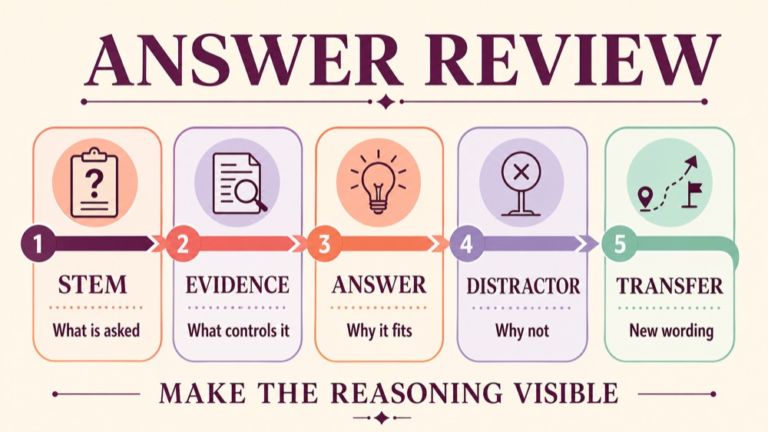
After answering, use a short answer-rationale record instead of copying the answer key. The record should preserve the reasoning that you can reuse on a new question.
- Stem task: rewrite the question in one sentence.
- Deciding evidence: quote or paraphrase the detail that controls the choice.
- Selected answer: state the choice and why it fits the task.
- Closest distractor: explain why it is less fit in this context.
- Boundary: name the fact or setting change that could alter the answer.
- Transfer check: write a new scenario and answer it after a delay.
Keep explanations proportional to the item. A two- or three-sentence rationale is often enough when it identifies the task, evidence, and distractor distinction. A longer note is useful when the item exposes a concept gap or a source conflict. The goal is a reusable explanation, not a transcript of every thought.
Compare your rationale with the source explanation, but keep the source’s limits visible. If a rationale makes a claim that conflicts with current ETS scope or authoritative clinical guidance, flag the issue for verification instead of silently adding it to your notes. A question bank can prompt investigation without deciding every broader claim.
Convert wrong answers into fresh checks
A missed question is useful when it leads to a concrete repair. Choose the repair based on the kind of miss:
| Miss type | Repair task | Fresh check |
|---|---|---|
| Concept | Write a definition, contrast, boundary, and example. | Retrieve it without notes. |
| Task | Restate the question before viewing choices. | Answer a stem with a different verb. |
| Evidence | Underline facts that support or limit each option. | Change one fact and reassess. |
| Distractor | Explain the closest alternative’s missing fit. | Defend the choice aloud. |
| Process | Practice a short block with a skip and return rule. | Compare reading and pacing notes. |
Limit the next repair list. Select two or three priority patterns, assign one action to each, and schedule a fresh check. Opening another question bank before testing the repair can create more data without improving the underlying skill.
Use spaced transfer. A fresh scenario immediately after review can still benefit from the explanation’s memory trace. A later scenario with changed wording, context, or decision demand gives stronger evidence that the principle is available for use.
Mix question types without losing the lane
Mixed practice should increase useful switching, not blur every error together. Start with one lane, then mix two decision types, and later add a third lane. Keep the lane and task tags in the log so that a mixed-set result remains interpretable.
| Stage | Mix | What to watch |
|---|---|---|
| Build | One lane, one decision type. | Concept accuracy and explanation. |
| Connect | Two lanes with a shared decision type. | Whether evidence changes the action. |
| Switch | Three lanes in a short mixed set. | Task recognition before answer selection. |
| Simulate | Longer set with recorded conditions. | Stamina, pacing, skips, and review behavior. |
For example, compare an assessment-sequencing question with a treatment-measurement question. Both may ask what comes next, but the evidence differs. The assessment item may depend on referral purpose and missing information. The treatment item may depend on functional goal and outcome alignment. Tagging both as “next step” without the lane would hide that difference.
Keep timing and source labels visible
The current ETS page lists 132 questions and 150 minutes. Use that official information to understand the test’s scale, but label smaller practice sessions by their own conditions. Untimed review, a 20-minute question block, and a longer simulation do not measure the same behavior.
- Learning mode: pause to study explanations and connect the item to a concept.
- Timed mode: protect the clock and record skips, rereads, and interruptions.
- Transfer mode: use fresh wording after a delay.
- Coverage mode: tag lanes and decision types regardless of percentage.
Keep practice percentages separate from official scores, passing requirements, or licensing decisions. A local result is evidence from one source under one set of conditions. Use the official responsible source for current reporting and requirement questions.
Record source, date, mode, environment, breaks, permitted materials, and interruptions. If you investigate an answer during the session, mark that block as learning mode or note the interruption. Honest labels make your progress record more useful.
Avoid practice-question traps
Check for these patterns before you treat a question-bank result as a broad study conclusion:
- Using a generic Praxis bank without confirming Speech-Language Pathology (5331) alignment.
- Counting questions without tagging the decisions they represent.
- Choosing an answer because a clinical noun sounds familiar while missing the requested task.
- Marking uncertain correct answers as secure without reviewing the rationale.
- Repeating identical wording and calling recognition transfer.
- Letting a practice explanation replace the current ETS source for changing logistics.
- Converting a provider’s percentage into an official scaled score.
- Copying purported live or confidential items into public content.
- Adding more resources before completing a repair action.
The correction is a small repeatable loop: verify the subject, label the task, capture the evidence, compare the closest distractor, and schedule fresh wording. This lets a question set support preparation without asking it to prove more than it can show.
Speech Language Pathology Praxis practice-questions checklist
Use this checklist with a set of speech language pathology praxis practice questions:
- Did I verify the Speech-Language Pathology (5331) subject through the current ETS page?
- Did I label the source as a bank, sample, drill, quiz, or simulation?
- Did I identify the task the stem requested?
- Did I sort the item into a primary lane and decision type?
- Did I record the evidence that controlled the answer?
- Did I distinguish confident correct from uncertain correct?
- Did I explain why the closest alternative was less fit?
- Did I label timing, environment, breaks, and interruptions?
- Did I classify the miss as concept, task, evidence, distractor, or process?
- Did I choose a small, observable repair action?
- Did I test the repair with fresh wording after a delay?
- Did I keep practice evidence separate from official score and logistics claims?
The goal is not to collect the largest number of questions. The goal is to make each question answer a useful preparation question: what decision did I practice, what evidence did I use, what alternative did I reject, and what will I test next?
Sources and next steps
Use the current ETS Speech-Language Pathology (5331) page for subject identity, format, duration, question count, content areas, and official preparation links. Search the ETS Praxis practice-test page for current subject options. Review ASHA’s Praxis preparation guidance for preparation materials, practice questions, timed work, and using strengths and weaknesses to guide review.
Continue your preparation: Explore the SLP Study Center learning resources after you have completed the answer-rationale record and selected the next transfer check.