
A speech language pathology praxis practice test is easier to use when every question belongs to a learning job. A short set can help you recognize a principle, interpret evidence, or practice choosing the next clinical move. It becomes less useful when one percentage is treated as a complete picture of readiness.
The current ETS Speech-Language Pathology (5331) page describes a computer-delivered selected-response test with 132 questions and 150 minutes. Use the live ETS page and your account for changing details. ASHA preparation guidance also recommends using the content areas, practice questions, timed work, and personal strengths and weaknesses to shape a preparation plan.
What a Speech Language Pathology Praxis practice test should train
A practice test should give you more than a right-or-wrong result. It should let you identify the task in the stem, locate the evidence that controls the choice, compare plausible alternatives, and explain how the same principle would work in a changed scenario. Those four moves are useful whether the question focuses on foundations, assessment, treatment, or professional practice.
| Practice job | What to capture | Useful follow-up |
|---|---|---|
| Recognize | The principle, term, or professional boundary the item targets. | State it in plain language and add a boundary. |
| Interpret | The client, setting, performance, or time-course detail that changes the choice. | Underline the deciding evidence. |
| Choose | The action requested by the question, such as sequence, measure, or plan. | Explain why the closest option is less fit. |
| Transfer | How the principle would behave in a new scenario. | Write one altered stem and answer it later. |
Use the practice set as a diagnostic conversation with yourself. If you selected an answer from recognition but could not defend it, mark the item as uncertain correct. If you changed an answer after rereading the task, record the reading issue separately from the content issue. A useful record keeps your next study block small enough to complete and specific enough to check.
Start with the current 5331 boundary
Begin with the current ETS Speech-Language Pathology (5331) page. Use it to confirm the subject identity, the current delivery and timing information, the broad content boundary, and the official preparation links. The live page is the control point for facts that can change, so date your note when you review it.
The current page lists a computer-delivered selected-response exam with 132 questions and 150 minutes. That information helps you understand the scale of a timed block, but it does not tell you that every third-party practice set mirrors the official experience. A quiz, a topic drill, a commercial simulation, and an official practice option may serve different learning jobs.
- Confirm the subject: make sure the material is for Speech-Language Pathology (5331), not a different Praxis subject.
- Read the source label: note whether the resource is a sample, quiz, drill, full-length simulation, or study guide.
- Map the decisions: tag what the items ask you to define, interpret, sequence, select, or evaluate.
- Inspect explanations: see whether the rationale addresses the answer and the closest alternatives.
- Record the limits: write down what the set does not represent before looking at the percentage.
- Keep content original: use original study examples and avoid purported live or confidential material.
This boundary check keeps a practice resource in the right role. It can support preparation without becoming a substitute for the current responsible source or a claim about an official score.
Build three study lanes from the current 5331 scope
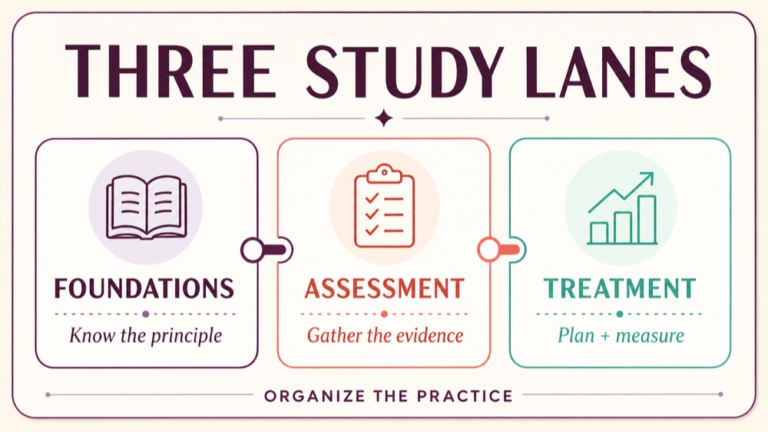
Organize your practice into three broad lanes that follow the current 5331 content direction: foundations and professional reasoning; screening, assessment, evaluation, and diagnosis; and treatment planning, implementation, and evaluation. The lanes are study containers, not a promise that every question belongs to only one category. Tag overlap when a stem requires more than one kind of thinking.
| Study lane | Core question | Practice evidence |
|---|---|---|
| Foundations and professional reasoning | What principle, role, boundary, or communication decision is relevant? | Accurate concept, context, and professional rationale. |
| Assessment and evaluation | What information or sequence best answers the referral question? | Purpose, evidence, measure choice, and interpretation. |
| Treatment and measurement | What plan fits the goal, and how will change be observed? | Functional goal, intervention logic, support, and outcome measure. |
Give each lane a visible notebook page or digital section. For every item, record the lane, the decision type, your confidence, and one sentence explaining the deciding evidence. A lane with many correct answers but little explanation is not yet a stable lane. It needs a transfer check before you increase the set size.
Use this simple rotation when a study session has three blocks:
- Block one: learn or retrieve one principle from the selected lane.
- Block two: answer a small set that asks for the lane’s characteristic decisions.
- Block three: answer a fresh mixed item and explain the transfer.
The rotation prevents a practice test from becoming a string of disconnected percentages. Each item adds either a confirmed skill, a gap to repair, or a question about how the source represents the current boundary.
Lane one: foundations and professional reasoning
Foundations work is not limited to memorizing terms. A strong item may ask you to apply a concept to a setting, distinguish a professional responsibility from a convenient shortcut, or identify the communication detail that changes an appropriate next step. When you review this lane, write the principle and the boundary together.
| Review prompt | Evidence to look for | Transfer exercise |
|---|---|---|
| What concept is being tested? | Definition, function, context, or contrast in the stem. | Explain it to a peer without using the answer choices. |
| What boundary matters? | Setting, role, consent, client need, or missing information. | Change one boundary and predict the effect. |
| Why is the choice fit? | Specific stem detail rather than familiar wording. | Defend the answer in two sentences. |
For a missed foundations item, avoid copying a long explanation into your notes. Write a compact card with the principle, a contrast, and a small example. Then create a second example in a different setting. That second example is the part that tests whether the idea has become usable knowledge.
Professional reasoning also benefits from a “not enough information” check. Some answer choices sound responsible but skip a needed fact. If the stem withholds a detail that controls the decision, say what you would gather or clarify. This does not mean choosing uncertainty for its own sake; it means matching the action to the evidence actually supplied.
Lane two: assessment and evaluation decisions
Assessment items often become clearer when you name the referral question before you look at the choices. Ask whether the stem is asking about screening, additional evaluation, measure selection, interpretation, or a sequence of information gathering. Then identify the evidence that makes one step more useful at that point.
- Name the purpose: what decision should the information support?
- Check the context: consider age, setting, communication needs, history, and the performance pattern described.
- Separate known from missing: list the evidence already available and the detail that could change the next step.
- Choose the next useful action: select the option that answers the stated purpose with the information given.
- Explain the alternative: identify what would make the closest option appropriate in a different situation.
A practice item can mention a test or measure without making that measure the correct answer. The question may instead be asking about sequence, purpose, or interpretation. Tag the requested decision, not the most memorable noun in the stem. This small habit reduces distractor pull and gives you better data about what your practice set actually covers.
For each assessment item, add a confidence label: confident correct, uncertain correct, incorrect, skipped, or rushed. Review uncertain correct items with the same care as incorrect items because the answer may have come from a fragile pattern. A fresh scenario with a changed referral question is a better follow-up than immediate repetition of the same stem.
Lane three: treatment planning and measurement
Treatment questions usually become more manageable when you connect the intervention to a functional goal and an observable measure. Read for the target, the context in which the skill matters, the supports available, and the information needed to decide whether the plan is helping.
| Treatment element | Review question | Evidence to record |
|---|---|---|
| Goal | What meaningful performance is expected to change? | Functional target and measurable behavior. |
| Intervention | Why does this activity address the target? | Mechanism, cueing, practice context, or support. |
| Generalization | Where should the skill carry over? | Partner, setting, task, or communication demand. |
| Outcome | What observation would show progress or a needed change? | Measure, time point, criterion, or client report. |
When you miss a treatment item, draw a short chain: goal, activity, support, observation. If one link is missing, the answer may sound plausible while failing to address the question. Rewrite the stem with a different goal and decide which link should change. That transfer task reveals whether you understand the plan or only recognize the wording.
Keep clinical reasoning separate from unsupported promises. A practice explanation should state what the evidence in the stem supports and what would need more information. Clear limits make your notes safer and make distractor review more precise.
Review each practice lane with the same decision loop
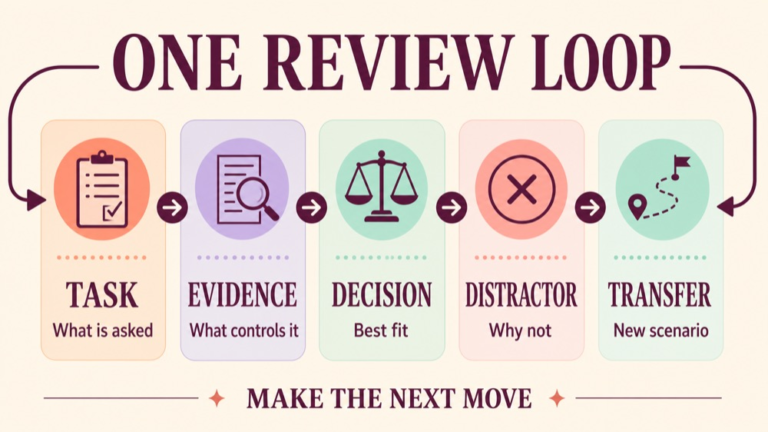
Use one review loop across all three lanes so that your records remain comparable. The loop is task, evidence, decision, distractor, transfer. It takes longer than circling an answer, but it turns a practice test into a reusable learning record.
- Task: restate what the question asks you to decide.
- Evidence: identify the detail or principle that carries the choice.
- Decision: state why the selected answer fits the task and evidence.
- Distractor: explain why the closest alternative is weaker for this question.
- Transfer: create a changed scenario and predict whether the same choice remains fit.
Use a two-column note when time is tight. In the left column write “question asks” and “evidence says.” In the right column write “best fit,” “closest alternative,” and “new scenario.” This format keeps the reasoning visible without requiring a full essay for every item.
Apply the loop differently by lane. In foundations, the evidence may be a definition or professional boundary. In assessment, it may be the referral purpose and missing information. In treatment, it may be the functional goal and outcome measure. The structure stays stable while the evidence changes.
Try three original practice questions
The following questions are original study examples created for this article. They are not copied from ETS and are not presented as live test material. Answer each one before reading the rationale, then tag its study lane and write the evidence that controlled your choice.
Question 1: Choose the assessment sequence
Scenario: A referral describes a communication concern, but the available note does not explain the person’s daily communication demands or the setting in which the difficulty occurs. What is the strongest first planning move?
Correct Answer: B. Why This Answer Is Correct: The stem highlights missing context that could change the assessment purpose and interpretation. Gathering the communication demand and referral purpose creates a better basis for deciding what information is useful next.
Why the Other Options Are Wrong: A moves to treatment without clarifying the problem. C discounts information that can affect measure choice and interpretation. D confuses a referral label with a complete functional description. B matches the requested sequence to the evidence available.
Question 2: Match a treatment plan to a goal
Scenario: A learner’s goal is to use a target communication skill during a classroom discussion. Which review note best connects the intervention to measurement?
Correct Answer: B. Why This Answer Is Correct: The plan connects practice to the classroom discussion demand and identifies an observation that can show performance. It keeps the goal, support, context, and measure in the same reasoning chain.
Why the Other Options Are Wrong: A may show drill completion without showing the functional target. C increases activity without specifying the behavior or outcome. D makes scoring convenience more important than alignment. B is the option that links treatment and measurement to the stated goal.
Question 3: Explain the closest alternative
Scenario: You choose an answer correctly on a foundations item, but your explanation only says that it is the “best practice.” What is the most useful repair?
Correct Answer: B. Why This Answer Is Correct: The weak point is the explanation, not the answer mark. Restating the task, naming the principle, and comparing the closest alternative tests whether the choice is supported by reasoning rather than a general phrase.
Why the Other Options Are Wrong: A builds recognition without explanation. C discards useful information about a fragile skill. D accepts a vague justification without matching it to the stem. B creates an observable repair and a stronger record.
Use timing and mixed practice with purpose
The ETS page currently lists 132 questions and 150 minutes. Use that information to understand the official scale, then design smaller practice blocks with clearly labeled purposes. A 15-minute concept check, a 30-minute mixed block, and a longer simulation are not interchangeable measurements.
| Session label | What it measures | What to record |
|---|---|---|
| Untimed learning | Concept retrieval and explanation. | Notes used, uncertainty, and distractor reasoning. |
| Short timed block | Reading, triage, and commitment under a modest clock. | Time checkpoints, skips, rereads, and rushed items. |
| Mixed transfer block | Switching among the three lanes. | Lane changes, task recognition, and fresh-scenario performance. |
| Long simulation | Stamina and process across a larger set. | Conditions, interruptions, pacing pattern, and review plan. |
Do not use timing to hide a content gap. If a timed block exposes a missed concept, return to the lane record and repair the concept before making the next block longer. If the concepts are sound but the process is inconsistent, practice the process with a small set and a move-on rule.
Mixed practice is most useful after each lane has a basic record. Start by mixing two lanes, identify the task before choosing, and then add the third. The goal is not to make every session difficult; it is to learn which decision rule should be carried into the next context.
Separate practice patterns from official score information
A practice percentage is local evidence from one source under one set of conditions. Keep it separate from official score reporting, passing requirements, or licensing decisions. A higher percentage can reflect learning, repeated exposure, easier wording, or improved pacing; a lower percentage can reflect a new decision type or a more demanding context.
Use a practice dashboard with four fields: source and date, conditions, lane and decision tags, and next action. Add confidence so that a correct answer reached by guessing does not look identical to a correct answer supported by an explanation. This makes the trend more informative than a single number.
- Practice result: what happened in this set.
- Learning interpretation: what the errors and explanations suggest.
- Fresh check: how you will test the interpretation with changed wording.
- Official boundary: which current ETS or responsible authority page must be checked separately.
If a provider uses a score label, record the label as the provider’s own measurement and read its conditions. Do not convert it into an official scaled result without responsible-source support. This separation protects both your study decisions and your interpretation of current requirements.
Verify logistics separately
Registration, appointment, delivery, identification, accommodations, score reporting, and preparation-resource availability belong in a dated logistics note. Practice content can help you rehearse decisions, but it should not be the only source for an administrative choice that may change.
- Confirm the exact Speech-Language Pathology (5331) subject and code in the current ETS source.
- Check the current delivery and appointment instructions that apply to your account.
- Review identification, arrival, and test-day requirements through the responsible source.
- Record accommodation steps through the relevant official channel when needed.
- Keep practice notes separate from score reporting and state or employer requirements.
- Set a recheck date for details that can change before your appointment.
The ETS practice-test page can help you locate current practice options by subject. It is still useful to read each product or resource description so you know whether you are opening a sample, a drill, or a longer simulation. Your three-lane notes should describe what the resource actually did.
Avoid three-lane practice mistakes
Before you expand a question set, check whether one of these habits is distorting the result:
- Using a generic Praxis resource without confirming Speech-Language Pathology (5331) alignment.
- Calling a large item count broad coverage without tagging the decisions represented.
- Putting every clinical scenario in the treatment lane even when it asks about assessment sequence.
- Counting uncertain correct answers as fully secure without reviewing the rationale.
- Repeating the same wording and calling the result transfer evidence.
- Extending the timer when the real issue is a missing concept or unclear task.
- Using a practice percentage as an official scaled score or licensing conclusion.
- Relying on a practice page for changing appointment or identification rules.
- Copying proprietary or purported live content into public notes or articles.
- Adding another resource before completing the repair action from the last set.
The fix is a disciplined sequence: verify the current boundary, tag the lane and task, capture the evidence, review the closest alternative, and schedule a fresh check. That sequence makes each practice session answer a useful question about preparation.
Speech Language Pathology Praxis practice-test checklist
Use this checklist before and after a speech language pathology praxis practice test session:
- Did I confirm the Speech-Language Pathology (5331) identity through the current ETS page?
- Did I label the resource as a sample, drill, quiz, practice test, or simulation?
- Did I sort each important item into a study lane?
- Did I identify the task the question requested?
- Did I record the evidence that controlled the choice?
- Did I separate confident correct from uncertain correct answers?
- Did I explain why the closest alternative was weaker?
- Did I record timing, interruptions, rereads, and skips?
- Did I turn each priority gap into one observable repair action?
- Did I write at least one fresh scenario for transfer?
- Did I keep practice evidence separate from official score and logistics claims?
A strong practice session does not need to make one percentage carry every conclusion. It needs to show which lane was practiced, what evidence supported the result, where the explanation was thin, and what fresh check comes next. That record is more useful than a number without a plan.
Sources and next steps
Use the current ETS Speech-Language Pathology (5331) page for test identity, format, duration, question count, content areas, and official preparation links. Search the ETS Praxis practice-test page for current subject options. Review ASHA’s Praxis preparation guidance for preparation materials, practice questions, timed work, and using strengths and weaknesses to guide review.
Continue your preparation: Explore the SLP Study Center learning resources after you have tagged your practice lanes and selected the next repair task.