A free praxis practice test speech pathology resource is most useful when you treat it as a coverage check, not as a complete preparation system. The set can show which broad decisions you recognize, where the explanations are thin, and which current-scope areas need a separate review block.
The current ETS Speech-Language Pathology (5331) page describes a computer-delivered selected-response test with 132 questions and 150 minutes. Use the live ETS page and your account for changing details. ASHA’s preparation guidance also points candidates toward the exam content, topic-area knowledge, preparation materials, practice questions, and a plan built around the learner’s needs.
What a free Praxis practice test speech pathology can check
A free set can answer a narrow question about your preparation. It may reveal whether you recognize a domain, can distinguish assessment from treatment, can identify the strongest evidence in a clinical scenario, or can explain why a tempting choice is weaker. It cannot show every part of readiness by itself.
| Coverage question | Evidence to capture | What it can lead to |
|---|---|---|
| Is the subject aligned? | The page names Speech-Language Pathology (5331) and explains its scope. | Keep the source for the intended learning job. |
| Which domain feels thin? | Items missed or answered with low confidence by broad area. | Build a targeted concept or distinction block. |
| Can I apply the concept? | Performance on a fresh scenario rather than a definition prompt. | Write a new example and explain the transfer. |
| Is the process causing errors? | Timing, skipped items, interruptions, or repeated task misreads. | Practice reading and pacing separately from content review. |
Coverage is not the same as quantity. A large set can repeat one area while leaving another untouched. A smaller set can be useful if it shows the task, evidence, explanation, and boundary clearly enough for you to plan the next step.
Start with the current 5331 source
Use the current ETS Speech-Language Pathology (5331) page as the control point for test identity, current format information, broad content scope, and official preparation links. The ETS practice-test selector can help you look for current options by subject. Record the date you checked the page because administrative details and resource availability can change.
Search results for speech pathology practice can include free quizzes, commercial study products, university library guides, videos, flashcards, and official practice options. Those sources may be useful for different jobs, but their presence in one results page does not make their claims interchangeable.
- Confirm the subject: verify that the material is intended for Speech-Language Pathology (5331).
- Read the format: note whether the set is a short quiz, sample, targeted drill, timed block, or longer simulation.
- Inspect the coverage: identify which broad areas and decision types appear in the free material.
- Sample explanations: check whether rationales explain the answer and the closest alternatives.
- Mark the boundary: separate a provider’s study advice from current ETS test or appointment information.
- Protect originality: avoid material that implies access to confidential or purported live content.
A source can be a useful supplement even when it covers only one learning job. The important distinction is whether your notes describe what the set actually supports instead of letting a free label imply comprehensive coverage.
Build a 5331 coverage map from a free test
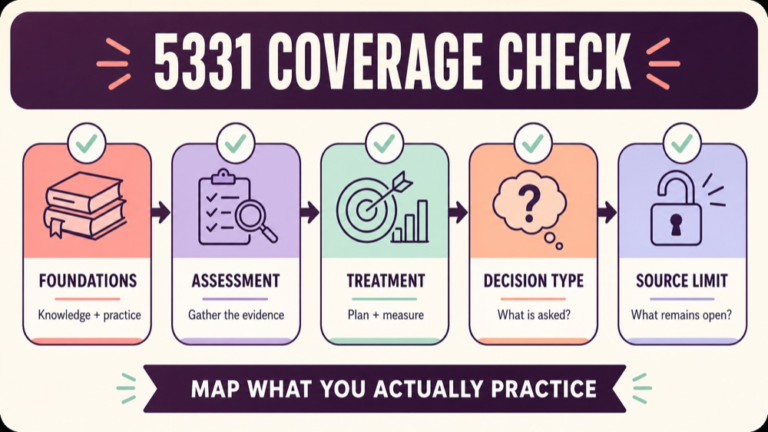
Turn each free practice item into a map entry. Instead of recording only right or wrong, note the broad domain, the decision type, the evidence that controlled the choice, and the reason for uncertainty. This creates a coverage picture that can guide review even when the set is short.
| Map field | Example question | Review use |
|---|---|---|
| Broad area | Foundations and professional practice, assessment, or treatment planning | See which part of the current scope needs representation. |
| Decision type | Define, interpret, choose a next step, select a measure, or apply a boundary | Practice the kind of reasoning that was requested. |
| Deciding evidence | Client goal, setting, time course, performance pattern, or missing information | Explain why one option fits the stem. |
| Answer status | Confident correct, uncertain correct, incorrect, skipped, or rushed | Separate stable reasoning from recognition and timing. |
| Source limit | Free set is a sample, not the full current test boundary | Prevent a narrow result from becoming a broad conclusion. |
Use broad labels as organizing categories, not as a substitute for the live ETS scope. A question may touch more than one area, and the map is allowed to record that overlap. The point is to see what the free resource represented and what it left unresolved.
- Foundations and professional practice: record whether the item asks about a professional decision, communication context, or underlying knowledge.
- Screening, assessment, evaluation, and diagnosis: record the referral question, missing information, and sequence of evidence gathering.
- Planning, implementation, and evaluation of treatment: record the goal, intervention choice, support, and outcome measure.
- Cross-domain reasoning: record when the best choice depends on a distinction that crosses broad categories.
- Current-source verification: mark any format or logistics statement that needs a fresh ETS check.
Separate topic coverage from question count
Question count is easy to advertise and easy to overread. A free resource may contain many items that test one vocabulary cluster, while a smaller set may expose a useful distinction across different contexts. Count what the items ask you to decide, not just how many screens you completed.
| If you see | Ask | Do next |
|---|---|---|
| Many similar stems | Am I learning the principle or memorizing the pattern? | Rewrite the concept in a new setting. |
| Several broad labels | Which decision type is actually represented? | Tag the item as definition, interpretation, sequence, application, or measurement. |
| One thin area | Is the gap in knowledge, practice, or source coverage? | Choose a targeted review action and then a fresh check. |
| Mixed, vague feedback | Can the score explain what to review? | Build your own error and coverage record. |
A coverage map also helps you choose between free resources. Keep a set that adds a missing decision type or a useful explanation. Set aside a resource that only increases familiar wording without helping you see what the answer means or why alternatives fail.
Label the conditions before you answer
Write the conditions at the top of the free-set record: source, date, mode, timing, environment, permitted materials, breaks, and interruptions. If you pause to investigate an answer, label the session learning mode. If you protect the timer, label the measured portion accordingly.
- Orientation: inspect the source and learn its question language.
- Learning: pause to read explanations and connect each item to the coverage map.
- Timed skill: use a short clocked block to practice reading and triage.
- Transfer: answer fresh or rewritten scenarios after a delay.
- Coverage audit: tag broad area and decision type regardless of the score.
A free set is not invalid because it is short or interrupted. It simply answers a different question from a clean long simulation. Honest labels let you use the evidence without making the source carry a claim it cannot support.
Try three original coverage-review questions
The following items are original study examples created for this article. They are not copied from ETS or presented as live test material. Answer before reading the rationale, then tag the broad area, decision type, and evidence that controls the answer.
Question 1: Identify a coverage gap
Scenario: A free quiz contains many terminology questions but no items asking you to choose an assessment sequence or match an outcome measure to a functional goal. What is the strongest conclusion?
Correct Answer: B. Why This Answer Is Correct: The evidence describes what the quiz represented and what it did not represent. It can serve a terminology job while leaving assessment sequencing and outcome measurement unresolved. The appropriate next move is to add practice for the missing decisions.
Why the Other Options Are Wrong: A makes a broad claim from a narrow sample. C treats quantity as coverage. D repeats the represented task instead of addressing the gap. B keeps the conclusion matched to the evidence and gives the learner a useful next action.
Question 2: Tag a clinical decision type
Scenario: A question describes a client goal, a setting, and a missing performance detail, then asks what information should be gathered before selecting treatment. Which map tag is most useful?
Correct Answer: B. Why This Answer Is Correct: The item asks what information should come before treatment selection. The task is about sequencing and evidence, even though the eventual clinical setting could involve treatment. Tagging the requested decision prevents the topic label from hiding the reasoning being tested.
Why the Other Options Are Wrong: A ignores the decision requested. C would apply only if the stem focused on time or pacing. D confuses a clinical planning question with appointment information. B captures the purpose of the item and makes the coverage map more useful.
Question 3: Interpret a free-set result
Scenario: A learner answers many free questions correctly but cannot explain why the closest alternative is weaker on a new scenario. Which next step best tests the unresolved issue?
Correct Answer: B. Why This Answer Is Correct: The unresolved issue is explanation and transfer, not simple answer recognition. A fresh scenario and distractor comparison show whether the learner can use the underlying principle when the wording changes.
Why the Other Options Are Wrong: A increases familiarity with the same material. C makes a broad conclusion from a narrow result. D removes the evidence needed to evaluate clinical reasoning. B creates a direct check of the missing skill.
Turn a coverage gap into a study action
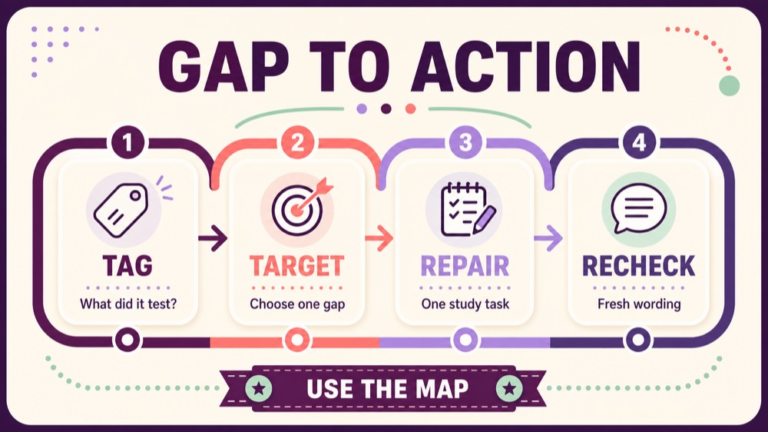
Once the map shows a thin area, choose one repair action instead of opening every available resource. The repair should match the gap. A missing concept needs explanation and retrieval; a missing decision type needs fresh applications; a process problem needs a timed or structured behavior check.
| Gap | Repair action | Fresh check |
|---|---|---|
| Scope gap | Return to the current ETS page and update the map. | Explain which source controls the boundary. |
| Knowledge gap | Write a plain-language concept note with a boundary and example. | Retrieve it without notes. |
| Decision gap | Compare two plausible choices using task and evidence. | Answer a changed scenario. |
| Explanation gap | Write why the closest distractor fails for the question asked. | Defend the answer before seeing choices. |
| Pacing gap | Run a short timed block with a defined move-on rule. | Compare checkpoint behavior, not only percentage. |
Keep the repair observable. “Review treatment” is not enough to tell whether the work changed your reasoning. “Choose an outcome measure that matches a functional goal in three fresh scenarios and explain the closest alternative” gives you a task, a boundary, and a way to check the result.
- Record the free source and the coverage it actually represented.
- Choose no more than three priority gaps for the next study cycle.
- Assign one repair task to each gap.
- Use fresh wording after a delay.
- Update the coverage map before choosing another large set.
Review the question task and the evidence
When an item is difficult, write the final task sentence in your own words. Then identify the evidence that carries the most weight and the information that remains missing. This method helps you see whether the difficulty came from the concept, the task, the sequence, or the source’s explanation.
- What decision did the item request?
- Which client, setting, timing, or performance fact changed the choice?
- What does the evidence support?
- What conclusion would be too broad?
- Why is the closest alternative less fit for this question?
- How could a changed scenario test the same principle?
If the explanation conflicts with the current ETS scope or authoritative clinical guidance, record the conflict and verify it before making the claim part of your study notes. Free practice can point to a question worth investigating without becoming the final authority on every answer.
Combine free coverage checks with deeper study
A balanced preparation system uses the free set as one input. Use current ETS pages for test identity and changing details, ASHA preparation guidance for planning principles, targeted concept study for knowledge gaps, and original practice for transfer. Your coverage map connects those inputs without forcing them into one score.
| Layer | Job | Evidence to keep |
|---|---|---|
| Current boundary | Define the subject and scope. | Dated source note and link. |
| Concept study | Build accurate knowledge and boundaries. | Plain-language notes and retrieval prompts. |
| Free practice | Check represented topics and decision types. | Coverage tags, conditions, and confidence. |
| Fresh practice | Test application when wording changes. | Rationales and distractor comparisons. |
| Process practice | Train pacing, reading, and review behavior. | Checkpoint and error-pattern notes. |
Use a free source repeatedly only when repetition has a defined job, such as correcting a misconception. When your goal is transfer, change the wording or scenario. When your goal is coverage, change the source or map the missing task. The label should determine the next move.
Keep changing logistics in a separate note
Registration, appointment, delivery, identification, accommodations, and score reporting belong in a dated logistics record based on current ETS information. A free practice page may contain helpful context, but it should not be the only source for an administrative decision that can change.
- Confirm the exact Speech-Language Pathology (5331) subject and code in the current account or source.
- Check the current appointment and delivery instructions that apply to you.
- Review current identification and arrival requirements through the responsible source.
- Record accommodation steps through the relevant channel when needed.
- Keep practice percentages separate from official score or licensing requirements.
- Date each logistics note so it has a clear recheck point.
This separation makes the coverage map cleaner. The map tells you what the free set represented. The logistics note tells you what the current responsible source says about the appointment. Neither record needs to carry the other’s job.
Avoid free-test coverage mistakes
Check for these patterns before you use a free set to make a study decision:
- Assuming a generic Praxis quiz covers Speech-Language Pathology (5331).
- Equating item count with broad topic coverage.
- Ignoring the decision type because the clinical topic sounds familiar.
- Counting uncertain correct responses as fully secure without reviewing the reasoning.
- Repeating familiar wording and calling the result transfer evidence.
- Reading explanations during a measured block without recording the interruption.
- Using a third-party score label as an official scaled result.
- Using a free page as the authority for changing appointment logistics.
- Copying proprietary or purported live material into notes or public content.
- Adding a new resource before turning the last coverage gap into an action.
The correction is straightforward: verify the subject, map the represented tasks, label the conditions, review the evidence, and add fresh practice for what the free set did not show. That process turns free access into usable study information.
Free coverage checklist for speech pathology
Use this checklist with a free praxis practice test speech pathology resource. Keep the completed record so you can tell whether a later change came from broader coverage, better reasoning, different conditions, or familiarity with the same source.
- Did I verify the Speech-Language Pathology (5331) identity through the current ETS source?
- Did I identify whether the free material is a quiz, sample, drill, trial, or simulation?
- Did I tag broad area and decision type for important items?
- Did I record source, date, mode, timing, environment, breaks, and interruptions?
- Did I separate confident correct from uncertain correct responses?
- Did I identify the evidence that controlled each important answer?
- Did I explain why the closest distractor was weaker?
- Did I mark which current claims need ETS or ASHA verification?
- Did I choose a repair task for each priority coverage gap?
- Did I test the repair with fresh wording after a delay?
- Did I keep practice evidence separate from official score and licensing claims?
A strong free praxis practice test speech pathology session does not need to cover everything at once. It needs to show what it covered, what it left open, and what you will do next. That is enough to make a free resource a disciplined part of preparation.
Sources and next steps
Use the current ETS Speech-Language Pathology (5331) page for test identity, format, duration, question count, content areas, and official preparation links. Search the ETS Praxis practice-test page for current subject options. Review ASHA’s Praxis preparation guidance for study planning, practice questions, timed practice, and using topic-area strengths and weaknesses to guide preparation.
Continue your preparation: Explore the SLP Study Center learning resources after you have completed the coverage map and selected the next repair task.