
A praxis practice test slp resource can be a useful study tool, but the label alone does not tell you whether the set will improve your preparation. The better question is what the source helps you practice: current scope recognition, clinical reasoning, pacing, transfer, or review of a specific gap.
The current ETS Speech-Language Pathology (5331) page describes a computer-delivered selected-response test with 132 questions and 150 minutes. Use the live ETS page and your account for changing test details. ASHA’s preparation guidance also points candidates toward the exam content, topic-area knowledge, preparation materials, practice questions, and a plan that fits the learner.
What a Praxis practice test SLP source should help you do
A good practice source gives you a way to rehearse a decision and learn from it. It may be a short quiz, a longer simulation, a set of clinical scenarios, or a source-linked practice product. Its value depends on the match between the source and the learning job you need right now.
Use a different standard for different stages. Early practice can help you recognize question language and identify knowledge gaps. Middle-stage practice can test distinctions and application. Later practice can examine pacing and endurance. The same set may be useful in one mode and weak in another, so label the purpose before judging the result.
| Learning job | What the set should provide | What to review afterward |
|---|---|---|
| Orientation | Clear test identity, question format, and readable explanations | Which task words and response patterns were unfamiliar? |
| Concept application | Fresh scenarios that require more than a definition | Which evidence changed the answer? |
| Clinical distinction | Plausible alternatives with a reason one choice fits better | Why did the closest distractor fail for this task? |
| Pacing | A defined time condition and a record of checkpoints | What behavior consumed time? |
| Transfer | New wording, setting, age, or communication demand | Did the principle survive the change in context? |
The goal is not to find a source that feels difficult in every way. The goal is to find a source that produces information you can act on. A confusing interface, vague rationale, or unstable topic mix can add noise without improving the next study decision.
Start with the current ETS boundary
Begin with the current ETS Speech-Language Pathology (5331) page. Confirm the subject identity, the current format information, the broad content scope, and the preparation links before you evaluate a practice provider. The official ETS practice-test page can help you search for current practice options by test subject.
This boundary matters because search results often mix official practice products, third-party materials, libraries, flashcards, videos, and generic quizzes. They may all use the word Praxis while serving different purposes. A source that does not identify which SLP Praxis test it supports should not be your only preparation anchor.
- Verify the subject: look for Speech-Language Pathology (5331), not a neighboring Praxis subject or a generic teacher test.
- Record the current facts: note the date checked for format, question count, duration, and other time-sensitive details.
- Read the source purpose: identify whether the material is official practice, a study guide, a quiz, a full simulation, or a review product.
- Check the explanation promise: look for rationales that explain the best choice and the tempting alternatives.
- Keep the claims separate: do not turn a provider’s marketing language into a statement about the official exam.
A source can be helpful without being official, and an official practice option can still require thoughtful review. The practical question is whether the material is transparent about its identity and whether it helps you perform the learning job you selected.
Compare a practice-test source on six signals
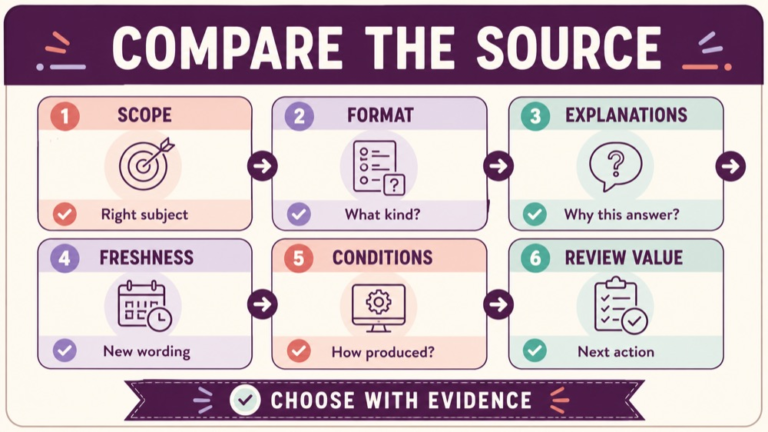
Use six signals when comparing a praxis practice test slp source: scope, format, explanations, freshness, conditions, and review value. Give each signal a simple note such as clear, partly clear, or unresolved. This prevents a large question count or attractive score report from dominating the decision.
| Signal | Questions to ask | Warning sign |
|---|---|---|
| Scope | Does the source name Speech-Language Pathology (5331) and describe its boundary? | It uses a generic Praxis label with no subject explanation. |
| Format | Does it explain whether the set is short, mixed, timed, or full-length? | The source calls every quiz a simulation. |
| Explanations | Does each rationale connect the answer to the task and evidence? | The page gives an answer letter with little reasoning. |
| Freshness | Are the examples new to you, and is the source date or update context visible? | Repeated wording makes recognition look like transfer. |
| Conditions | Can you record timing, breaks, environment, and interruptions? | The score has no information about how it was produced. |
| Review value | Can the result point to a specific concept, distinction, or process repair? | The only feedback is a broad readiness label. |
Use the six signals as a decision aid rather than a universal rating. A short source with excellent explanations may be ideal for repairing a distinction. A longer source with weak rationales may be useful only for practicing endurance, and only if you keep the purpose narrow.
- Scope note: write the exact test subject and the source page used to verify it.
- Format note: record the number of items, time condition, and whether the set was mixed or targeted.
- Rationale note: sample several explanations before committing to the resource.
- Freshness note: mark whether you had seen the item, phrase, or answer pattern before.
- Condition note: save the environment, break, fatigue, and interruption details.
- Action note: state what the result will change in your next study block.
Separate official options from third-party study sets
Official and third-party resources can play different roles. The current ETS practice-test selector is the place to check current official options. Third-party sources may offer more explanations, different teaching sequences, or additional practice volume. Treat the source identity and its claims as part of your notes so you know what a result represents.
Do not assume that a third-party percentage is comparable with an official score. Practice providers can use different content, item difficulty, scoring conventions, and explanations. A result can still be useful when it is interpreted inside its own conditions, but it should not be used to announce a pass decision or a licensing conclusion.
| Source role | Best use | Boundary to keep |
|---|---|---|
| Current ETS page | Verify test identity, scope, format, and changing logistics. | Use the live source for current administrative facts. |
| Official ETS practice option | Become familiar with the available practice format and source context. | Read the product description and current terms carefully. |
| Third-party question set | Increase original applications, explanations, and varied scenarios. | Keep its percentage inside the provider’s own conditions. |
| Study group or flashcard set | Retrieve concepts and discuss confusing distinctions. | Verify contested claims against authoritative material. |
| SLP Study Center resource | Connect practice review with structured learning and repair. | Use the current ETS source for changing exam facts. |
The best resource mix is often small. Choose one source for current boundaries, one source that explains reasoning well, and one method for fresh transfer checks. Adding every available quiz can make review less consistent and make it harder to identify what actually changed your performance.
Set conditions before you compare results
Practice results become more informative when you record how they were produced. Before starting, write the purpose, source, date, format, timing, environment, planned break, permitted materials, and answer labels. This takes a few minutes and prevents later comparisons from turning into guesses.
- Learning mode: pause to investigate concepts and read explanations while the purpose is understanding.
- Timed skill mode: use a smaller clocked set to practice reading, elimination, or move-on behavior.
- Simulation mode: protect the measured portion from explanations and record any interruption.
- Transfer mode: choose new wording or a changed context to test whether the principle travels.
- Review mode: revisit familiar items only to explain a misconception, not to inflate a readiness label.
Label an interrupted attempt rather than discarding it or quietly comparing it with a clean session. The interruption may still reveal something about attention or recovery, but it answers a different question from a controlled simulation.
Try three original source-selection questions
The following questions are original study examples created for this article. They are not copied from ETS or presented as live test material. Answer before reading the rationale, then write the selection signal or review behavior that the item is testing.
Question 1: Choose the strongest source signal
Scenario: Two SLP Praxis study sets contain a similar number of items. Set A names Speech-Language Pathology (5331), explains its format, and gives rationales for the best answer and close alternatives. Set B advertises a large question count but gives only answer letters. Which signal should carry more weight when choosing a first study source?
Correct Answer: B. Why This Answer Is Correct: A first source should help you confirm the test boundary and understand why an answer fits the task. Explanations for close alternatives create review value that a large item count or technical wording cannot provide by itself.
Why the Other Options Are Wrong: A measures volume without showing whether the material is aligned or teachable. C treats marketing feedback as evidence about learning. D confuses difficult language with relevant, well-explained practice. B combines scope transparency with a path for correcting reasoning.
Question 2: Respond to a source conflict
Scenario: A third-party explanation gives a logistics detail that conflicts with the current ETS page. You are about to use that detail in your appointment plan. What is the strongest next action?
Correct Answer: C. Why This Answer Is Correct: ETS is the responsible source for current Praxis test identity and changing administrative details. A dated verification note keeps the appointment plan connected to the source that controls the information instead of to a stale practice explanation.
Why the Other Options Are Wrong: A gives a third-party teaching page authority over a changing administrative fact. B invents a compromise that may not describe any real rule. D leaves a known conflict unresolved and can create an avoidable appointment problem.
Question 3: Interpret repeated high results
Scenario: A learner scores well on the same practice set several times but cannot explain why close alternatives are weaker on a new set. Which next study action is most useful?
Correct Answer: B. Why This Answer Is Correct: Familiar wording can support recognition without showing flexible reasoning. Fresh stems and distractor explanations reveal whether the learner can identify the task, use the deciding evidence, and transfer the principle beyond the original set.
Why the Other Options Are Wrong: A can increase familiarity without adding new evidence. C treats a repeated practice result as a broad conclusion. D stores answer patterns rather than the clinical or test-taking reasoning needed for a changed scenario.
Use results to choose your next study action
Once a set is complete, sort the result before deciding what to buy, read, or schedule next. Separate confident correct, uncertain correct, incorrect, skipped, and rushed responses. Then identify the cause: knowledge, distinction, task reading, evidence weighting, sequence, pacing, or source confusion.
| Result pattern | Likely question | Next action |
|---|---|---|
| Incorrect and low confidence | Was the concept missing or inaccessible? | Review a trusted explanation and retrieve it without notes. |
| Incorrect and high confidence | Did a tempting rule or assumption override the evidence? | Compare the best choice with the closest distractor. |
| Correct and low confidence | Was the answer a guess or a weak recognition? | Explain the task and evidence, then retry with fresh wording. |
| Late-session misses | Did fatigue, breaks, or time pressure change the process? | Run a smaller timed block and inspect the pacing behavior. |
| Source-specific strength | Did familiar phrasing make the set easier? | Mix a new source or new cases before drawing a conclusion. |
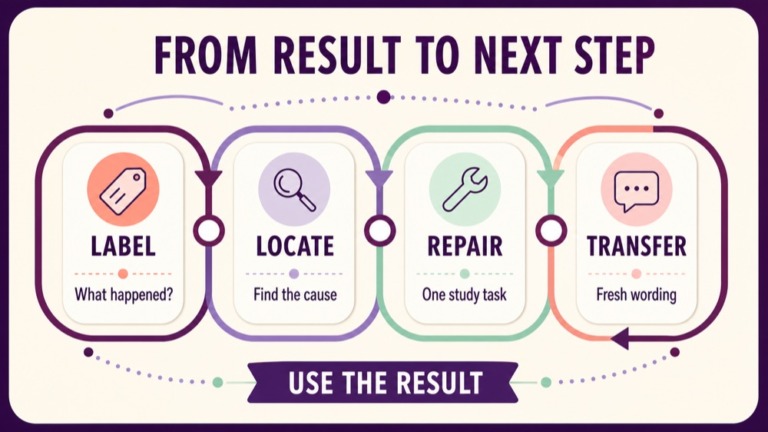
A practice result is most valuable when it changes one observable action. “Study more” is too broad. “Compare two next-assessment decisions using the missing history in the stem” or “complete ten fresh items with a two-minute checkpoint” gives the next block a clear purpose.
- Name the result: record accuracy, confidence, timing, breaks, and interruptions.
- Locate the cause: identify the most likely reasoning or process gap.
- Choose one repair: select a source check, concept review, comparison note, or fresh mini-case.
- Schedule transfer: revisit the principle after a delay with changed wording.
- Reassess the source: keep or replace the practice resource based on its review value, not on frustration alone.
Review rationales for transfer, not answer memory
A rationale should answer more than “Why is B correct?” It should connect the prompt’s task to the evidence, explain the boundary of the conclusion, and show why the other choices are less appropriate for that specific question. Read it actively and rewrite the reasoning in your own words.
- State the decision the item requested.
- Underline the fact that changed the choice.
- Explain why the correct option fits both the task and the evidence.
- Explain what each close alternative would require or answer instead.
- Write one boundary describing what the scenario does not establish.
- Create a new example that keeps the principle but changes the surface wording.
If an explanation is vague, contradictory, or built on a current administrative claim that cannot be verified, mark it for a source check. A practice set can still provide a useful prompt, but the explanation should not become a permanent study note until the conflict is resolved.
Use the “fresh wording” test after review. Hide the original answer choices, state the principle, and explain how it would apply to a changed client, setting, communication demand, or time condition. The ability to explain the change is stronger evidence of learning than remembering the answer letter.
Choose free, paid, and mixed practice intentionally
Free and paid resources are not automatically different in learning value. A free set may be useful for orientation or a quick retrieval check. A paid set may provide longer simulations, source-specific explanations, or organized progress tracking. Evaluate the learning job and review quality before treating price as a proxy for alignment.
| Resource choice | Good reason to use it | Question to ask first |
|---|---|---|
| Free short set | Quickly test a concept or learn how a source explains its items. | Can I see the subject scope and a useful rationale? |
| Paid practice product | Need structured volume, longer sessions, or detailed review. | Does the product explain its format, freshness, and feedback? |
| Official practice option | Want to inspect current official practice availability and source context. | Have I checked the current ETS subject selector? |
| Mixed source plan | Need fresh wording after a familiar bank or want to separate pacing from reasoning. | Can I label which source produced each result? |
Keep the mix small enough to analyze. If every source uses different labels, timing, and scoring, record the conditions in a single review sheet. The purpose is not to create a perfect aggregate score; it is to see which learning action produces better reasoning on fresh material.
Verify logistics away from practice-score notes
Administrative preparation deserves its own source trail. Confirm registration, appointment, delivery setting, identification, accommodations, score reporting, and other changing details through the current ETS page or account. Do not let a practice provider’s old paragraph become the only record for an appointment decision.
- Write the exact test subject and code shown in your account.
- Check the current appointment date, time, location, or at-home instructions that apply to you.
- Review identification and arrival requirements from the current responsible source.
- Record accommodation steps and lead times through the relevant channel when needed.
- Keep score-reporting and recipient instructions separate from third-party practice percentages.
- Date every logistics note so you know when it needs a fresh check.
This separation also improves study clarity. Your practice record can focus on reasoning, timing, confidence, and transfer. Your logistics record can focus on what the current source says you must do for the appointment. The two records support each other without pretending to measure the same thing.
Avoid common Praxis practice-test SLP mistakes
Review these patterns before choosing another resource or scheduling another long set:
- Searching for a generic Praxis quiz without confirming Speech-Language Pathology (5331) scope.
- Choosing the largest question bank without reading sample rationales.
- Treating a score label as more important than the reason behind each answer.
- Repeating familiar items until recognition replaces fresh application.
- Comparing percentages from sources with different timing, formats, or scoring.
- Reading explanations during a measured session and then calling the result timed.
- Using a third-party paragraph as the authority for current appointment logistics.
- Copying proprietary or purported live content into notes or public material.
- Adding another resource before deciding what the current result actually showed.
The repair is usually a narrower choice. Define the learning job, compare sources on the six signals, run the set under labeled conditions, review the closest alternatives, and use fresh wording before deciding whether the resource belongs in the next cycle.
Practice-test selection checklist
Use this checklist when you are comparing a new praxis practice test slp resource. Save the answers with your first result so you can tell whether the source helped because of its explanations, its freshness, its format, or simply because you became familiar with it.
- Does the source clearly identify Speech-Language Pathology (5331)?
- Did I verify current format and scope through the live ETS source?
- Do I know whether the set is short, targeted, timed, mixed, or full-length?
- Can I record purpose, source, date, environment, breaks, and interruptions?
- Have I read enough rationales to judge explanation quality?
- Does the source explain why close alternatives are weaker?
- Are the items fresh enough to test application rather than memory?
- Can the result point to a specific concept, distinction, or process repair?
- Will I separate confident correct from uncertain correct responses?
- Will I test the repair with changed wording after a delay?
- Am I keeping practice percentages separate from official score and licensing claims?
- Will I verify changing appointment details from the current responsible source?
A well-chosen praxis practice test slp resource should leave you with better questions, not just a bigger number. You should know which evidence you missed, which explanation changed your thinking, and what fresh practice will test the repair. That is the information that makes the next study block worthwhile.
Sources and next steps
Use the current ETS Speech-Language Pathology (5331) page for test identity, format, question count, duration, content areas, and official preparation links. Search the ETS Praxis practice-test page for current subject options. Review ASHA’s Praxis preparation guidance for study planning, practice questions, timed practice, and topic-area review.
Continue your preparation: Explore the SLP Study Center learning resources after you have selected a source and written the review conditions.