
praxis slp practice test work is most valuable when each item trains a clinical decision, not just a memorized definition. A useful set asks you to identify the task, notice the evidence that changes the decision, compare plausible choices, and explain what would make the next step appropriate.
The current ETS Speech-Language Pathology (5331) page describes a computer-delivered selected-response test with 132 questions and a 150-minute duration. ETS also points candidates to the official Study Companion and Study Plan, while ASHA recommends using the exam content, your topic-area knowledge, preparation materials, and practice questions to build a plan. The mini items in this article are original teaching examples, not official ETS questions.
What this Praxis SLP practice-test set is for
A practice set is a rehearsal for making decisions with limited information. It can show whether you recognize the relevant content, select the best evidence, prioritize the next step, and explain why a tempting alternative does not fit. That is different from reading a chapter and feeling familiar with its vocabulary.
Use the set for one of four purposes, and choose the label before you begin so your notes show what the result is supposed to teach you rather than turning every percentage into a broad readiness judgment about the full examination:
- Orientation: learn how selected-response stems ask you to apply knowledge.
- Diagnosis of your study process: identify knowledge, reading, prioritization, or timing issues.
- Repair: practice one weak decision with new examples after reviewing the cause of an error.
- Transfer: test whether a repaired idea works when the setting, age, or communication need changes.
A practice result is evidence about the conditions under which you practiced. It is not a promise about the official result and it does not replace the current ETS scope or the requirements of your program, state, or certification pathway.
Choose the right question set before you start
Begin with the current ETS boundary. The 5331 page identifies the test, describes the broad practice areas, and links to official preparation material. The current ETS practice-test page lets candidates search by test subject, including Speech-Language Pathology (5331). Use those pages to verify that a resource is aimed at the exam you are preparing for.
When you compare an outside set, inspect more than the number of questions. Look for current test identity, explanations, content coverage, and original teaching material. Avoid resources that imply access to confidential or purported live items. A trustworthy practice source should help you learn how to reason when the wording changes.
| Question-set feature | What to check | Why it helps |
|---|---|---|
| Scope | Does it identify Speech-Language Pathology (5331) and its content boundary? | Prevents study time from drifting to another Praxis exam. |
| Rationale | Does it explain the best answer and the weaker choices? | Supports correction instead of simple answer matching. |
| Freshness | Are the items new to you, or have you seen them repeatedly? | Shows whether the result measures transfer or recognition. |
| Conditions | Can you label the set untimed, timed, partial, or longer simulation? | Makes later comparisons more honest. |
| Purpose | Is the set for learning, measurement, or review? | Lets you choose the right response to the result. |
Keep the source and form name in your notes. If a later percentage changes, you need to know whether the content, difficulty, timing, or familiarity changed with it.
Set up a clinical reasoning baseline
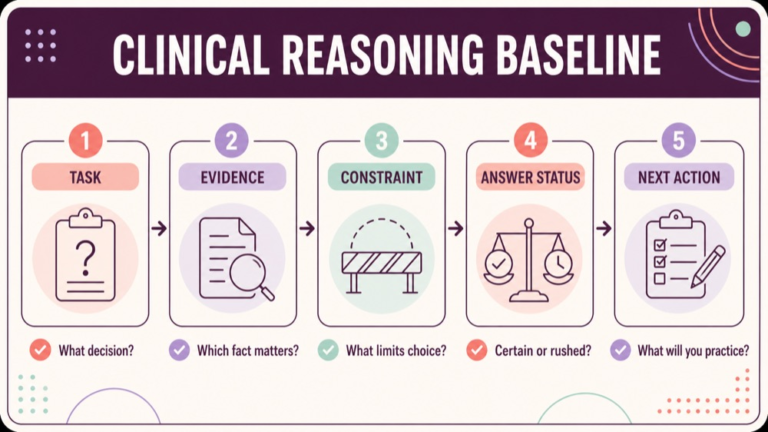
Before you begin, write down what you want the set to show. A baseline can be a full session or a shorter representative group. The important part is to preserve the conditions and review the evidence instead of rushing to a label.
- Confirm the set is intended for Speech-Language Pathology (5331) or record its limits.
- Decide whether this attempt is learning mode, timed skill mode, or measurement mode.
- Remove notes, answer keys, and search tools from immediate reach.
- Use a simple record for topic, answer status, confidence, and timing.
- Mark correct, incorrect, and correct-but-uncertain responses separately.
- Note the question task and the fact that made one choice stronger.
- Save your raw notes before reading rationales or searching for explanations.
| Baseline field | Example | Next use |
|---|---|---|
| Question task | Choose the next assessment, treatment, or evaluation decision | Practice that task in new wording. |
| Evidence | Setting, timing, communication partner, or stated constraint | Underline the detail that changed the choice. |
| Answer status | Confident correct, uncertain correct, incorrect, or rushed | Separate stable reasoning from recognition. |
| Cause | Knowledge gap, task misread, priority confusion, or timing | Assign a specific repair action. |
| Follow-up date | Fresh question check after a delay | Measure transfer rather than immediate recall. |
If the baseline is interrupted, keep the record and label the interruption. A partial set with clear conditions can still guide a next step; an unlabeled result can mislead you.
Read the stem for task, evidence, and constraints
Clinical reasoning questions often include more information than you need for the first decision. Read the final question sentence first when that helps you identify the task, then return to the scenario and locate the facts that change the answer. The task may ask for an initial action, the best next step, the most appropriate goal, or the strongest explanation.
- Task: what kind of decision does the item require?
- Evidence: which client, setting, timing, or performance detail carries the most weight?
- Constraint: what limits the choice, such as available information, current support, or the stated setting?
- Alternatives: which choices answer a different task or skip an earlier step?
- Confidence: what would you need to verify if two choices still appear plausible?
Write a one-sentence paraphrase before selecting an answer: “I need the next information-gathering step,” or “I need a measurable way to evaluate carryover.” That sentence reduces the chance that a familiar term will pull you toward a choice that does not answer the question.
Try three original clinical reasoning questions
These are original study examples created for this guide. They are not recalled, copied, or official ETS questions. Answer each one before reading the rationale, then add the deciding fact to your error log.
Question 1: Connect the measure to the real goal
A client improves on a structured naming drill, but the stated goal is to communicate needs during workplace conversations. Which next evaluation step gives the clearest information about progress toward the goal?
Why the Other Options Are Wrong: A measures the drill rather than the stated workplace communication goal. C expands the target instead of making progress clearer. D assumes transfer without collecting functional evidence. B connects the measure to the context and behavior the goal describes.
Question 2: Match access information to an AAC decision
A client can select symbols accurately for a short period but develops fatigue during longer communication routines. Before finalizing an access recommendation, which information is most important to add?
Why the Other Options Are Wrong: B substitutes popularity for individual fit. C adds content without testing the access problem. D transfers another person’s experience without confirming the client’s needs. A adds the performance and context information needed to judge whether the access method remains usable.
Question 3: Prioritize the next step from incomplete information
A referral asks for a treatment plan but gives no clear description of the client’s current communication environment, partner supports, or previous response to intervention. What is the strongest first reasoning move?
Why the Other Options Are Wrong: A chooses an intervention before the relevant baseline is clear. C confuses severity language with a complete priority decision. D ignores individual context and response history. B keeps the plan tied to the information needed to select and evaluate appropriate priorities.
Use the answer-to-action review loop
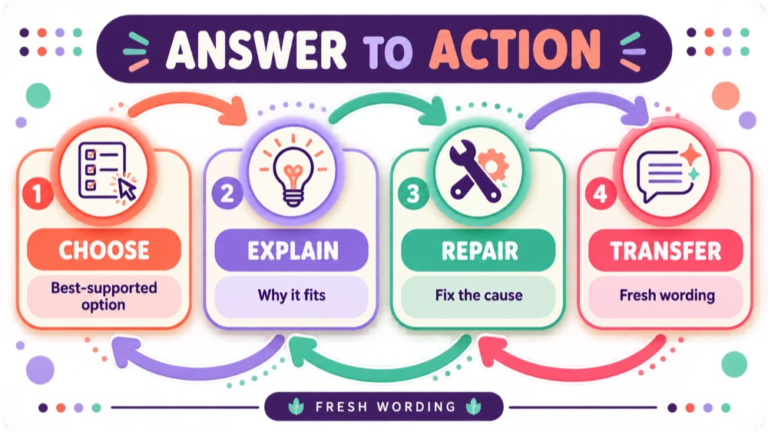
After a question set, do not stop at the answer key. Move each important response through a four-step loop: name what happened, find the cause, repair the reasoning, and check it with fresh wording. The loop is what turns a practice percentage into a study plan.
| Review step | Question to ask | Output |
|---|---|---|
| Name | Was the answer incorrect, uncertain, rushed, or confidently correct? | An honest answer-status label. |
| Find | Did I miss knowledge, task, evidence, priority, distractor, or timing? | One likely cause rather than a vague “bad question.” |
| Repair | What source, comparison, retrieval, or new case will address the cause? | A task that fits one study block. |
| Check | Can I use the principle in a fresh scenario after a delay? | Transfer evidence and a next decision. |
When you read the rationale, explain it in your own words. Include why the best choice fits the task and why the attractive alternatives do not. Keep your notes short enough to revisit and specific enough to guide the next question.
If the explanation conflicts with the current ETS scope or authoritative clinical material, record the conflict and verify it with the appropriate source or instructor. Do not force a confusing rationale into your notes just because it came from a practice provider.
Turn each error into a practice task
An error log is useful only when it changes the next session. Replace broad labels with observable actions. “Review AAC” is a topic; “compare two access decisions using fatigue, position, and task demands” is a practice task.
- Knowledge: make a concise distinction and retrieve it without notes.
- Assessment: list the missing information that would change the next decision.
- Treatment: connect the goal, activity, support, and measure.
- Evaluation: choose an outcome that matches the stated behavior and setting.
- Professional practice: identify the relevant communication, consent, privacy, or scope constraint in the scenario.
- Timing: run a shorter set with a clear move-on rule and review the pacing notes.
- Summarize the item in your own words rather than copying the full question.
- Write the choice you made and the choice best supported by the evidence.
- Underline the deciding fact or missing information.
- Explain why the most tempting alternative did not fit.
- Create one new example that would test the same principle.
- Schedule that new example after a delay.
Do not use the original answer wording as your only memory cue. A fresh example is a better check of whether the reasoning became portable.
Build a mixed set after targeted repair
Targeted repair should eventually return to mixed practice. When all the questions are from one area, you know what concept is coming before you read the stem. A mixed set asks you to identify the relevant content while the context changes, which better tests retrieval and prioritization.
| Stage | Practice design | What to watch |
|---|---|---|
| Repair | Several new examples of one error type or decision | Can you explain the rule without the original item? |
| Bridge | Current topic mixed with one earlier topic | Can you identify which evidence matters? |
| Transfer | Different age, setting, or communication demand | Does the reasoning survive a changed context? |
| Simulation | Longer mixed session with a time boundary | Can you protect pacing and review quality? |
Change one variable at a time when you are testing a repair. If you change the source, timing, format, and topic simultaneously, a better or worse result is harder to interpret.
Practice timing without losing reasoning
The current ETS page describes 132 questions and 150 minutes for the 5331. That makes the average time per question a rough planning reference, not a rule that every item must receive identical seconds. Use timing practice to learn which behavior consumes time and which questions need a move-on decision.
- Read the task before investing in every detail.
- Identify the evidence that changes the choice.
- Eliminate options that answer a different task.
- Choose the best-supported response when the evidence is sufficient.
- Mark a sticky question if the interface permits and move with a defined return plan.
- Review timing notes after the set rather than guessing why the clock felt difficult.
A timed result with weak reasoning is a process signal. Slow down during the repair phase, then reintroduce a smaller time boundary. A fast result filled with guesses needs confidence and retrieval work, not a faster timer.
Separate practice evidence from an official score
Practice providers can use different content, difficulty, scoring, and explanations. Their percentages are useful only inside the conditions you recorded. The official ETS score is connected to the real appointment and current score-reporting process; a practice percentage is not a scaled score or a licensing decision.
Use careful labels in your notes so a practice percentage stays tied to its purpose and conditions. This distinction makes later comparisons more useful and keeps third-party results separate from official score reports, certification requirements, and licensing decisions after the real examination:
- “Untimed learning set” for questions used while learning a reasoning pattern.
- “Timed skill set” for a smaller group used to inspect pacing.
- “Fresh mixed set” for new questions used to check transfer.
- “Repeated review” for familiar items used to explain a misconception.
- “Official result” only for the score reported through the current ETS process after the real test.
This language keeps your next decision grounded. A low practice result may identify a repair target, while a high repeated result may show recognition rather than broad readiness.
Avoid common Praxis SLP practice-test mistakes
Practice is easiest to misuse when the test becomes the goal. Check for these patterns before you schedule another set.
- Choosing a generic Praxis quiz without verifying the Speech-Language Pathology (5331) scope.
- Taking a test without deciding what evidence to record.
- Reading rationales during the timed attempt.
- Counting only incorrect answers and ignoring uncertain correct responses.
- Repeating the same questions until the wording feels familiar.
- Copying proprietary or purported live question content into notes or posts.
- Writing “study more” instead of a specific repair action.
- Changing several study variables at once and then overinterpreting the result.
- Taking long simulations so often that no time remains for repair.
- Calling a third-party percentage an official scaled score or pass decision.
- Ignoring a source conflict instead of checking current authoritative guidance.
The repair is a consistent loop: choose the right source, label the conditions, answer from task and evidence, review the cause, and test the repair with fresh wording.
Praxis SLP practice-test checklist
Before and after your next set, confirm:
- Did I verify that the material is aimed at Speech-Language Pathology (5331)?
- Did I write whether the set is for learning, timing, measurement, or transfer?
- Did I record source, form, date, conditions, breaks, and fatigue?
- Did I label incorrect, uncertain, rushed, and confident responses?
- Did I identify the task, deciding evidence, and stated constraints?
- Did I review the reasoning behind every incorrect and uncertain response?
- Did I explain why the tempting distractor did not fit?
- Did I turn important errors into one-block repair tasks?
- Did I schedule a fresh check after a delay?
- Did I return targeted repair to mixed practice?
- Am I treating the result as practice evidence rather than an official score?
A strong praxis slp practice test gives you more than a number. It shows how you make clinical decisions, what evidence you overlook, and which next practice task can make your reasoning more reliable.
Sources and next steps
Use the current ETS Speech-Language Pathology (5331) page for the test identity, format, duration, question count, content areas, and official preparation links. Search the ETS Praxis practice-test page for current official practice options. Review ASHA’s Praxis preparation guidance for study planning, practice questions, timed practice, and using topic-area strengths and weaknesses to guide preparation.
Continue your preparation: Explore the SLP Study Center learning resources.