
slp praxis practice test preparation is most useful when the practice test changes what you do next. A single percentage can feel important, but the richer information is inside the answers: which topics were uncertain, which choices looked similar, where timing broke down, and which errors repeat after review.
The current ETS Speech-Language Pathology (5331) page describes a computer-delivered, selected-response exam with 132 questions and a 150-minute test length. ETS also points candidates to official preparation resources, and the Praxis practice-test page lets users search by test subject. This guide explains how to choose, take, and review a practice test without treating an unofficial result as an official score.
What an SLP Praxis practice test can tell you
A practice test is a structured sample of your current preparation. It can reveal content gaps, uncertain reasoning, question-reading habits, pacing patterns, and the effect of fatigue. It cannot guarantee a future result, reproduce every feature of the live test, or replace the current ETS Study Companion and instructions.
Use the result as a set of decisions. If you miss a question because the concept is unfamiliar, you need targeted learning. If you know the concept but select the wrong priority, you need application and comparison. If you select the best answer but cannot explain why, you need retrieval and another later check. If you rush, you need a pacing experiment rather than a larger pile of notes.
- Content evidence: which broad practice areas and subtopics need attention?
- Reasoning evidence: did you miss the task, the key fact, the priority, or the distinction between choices?
- Timing evidence: where did the clock change your reading or decision quality?
- Confidence evidence: which correct answers were guesses or lucky recognitions?
- Transfer evidence: can you use a repaired concept in a new scenario?
That evidence is more useful than labeling yourself “ready” or “not ready” after one sitting. Your next study block should be traceable to something the practice test showed you.
Choose a practice source that matches your goal
Start with the official source boundary. The current ETS 5331 page links to official preparation materials and says the Study Companion helps candidates understand test content, practice sample questions, and gather guidance for different question types. The current ETS Praxis practice-test page invites candidates to search by test subject, including Speech-Language Pathology (5331).
Other resources can be useful, but compare them before you use the result to make a major decision. Check whether the material identifies the current test code, reflects selected-response practice, explains answers, and separates original teaching material from claims about the live exam. A resource that promises recalled or “actual” test questions is not a trustworthy preparation boundary.
| Practice source feature | Why it matters | What to record |
|---|---|---|
| Current test identity | Content and format can differ across Praxis tests. | Test name, code, and date checked. |
| Explanations | An answer key alone does not show how to repair reasoning. | Whether rationales explain the best choice and distractors. |
| Scope alignment | A long quiz can still miss the target exam. | Which official content areas the set covers. |
| Fresh application | Recognition of repeated items can overstate readiness. | Whether questions are new to you and how often you reused them. |
| Timing fit | Pacing practice needs a clear time boundary. | Untimed, section-timed, or full-session conditions. |
Keep one primary practice source for a cycle when possible. Switching sources after every low result makes it difficult to know whether your knowledge changed or the question style changed.
Set up a valid baseline before you study
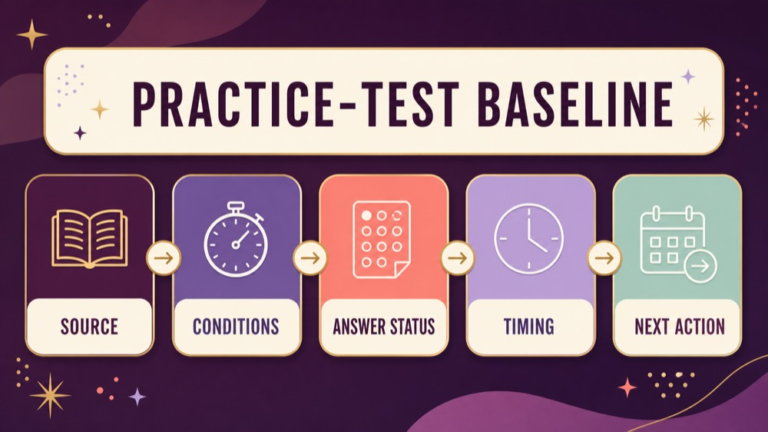
Take your baseline before a major review cycle so the result can guide your priorities. Choose a quiet window, use material you have not recently memorized, and set a time boundary that matches the purpose of the exercise. If a full-length session is not realistic, use a shorter representative set and label it honestly as a partial baseline.
- Verify that the practice set is intended for Speech-Language Pathology (5331) or clearly state what it covers.
- Write down whether the attempt will be timed, partly timed, or untimed.
- Remove notes and answer explanations from immediate reach.
- Use the same reading and marking habits you want to test.
- Record each answer as correct, incorrect, or correct-but-uncertain.
- Note where you lost focus, reread a stem, or spent unusually long on one choice.
- Stop and save the raw evidence before opening the explanations.
| Baseline field | Example record | Why to keep it |
|---|---|---|
| Source and date | Provider, form or set name, date used | Shows whether a later result is a fresh comparison. |
| Conditions | Timed, quiet room, breaks used | Explains differences between attempts. |
| Answer status | Correct, incorrect, or uncertain | Separates confident knowledge from recognition. |
| Topic | Broad area plus the narrower decision | Turns a missed item into a study target. |
| Next action | Review, retrieve, compare, or retest later | Creates the bridge to the schedule. |
Do not spend the baseline session searching for the perfect test. A consistent, well-labeled first attempt is more useful than a delayed attempt surrounded by endless setup research.
Simulate the test without creating a false crisis
Simulation has levels. A full practice session can help you rehearse stamina, navigation, pacing, and the emotional experience of not knowing every answer. A shorter timed set can isolate a question type or content area. An untimed set can help you learn a new reasoning pattern. Use the level that matches your current goal.
The current ETS 5331 page describes 132 selected-response questions in 150 minutes. If you use that as a full-session reference, remember that the average time per question is only a rough planning calculation. Your practice should also include reading, navigation, and review habits, and the official appointment interface can differ from a third-party worksheet.
- Learning mode: pause to explain the question and compare choices.
- Skill mode: time a smaller set to isolate reading or pacing behavior.
- Mixed mode: combine several areas and keep an error log.
- Simulation mode: use a longer uninterrupted session with limited help.
- Review mode: return to marked and uncertain items after a delay.
Do not use simulation as punishment. If the first full-length attempt produces fatigue and scattered notes but no actionable analysis, shorten the next session, repair the process, and try again under clearer conditions.
Review every question, not only the wrong ones
Reviewing a practice test is where most of the learning value appears. Begin with incorrect answers, but include correct answers that were guesses, rushed, or based on a fragile association. A correct answer with weak reasoning can become a future miss when the scenario changes.
| Answer status | Review question | Record |
|---|---|---|
| Incorrect | What fact, task, or comparison caused the miss? | Cause and one repair action. |
| Correct but uncertain | Could I explain the answer without looking? | Retrieval date and confidence check. |
| Correct and confident | Did I use the relevant evidence rather than a shortcut? | One sentence explaining the decision. |
| Changed answer | What evidence caused the change? | Whether the change improved the reasoning. |
| Skipped or rushed | Was the issue timing, attention, or content? | Pacing or content experiment for next time. |
Write the rationale in your own words before reading the explanation when possible. Then compare your reasoning with the source. Notice not only what the best answer says, but why the other choices are less appropriate under the facts in the question.
If an answer explanation conflicts with the current ETS scope or authoritative clinical guidance, pause. Record the source conflict and verify it with the appropriate authority or instructor instead of forcing your notes to match a questionable key.
Try three original mini practice questions
These three items are original teaching examples, not recalled or official ETS questions. Use them to practice the same evidence-and-reasoning process that you use when reviewing a larger slp praxis practice test. Write your choice before opening the answer and rationale.
Question 1: Identify the next information to gather
A school-age child is referred because listeners have difficulty understanding the child in class. The referral note gives a brief speech sample but does not include hearing information or a description of communication across settings. What is the best next preparation decision?
Why the Other Options Are Wrong: A moves to treatment before the available information supports the plan. C narrows the decision from a label without confirming the pattern or context. D is not a substitute for relevant assessment information. B keeps the next step connected to the missing evidence and the referral question.
Question 2: Match the tool to the communication need
An adult with a new communication impairment uses gestures and a few spoken words but has not been asked how communication works at home, at work, or with familiar partners. Which preparation choice best supports an individualized plan?
Why the Other Options Are Wrong: A skips the person’s context. C treats one mode as a reason to postpone supported communication. D transfers another person’s plan without confirming fit. B keeps the decision person-centered and links the recommendation to real communication demands.
Question 3: Choose the clearest treatment-evaluation link
A clinician writes a goal for a client to communicate more effectively but does not specify the behavior, support level, or setting. Which revision would make the goal easier to evaluate?
Why the Other Options Are Wrong: A changes tone but not measurability. C makes the target harder to prioritize and evaluate. D makes the outcome too vague to interpret. B connects the target, conditions, supports, and measurement so progress can be reviewed.
After each item, add the question’s deciding fact to your error log. The point is not to memorize these examples; it is to transfer the reasoning pattern to fresh wording.
Turn errors into specific repair tasks
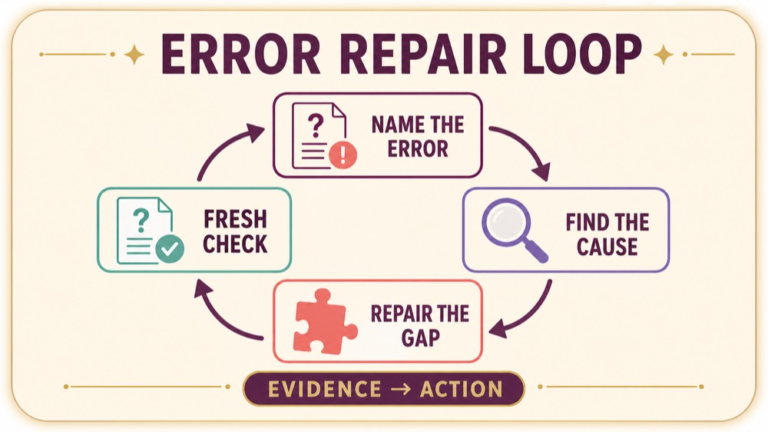
An error log should make the next action obvious. Avoid categories so broad that they become labels rather than guidance. “Language” is a content area; “differentiate the next assessment priority when receptive and expressive language findings point in different directions” is a study task you can practice.
| Error type | Diagnostic question | Repair task |
|---|---|---|
| Knowledge gap | Could I define or explain the concept? | Read a focused source, create a distinction, and retrieve it later. |
| Stem-reading gap | Did I answer the question that was asked? | Rewrite the task in plain language before choosing. |
| Priority gap | Why was one action better at this time? | Compare two options in a new scenario and state the deciding fact. |
| Distractor gap | Why did a plausible wrong choice attract me? | Write the condition that would make it appropriate and the condition that does not. |
| Timing gap | Where did the clock change my process? | Run a shorter timed set with a move-on rule. |
| Confidence gap | Was the answer correct because I knew it or recognized a phrase? | Retrieve the principle without the original item. |
- Copy the topic and question type, not the full copyrighted item.
- Record your answer and the best answer in brief, original language.
- Name the deciding evidence or concept.
- Write why the attractive distractor did not fit.
- Create a next action that can be completed in one study block.
- Schedule a fresh application check after a delay.
Keeping your own paraphrase also reduces dependence on memorizing one question’s wording. The goal is transferable reasoning, not recognition of a repeated page.
Use practice results to build your next week
After review, sort the error log into a short priority list. Pick one or two repair targets for the next week, then maintain older material through a mixed revisit. If you assign every error to the next day, the practice test becomes a source of overload instead of a planning tool.
| Result pattern | Next-week emphasis | Keep in rotation |
|---|---|---|
| Many errors in one area | Focused review plus new application examples | One mixed question from another area. |
| Errors spread across areas | Prioritize reasoning and question reading | Short content refreshers tied to each error. |
| Good untimed, weak timed performance | Practice pacing, reading, and move-on decisions | Untimed repair work so speed does not replace learning. |
| Good score, many uncertain answers | Retrieval and explanation practice | Fresh scenarios instead of repeated forms. |
| Low score with high fatigue | Shorter cycles, breaks, and schedule capacity check | Gradually longer sessions after the process improves. |
Use a simple weekly loop: review one priority, retrieve it, apply it, analyze errors, and revisit an older area. Repeat the loop before taking another larger practice test. The interval between tests gives you a chance to see whether the repair transferred.
Keep a record of practice-test dates and forms. A later result is easier to interpret when you know whether the questions were fresh, repeated, timed, and reviewed.
Practice pacing without chasing a single number
Pacing is a skill made of smaller behaviors. You may lose time by rereading the stem, comparing choices without naming the task, overworking one difficult item, or failing to mark a question for later. Identify the behavior before you choose a pacing rule.
- Read the task before analyzing every detail.
- Identify the facts that change the professional decision.
- Eliminate choices that answer a different task or ignore a stated constraint.
- Choose the best-supported answer when the evidence is sufficient.
- Mark and move when another minute is adding repetition rather than insight.
- Return to marked items with a specific question, not a general feeling of doubt.
Use the clock as feedback, not as a verdict. A practice score can rise because you guessed faster, or fall because the set covered a weak area. Pair the number with timing notes, confidence, and error type before changing your whole study plan.
ETS’s current preparation guidance emphasizes familiarity with the format, a written plan, practice tests, and identifying strengths and improvement areas. Those recommendations support an evidence-based practice cycle, not a promise that one test can predict the official result.
Avoid repeated exposure and unofficial-score confusion
Repeating the same practice test too soon can make you remember the answer rather than understand the principle. Use a fresh form or a new set for measurement, and reserve familiar items for deliberate teaching or review. Label each attempt so you know whether the result measures learning, recall, or transfer.
Do not describe a third-party practice score as an ETS score. Practice providers can use different difficulty, coverage, scoring, and explanations. The official score is handled through the current ETS reporting process for the real appointment, not through a practice-site percentage.
- Fresh measurement: use new questions when evaluating a change in readiness.
- Teaching review: reuse an old item only to examine a reasoning step or misconception.
- Source check: verify clinical or administrative claims against current authoritative material.
- Privacy: avoid copying or publishing proprietary question content in your notes or posts.
- Score language: call an unofficial result a practice result and record its conditions.
If a practice resource uses sensational claims about “real” exam items, skip those claims and return to the official scope and original learning work. Reliable preparation should make your reasoning stronger even when the wording changes.
Avoid common SLP Praxis practice-test mistakes
A practice test becomes less useful when it is treated as a ceremony. Check for these patterns before scheduling another one.
- Taking a test before deciding what evidence you will record.
- Choosing a generic Praxis or teacher test that does not match Speech-Language Pathology (5331).
- Using a remembered or repeated form as proof of current readiness.
- Looking at the answer key while the timed attempt is still in progress.
- Counting only incorrect answers and ignoring guessed or uncertain correct answers.
- Copying the entire question instead of writing an original summary and the deciding concept.
- Reviewing answers without explaining why the distractors did not fit.
- Changing the study plan after one score without checking timing, fatigue, and error type.
- Taking full-length sessions so often that there is no time for repair.
- Calling a practice percentage an official scaled score or pass decision.
- Ignoring current ETS instructions because an old practice resource says something different.
The repair is a documented cycle: choose the right source, set the conditions, record the evidence, repair specific errors, and measure transfer with fresh practice.
SLP Praxis practice-test checklist
Before and after your next practice test, confirm:
- Did I verify that the material is for Speech-Language Pathology (5331) or clearly label its scope?
- Did I record the source, form, date, timing condition, and breaks?
- Did I use material I had not recently memorized for the baseline?
- Did I record incorrect, uncertain-correct, confident-correct, rushed, and skipped answers?
- Did I note where timing or fatigue changed my process?
- Did I review every incorrect and uncertain answer?
- Did I write the deciding evidence and why the distractors did not fit?
- Did I turn each priority error into a study action that fits one block?
- Did I schedule a fresh application check after a delay?
- Did I keep a mixed revisit so older areas remain available?
- Am I describing the result as practice evidence rather than an official score?
A useful slp praxis practice test does more than give you a number. It shows what to repair, what to retrieve, what to practice under time, and what to revisit with fresh wording.
Sources and next steps
Use the current ETS Speech-Language Pathology (5331) page for the test identity, format, question count, duration, and official preparation links. Search the ETS Praxis practice-test page by test subject for current official practice options. Review ASHA’s Praxis preparation guidance for study plans, practice questions, timed practice, and using topic-area strengths and weaknesses to guide preparation.
Continue your preparation: Explore the SLP Study Center learning resources.
Continue your preparation: Explore the SLP Study Center learning resources.