
slp praxis exam study schedule planning works best when it turns a large exam into repeatable weekly actions. Instead of waiting for a free weekend or rereading every topic in order, build a schedule that shows what you will study, how you will practice, and how you will use mistakes to choose the next week’s work.
The current ETS Speech-Language Pathology (5331) page describes a 132-question, 150-minute, computer-delivered selected-response exam and points candidates to the official Study Companion and Study Plan. ASHA also recommends becoming familiar with the format and content, developing a plan around your knowledge by topic area, and using preparation materials and practice questions. This guide turns those principles into a flexible weekly system; it is not an official ETS timetable.
What a useful study schedule must do
A good schedule answers three questions every week: what deserves attention, when will you practice it, and what evidence will tell you to adjust? It should be specific enough to start without another planning session, but flexible enough to survive a busy clinic week, a difficult class, or a study block that takes longer than expected.
The schedule is a container for decisions, not a promise that every day will be perfect. Your goal is to create a repeatable rhythm that moves from understanding to application. Reading a definition can feel productive, but Praxis preparation also requires choosing the best next action in a professional scenario and explaining why the alternatives are weaker.
- Scope: connect each week to the current ETS test description and official preparation materials.
- Priority: give more time to weak or high-confusion areas instead of dividing every topic equally.
- Practice: include selected-response questions and timed work before the final week.
- Feedback: record why an answer was missed so the next block has a clear purpose.
- Recovery: leave a reset path for a missed session instead of doubling every later assignment.
If your schedule contains only reading assignments, add application practice. If it contains only practice tests, add targeted review that repairs the reasoning behind repeated errors. The balance changes as your exam date approaches.
Start with your baseline and weekly capacity
Before choosing a study calendar, take a short baseline using material that reflects the current exam scope. The purpose is not to predict a final score from one sitting. It is to identify topics that feel familiar but produce uncertain decisions, topics you have not reviewed recently, and timing or concentration issues that need a separate response.
Then count the study blocks you can repeat during an ordinary week. A schedule based on five ideal evenings is fragile if your actual semester provides three dependable blocks. Put fixed classes, practicum, work, commute, caregiving, sleep, and recovery on the calendar first. Schedule preparation inside the remaining capacity.
| Baseline question | What to record | How it changes the schedule |
|---|---|---|
| Which areas feel least secure? | Topic, question type, and the reason for uncertainty | Place targeted review earlier and revisit it later. |
| What kind of mistake repeats? | Knowledge gap, misread stem, distractor choice, or rushed decision | Assign a correction task, not just more questions. |
| How long can you focus? | Realistic block length and break need | Use shorter cycles if attention fades before the content does. |
| What time is dependable? | Days and windows that survive a normal week | Build the core schedule around those windows. |
| What deadline controls you? | Test date, score date, application, or program requirement | Reserve review and administrative buffer before the deadline. |
Keep the baseline notes in one place. A simple record of date, source, topic, confidence, and next action is enough. You are designing a feedback loop, not building a perfect data set.
Build your weekly study system
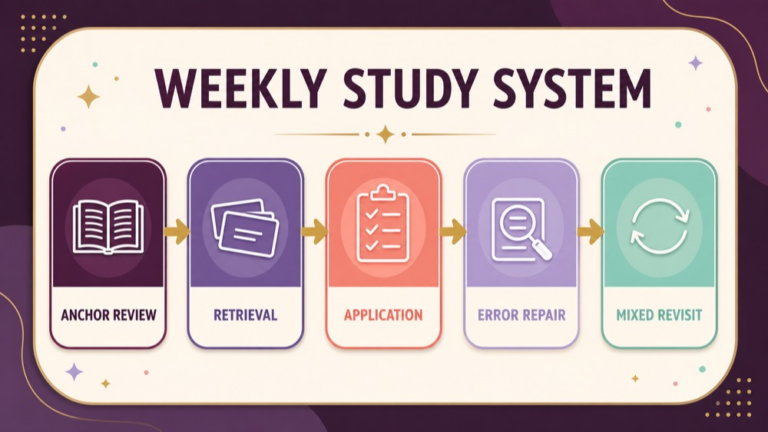
Start each week with one anchor session and two or three supporting sessions. The anchor session sets the topic and the week’s application goal. Supporting sessions make the knowledge usable through retrieval, case decisions, error review, and a short cumulative revisit. This structure is more durable than assigning a new topic to every day.
- Choose one primary target: select a content area or decision skill based on your baseline and the official scope.
- Set one application outcome: define what you should be able to recognize, compare, prioritize, or explain by week’s end.
- Schedule the anchor block: read or watch the focused material, create a compact concept map, and note open questions.
- Add retrieval blocks: close the source and recall key distinctions before checking your notes.
- Add practice: answer a manageable set of questions, then review every uncertain choice.
- Reserve a cumulative revisit: mix the current topic with one earlier topic so older material stays available.
- End with a reset: mark what is complete, what needs another pass, and what the next week should start with.
A weekly system can be expressed as a small menu:
| Block | Primary job | Useful finish line |
|---|---|---|
| Anchor review | Learn or organize one focused area | One page of distinctions and open questions |
| Retrieval | Recall without looking at the source | Brief answers corrected against the source |
| Application | Work through case-based or scenario questions | Reason for the best answer and distractors |
| Error repair | Fix the cause of missed or uncertain answers | One corrected rule plus a new example |
| Cumulative revisit | Mix current and earlier content | Short mixed set with a confidence check |
Do not assign every available minute. A schedule with one protected catch-up window is easier to maintain than a full calendar that turns one missed block into a crisis. If a week goes well, use spare capacity for a second application set or deeper error repair.
Use an eight-week template without forcing eight weeks
An eight-week outline is a useful organizing frame because it shows how preparation can change over time. It is not a universal requirement and should not be treated as an official ETS recommendation. Some candidates need longer because of school, clinical work, accommodations, or a long gap from coursework. Others may have less time and need a narrower, more selective plan.
| Phase | Schedule emphasis | Evidence to collect |
|---|---|---|
| Weeks 1–2: map | Review the scope, take a baseline, and identify weak decisions | Topic priorities and a realistic weekly capacity |
| Weeks 3–4: build | Use focused review, retrieval, and short practice sets | Fewer repeated concept errors |
| Weeks 5–6: connect | Mix content areas and apply knowledge to new scenarios | Better transfer across settings and question types |
| Week 7: simulate | Use timed mixed work and analyze pacing without cramming | Timing patterns and a short repair list |
| Week 8: consolidate | Review the repair list, protect sleep, and confirm logistics | Confidence in the plan, not a brand-new content pile |
If you have twelve weeks, expand the map and build phases rather than repeating the same full practice test every weekend. If you have four weeks, combine map and build, choose the most important repair targets, and keep at least one mixed and timed practice opportunity. In either case, preserve the feedback cycle.
Use the scheduled exam date and reporting deadline to work backward, but let your baseline determine the intensity inside each phase. A calendar can tell you how many weeks remain; it cannot tell you how quickly a particular concept will become reliable.
Divide the big nine without overstuffing your calendar
The current ETS 5331 description organizes the test around nine broad areas of practice: speech sound production; fluency; voice, resonance, and motor speech; receptive and expressive language; social aspects of communication, including pragmatics; cognitive aspects of communication; augmentative and alternative communication; hearing; and feeding and swallowing. Use those areas as a coverage map, not as nine equal boxes that must receive identical hours.
- List the nine areas on one page using the current official wording.
- Under each area, add the decisions you expect to make rather than a long list of isolated terms.
- Mark each area as strong, developing, or uncertain after the baseline.
- Pair one uncertain area with one retrieval or application block each week.
- Return to earlier areas through mixed practice instead of waiting until the end.
- Keep a separate list for cross-area questions, such as a case that touches hearing, language, and treatment planning.
Use a priority ratio instead of a fixed equal split. For example, a week may contain two blocks for a developing area, one shorter block for a strong area, and a mixed session that touches both. The exact ratio should follow your evidence and available time.
| Priority label | Meaning | Next schedule move |
|---|---|---|
| Strong | You can explain the distinction and apply it with reasonable confidence. | Maintain with retrieval and mixed questions. |
| Developing | You recognize the concept but hesitate or miss related distractors. | Add focused review and a new application set. |
| Uncertain | You cannot yet explain the rule or select consistently. | Break the topic into smaller decisions and seek clarification when needed. |
Coverage is not the same as readiness. The schedule should show both what you have touched and whether you can use it in a new question.
Structure one study block
A study block does not need to be long to be useful. Define the finish line before you begin, keep the source list small, and stop when the learning objective is complete. If you have a longer window, use two cycles with a real break rather than pretending that uninterrupted attention is unlimited.
- Orient: write the topic, the decision skill, and the one question you want the block to answer.
- Retrieve: spend a few minutes recalling what you already know before opening the material.
- Learn and apply: review the targeted material, then use a case, explanation, or selected-response question to test transfer.
- Close: write one rule, one example, one unresolved question, and the next review date.
For a 60-minute block, you might use 5 minutes to orient, 15 minutes to retrieve and review, 25 minutes to work through application, 10 minutes to analyze errors, and 5 minutes to set the next action. Those minutes are a planning example, not a required formula. Adjust them to your concentration and the difficulty of the topic.
Keep notes decision-focused. “Review swallowing” is too broad to guide a session. “Differentiate the next assessment or treatment priority in a swallowing scenario” gives you something you can practice and check.
Turn practice questions into schedule feedback
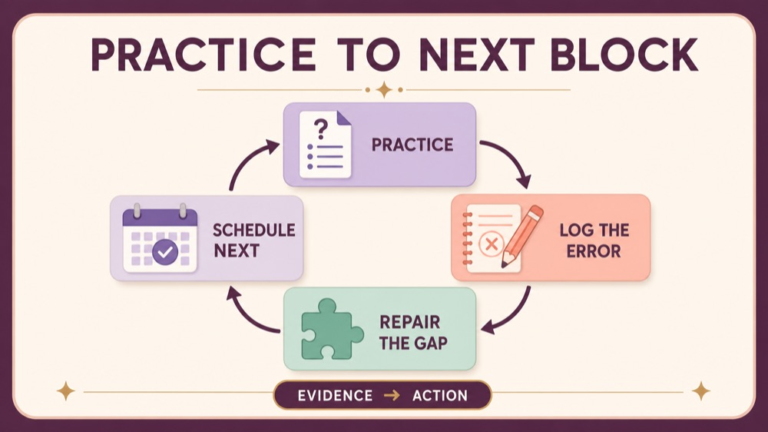
Practice questions are most valuable when they change the next block. ASHA identifies practice questions and timed practice as useful preparation tools, including for time management. Do not treat a practice set as a score announcement or complete it only to collect a percentage. Review the reasoning behind correct, incorrect, and guessed answers.
| What happened | Possible cause | Schedule response |
|---|---|---|
| Incorrect because the concept was unfamiliar | Knowledge gap | Return to the source, make a distinction, and answer a new example. |
| Incorrect because two choices looked similar | Comparison or prioritization gap | Write why the best choice fits and why the distractors do not. |
| Correct but uncertain | Recognition without stable reasoning | Mark it for retrieval and a later mixed question. |
| Incorrect after rushing | Pacing, reading, or attention issue | Add timed practice and a stem-reading routine. |
| Correct with a clear explanation | Stable performance | Maintain with a cumulative revisit rather than overstudying it. |
Use a small error log with five columns: question or topic, your choice, best answer, reason for the difference, and next action. The next action should be observable. “Study more” is vague; “compare two assessment priorities and answer three new scenarios” can be scheduled.
When you practice under time, record where the time went. Did you reread stems, overanalyze familiar content, or lose minutes on one difficult question? The repair might be a pacing rule, a shorter review cycle, or more practice with that question type. It may not be another full-length test.
Adjust the plan around school, clinical work, and life
A schedule has to work in the weeks you actually live. ASHA notes that candidates should consider when to take the exam in relation to graduate coursework and clinical practicum, and that many candidates are better positioned after completing that preparation. Your own program, state, certification pathway, and current responsibilities may add requirements, so use the responsible organization’s instructions for decisions that are not purely study-related.
- Place the anchor block on the most dependable day, not necessarily the day with the most theoretical free time.
- Keep a 20-minute fallback task for a week when a full study block disappears.
- Move unfinished work to the reset window before adding it to the next day.
- Protect sleep and clinical documentation time so the study plan does not create a second crisis.
- Use audio review, flashcard retrieval, or a short error-log pass only when that format genuinely helps you learn.
- Mark high-load weeks early and reduce new content during them.
- If accommodations or testing logistics are part of your plan, begin the administrative questions early and follow current ETS instructions.
Two dependable blocks completed every week can produce more useful feedback than seven ambitious blocks completed once. Consistency makes it easier to see whether the problem is knowledge, application, timing, or the calendar itself.
Use the final seven days to taper and check logistics
The final week is for consolidation and readiness, not for opening an entirely new resource. Use the official scope, your repair list, and the questions that exposed uncertainty. Reduce the size of new study tasks as the appointment approaches, and reserve time for the practical details shown in your current ETS account.
| Final-week window | Study action | Practical action |
|---|---|---|
| Seven to five days before | Complete a mixed set and update the repair list. | Confirm date, time, delivery mode, location, and account details. |
| Four to three days before | Review high-yield distinctions and one or two representative examples. | Check identification, check-in, equipment, travel, or room requirements. |
| Two days before | Use light retrieval; stop expanding the content list. | Prepare the route or testing space and set a realistic sleep plan. |
| Day before | Brief confidence review only if it helps; avoid a late cramming marathon. | Save confirmation details and plan food, breaks, and arrival or login time. |
| Test day | Use the pacing routine you practiced. | Follow the current appointment instructions and ask for help through the listed channel if needed. |
The current ETS page identifies the 5331 test as 150 minutes with 132 selected-response questions. Use the live test page and your appointment instructions for current logistics. The final-week plan should protect your ability to use what you know under the actual testing conditions.
Avoid common study-schedule mistakes
Most schedule problems are design problems rather than motivation problems. A plan becomes difficult to follow when it has no priority, no finish line, or no mechanism for responding to evidence. Check for these patterns before blaming yourself for a missed week.
- Planning by hours only, without naming the decision or skill each block should build.
- Giving equal time to every topic even after the baseline shows different needs.
- Reading the same notes repeatedly while postponing application practice.
- Using one practice percentage as proof that the whole plan is working.
- Recording a missed question but not recording why it was missed.
- Filling every open window and leaving no catch-up or recovery space.
- Saving mixed or timed practice for the night before the test.
- Changing resources every week before completing a feedback cycle.
- Ignoring school, clinical, work, accommodation, or score-reporting constraints.
- Extending a late study session until the next day’s dependable block becomes impossible.
The repair is usually small: choose one primary target, define an observable finish line, and schedule the next action from the evidence you already have.
SLP Praxis exam study schedule checklist
Before you start the next week of preparation, confirm:
- Did I verify the current Speech-Language Pathology Praxis test and code required by my pathway?
- Did I review the current ETS content description and official preparation materials?
- Did I take a baseline that shows both topic gaps and reasoning or timing patterns?
- Did I count dependable weekly study blocks after fixed obligations?
- Does each block have one clear learning or application finish line?
- Have I scheduled retrieval, practice questions, error review, and a cumulative revisit?
- Am I giving extra attention to developing or uncertain areas without abandoning strong areas?
- Do I have a catch-up path if one block disappears?
- Have I included mixed and timed practice before the final week?
- Have I reserved final logistics, recovery, and score-reporting follow-up time?
A strong slp praxis exam study schedule is a weekly feedback system: choose a priority, practice it, analyze the evidence, and let that evidence shape the next block. Keep the plan realistic enough to repeat and specific enough to tell you what to do when you sit down.
Sources and next steps
Start with the current ETS Speech-Language Pathology (5331) page for the test format, content areas, and official preparation links. Review ASHA’s Praxis preparation guidance for study-plan, practice, time-management, and timing context. Use ETS Getting Your Scores when your study schedule needs to work backward from a score-reporting date.
Continue your preparation: Explore the SLP Study Center learning resources.
Continue your preparation: Explore the SLP Study Center learning resources.