
An slp praxis exam prep timeline should answer a practical question: what should you study, practice, and verify between today and the test date? The right calendar depends on your starting point, weekly capacity, coursework, clinical responsibilities, and the amount of time available. A plan copied from another student can be too dense, too light, or aimed at a different stage of training.
Use the current ETS Speech-Language Pathology 5331 page and Study Companion as the scope anchor. Then build a timeline with four repeating moves: establish a baseline, map the content, practice application, and recheck the plan. The four-, eight-, and twelve-week examples below are flexible frameworks for organizing work; they are not a required ETS schedule or a promise about a candidate’s result.
What an SLP Praxis exam prep timeline should do
A useful timeline turns a distant test date into decisions you can make this week. It identifies the current exam, divides the available runway into phases, assigns a small number of repeatable study actions, and includes checkpoints where you can change the plan. The calendar should make the next step visible without pretending that every learner needs the same number of days.
The current ETS page describes Speech-Language Pathology 5331 as a computer-delivered, selected-response test with 132 questions and a 150-minute test length. It also describes broad areas that span foundations, professional practice, and specialized knowledge across clinical settings. Use those official details to shape practice, while treating the calendar itself as your personal planning tool.
- Scope: identify the current test code, content categories, and official source materials.
- Runway: count the usable weeks between today and the confirmed appointment.
- Capacity: estimate study blocks you can repeat during a normal week.
- Evidence: use baseline work, error logs, and timed practice to adjust emphasis.
- Recovery: leave room for sleep, clinical work, coursework, and a calm final review.
A calendar is doing its job when it helps you choose the next action and notice when the plan needs to change. It is not a score prediction. Keep the outcome question separate from the process question so a difficult practice set can inform your plan without rewriting your identity as a learner.
Start with your test date and constraints
Before choosing a study length, confirm the appointment details in the current ETS account or registration flow. Record the test name and code, date, time, delivery method, location or at-home requirements, score-reporting date shown by ETS, and any deadline supplied by your program or licensing authority. If the date is not confirmed, build a provisional calendar and label it provisional.
Next, list the constraints that will change your weekly capacity. A graduate course load may make weekday evenings unreliable. Clinical placement may create long commute or documentation days. Work, caregiving, health, accommodations, travel, and family events can all change the number of high-quality study blocks available. A realistic plan counts usable attention, not only empty boxes on a calendar.
| Planning input | Question to answer | Calendar decision |
|---|---|---|
| Appointment | What test date and delivery details are confirmed? | Set the final review and logistics checkpoints. |
| Deadline | When does a school, state, or agency need the result? | Leave room for its stated process and timing. |
| Capacity | How many focused blocks fit in an ordinary week? | Choose repeatable study sessions instead of idealized hours. |
| Baseline | What content and question types need the most work? | Weight the middle weeks without dropping the full map. |
| Energy | When are reading, cases, and timed work most useful? | Match task difficulty to the time of day and week. |
If the appointment changes, recalculate the runway rather than trying to force the old calendar to fit. A timeline is a living plan connected to a real date, not a document that becomes more correct by remaining unchanged.
Choose the right timeline runway
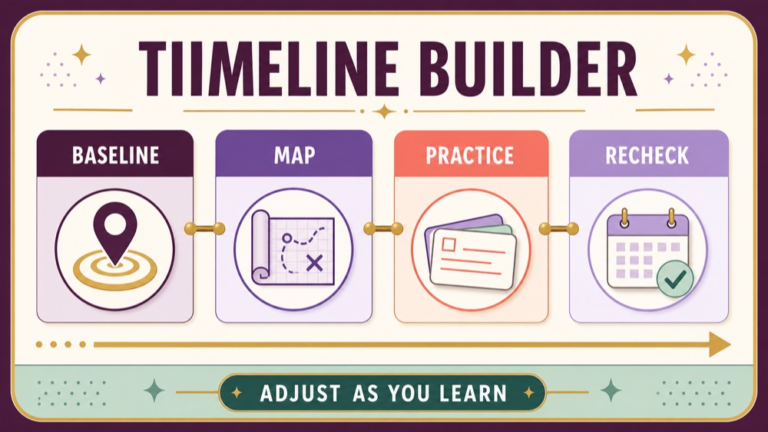
There is no single official number of weeks that fits every SLP Praxis candidate. Choose a runway by comparing the available time with the amount of new learning, retrieval practice, application work, and review you need. A shorter runway can work as a focused refresh when the foundation is strong; a longer runway can reduce compression when you are balancing school or clinical work.
Use these frameworks as starting shapes, then adjust the block count to your actual capacity:
| Runway | Best use as a framework | Suggested phases |
|---|---|---|
| Four weeks | Focused consolidation when the test date is close and the baseline is clear | Baseline and map; targeted repair; timed application; final recheck |
| Eight weeks | Balanced preparation with space to revisit weak categories | Baseline; content map; two repair cycles; mixed practice; final recheck |
| Twelve weeks | Lower weekly density or broader rebuilding from an uneven foundation | Orientation; foundations; professional practice; specialized application; mixed practice; final recheck |
For a four-week runway, avoid turning every day into a full test. Use the first few sessions to discover priorities, the middle sessions to repair and apply, and the final days to rehearse the current format and close open logistics questions. For eight or twelve weeks, use recurring review so early material does not disappear while you work on later categories.
- Choose shorter: when your baseline is strong, your test date is firm, and you can protect focused blocks.
- Choose longer: when several categories need rebuilding or your weekly capacity is limited.
- Choose flexible: when coursework, clinical placement, or an appointment change may affect the date.
- Choose a reset: after a previous attempt when the new plan must be based on score information and error patterns.
Do not use another candidate’s timeline as evidence that your plan is too slow or too fast. Use your baseline, the current blueprint, and the practice evidence you collect.
Use week one for a baseline and map
The first week is for orientation, not for proving how much you can cram. Read the current ETS test page and Study Companion, confirm the test code, and create a one-page map of the content categories. Then complete a permitted diagnostic or mixed practice set under conditions that give you useful information. The point is to see where your decisions break down, not to assign a permanent label to the result.
Review the baseline by separating knowledge gaps from process gaps. A wrong answer can reflect a missing concept, a misread question, an attractive distractor, a failure to prioritize the referral question, or time pressure. Record the reason you think the answer went wrong and what evidence would have changed the decision. That log becomes more useful than a single percentage.
- Confirm the current Speech-Language Pathology Praxis 5331 scope and format.
- List the major content categories from the official source.
- Complete a mixed, permitted baseline set without looking up answers midstream.
- Mark each missed or uncertain item by concept, reasoning, wording, or pacing.
- Choose the first two repair targets and one maintenance target.
- Place the first study blocks and the next checkpoint on the calendar.
Keep the diagnostic work private enough that you can examine it honestly. A baseline is a planning instrument. It does not decide what you are capable of, and it does not replace the official score report or an organization-specific requirement.
Plan the middle weeks around application
The middle of the timeline is where reading becomes usable decision-making. Each study cycle should move from a focused concept review to original case application, then to explanation and correction. For example, after reviewing assessment principles, practice identifying the referral question, selecting relevant evidence, and rejecting options that solve a different problem.
Rotate across the current blueprint so that a strong category stays active while a weaker category receives more attention. The ETS Study Companion can anchor the topic map, while your own error log decides which distinctions deserve another pass. Use authoritative professional sources for concepts that need clarification, and note the source date when a rule or practice detail may change.
- Repair block: study one defined concept and write a short explanation in your own words.
- Application block: solve new cases that require selecting, prioritizing, or evaluating an action.
- Retrieval block: close the notes and recall the decision rule or contrast.
- Mixed block: combine categories so you practice switching contexts.
- Correction block: update the error log with the decisive evidence.
- Maintenance block: revisit a previously repaired category before it fades.
Use a topic label narrower than “study swallowing” or “review language.” A useful label names the decision, such as distinguishing an assessment purpose from a treatment goal or matching a communication support to the person and context. Narrow labels make it easier to tell whether a review session changed your reasoning.
Build a weekly study rhythm
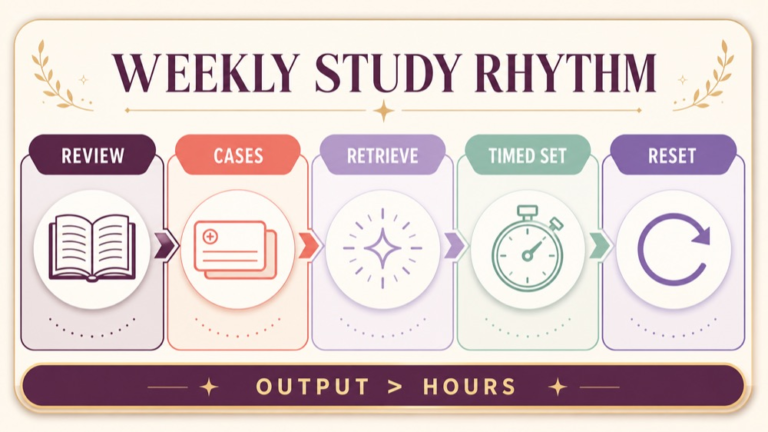
A weekly rhythm gives the timeline a repeatable operating pattern. The exact days can move around, but the functions should recur: learn or repair, apply, retrieve, practice under time, and reset. If you only read, you may not notice whether you can select the best answer in a new scenario. If you only take timed sets, you may collect errors without repairing the concepts underneath them.
Choose a number of blocks you can sustain. A block can be a short focused session or a longer protected period, depending on your schedule. Define the output before you start: a one-page comparison, a set of original case decisions, an error-log update, or a timed set followed by review. A visible output prevents “hours studied” from becoming the only measure of progress.
| Weekly function | Example output | Evidence to review |
|---|---|---|
| Review | One concise concept map or contrast table | Can you explain the decision in plain language? |
| Cases | New scenarios with a written rationale | Did the evidence support the selected option? |
| Timed set | Timed questions followed by correction | Which errors came from pace or attention? |
| Retrieval | Closed-note recall or short teaching explanation | Can you retrieve the rule without the page open? |
| Reset | Next week’s priorities and one protected rest period | What should change based on the log? |
Place the hardest reasoning work when your attention is usually highest. Use lighter retrieval, organization, or source checking during lower-energy windows. A plan that respects your energy can provide more useful practice than a plan that looks impressive but collapses after a few days.
Use practice evidence to adjust
Schedule a checkpoint at least once in the middle of the runway. Review the last several practice sessions, not only the latest score. Look for repeated categories, repeated distractor patterns, time clusters, and questions you changed from a supported answer to an unsupported one. Then update the next week’s emphasis.
Use a simple decision rule for adjustments: keep what is producing clearer reasoning, increase work on repeated errors, and reduce low-value repetition. If accuracy improves but timing remains tight, add shorter timed sets and review reading efficiency. If timing is comfortable but the same concept errors recur, return to the concept map and new applications. If the practice material does not resemble the current scope, change the material rather than blaming the learner.
- Repeat concept errors: rebuild the distinction with an authoritative explanation and new cases.
- Repeat wording errors: practice identifying the task, population, and decisive evidence before choosing.
- Repeat pacing errors: use smaller timed blocks, then review why time was lost.
- Repeat confidence errors: record the evidence that supports keeping or changing an answer.
- Improving performance: maintain the repaired areas while adding mixed and transfer practice.
Do not change the entire plan after one difficult set. Ask whether the pattern repeats across enough work to justify a change. The timeline should respond to evidence while still preserving the full exam map.
Protect the final review window
The final phase is for integration and verification. Complete at least one realistic timed rehearsal with permitted material, then review the decisions and the process. Revisit the most important error patterns, not every page you have ever opened. Use the current ETS page for test details, the account for appointment information, and the score calendar or registration record for reporting-related timing.
Reduce novelty as the appointment approaches. A final review can include concise comparison sheets, mixed cases, retrieval prompts, and a short list of questions to confirm with ETS or your program. Keep sleep, meals, movement, and a practical test-day plan in the calendar. Recovery is part of the preparation sequence because tired practice produces noisy evidence.
- Finish a timed rehearsal that matches the current test frame as closely as permitted.
- Review the error log and select the few distinctions that still need attention.
- Recheck the current ETS appointment, delivery, identification, and check-in information.
- Confirm any accommodation, school, state, or certification documentation step.
- Review the current score-reporting date shown for the test and save the account details.
- Set a lighter final study block and a realistic bedtime or recovery plan.
The final review is not the moment to chase every possible topic. It is the moment to make your process stable, your sources current, and your next action clear.
Fit preparation around school and clinical work
Many SLP candidates prepare while completing graduate coursework, clinical practicum, or early professional responsibilities. Use the schedule you actually have. A busy week can still include a short retrieval block, one case-analysis block, and a weekend correction session. When a major assignment or placement week arrives, reduce volume while protecting contact with the blueprint.
Connect preparation to learning without assuming that every class or client experience maps directly to a test question. A clinical encounter can prompt a useful review of a concept, but the Praxis asks you to apply knowledge across settings and scenarios. Keep a boundary between patient information and study notes; do not place identifying details into a personal error log.
- Choose two anchor blocks that stay protected most weeks.
- Keep a small portable retrieval task for commutes or waiting periods when appropriate.
- Use one weekly reset to move unfinished work instead of stacking guilt onto the next day.
- Tell a supervisor, instructor, or household member which blocks are important when support is available.
- Adjust the calendar after an unusually demanding week instead of doubling the next session.
If you need accommodations or have a health-related constraint, include the current ETS process and your support plan early. The timeline should fit the approved testing arrangement and the actual requirements of your pathway.
Avoid common timeline mistakes
Timeline problems are usually design problems that appear before the first study session. A candidate chooses a date without checking the reporting deadline, counts every calendar hour as study capacity, spends the first weeks making elaborate notes, or leaves all timed practice for the final weekend. Review these patterns before they become expensive.
- Copying a six- or eight-week schedule without comparing it with your baseline.
- Building the plan around ideal availability instead of a normal school or work week.
- Reading the Study Companion once without turning categories into decisions and practice.
- Using one broad topic label for an entire clinical area.
- Taking practice sets without reviewing why the wrong options were attractive.
- Adding more material after every difficult score instead of checking for a repeated pattern.
- Skipping mixed practice because category-by-category work feels safer.
- Leaving current appointment, accommodation, or score-reporting checks until test morning.
- Removing rest because the calendar has fallen behind.
The repair is to shrink the next action, preserve a weekly rhythm, and use evidence at the next checkpoint. A timeline can be revised without being abandoned.
SLP Praxis exam prep timeline checklist
Before you start and at each checkpoint, confirm the following:
- Is my Speech-Language Pathology Praxis test code and appointment date confirmed?
- What score-reporting or application deadline must the plan respect?
- Which current ETS source defines the scope and format I am studying?
- How many focused blocks fit in a normal week rather than an ideal week?
- What did my baseline reveal about knowledge, wording, pacing, and confidence?
- Which two repair targets and one maintenance target come first?
- Does each week include review, new application, retrieval, timed work, and correction?
- When will I review the error log and change the next week’s emphasis?
- Have I scheduled a final source, appointment, and recovery check?
- Am I using current, permitted preparation material and protecting private information?
The best timeline is specific enough to guide the next block and flexible enough to reflect evidence. Start with the confirmed test and the current ETS scope, build a repeatable rhythm, and let practice review tell you where to spend the next part of the runway.
Sources and next steps
Use the current ETS Speech-Language Pathology 5331 page for test details and official study-resource links. Read the ETS Study Companion for the content map, and check ETS registration instructions and ETS score-reporting guidance for current appointment and reporting information. Review ASHA’s Praxis exam context alongside the requirements for your own program or state.
Continue your preparation: Explore the SLP Study Center learning resources.
Continue your preparation: Explore the SLP Study Center learning resources.