
The praxis slp retake policy is easier to follow when you separate three situations: you completed the Speech-Language Pathology Praxis and want another attempt, you scheduled the test but did not take it, or you may qualify for a later Free After 3 benefit. Each situation has a different next step, so a single remembered rule can lead you in the wrong direction.
Current ETS materials state that the same Praxis test must be taken on a date at least 28 days after the previous test date. The current appointment page also describes a different re-registration path after a missed test, while the Free After 3 page lists separate eligibility conditions. This guide turns those policies into a verification routine and a focused study reset.
Start with the current ETS rule
Begin with the current ETS Manage Your Praxis Test Appointment page and the current Information Bulletin. The appointment page is written for practical actions such as rescheduling, canceling, missed-test re-registration, and retaking. The Bulletin gives the testing-year policy frame and warns that terms and fees can change, so both sources belong in your final check.
Confirm that your question concerns the Speech-Language Pathology Praxis, currently identified by ETS as test 5331. Then write down the date of the last test you actually took, the status of your score, and the deadline supplied by your program or licensing authority. A correct date calculation cannot replace those separate requirements.
- Completed test: use the same-test retake rule and count forward from the previous test date.
- Missed appointment: read the current re-registration instructions because the appointment page treats this differently from a completed attempt.
- Score or policy question: use the current ETS source or contact ETS through its official support route.
- Program deadline: verify the timing and score requirement with the organization receiving your result.
How the praxis slp retake policy works
For a completed attempt at the same Praxis test, ETS currently says the next test date must be at least 28 days after the previous test date. The appointment page gives the practical interpretation: you may register, but the new test date must fall 28 days or more after the last test date. Treat the date rule as a scheduling boundary, not as a suggestion about how quickly you should rebuild your study plan.
The current ETS page says the 28-day period applies even if you canceled your scores or did not perform as expected. The current Information Bulletin also explains that violating the restriction can lead to cancellation of the retest scores and loss of test fees. Because this is a policy with financial and score consequences, verify the live page before you pay for the next appointment.
The waiting period can be productive if you divide it into recovery, targeted learning, and final verification. Recovery means reading the score report and reconstructing the test-day process. Targeted learning means reviewing specific domain or reasoning weaknesses. Final verification means checking the current policy, appointment details, and deadline before scheduling.
Make a retake decision map
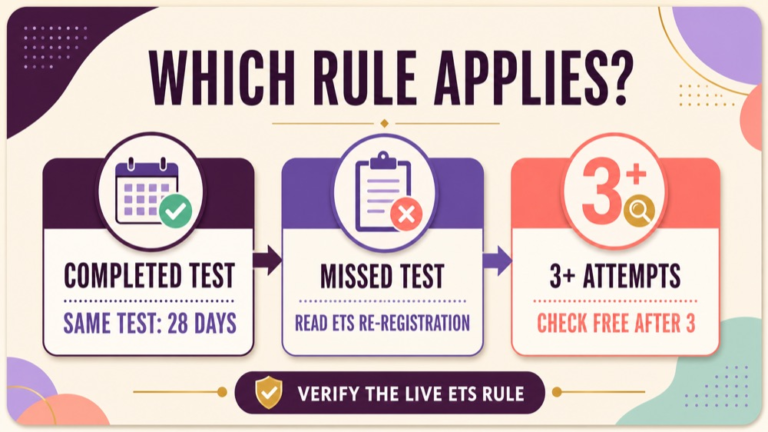
Before you select a date, identify which branch describes what happened. The key question is whether you completed the test administration. If you did, the same-test 28-day rule applies. If you did not take the scheduled test, read the missed-test instructions instead. If you have taken the same test three or more times, review Free After 3 as a separate possibility rather than assuming it changes the basic scheduling rule.
| Your situation | First source to read | Next record to make |
|---|---|---|
| Completed the SLP Praxis | ETS appointment page and Information Bulletin | Previous test date and earliest permitted test date |
| Scheduled but did not test | ETS missed-test re-registration instructions | Reason, appointment status, and the re-registration timing shown by ETS |
| Scores canceled | ETS retake and score policies | Score status and any notice connected to the cancellation |
| Three or more same-test registrations | ETS Free After 3 page and FAQ | Attempt dates, reported-score status, and eligibility window |
| Program deadline involved | Your school, state, or licensing authority | Required score, reporting date, and contact person |
This map keeps policy branches visible. It also prevents a study conversation about motivation from replacing a logistics check. If the branch is unclear, pause and ask ETS or the organization that supplied the requirement before spending money on a new appointment.
Separate a missed test from a retake
The current ETS appointment page distinguishes a missed test from a completed retake. If you did not take the scheduled test, it says you can re-register for a new date without waiting for the 28-day retake period, subject to the timing and steps shown on the live page. The page currently describes re-registering and paying for a new appointment at least three business days after the original test date.
A missed appointment can have several causes, including a check-in issue or a technical problem. Keep the facts of what occurred, but do not assume that the cause automatically changes the policy. The current page says a formal complaint may also be available for certain test-day issues. Review the Bulletin and current support instructions before deciding whether to re-register, submit a complaint, or do both.
- Confirm whether the scheduled test was actually administered.
- Open the current ETS missed-test instructions.
- Record the original appointment date and account status.
- Note any technical, check-in, or appointment message received.
- Check the current re-registration timing and payment steps.
- Review the complaint route if the issue was a test-day problem.
- Compare the new date with your program or licensing deadline.
- Save the new confirmation and recheck the live instructions.
Check Free After 3 separately
ETS currently describes Free After 3 as a possible benefit for candidates who have taken the same Praxis test three times. The current page lists conditions including a first attempt on or after October 1, 2025, three or more registrations for the same test title, reported scores for those attempts, and being within five years of the date the third attempt’s scores were reported. These conditions are specific; a general feeling that you have tested several times is not enough to confirm eligibility.
The current Free After 3 page says that, after the third score has been reported for the same test code, an eligible next registration can receive an automatic price adjustment at checkout after scheduling. It also says a new voucher is needed for each retake and that vouchers are valid for six months. Read the current FAQ and account notices before relying on a benefit, because the live eligibility record and policy wording control.
Free After 3 does not erase the need for a study reset. A lower-cost or free attempt still deserves a plan based on score information, error patterns, timing, and the current blueprint. It also does not replace a separate state, program, or certification requirement.
Build a retake study reset
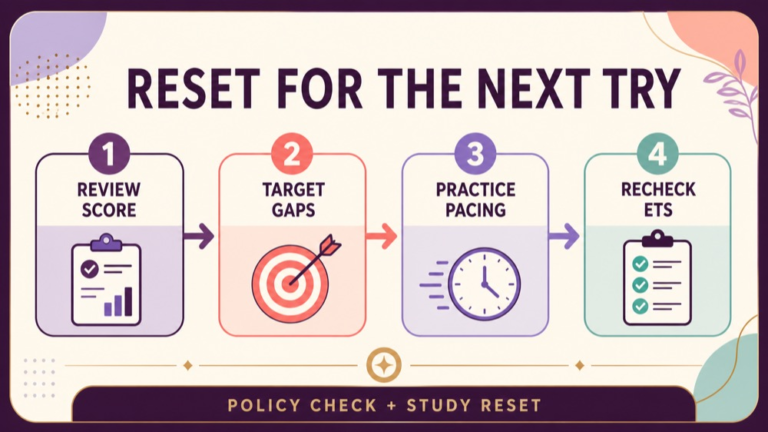
Use the waiting period to make a smaller and more precise plan. Start with a neutral review of the previous attempt: what topics felt familiar, where time pressure appeared, which question types created hesitation, and whether the issue was knowledge, interpretation, pacing, or test-day process. Then choose the next study actions from evidence rather than from the emotional intensity of the result.
Keep the major content categories in rotation. The current ETS Study Companion organizes Speech-Language Pathology content around foundations and professional practice; screening, assessment, evaluation, and diagnosis; and planning, implementation, and evaluation of treatment. A retake plan can weight the weakest area more heavily while still giving each category recurring review.
- Score review: read the report and translate broad information into specific topic questions.
- Error log: record the prompt, evidence noticed, selected option, and reason the choice changed or stayed.
- Domain repair: revisit the weakest blueprint category with authoritative notes.
- Case application: practice explaining why a choice fits the referral question and context.
- Pacing rehearsal: use the current ETS timing and question-count frame for timed practice.
- Process check: review identification, delivery, accommodations, or appointment details that affected the experience.
- Recovery block: schedule rest and a return-to-study date instead of studying from panic.
- Final source check: compare policy, deadline, and appointment details before booking.
Use score information with care
A score report can guide your next learning decision, but it does not explain every cause of performance. A broad category result may point you toward review, while your error log can reveal whether the underlying issue was a missing concept, a rushed reading, a distractor pattern, or an unfamiliar application. Use more than one piece of evidence before changing your entire study plan.
A retake is not a reason to chase remembered or unauthorized test content. Keep your practice grounded in the ETS Study Companion, current professional sources, original case reasoning, and permitted preparation materials. The goal is stronger transfer of knowledge and decision-making across new scenarios, not reconstruction of a prior administration.
If you use accommodations, review the approval letter and current ETS process as part of the reset. If the test format, delivery mode, or appointment setting will differ, add a process rehearsal. If an individual result raises a question about requirements, ask your program or licensing authority rather than inferring a rule from a score alone.
Schedule the next attempt
When you are ready to book, calculate the earliest permissible test date from the completed attempt, then compare it with the date you can realistically prepare. Confirm the full test name and code, current fee, delivery option, appointment availability, score-recipient instructions, and cancellation or rescheduling rules in the live ETS flow. The current Information Bulletin applies to the 2026–27 testing year and states that its fees and terms may change.
Save the confirmation and write down the next policy-check date. Reopen the current source before the final week, especially if the appointment was moved, an accommodation approval has an expiration, or the testing year has changed. A retake plan is complete only when the study calendar and the verified appointment details agree.
Common retake-policy mistakes
- Counting 28 days from the wrong date instead of the previous completed test date.
- Applying the completed-test rule to an appointment that was never taken.
- Assuming canceled scores remove the waiting-period requirement.
- Treating Free After 3 as automatic without checking its dates and same-test conditions.
- Using an old Bulletin after a new testing-year policy has started.
- Choosing a retake date before checking a program or licensing deadline.
- Repeating the same study routine without reviewing the score and error pattern.
- Booking from a search snippet instead of the live ETS account and policy pages.
The repair is straightforward: identify the branch, read the controlling ETS source, record the dates, verify the outside requirement, and then build a targeted reset. If a policy sentence or account status is unclear, ask the source owner before finalizing the appointment.
Quick retake checklist
Before you register for another Speech-Language Pathology Praxis attempt, confirm:
- Did I actually complete the previous test administration?
- What date does ETS list as the previous test date?
- Does the 28-day same-test rule apply to my situation?
- If I missed the test, did I follow the current re-registration instructions?
- Have I checked Free After 3 separately if I may meet its conditions?
- Does my program or licensing authority set a separate deadline or score requirement?
- What evidence from my last attempt will shape the new study plan?
- Have I rechecked the live ETS page, Bulletin, and appointment confirmation?
A retake is best handled as two linked projects: a policy check and a learning reset. ETS controls the dates and administrative rules; your score information and study evidence shape the preparation work. Keeping those roles separate makes the next decision clearer and reduces avoidable surprises.
Sources and next steps
Read the current ETS appointment management page for retake and missed-test directions. Review the ETS Free After 3 page for current eligibility conditions, and use the 2026–27 Praxis Information Bulletin for the testing-year policy boundary. Confirm the Speech-Language Pathology exam context with ASHA’s Praxis information.
Continue your preparation: Explore the SLP Study Center learning resources.
Continue your preparation: Explore the SLP Study Center learning resources.