
praxis slp exam accommodations are easiest to manage when you treat them as an early planning track, not as a last-minute registration checkbox. The current ETS accommodations page explains how to request support, what kinds of documentation may be relevant, how review timing works, and when approval must be in place before scheduling. Your study plan can run alongside that process, but it should not replace it.
This guide is an organization tool for candidates preparing for the Speech-Language Pathology Praxis. It does not decide whether you qualify, which accommodation fits your circumstances, what documentation is sufficient, or whether ETS will grant a request. Use the current ETS instructions and your own approval letter as the controlling sources for an individual case.
Start with ETS
Open the current ETS Praxis accommodations page before collecting forms or choosing an appointment. The page describes the request process for test takers with disabilities or health-related needs and links to the current forms, documentation guidance, and related resources. Because forms and procedures can change, a saved copy of an older checklist should be treated as a starting note rather than the final instruction.
Also confirm the assessment you intend to take. The current ETS Speech-Language Pathology page identifies the Praxis test as Speech-Language Pathology, code 5331. Keep that identity beside your accommodations notes so the request, registration, and study calendar all point to the same assessment. The test code does not determine eligibility for accommodations; it simply helps prevent an exam-selection mismatch.
- Current ETS page: use the live accommodations instructions as the process reference.
- Assessment identity: confirm Speech-Language Pathology and test code 5331 in current ETS materials.
- Program requirement: check your school, state, or licensing organization for separate deadlines or score rules.
- Personal decision: discuss individual documentation or support questions with the appropriate qualified professional and ETS, not with a generic checklist.
Know what the process is for
An accommodation request asks ETS to review the support needed for a standardized testing setting. It is separate from requesting a study strategy, asking for a different exam, or changing the content being assessed. The request process has its own forms, documentation expectations, review steps, and registration directions.
That separation helps you make a realistic plan. You can study the Speech-Language Pathology blueprint while the request is under review, but you should avoid scheduling a computer-delivered Praxis test that depends on an accommodation before you receive the approval instructions. The current ETS page states that approval must be in place before scheduling with accommodations.
Some health-related needs involve items or conditions in the testing room, such as equipment, beverages, snacks, or additional or extended breaks. ETS directs test takers with those needs to follow the request procedures in the Bulletin Supplement. Do not assume that a center rule or a familiar support automatically covers a new request.
Build the accommodation request path
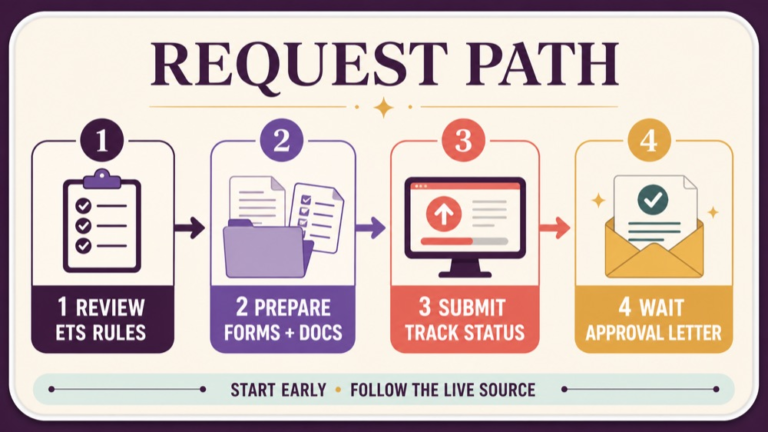
Use a simple path with a checkpoint at each stage: identify the test, open the current ETS accommodations page, review the available support categories, gather the required forms or documentation, submit the request through an available channel, track the response, and follow the approval letter before registration. The exact screen labels or form versions may change, so the path is a planning model rather than a replacement for ETS directions.
| Stage | What to verify | Record to keep |
|---|---|---|
| Identify | Speech-Language Pathology Praxis and current code | Current ETS test-page URL and date checked |
| Review | Which ETS page, supplement, and form instructions apply | Links and current form names |
| Prepare | Required request information and supporting documentation, if applicable | Submission checklist without unnecessary private details |
| Submit | Online, email, or mail route described by ETS | Submission date and confirmation |
| Wait | Review status and any request for additional information | Secure correspondence record |
| Register | Approval letter directions and appointment requirements | Approval letter and final confirmation |
Make the checklist specific enough to prevent omissions but restrained enough to protect privacy. Store personal medical information only where the official process requires it. This article does not need your diagnosis, documentation, password, payment information, or private correspondence.
Prepare information without guessing
The current ETS page describes online submission through a Praxis account and also provides email and mail routes with different document instructions. Read the route you plan to use from the live page. If you use email or mail, follow the current form list and send documents only to the destination ETS identifies. The page also warns test takers not to include credit card information on a registration form sent by email.
Documentation questions are individual. A form or letter that was accepted in one context may not answer a different request, and a previous approval may have an expiration or test-specific condition. If ETS asks for additional documentation, respond through the official instructions and note the date you sent the new material. A generic article cannot tell you what evidence will be sufficient for your situation.
- Open the live ETS accommodations page and note the date checked.
- Confirm the test name and current code in the ETS test materials.
- Read the available-support list and the Bulletin Supplement links.
- Identify the submission route that fits the current ETS instructions.
- Gather only the forms and documentation the official process requests.
- Keep a secure record of submission, correspondence, and any status message.
- Watch for a request for additional information and follow its deadline.
- Wait for the approval letter before scheduling an appointment that depends on support.
Track time and approval
ETS currently states that documentation review takes approximately four to six weeks after the request and complete paperwork have been received. If additional documentation is requested, the page says the review may take another two to four weeks from receipt of the new documentation. These are approximate process estimates, not a personal promise about when a decision will arrive.
Plan backward from the deadline that matters to you, then add room for questions, missing information, and appointment availability. If your program or licensing organization has a score deadline, verify that deadline with them. A study calendar can continue during the review, but an appointment date should be chosen only according to the current approval and registration instructions.
Use a small timeline with three dates: request submitted, follow-up or documentation due, and earliest practical registration check. Add the date you last read the live ETS page. This makes it easier to notice whether a saved instruction has become stale without putting private medical details into a shared calendar.
Read the approval letter
The approval letter is the bridge between the review decision and registration. ETS states that the letter confirms the approved accommodations and explains how to register for a test with them. Read every instruction before opening or finalizing an appointment, including any expiration, test-specific direction, scheduling channel, voucher, or center requirement described in the letter.
If you previously received accommodations from ETS and the approval is still current, the current page says you may be able to request the same support again without submitting disability documentation. If another standardized testing agency approved support for you, ETS describes a route for submitting the approval letter for review. The current page also notes that the result depends on appropriateness for the current test and test-security or construct considerations.
Some approved supports can be scheduled online through a Praxis account according to the current ETS page, including examples such as extended time, extended breaks, screen magnification, and selectable foreground and background colors. Your approval letter controls what applies to you. Do not use an example list as a substitute for the letter.
Plan study time around approved supports
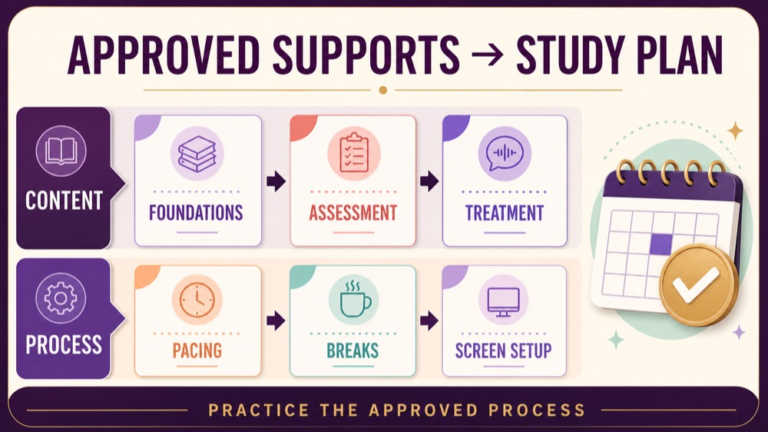
Once the support and registration directions are clear, adapt practice to the approved testing conditions. If your approval includes additional time or breaks, rehearse how you will divide a timed set and when you will pause. If it changes screen presentation, use accessible study settings that resemble the approved environment when possible. The goal is familiarity with your permitted process, not an assumption that practice can predict an individual result.
Keep two columns in your study plan: content and process. Content blocks rotate through foundations and professional practice, screening and assessment, and treatment planning and evaluation. Process blocks cover pacing, break decisions, screen setup, instructions, and the source-check routine. This structure keeps accommodations from being treated as an afterthought while preserving the same learning goals.
- Content rotation: keep all major blueprint categories in the calendar.
- Timing rehearsal: use the approved timing instructions when practicing.
- Break plan: rehearse the approved break process instead of improvising on test day.
- Screen setup: become comfortable with approved display settings before the appointment.
- Instruction check: read the current ETS and approval-letter directions at the start of the final week.
- Error review: study reasoning patterns, not only the number correct.
- Contingency note: save the official support contact route for an unanswered question.
- Final confirmation: compare the appointment with the approval letter and current instructions.
Separate accommodations from exam content
Accommodations change access conditions, not the need to learn the assessment content. Continue to review the ETS Study Companion and the current test page for scope and structure. Use ASHA or your program’s authoritative materials for professional context. Keep the accommodations file focused on process details so it does not become a second, confusing version of the exam blueprint.
This distinction also protects your privacy and your confidence. A request under review is an administrative process, not a measure of your clinical knowledge. A practice result is feedback about a study session, not a decision about whether a support request will be approved. Track each process with its own evidence and its own next action.
Common process mistakes
- Waiting until the intended test date is close before reading the ETS accommodations page.
- Scheduling a computer-delivered test before receiving the approval letter.
- Using an old form or remembered timeline without checking the live source.
- Assuming a prior approval automatically applies to a different test code or expired approval.
- Sending unnecessary private information or payment details through an unapproved route.
- Treating a list of examples as proof that a particular support will be approved.
- Failing to record a request for additional documentation and its response date.
- Practicing under conditions that do not resemble the approved process.
The repair is a dated, source-linked routine: read the current ETS page, confirm the assessment, follow the correct form route, keep a secure submission record, wait for the approval letter, and then register exactly as instructed. If a question remains unanswered, contact ETS through the official support information instead of filling the gap with a forum post or an old screenshot.
Quick accommodations checklist
Before you move from request planning to appointment planning, check these items:
- Have I opened the current ETS accommodations page?
- Did I confirm Speech-Language Pathology and code 5331?
- Did I read the current Bulletin Supplement and linked form instructions?
- Do I know which submission route and documents the live ETS page requires?
- Did I record the submission date and keep correspondence securely?
- Have I left time for review and a possible request for more documentation?
- Did I receive and read the approval letter before scheduling?
- Does my appointment confirmation match the approval letter and current ETS directions?
A calm accommodations plan is a sequence of verified decisions: start early, use the current ETS process, protect private information, track the review, and schedule only after the approval instructions are clear. You can keep studying throughout that sequence while letting ETS decide the administrative questions that belong to ETS.
Sources and next steps
Start with the current ETS Praxis accommodations and application guide. Confirm the assessment on the ETS Speech-Language Pathology 5331 page, and use the ETS Study Companion for study structure. Recheck the live ETS instructions before submitting a request or scheduling an accommodated appointment.
Continue your preparation: Explore the SLP Study Center learning resources.
Continue your preparation: Explore the SLP Study Center learning resources.