The praxis speech language pathology test code is more than a number to memorize. In current ETS materials checked for this guide, the Speech-Language Pathology assessment is identified by code 5331. That code gives you a compact way to check whether a test page, study guide, registration choice, score instruction, and set of notes are all referring to the same assessment.
A code is useful only when you use it within the right boundary. It can help confirm exam identity, but it does not decide your eligibility, required score, state requirement, appointment availability, or readiness. This guide shows how to use 5331 as an identity check and how to keep code verification separate from the clinical learning work that follows.
What the test code identifies
A test code is an identifier attached to a particular assessment in the testing system. For this article, the current ETS Speech-Language Pathology page and the ETS Study Companion both identify the assessment as Speech-Language Pathology with test code 5331. When you see the full name and the code together, you have a stronger identity check than either a short label or a familiar acronym by itself.
This distinction matters because preparation products, course pages, flashcard sets, and older notes may use shorter names. Some resources may say SLP Praxis, Praxis SLP, or Speech Pathology Praxis without displaying the code. Those labels may be useful for discovery, but before you rely on a resource, compare its scope and source with the current ETS materials.
- Full assessment name: Speech-Language Pathology in the current ETS materials.
- Test code: 5331 in the current ETS test page and Study Companion checked for this guide.
- Assessment role: a Praxis examination used within a broader professional and certification pathway.
- Verification rule: confirm the full name and code together before treating a page as the right source.
Why a code check prevents confusion
Many exam-preparation errors begin with a near match. A learner saves a general Praxis page, opens a preparation product with a similar title, or copies a number from an older document without checking what the number represents. The problem is not that every near match is useless; the problem is that a near match can quietly change the scope, timing, content emphasis, or administrative instructions in your plan.
Use the code as a quick checkpoint whenever you switch sources. It is especially helpful when you move from a search result to an ETS page, from the ETS page to the Study Companion, from a study product to a registration screen, or from a program instruction to a personal calendar. A ten-second check can reveal that two resources are not describing the same object.
Use 5331 as an identity check
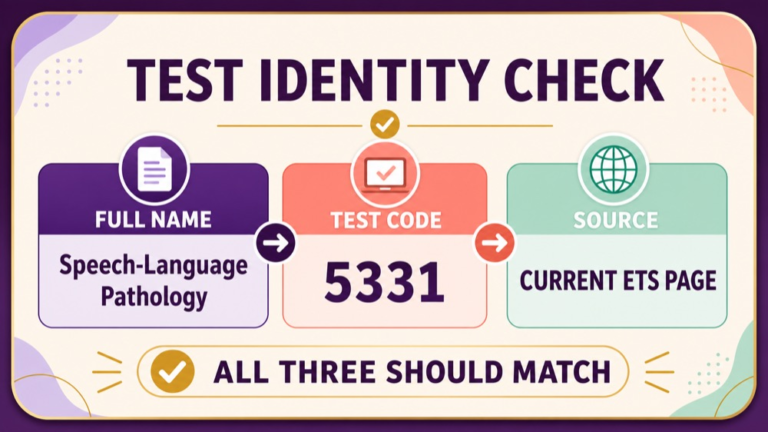
When a resource appears relevant, compare four pieces of information: the name, the code, the source owner, and the purpose of the page. The code is strongest when all four line up. An ETS page with Speech-Language Pathology and 5331 serves a different purpose from an ASHA certification explanation or an independent review course, even when each page uses the words Praxis and SLP.
| Source or screen | What to compare | What the result means |
|---|---|---|
| ETS test page | Full name, code, format, timing, delivery, and current page details | Use as the primary exam identity and live logistics reference. |
| ETS Study Companion | Title, code, test-at-a-glance section, and study topics | Use to organize content review and understand the blueprint frame. |
| Registration flow | Selected test name and code before submission | Confirm that the appointment is tied to the intended assessment. |
| Study product | Stated coverage, source date, and connection to 5331 | Decide whether it supports your plan; do not treat its label as the ETS title. |
| Program or licensing instruction | Required test, deadline, and score policy | Follow the issuing organization for your individual requirement. |
If a resource displays a different code, pause before adding it to your core plan. Check the source date and the full title, then confirm the assessment with ETS or with the organization that directed you to take it. A mismatch is a reason to investigate, not a reason to guess.
How the code relates to the ETS page
The current ETS page lists Speech-Language Pathology as test 5331 and provides the page-level frame for the assessment. The same page currently lists computer delivery, selected-response questions, 150 minutes, and 132 questions. It also contains administrative details such as delivery choices and current purchasing information. Treat the code as the stable identity anchor while you separately recheck details that can change.
The ETS Study Companion adds another layer. Its test-at-a-glance section identifies code 5331, the same 150-minute and 132-question frame, and three broad content categories: foundations and professional practice; screening, assessment, evaluation, and diagnosis; and planning, implementation, and evaluation of treatment. The code links your study notes to the right companion, while the companion supplies the structure for those notes.
Do not infer more from the number than the sources state. Code 5331 does not tell you which state requirement applies, whether you qualify to test, what score your organization requires, or whether an appointment is available. Those questions belong to current ETS instructions and the organization responsible for your pathway.
Separate the test code from other numbers
A page can contain several numbers that serve different purposes. The test code identifies the assessment. A price identifies a current transaction detail. A question count describes the current page or companion frame. A score requirement belongs to a program, state board, or certification policy. A product number may identify a course or practice form. Put a label beside each number in your notes so they do not blend together.
- Test code: use 5331 to identify the Speech-Language Pathology assessment in the cited ETS materials.
- Question count: record the current source’s number for pacing practice, then recheck the source during an update.
- Time limit: use the current source’s timing for a pacing rehearsal, not as a substitute for reading the live instructions.
- Price: treat it as a changeable purchase detail and confirm it in the current ETS flow.
- Score requirement: obtain it from the relevant program, state, or certification authority.
- Appointment number: save it as a booking record and keep it separate from the test code.
- Product or form number: check what the publisher says it identifies before using it as a study reference.
- Source date: write down when you checked the page so an old note is easy to spot.
Turn the code into a study habit
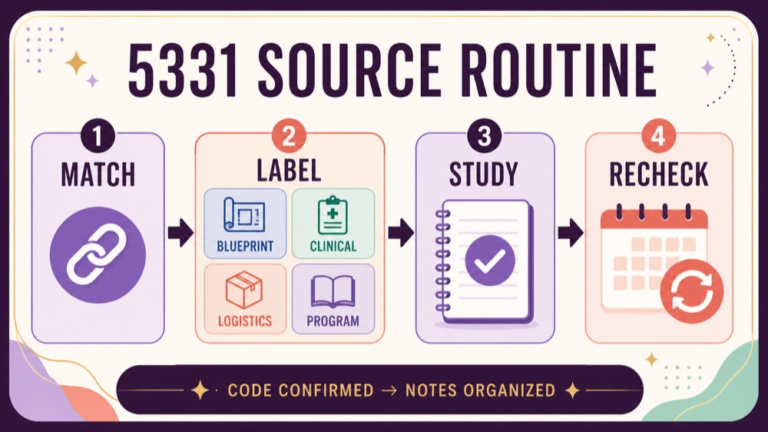
Make code verification part of your source routine. At the start of a study session, write “Speech-Language Pathology — 5331” at the top of the page you are using. When you open a new resource, compare its title and stated coverage before you add notes. At the end of the session, keep the URL and the date checked beside the notes. This routine turns a single number into a practical guardrail.
The habit is most useful when your study folder grows. You may collect class notes, the Study Companion, practice explanations, program instructions, and registration reminders. A consistent identity line lets you sort these documents without pretending that they all have the same authority or purpose.
- Open: start with the current ETS test page or the source named in your plan.
- Match: compare the full test name and code 5331.
- Label: mark the note as blueprint, clinical learning, logistics, or program requirement.
- Study: use the source for the purpose it actually supports.
- Record: save the source URL and date checked.
- Flag: mark any price, availability, score, or policy detail for later verification.
- Review: remove or update notes that no longer match the current source.
- Recheck: repeat the identity check before registration and before final-week planning.
Connect 5331 to the blueprint
Once the assessment identity is secure, use the Study Companion to organize learning across the three broad categories. For foundations and professional practice, connect terminology to decisions involving ethics, documentation, evidence, collaboration, typical development, and culturally and linguistically appropriate services. For screening and assessment, connect the referral question to history, test selection, interpretation, and the limits of screening information.
For planning, implementation, and evaluation of treatment, connect assessment findings to priorities, goals, treatment details, progress monitoring, outcomes, and follow-up. The code does not teach these topics; it keeps your study materials pointed toward the intended assessment while you do the clinical reasoning work.
Use the category structure as a balance check. If every note in your folder is about one clinical area, the problem is not solved by writing 5331 at the top. You still need a balanced plan that rotates through foundations, assessment, and treatment, with time for application and review of uncertainty.
Use the code before registration
Before you begin or finalize registration, compare the current ETS test page with the selection shown in your account. Confirm the full name and code, then review the date, delivery mode, location or at-home requirements, identification instructions, price, and policies. These details are separate from the code and may change, so use the live ETS instructions for the final decision.
Also compare the appointment plan with the deadline supplied by your program or licensing authority. A correct test code does not make an appointment date workable if scores are needed by an earlier deadline. Keep the code, confirmation details, and receiving-organization instructions in one secure folder, but label each item by its purpose.
Common test-code mistakes
- Searching only for “SLP Praxis” and accepting the first page without checking the full title.
- Copying 5331 into notes without confirming that the surrounding page is current and authoritative.
- Confusing an ETS preparation product or practice form with the assessment itself.
- Using a score requirement from a different organization because it appears beside the same code.
- Treating a current question count or price as a permanent meaning of the code.
- Assuming the code answers an eligibility or accommodations question.
- Leaving an old source in the study folder without recording its date checked.
- Checking the code once and then skipping the final comparison at registration.
Correct these errors with a four-part reset: identify the source owner, compare the full title, confirm 5331 in current ETS materials, and label the remaining details by who controls them. That reset keeps a simple identifier useful without turning it into a shortcut for decisions it cannot answer.
Quick code checklist
Use these questions when a new resource, page, or instruction enters your preparation system:
- Does the full title say Speech-Language Pathology?
- Does the current ETS source show code 5331?
- Am I looking at an assessment page, a Study Companion, a registration screen, or a product page?
- Which facts on this page are stable study structure and which are changeable logistics?
- Have I recorded the source URL and date checked?
- Does my program or licensing authority provide a separate requirement?
- Have I kept appointment details and score instructions separate from the test code?
- Will I repeat the comparison before registration and final-week planning?
The practical value of 5331 is consistency. Use it to confirm the intended assessment, organize the right source materials, and notice mismatches early. Then let ETS control current exam logistics, the Study Companion shape your study map, ASHA provide certification context, and your own program or licensing authority define the requirement that applies to you.
Sources and next steps
Verify the identity and current page details on the ETS Speech-Language Pathology 5331 page. Use the ETS Speech-Language Pathology Study Companion for the test-at-a-glance frame and study topics. For professional context, review ASHA’s Speech-Language Pathology Praxis information. Recheck the live sources before relying on current administrative details.
Continue your preparation: Explore the SLP Study Center learning resources.
Continue your preparation: Explore the SLP Study Center learning resources.