
If your SLP Praxis study plan is a pile of disorder names, you may be working hard without practicing the skill the exam actually asks for: making a defensible decision from a short clinical or professional scenario. The better starting question is not “How many pages can I finish?” It is “What kind of decision am I being asked to make, and what evidence should control it?”
This guide turns the current Speech-Language Pathology Praxis 5331 information into a practical study routine. You will see what to verify before registration, how to organize the three broad content areas, and how to turn missed questions into a distinction log you can use again. The goal is a calmer, more connected way to prepare for the SLP Praxis—not a promise of a particular score.
Table of Contents
- Start With the Decision, Not the Chapter
- Know the Current 5331 Format Before You Plan
- Turn the Three Content Areas Into Three Questions
- Build a Study Session Around One Clinical Decision
- Use a Distinction Log for Concepts That Look Alike
- Use Practice Questions as Feedback
- A Seven-Day Reset Before Test Day
- Check Registration and Score Rules at the Source
Start With the Decision, Not the Chapter
Many candidates begin with a familiar sequence: read a chapter, highlight terms, make flashcards, and hope that recognition becomes recall. That sequence can help you learn vocabulary, but it does not automatically teach you how to choose the next assessment step, separate a screening result from a diagnosis, or select a treatment priority when several answers sound reasonable.
Instead, give each study block a decision. For example, “choose the most appropriate next step after a failed screen” is a decision. “Review aphasia” is a topic. A topic can be too large to guide your practice; a decision tells you what evidence to look for.
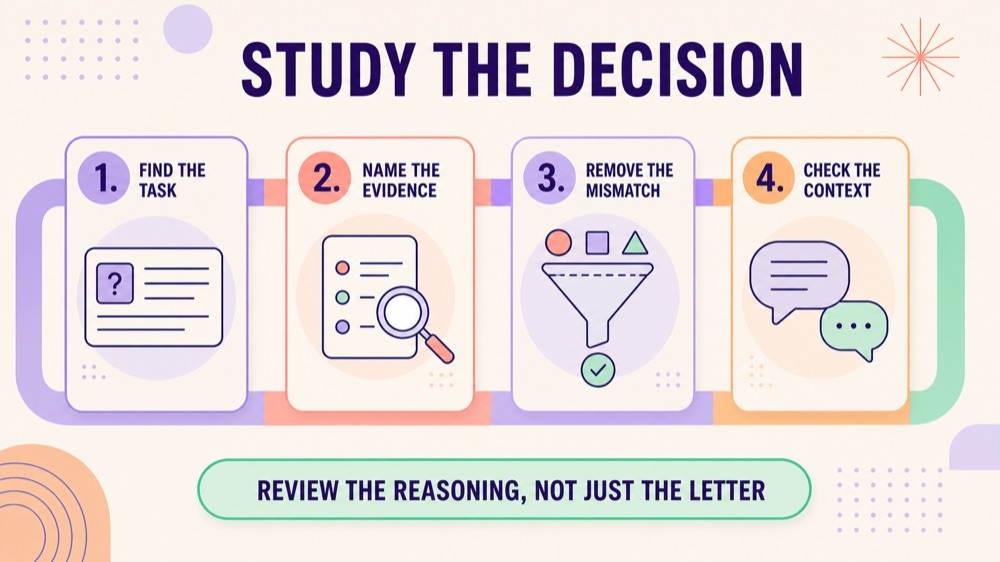
When you miss an item, do not record only the topic. Record the task, the decisive clue, and the mismatch in the answer you chose. A useful review note might say: “I treated a screening result as a diagnosis. The decisive clue was that the question asked for the next step, not a disorder label.” That sentence is more reusable than a copied definition.
Know the Current 5331 Format Before You Plan
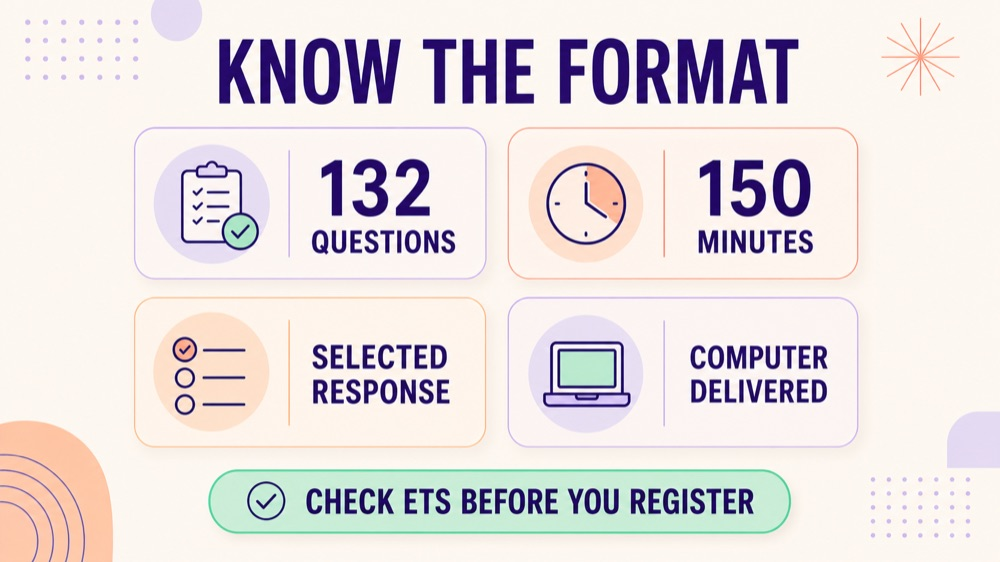
Before you divide your calendar into study weeks, check the current ETS Speech-Language Pathology 5331 page. ETS currently lists a computer-delivered, selected-response test with 132 questions and 150 minutes of testing time. The same page lists the current fee, delivery information, and score-recipient details. Those administrative details can change, so use the official page again when you register rather than treating a study article as a permanent source.
- Test code: Speech-Language Pathology 5331.
- Question format: selected-response questions as currently listed by ETS.
- Question count: 132 questions as currently listed by ETS.
- Testing time: 150 minutes as currently listed by ETS.
- Delivery: computer delivered, with the available testing options shown by ETS.
- Score reporting: confirm the current recipient and reporting rules at registration.
That format works out to a little over one minute per question on average, but an average is not a command to rush every item. Use it as a pacing signal. If you spend too long on one unfamiliar scenario, mark your best answer, move forward, and return if the testing interface allows it. Practice the same rhythm in mixed sets so time pressure does not become a surprise at the end of preparation.
ETS also notes that some questions may not count toward the score and that candidates cannot identify those questions during the session. The practical takeaway is simple: respond carefully to every item and do not try to guess which questions are experimental.
Turn the Three Content Areas Into Three Questions
ASHA’s current 5331 content page describes three broad categories with approximately 44 questions, or about one-third of the test, in each category: Foundations and Professional Practice; Screening, Assessment, Evaluation, and Diagnosis; and Planning, Implementation, and Evaluation of Treatment. Use the categories to check coverage, then study them through decisions instead of memorizing three isolated lists.
1. Foundations and Professional Practice: What makes the service appropriate?
This category connects foundational knowledge with professional practice. It includes development across the lifespan, communication and swallowing factors, ethics, documentation, counseling, collaboration, advocacy, culturally and linguistically appropriate service delivery, research methods, and evidence-based practice. When a question contains professional context, do not ignore it while searching for a clinical label. The context may be the evidence that determines the appropriate action.
2. Screening, Assessment, Evaluation, and Diagnosis: What is known, and what still needs to be measured?
This category asks you to reason from referral information, case history, observation, screening, assessment tools, and interpretation. A screen can indicate that more information is needed; it does not automatically provide a complete diagnosis. When you compare choices, ask whether each one matches the purpose of the step and the strength of the evidence available.
3. Planning, Implementation, and Evaluation of Treatment: What should happen next, and how will you know?
This category follows the clinical reasoning from treatment selection to follow-up. Review goals, intervention details, prognosis, communication with clients and families, collaboration, progress monitoring, outcomes, and referrals. A treatment answer is stronger when it fits the client’s needs and includes a way to evaluate whether the plan is working.
Across all three categories, keep the same four-part question in view: What is the task? What facts are decisive? What professional or clinical boundary applies? What result would show that the decision was effective?
Build a Study Session Around One Clinical Decision
A useful study session does not need to be long, but it should have a beginning, a decision target, and a retrieval step. Try the following 45–60 minute structure and adjust it to your schedule:
- Orient for five minutes: write the decision you will practice, such as screening versus full evaluation or treatment goal versus outcome measure.
- Learn for fifteen minutes: review the concept, its nearest confusion, the evidence that separates the two, and any relevant professional boundary.
- Apply for fifteen minutes: answer a small set of new scenarios without looking at the explanation first.
- Explain for ten minutes: state why the best answer fits and why each distractor answers a different question.
- Retrieve for five minutes: close the notes and write the rule in your own words, then add the concept to your distinction log if it could recur.
Once the process feels stable, mix domains. A set that moves from voice to language to swallowing is harder than a predictable topic block, but it gives you better practice at recognizing the task before the familiar vocabulary tells you what to think. Add timed sets gradually; speed is useful only when it does not replace careful reading.
Use a Distinction Log for Concepts That Look Alike
A distinction log is different from a list of everything you got wrong. It focuses on pairs or groups that could be confused again. For each entry, answer five questions:
- What decision does concept A support?
- What decision does concept B support?
- What evidence separates them?
- What wording in a question would make A more likely?
- What would I need to know before choosing either one confidently?
Useful entries might include screening versus assessment, assessment versus diagnosis, impairment versus activity limitation, phonological pattern versus motor-speech feature, treatment selection versus treatment evaluation, or a referral need versus a treatment recommendation. The point is not to force every case into a binary. The point is to make the boundary visible so that you can notice what the question is actually testing.
Use Practice Questions as Feedback
Practice questions are valuable when they change what you do next. They are less useful when you treat a percentage as a final judgment or memorize a familiar answer pattern. Before reading the options, identify the question type: definition, next step, interpretation, priority, referral, ethics, treatment, or outcome evaluation.
Then use this review loop: choose an answer, state the decisive clue, explain why the correct option fits the task, and identify the exact mismatch in every distractor. If you cannot explain the distractor, the review is not finished. Add the concept to your distinction log when the same confusion could appear in a different clinical area.
Three original self-checks
These are original learning prompts, not official ETS questions or recalled exam items.
- A client does not pass an initial communication screen. What is the safest reasoning move? Treat the result as information that may justify further evaluation, not as a complete diagnosis. The decisive distinction is the purpose of a screen.
- A treatment plan names a technique but no measurable outcome. What should you ask next? Ask how progress will be monitored and what observable change would indicate that the plan is helping. The missing piece is evaluation, not another technique name.
- A question includes language, cultural, and access information that seems unrelated to the disorder label. Should you ignore it? No. Those facts may affect assessment validity, service delivery, counseling, or collaboration. The scenario context is part of the evidence.
A Seven-Day Reset Before Test Day
If you are close to the exam and feel behind, do not respond by opening every resource at once. Use a short reset:
- Day 7: take a mixed baseline and sort errors by reasoning type.
- Day 6: repair the two most frequent concept distinctions.
- Day 5: review foundations and professional-practice decisions.
- Day 4: review screening, assessment, evaluation, and diagnosis decisions.
- Day 3: review planning, implementation, treatment, and outcome decisions.
- Day 2: complete a moderate mixed set with pacing, then stop adding new systems.
- Day 1: confirm logistics, review your short distinction log, and protect sleep and concentration.
This sequence is not a guarantee and it is not a substitute for a longer plan. It simply keeps the final week focused on retrieval, distinctions, and decisions rather than endless rereading.
Check Registration and Score Rules at the Source
Before you register, return to the current ETS Speech-Language Pathology 5331 page for the fee, delivery options, scheduling, accommodations, and score-recipient instructions. Then check the authority that will receive your score. ETS administers the examination, while ASHA describes the certification relationship and current certification guidance; a state licensing board or education agency can have additional rules.
ASHA currently lists a passing score of 162 on a 100–200 scale for its certification purpose and notes that state requirements can differ. ASHA also provides guidance about the age of scores used for initial certification. These are changeable administrative facts, so verify them again for your application and record the date you checked.
If you want a structured review next, you can explore the SLP Study Center preparation resources. Use a study product as learning support, and keep ETS, ASHA, and the relevant state authority as the final source for current requirements.
Sources
For current exam format, timing, delivery, question count, fee, and broad test information, review the ETS Speech-Language Pathology (5331) test page. For certification context, passing-score information, state variation, and score-age guidance, review ASHA’s Speech-Language Pathology Praxis Exam overview. For the three content categories and topic coverage, review the ASHA Speech-Language Pathology Exam 5331 content page. Check these sources again before registration or publication updates.