
slp praxis exam domains give your preparation a structure. Instead of treating the Speech-Language Pathology Praxis as one giant list of facts, use the domains to sort concepts, clinical decisions, and professional responsibilities into a study map. The map is broad by design: it helps you plan coverage without pretending to forecast the wording of a future item.
The current ETS Speech-Language Pathology Praxis 5331 materials checked for this guide organize the content into three broad areas: Screening, Assessment, Evaluation, and Diagnosis; Planning, Implementation, and Evaluation of Treatment; and Foundations and Professional Practice. The Study Companion lists relative emphasis of approximately 50%, 33%, and 17%. Confirm the current ETS page and Study Companion before relying on the names or percentages.
Why the domains matter
A domain is a container for related decisions, not a chapter title to memorize. When you use it well, you can answer three planning questions: what should I learn, what should I practice, and how will I know the skill transfers to a new case? That makes review more active and exposes gaps earlier.
Keep these four ideas distinct:
- Domain: the broad area named in the current ETS scope materials.
- Subskill: a narrower ability within that area, such as interpreting findings or monitoring progress.
- Scenario: a practice context in which the subskill is applied.
- Weight: a relative planning signal, not an exact forecast of one test session.
A domain label also protects you from studying in isolated fragments. Assessment knowledge affects treatment planning. Professional responsibilities shape how assessment and treatment decisions are carried out. The goal is not to blur the categories; it is to understand their boundaries and the links between them.
Screening, assessment, evaluation, and diagnosis
This is the largest broad area in the current materials checked for this guide. Study it as a chain of information and decisions. Screening asks whether a concern needs more attention. Assessment and evaluation gather and interpret information. Diagnosis is a reasoned clinical conclusion within the available evidence and professional boundaries.
Useful study questions include:
- What is the referral question, and what information would answer it?
- Which observations or measures fit the person, setting, and purpose?
- How do reliability, validity, sensitivity, specificity, and context affect interpretation?
- How should multiple sources be integrated rather than read in isolation?
- What additional information, referral, or collaboration is needed?
Do not reduce this domain to a list of standardized test names. A selected-response task may be asking you to match a measure to a decision, recognize a limitation, or interpret a pattern. Use the current ETS Study Companion for scope and ASHA resources for professional context when you build your notes.
| Study layer | Example output |
|---|---|
| Screening | A decision rule for whether a concern warrants follow-up. |
| Assessment | A plan for collecting information tied to the referral question. |
| Evaluation | An integrated interpretation of findings and functional impact. |
| Diagnosis | A cautious, evidence-based conclusion within scope and context. |
Planning, implementation, and evaluation of treatment
The treatment domain follows what happens after information has been gathered and interpreted. Preparation should connect a profile to functional goals, intervention choices, implementation details, collaboration, and progress monitoring. The words plan and evaluate matter: treatment is not just selecting a technique.
Build a treatment study frame around:
- Need: what communication or swallowing participation problem matters to the person?
- Goal: what observable, meaningful change is being targeted?
- Approach: why does the intervention fit the profile and evidence?
- Context: who will support practice and how will access be addressed?
- Progress: what data will show whether the plan needs adjustment?
When you review treatment concepts, include the decision that comes before the technique. A cueing approach may be useful in one context and poorly matched in another. A goal may be measurable but still miss the client’s participation priority. Practice explaining the fit, not just naming the method.
Foundations and professional practice
Foundations and Professional Practice provides the frame for safe, ethical, evidence-informed work. Topics may include communication science and development, service delivery, collaboration, documentation, cultural and linguistic responsiveness, ethics, and professional responsibilities. The smaller relative emphasis listed in the current materials does not make it a topic to skip.
Study this domain through practical questions:
- What professional responsibility shapes the decision?
- How does the service setting affect collaboration and documentation?
- What access or communication-partner issue needs attention?
- How do evidence and client values inform a plan?
- What action stays within the clinician’s role and available information?
Foundations can be easy to postpone because the topics feel less concrete than a disorder label. Make them concrete by connecting each principle to a short scenario. For example, study how informed consent, interpreter access, or supervision affects the next step in a case without inventing details the scenario does not provide.
See how the domains connect
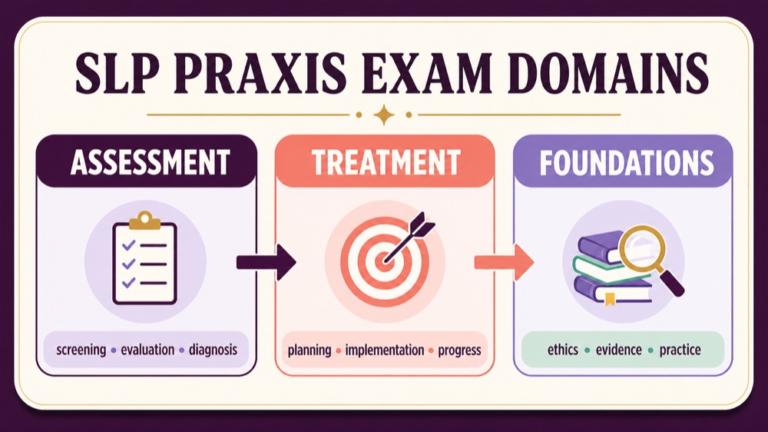
Many useful practice cases move through more than one domain. A school referral may begin with screening, require evaluation, lead to a participation-focused goal, and involve collaboration with a family and team. An adult with a new communication change may require history, assessment, interpretation, referral awareness, treatment planning, and documentation.
Use a simple chain:
- Question: what concern or decision starts the case?
- Information: what must be gathered and interpreted?
- Plan: what action fits the findings and goal?
- Frame: what professional, access, safety, or collaboration issue matters?
- Feedback: what evidence will guide the next adjustment?
This chain is a way to organize study, not a substitute for a full clinical process or supervision. Its value for exam preparation is that it keeps you from jumping straight from a symptom word to a technique without checking the question and the evidence.
Map each domain to a study skill
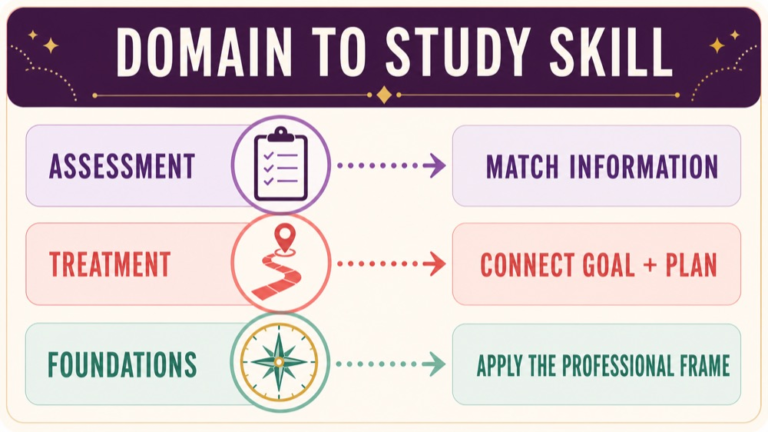
Turn every domain into an observable action. “Review assessment” is too vague to schedule or assess. “Match a referral question to the information needed, then explain one limitation” is specific. Use a domain-to-skill card:
| Domain | Skill statement | Practice evidence |
|---|---|---|
| Assessment | Match information to the decision. | Reasoned assessment map. |
| Treatment | Connect profile, goal, approach, and progress measure. | Short plan with rationale. |
| Foundations | Apply professional and access boundaries to a case. | Next-step explanation. |
After a practice item, write the domain, task verb, decisive clue, and transfer rule. If you cannot name the transfer rule, you may have remembered an answer without learning the concept. Use the gap to choose the next review activity.
Build a balanced domain plan
Use the current relative emphasis as a starting allocation. If you study ten hours in a week and the listed percentages remain unchanged, a reasonable first draft is about five hours for assessment-related work, three for treatment planning and evaluation, and two for foundations and professional practice. Then adjust based on your error log.
Each domain block should contain:
- short concept review;
- closed-note retrieval;
- original or preparation practice;
- an explanation of the best-supported choice;
- a correction note for the next session.
Do not count only reading time. A domain is covered when you can recognize the task, use the evidence, and explain the decision in a new context. Keep a separate note for current administration facts and recheck them on the ETS page when your test date approaches.
Practice domain switching
Once you have studied each area separately, mix them. Complete one assessment interpretation, one treatment-planning decision, and one professional-practice scenario in the same session. The purpose is to practice identifying what kind of decision the prompt requires before selecting a response.
After the mixed set, sort errors by two labels: domain and reasoning type. A wrong answer may be an assessment knowledge gap, a treatment-fit problem, a professional-boundary problem, or a general reading or pacing issue. The two-label system tells you whether to return to content, decision practice, or test-taking behavior.
Common domain mistakes
- Memorizing the domain names without learning the decisions inside them.
- Treating the listed percentages as exact future item counts.
- Studying assessment and treatment as if they never influence each other.
- Leaving professional practice until the final day.
- Using a disorder label as a shortcut for every clinical decision.
- Measuring progress by pages or flashcards alone.
- Using an old scope document without checking the current ETS materials.
- Treating a practice score as a direct prediction of the Praxis result.
Fix the pattern with a current-source check, domain-to-skill cards, mixed practice, and an error log. The domains should change what you do next, not simply decorate a study calendar.
Domain review checklist
Before your next review week, answer:
- What domain and subskill am I studying?
- What task verb should I expect in my practice?
- What evidence will support the choice?
- What professional or access boundary might matter?
- How will I apply the concept in a new context?
- How will I balance domain emphasis with my own error data?
- When will I run mixed-domain practice?
- Which current ETS source will I recheck before test day?
The practical use of slp praxis exam domains is simple: organize scope, practice decisions, connect the areas, and let evidence from your study log refine the allocation. Keep the live ETS materials in control of changing facts.
Sources and next steps
Use the current ETS Speech-Language Pathology Praxis 5331 page for the live test description. Use the ETS Study Companion for domain scope and relative emphasis, and review ASHA’s Praxis information for certification context. Confirm current materials before relying on domain names or percentages.
Continue your preparation: Explore the SLP Study Center learning resources.