
slp praxis exam blueprint is the document that turns a broad SLP review project into a manageable map. It shows the major content domains and helps you decide where to spend study time. It does not tell you the wording of a future item, and it should not be used to predict a result from a single practice percentage.
Use the current ETS Speech-Language Pathology Praxis 5331 page and Study Companion as your source of truth. In the materials checked for this guide, the blueprint grouped content into three broad areas: Screening, Assessment, Evaluation, and Diagnosis; Planning, Implementation, and Evaluation of Treatment; and Foundations and Professional Practice. The listed emphasis was approximately 50%, 33%, and 17%, respectively. Verify the current edition before building a long plan.
What the blueprint is for
A blueprint answers a scope question: which kinds of knowledge and professional decisions belong in the preparation plan? It helps you choose resources, balance domains, and notice when your studying has become too narrow. It is more useful than a random list of vocabulary because it connects topics to the work an SLP may need to understand.
Keep three ideas separate:
- Domain: a broad area of the assessment, such as assessment or treatment.
- Competency: a more specific ability within that domain, such as selecting information or interpreting a profile.
- Practice task: an original question, case, chart, or explanation used to rehearse the competency.
- Weight: the relative emphasis listed in the current test materials, not a guarantee about any one sitting.
This separation prevents two common problems. A learner may copy the domain headings without practicing the decisions hidden inside them, or may spend all week on a favorite topic because it feels familiar. The blueprint should guide both breadth and depth.
Read the three blueprint domains
The largest area in the current materials checked for this guide is Screening, Assessment, Evaluation, and Diagnosis. Study here includes choosing information, understanding measurement, integrating findings, and recognizing when a referral or additional evaluation matters. The domain is broader than memorizing test names.
Planning, Implementation, and Evaluation of Treatment focuses on how an SLP moves from findings to goals, intervention choices, implementation, progress monitoring, and adjustment. A strong study block connects a client profile to a functional target and a way to judge whether the plan is helping.
Foundations and Professional Practice provides the professional frame. It includes communication science and development, service delivery, ethics, evidence use, collaboration, and responsibilities that shape safe and effective care. Smaller listed emphasis does not make this domain optional; it makes efficient coverage important.
| Blueprint area | Study question | Useful output |
|---|---|---|
| Screening, Assessment, Evaluation, and Diagnosis | What information supports the decision? | Assessment map with interpretation notes. |
| Planning, Implementation, and Evaluation of Treatment | What plan fits the profile and goal? | Goal, intervention, and progress-monitoring outline. |
| Foundations and Professional Practice | What professional frame guides the work? | Scope, ethics, collaboration, and evidence checklist. |
Use blueprint emphasis to allocate study time
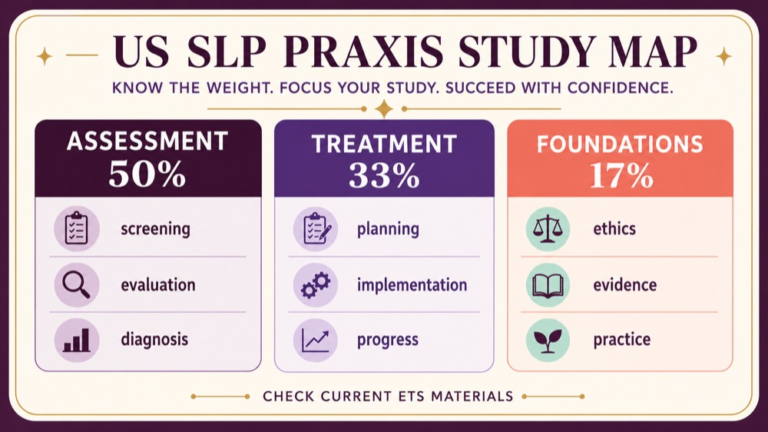
If the current percentages remain the same when you check the ETS materials, use them to set a starting allocation rather than a rigid promise. For example, a ten-hour week might begin with about five hours for assessment-related work, three hours for treatment planning and evaluation, and two hours for foundations and professional practice. Adjust after practice reveals a real weakness.
Do not measure study only by pages read. A useful allocation includes several kinds of work:
- Concept building: learn the terminology, distinctions, and relationships.
- Decision practice: apply the concept to an original scenario or selected-response exercise.
- Explanation: state why the leading choice fits and why alternatives fall short.
- Retrieval: recall the principle without looking at the note.
- Correction: record the specific error and choose a targeted next step.
A heavier domain can receive more total time, but every domain still benefits from retrieval and application. If you are confident in assessment vocabulary but slow when comparing treatment choices, reallocate some time toward decision practice instead of repeating familiar reading.
Turn domains into decision skills
Write one observable skill under each domain. For assessment, that might be matching a referral question to information needed. For treatment, it might be linking a functional goal to an intervention and progress measure. For professional practice, it might be identifying the ethical or scope boundary that changes the next step.
Use a skill card with five fields:
- Domain: which blueprint area does this belong to?
- Situation: what client, setting, or professional context is present?
- Task: what decision must be made?
- Evidence: which detail supports or limits the decision?
- Transfer rule: what principle should carry to a new case?
This format makes review more active. Instead of writing “study aphasia,” you can write “given a communication profile, distinguish the information needed for differential reasoning from the information needed for treatment planning.” That statement gives you a practice target and a way to judge whether your answer is supported.
Practice cross-domain reasoning
Real clinical decisions do not stay in separate boxes. A case may begin with a screening concern, move into evaluation, lead to a treatment plan, and require collaboration or referral. Use the blueprint domains as organizing labels, but include mixed practice after you understand the individual areas.
For a mixed case, ask:
- What concern or referral question is being addressed?
- What information is already available, and what is missing?
- What assessment or interpretation step is justified by the evidence?
- What functional goal or intervention direction follows from the profile?
- What professional, safety, access, or collaboration boundary matters?
Keep these as study scenarios you create or obtain from a preparation resource. Do not represent a practice case as a live or remembered item. The transferable value is the sequence of reasoning, not a claim about what will appear.
Build a weekly blueprint map
A weekly map should be simple enough to use. Start with the current domain emphasis, then assign each study block one primary skill and one review action. Leave room for mixed practice because the final assessment may shift from one content area to another.
| Block | Primary focus | Evidence of progress |
|---|---|---|
| Learn | One concept cluster from the blueprint. | Can explain it in plain language. |
| Apply | Original scenarios or preparation questions. | Can identify task, clue, and best-supported choice. |
| Retrieve | Closed-note recall across two domains. | Can rebuild the decision rule. |
| Audit | Error log and next-week adjustment. | Can name the gap and correction. |
Rotate the primary focus across the three domains. A week that feels productive because it repeats one comfortable chapter may leave a large blind spot. Your map should make that imbalance visible before a full-length practice session exposes it.
Audit the blueprint with a review cycle
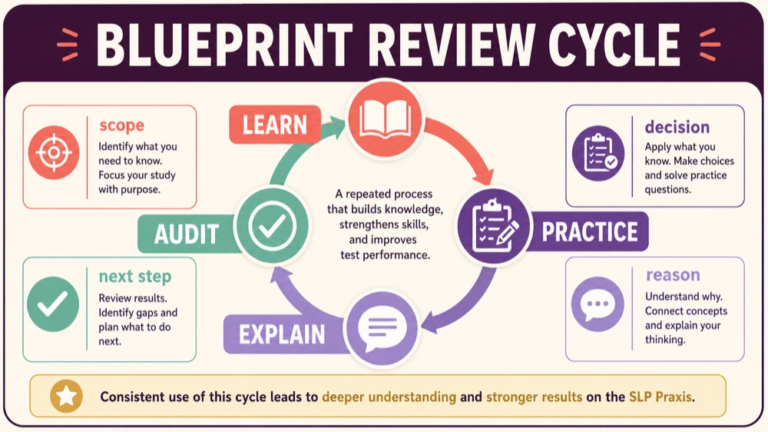
Use a four-part review cycle: learn, practice, explain, and audit. In the audit step, sort errors by domain and by reasoning type. You may discover that your content knowledge is adequate but your interpretation of task verbs is weak. That finding changes the next practice block more effectively than simply adding more notes.
- Coverage check: have I touched every current domain?
- Depth check: can I apply the principle to more than one context?
- Evidence check: can I identify the decisive detail?
- Transfer check: can I explain a rule without copying the example?
- Timing check: can I use the reasoning routine within a timed set?
- Source check: are changing administration facts verified on current ETS materials?
Repeat the audit after a mixed set and after a full-length simulation. The blueprint is most useful when it changes your next action. If the audit only produces a percentage, it has not yet become a study map.
Common blueprint mistakes
- Treating the blueprint percentages as a prediction of exact item counts.
- Studying the largest domain while ignoring the other two.
- Memorizing headings without practicing decisions inside them.
- Confusing a topic list with the current scope document.
- Using an old Study Companion without checking the current ETS page.
- Counting pages or flashcards instead of measuring application.
- Keeping practice in isolated domains for too long.
- Using a practice score as a direct estimate of a Praxis result.
The correction is to verify the current source, translate each domain into skills, schedule weighted but balanced practice, and review errors by cause. A blueprint can guide attention, but it cannot replace reasoning practice.
Blueprint checklist
Before you start the next study week, answer:
- Which ETS blueprint edition and test page did I check?
- What are the current broad domains?
- What relative emphasis does the current material list?
- What decision skill will I practice under each domain?
- How will I include retrieval and application?
- When will I run mixed-domain practice?
- How will I classify errors?
- What will make me change next week’s allocation?
The best use of the slp praxis exam blueprint is practical: let it set coverage and starting priorities, then let your error log refine the plan. Recheck the live ETS materials when your test date approaches.
Sources and next steps
Use the current ETS Speech-Language Pathology Praxis 5331 page for the live test description and administration information. Use the ETS Study Companion for blueprint scope and preparation context, and review ASHA’s Praxis information for certification context. Verify current materials before relying on percentages or test details.
Continue your preparation: Explore the SLP Study Center learning resources.