
slp praxis exam time limit is not just a number to memorize. It is a planning constraint that affects how you read, compare answer choices, decide when to move, and reserve attention for a later review. A calm pacing system gives each question an appropriate amount of attention without turning the clock into a second source of stress.
The current ETS Speech-Language Pathology Praxis 5331 page should control the live timing and delivery details. When this guide was checked, ETS listed 150 minutes and 132 questions, but administration information can change. Verify the current page and Study Companion before your appointment. The method in this guide remains useful if the listed numbers change.
What the time limit changes
Without a time limit, you can treat every question as an open-ended research problem. Under a timed selected-response assessment, the goal is different: make the best supported decision with the information available, then preserve enough time to finish the full set. That requires an explicit stopping rule for uncertainty.
Think about the limit through four linked tasks:
- Reading: identify the task verb and the details that change the answer.
- Comparing: weigh plausible options against the same evidence.
- Moving: recognize when more rereading is unlikely to improve the decision.
- Reviewing: return to flagged or uncertain items only after the remaining work is protected.
A time limit does not mean rushing every item. It means allocating attention deliberately. Direct items may take less time; complex scenarios may take more. Your practice should show whether you are slow because of a knowledge gap, an option-comparison habit, a reading problem, or a tendency to seek certainty that the stem cannot provide.
Turn the time limit into checkpoints
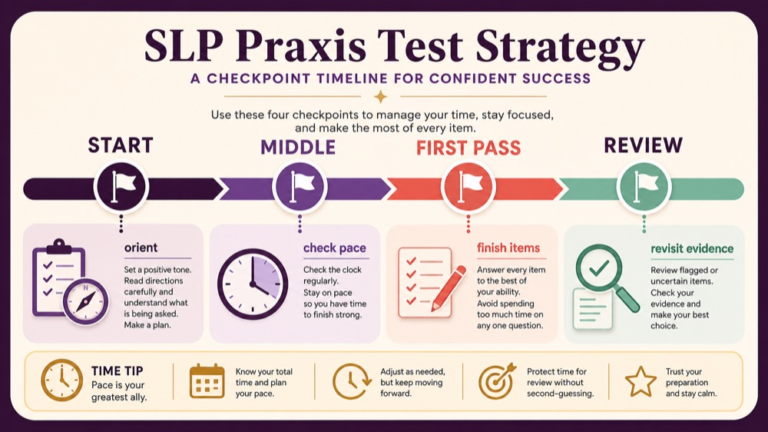
Convert the current ETS time into a few progress checkpoints. Avoid setting a separate alarm for every question, because that can interrupt reasoning. Instead, decide when you will look at the remaining time and attempted-question count. Your checkpoints should tell you whether you are on pace for a complete first pass and a realistic review window.
| Checkpoint | What to check | What to do if you are behind |
|---|---|---|
| Early | Am I spending too long establishing the routine? | Use the stem-reading steps and reduce repeated rereading. |
| Middle | Are attempted items and time remaining compatible? | Apply the slow-item rule and continue with the next task. |
| Late first pass | How many items remain before review? | Finish unanswered items before revisiting low-value uncertainty. |
| Review | Which flagged items have a clear reason for reconsideration? | Review evidence, not feelings, and stop when the review window closes. |
The exact minutes for a checkpoint depend on the current test length and your practice data. Use the live ETS page for the administration number, then test your plan in a full-length simulation. A checkpoint is useful only when it leads to a decision; staring at the clock without changing behavior adds pressure without information.
Use a flexible first pass
During a first pass, aim for complete and supported responses. Read the stem, identify the task, compare the options, and select the choice that best fits the evidence. If the item is difficult but the reasoning path is clear, give it the attention it needs. If you are cycling through the same sentence without gaining a new clue, use your stopping rule.
A flexible first pass can follow this sequence:
- Orient: identify whether the item asks for an interpretation, priority, measure, goal, or action.
- Filter: mark age, setting, safety, participation, and scope details.
- Compare: explain why the leading choice answers the task better than the alternatives.
- Commit: select the best supported answer and note it for review only if a specific concern remains.
- Continue: move to the next item while your attention is still available.
Do not confuse a flexible first pass with careless speed. A fast answer based on a missed constraint is not efficient. The aim is to remove unproductive loops while preserving the short reasoning routine that catches decisive clues.
Build a recovery plan for slow items
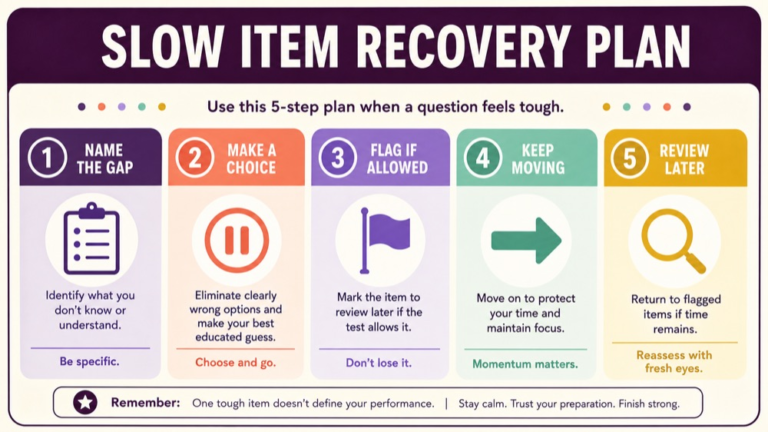
Every timed practice session should include a recovery plan. Slow items happen for different reasons, and the response should match the cause. If you spend several minutes on a concept you do not know, rereading will not create the missing knowledge. If you know the concept but cannot choose between two options, write a one-sentence comparison and look for the stem detail that separates them.
- Unknown concept: make the best supported choice, flag it if allowed, and record the topic for later study.
- Dense stem: restate the task and remove details that do not change the decision.
- Two plausible options: compare safety, sequence, fit, and evidence rather than choosing by tone.
- Emotional spike: pause briefly, breathe, and return to the task verb and decisive clue.
- Repeated rereading: set a stopping point and continue so one item does not control the whole session.
Practice the recovery plan before test day. A rule that exists only in your notes may disappear when the clock feels urgent. After each timed set, write down whether your slow items were caused by knowledge, task interpretation, evidence, comparison, or confidence. That classification gives your next study block a specific target.
Protect review time
Review time is not leftover time. It is a planned part of the session. Reserve a window only after you know how many items remain and whether any are unanswered. Review the items with a concrete reason first: a missed word, an overlooked safety detail, a misread number, or an option that needs one final comparison.
Be careful with answer changes. A second look is helpful when it adds evidence. It is less useful when it merely gives anxiety a new opportunity to replace a supported choice. For each flagged item, ask what changed in your reasoning. If nothing changed, the original decision may still be the better supported one.
The current testing interface determines which navigation or review tools are available. Learn the actual instructions at your appointment and do not assume that a feature from a practice platform behaves the same way on the live assessment.
Practice under the same constraint
Use the ETS Study Companion to select representative content areas, then schedule practice that includes both untimed learning and timed application. Untimed work helps you build accurate reasoning. Timed work shows whether the reasoning routine is efficient enough under a limit. You need both kinds of feedback.
- Complete a short untimed set and write the evidence behind each choice.
- Repeat a comparable set with a light time boundary.
- Complete a mixed-domain set so you must identify the task before applying a strategy.
- Run a full-length simulation using the current listed time and your checkpoint plan.
- Review patterns and adjust one behavior for the next session.
Keep practice questions clearly labeled as original or preparation content. Do not treat a practice score as a direct conversion to a Praxis score, and do not use claims about live or remembered items as a study method. Practice is most valuable when it strengthens a transferable decision skill.
Common pacing errors
- Using the same target seconds for every question regardless of complexity.
- Checking the clock so often that it interrupts reading and comparison.
- Spending review time on one uncertain item while other items remain unanswered.
- Skipping the task verb and answering the topic instead of the question.
- Changing answers without identifying new evidence.
- Practicing only untimed questions and discovering a pacing problem late.
- Assuming a slow item means the entire session is lost.
- Building a plan around an old timing number without checking ETS.
Replace a vague goal such as “go faster” with a measurable adjustment. For example, record the number of repeated rereads, use a two-sentence comparison for close options, or check progress at two planned points. Small observable changes are easier to review and refine.
Time-limit checklist
Before your next timed block, write down:
- What timing and question count does the current ETS page list today?
- What is my first-pass checkpoint?
- When will I check the middle of the session?
- What is my rule for a slow or unfamiliar item?
- How will I protect unanswered questions?
- Which flagged items deserve review first?
- What evidence must be present before I change an answer?
- What pacing behavior will I analyze after the set?
The practical answer to the slp praxis exam time limit is a current source check plus a flexible operating plan. Know the live constraint, practice under it, and keep your attention on the reasoning task rather than on a rigid countdown.
Sources and next steps
Verify current timing, question count, delivery, and administration details on the ETS Speech-Language Pathology Praxis 5331 page. Use the ETS Study Companion for preparation scope, and review ASHA’s Praxis information for certification context. Recheck these sources before your appointment.
Continue your preparation: Explore the SLP Study Center learning resources.