
praxis slp selected response questions are best approached as structured decisions. You are not only looking for a familiar term. You are reading a stem, identifying the problem it actually asks about, weighing the evidence, and selecting the response that fits the client, setting, goal, and professional context.
The current ETS Speech-Language Pathology Praxis 5331 page describes a computer-delivered, selected-response assessment. When this guide was checked, ETS listed 132 questions and 150 minutes, but administration details can change. Confirm the live ETS page and Study Companion before test day. The strategy below is designed to remain useful even when a number or interface detail changes.
What selected response means
Selected response is a response format, not a promise that each item tests simple memorization. A prompt may ask you to choose the best assessment step, the most appropriate treatment decision, the clearest interpretation, or the action that fits professional responsibilities. The answer choices may all sound reasonable until you connect them to the decisive detail in the stem.
Keep four layers separate while you study:
- Format: you select from the choices presented in the current testing interface.
- Content: the item may draw on speech, language, swallowing, hearing, cognition, or professional practice.
- Reasoning: you match the best choice to the evidence and the task verb.
- Boundary: you work from the current ETS scope and professional standards, not from rumors about test items.
This distinction helps explain why a large flashcard deck can still leave you unsure between two options. The missing skill may be comparison, prioritization, or interpretation rather than another isolated definition. Use the ETS Study Companion to map domains, then practice the decision behavior those domains require.
Read the stem before the options
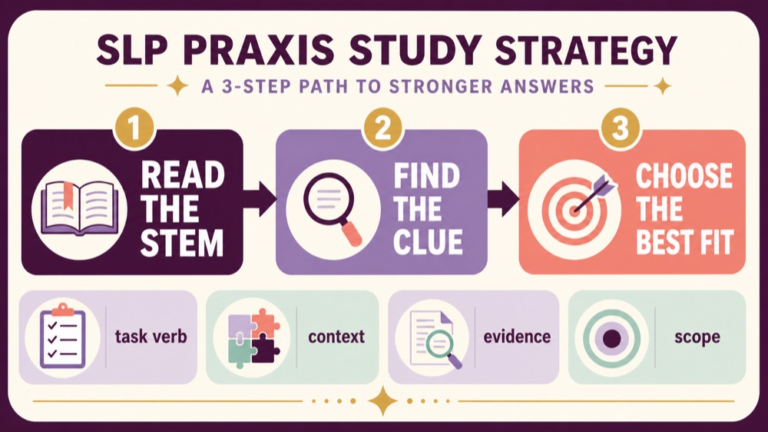
Before looking for a keyword, identify the task. Words such as best next step, most appropriate, most likely explanation, and priority create different decision rules. A question about what to do first is not the same as a question about what could eventually be included in a full plan.
Use a short stem-reading routine:
- Name the task: restate the question in plain language.
- Locate the client: note age, communication profile, medical or educational setting, and participation need.
- Mark the constraints: identify safety, consent, access, scope, time, or available-evidence limits.
- Underline the change-maker: find the fact that separates a strong option from a merely plausible one.
- Predict the direction: before reading all options, describe what a defensible response should accomplish.
Do not turn this routine into a reason to reread every sentence repeatedly. The purpose is to create a decision frame. If the stem gives a clear safety concern, that concern may carry more weight than a detail that is interesting but not action-changing. If the stem asks about a goal, keep the goal in view while you compare interventions.
| Stem signal | Question to ask | Likely reasoning move |
|---|---|---|
| First or next | What must happen before later steps? | Prioritize sequence and prerequisites. |
| Best measure | What information is needed for this decision? | Match the measure to the referral question. |
| Most appropriate goal | What functional change is supported by the profile? | Connect the goal to participation and evidence. |
| Most likely explanation | Which pattern accounts for the full set of clues? | Compare the whole pattern, not one word. |
Compare options with evidence
Once you understand the task, compare each choice against the same criteria. Avoid choosing an option because it contains the most technical language or because it resembles a sentence from your notes. A concise answer that directly solves the stated problem can be stronger than an elaborate answer that skips a prerequisite.
For each option, ask:
- Does it answer the exact task verb?
- Does it fit the client’s age, setting, and stated need?
- Does it respect safety, consent, scope, and available information?
- Does it represent a first step, an interpretation, or a later step accurately?
- Would the choice still make sense if the decisive detail were removed?
The last question is useful because distractors often survive on a broad association. If an option feels correct only because the topic reminds you of it, check whether it uses the actual evidence. A strong option usually has a clear relationship to the stem rather than a loose relationship to the general subject.
When two choices remain, write one sentence for each: “This option fits because…” and “This option falls short because…”. The comparison exposes whether you are relying on evidence or preference. It also gives you a review note that is more useful than marking an answer simply right or wrong.
Handle clinical scenarios
Clinical scenario items can combine knowledge from more than one domain. An adult with a new communication change may require attention to medical history, cognitive-communication function, participation, and referral boundaries. A child’s school-based case may require you to integrate classroom access, language demands, family priorities, and educational context. The safest study habit is to identify what information is present and what information is missing.
Use this sequence for a scenario:
- Define the concern: distinguish the reported complaint from the functional impact.
- Check the context: identify who requested help, where the service occurs, and what decisions are in scope.
- Look for risk: notice signs that call for safety action or additional evaluation before routine treatment.
- Match the evidence: connect the observed pattern to an assessment or intervention choice.
- Choose the narrowest defensible answer: avoid adding assumptions the stem does not provide.
These steps are study guidance, not a substitute for clinical supervision, local policy, or current ASHA resources. For exam preparation, the value is learning how to organize a case before selecting an option. A scenario does not require you to invent a diagnosis from one isolated clue.
Build a selected-response practice loop
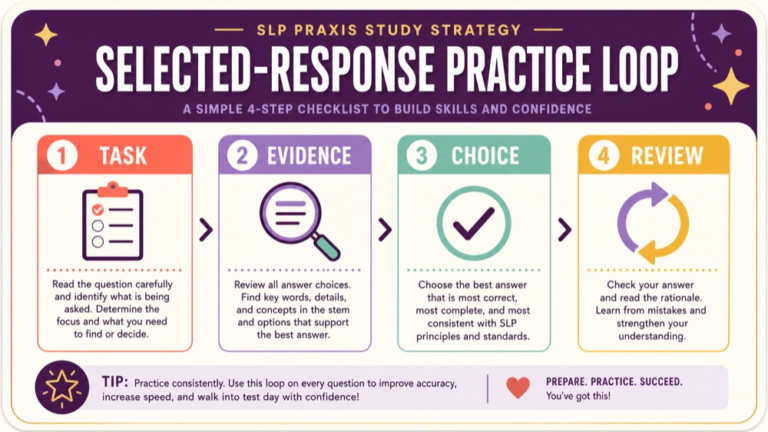
Practice works better when each item produces a reasoning record. Use the current ETS Study Companion to choose a domain, then complete a short set of original practice items. After each item, record the task verb, decisive clue, selected option, and reason the other options were weaker. This creates a feedback loop instead of a score-only routine.
- Round one, untimed: focus on identifying the task and supporting evidence.
- Round two, lightly timed: keep the same reasoning routine while reducing unnecessary rereading.
- Round three, mixed: combine domains so you must identify the topic before applying the strategy.
- Round four, review: revisit only the items whose reasoning record is incomplete or uncertain.
Label practice content honestly. Your own items and third-party preparation questions are study tools; they should not be described as live, remembered, or released test material. Review the explanation for the principle that transfers to a new scenario. If you only memorize the answer letter, the next wording change can remove the benefit.
Pace your decisions
The ETS page should control the current timing information. When this article was checked, the listed 150 minutes and 132 questions produced an average of a little more than one minute per displayed question. Treat that arithmetic as a planning reference, not a demand that every item take the same amount of time. Some stems are direct; others require a careful comparison.
Set checkpoints rather than watching the clock after every sentence. At each checkpoint, ask whether your pace is creating enough time for later review and whether you are losing time to a repeated habit. If an item is consuming attention without adding evidence, make the best supported selection, flag it when the interface permits, and continue according to the current instructions.
In practice, track three numbers: items attempted, items needing review, and minutes remaining. A slow set may reflect unfamiliar content, weak stem reading, option-comparison difficulty, or anxiety. Each cause needs a different adjustment. More content review is useful for a knowledge gap; a timed comparison drill is more useful for a pacing gap.
Common mistakes to correct
- Reading the choices first and forcing the stem to fit a preferred answer.
- Choosing the most technical-sounding option without matching the task.
- Ignoring age, setting, safety, or participation details.
- Confusing a possible later action with the best first action.
- Using one memorable association instead of the complete pattern.
- Changing a supported answer because another option sounds more familiar.
- Practicing only one domain and losing time when the topic changes.
- Using a practice percentage as a direct prediction of a Praxis result.
Correct these one at a time. For your next set, choose one behavior to observe, such as marking the task verb before reading the options. Improvement is easier to measure when the intervention is specific.
Quick review checklist
Before a selected-response study block, confirm:
- Which ETS blueprint domain am I practicing?
- What task verbs will I watch for?
- What evidence will I record after each item?
- What is my rule for a question that takes too long?
- When will I check attempted items and time remaining?
- How will I label a knowledge, task, evidence, option, or pacing gap?
- Will I review the principle rather than memorize an answer letter?
- Have I separated original practice content from claims about the live assessment?
Good preparation for praxis slp selected response questions combines current format verification with repeatable reasoning. Use the ETS page for administration facts, the Study Companion for scope, ASHA resources for professional context, and your practice log for the habits that need work.
Sources and next steps
Review the current ETS Speech-Language Pathology Praxis 5331 page for the live selected-response format, question count, timing, delivery, and administration details. Use the ETS Study Companion to organize content areas, and read ASHA’s Praxis information for certification context. Recheck current sources before your appointment.
Continue your preparation: Explore the SLP Study Center learning resources.