
praxis slp exam format is more than a question count. It includes how the test is delivered, what kind of response a test taker gives, how much time is listed, how the appointment is scheduled, and which current ETS materials define the assessment. Understanding those parts helps you choose a study method that matches the task.
This U.S.-focused guide uses the current ETS Speech-Language Pathology Praxis 5331 page and Study Companion as the authority for live exam facts. ETS can update dates, delivery options, fees, timing, or question information, so verify the current page before your appointment. The study strategies below are planning suggestions, not promises about a score.
What the Praxis SLP exam format includes
ETS currently describes the Speech-Language Pathology Praxis test as a computer-delivered selected-response assessment. The live test page currently lists 132 questions and 150 minutes, while also noting that some questions may not count toward a score. The page lists test-center and at-home delivery options when available and gives current administrative details. Treat those values as current-page facts to recheck, not permanent facts to copy forever.
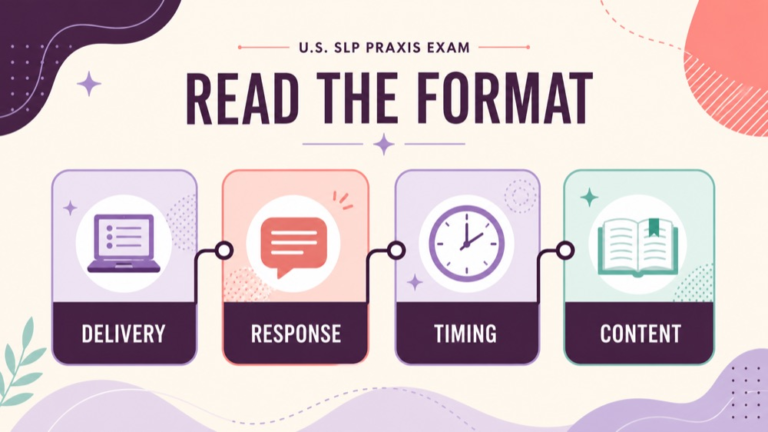
The format therefore has at least four layers:
- Delivery: where and how the computer-based appointment takes place.
- Response: how the test taker selects or enters the answer to the task.
- Timing: the listed appointment or testing time and the pace required across the assessment.
- Content: the knowledge areas and professional decisions described by current ETS materials.
These layers interact. A selected-response test still requires careful clinical reasoning. A familiar topic can take too long if you reread every option without a decision rule. A strong content outline does not remove the need to plan the appointment, interface, identification, and pacing details.
Read the format as a set of decisions
When you review the ETS page, turn each format fact into a practical question.
| Format fact | Planning question |
|---|---|
| Computer delivery | Have I practiced reading and deciding on screen rather than depending on paper-only habits? |
| Selected response | Can I identify the task, compare options, and choose the best supported response? |
| Listed timing | What pace allows me to make a reasoned decision and keep moving? |
| Test center or at-home option | Which setting can I meet under the current ETS instructions? |
| Blueprint domains | Does my study plan cover the knowledge and professional decisions described by ETS? |
| Current-page updates | Which facts must I recheck before registration and test day? |
This translation is useful because it prevents passive reading. Instead of memorizing that the test is computer delivered, practice the behaviors computer delivery requires: scrolling carefully, reading the entire stem, using the available interface features appropriately, and recording a pacing decision. Instead of memorizing a number, use the current number to plan a timed practice block.
Understand selected-response work
Selected-response questions present a task and response choices. The exact wording and item content on a live exam should not be invented or represented by a study article. Your preparation should focus on reading the construct, recognizing the evidence in the scenario, comparing each option with the question, and choosing the response that best fits the information provided.
- Identify the ask: determine whether the question requests an assessment decision, interpretation, intervention principle, professional action, or another response.
- Extract decisive evidence: mark the age, setting, communication or swallowing profile, safety issue, goal, and other details that change the answer.
- Predict the direction: state what a defensible answer should accomplish before comparing the options.
- Compare options: test each option against the stem, scope, evidence, and level of certainty.
- Choose and move: select the best-supported response, note the reasoning for later review, and continue at a controlled pace.
The goal is not to find a magic word. A response can sound clinically familiar and still fail to answer the question asked. A response can be technically possible and still be premature if the stem asks for the first step. The format rewards attention to the task as well as knowledge of the topic.
Build a pacing plan
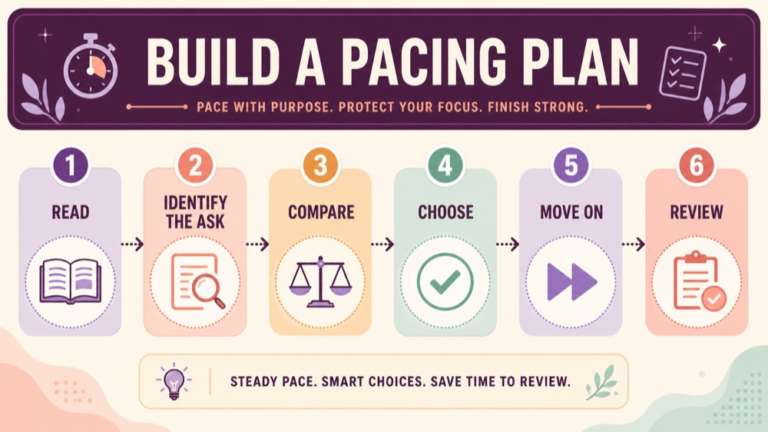
Use the current ETS timing to design practice, but avoid pretending that one pace fits every question. Some tasks will be quick; others require comparison. Your plan should include a starting pace, a checkpoint, and a recovery strategy if one item consumes too much attention.
- Starting pace: begin with a calm reading routine and do not spend the first items proving that you are fast.
- Decision checkpoint: periodically compare your progress with the current time and remaining work.
- Flag strategy: if the interface permits, mark a genuinely uncertain task and return according to the current instructions.
- Recovery rule: leave a difficult item after a reasoned attempt instead of allowing one question to control the whole session.
- Final review: reserve enough time to review flagged items and check unanswered responses if the interface allows.
Practice pacing with the same behavior you want on test day. Read on screen, explain why the best option fits, and record whether the difficulty came from knowledge, wording, distractor comparison, or time pressure. Then change one variable in the next practice block. A timed score without an error explanation is less useful than a smaller practice set with clear reasoning.
Connect format to the blueprint
The format tells you how you will work; the blueprint tells you what knowledge the exam samples. ETS materials describe foundational, professional, and specialized knowledge across the content areas of the Speech-Language Pathology test. Use the current Study Companion to map those areas to your study resources and identify the decisions you need to explain.
Build a review matrix with four columns: domain, core concept, clinical decision, and evidence for the decision. For an assessment topic, that might mean distinguishing a screening purpose from a diagnostic evaluation. For a treatment topic, it might mean matching the intervention principle to the goal, client, context, and evidence. For professional topics, it might mean identifying the responsible next step and the limit of your role.
Keep the matrix current. If the ETS blueprint or Study Companion changes, update the study plan instead of assuming an older outline remains complete. The official source controls the test description; your notes should make it easier to apply the description.
Common format mistakes
- Memorizing a question count or time value without checking the current ETS page.
- Studying definitions only and ignoring the selected-response decision task.
- Practicing only untimed items and discovering pacing pressure late.
- Spending too long on one hard question because the topic feels important.
- Using unverified claims about live or recalled exam content.
- Ignoring the difference between a test center and at-home appointment setting.
- Focusing on the format while neglecting the current ETS blueprint and Study Companion.
- Treating one practice score as a permanent prediction of test performance.
Correct these habits by linking every format fact to an action. Recheck the live page, use timed practice, explain option comparisons, and study the blueprint. The format becomes useful when it changes how you prepare.
Quick format review
Use this review before a timed study session:
- What does the current ETS page say about delivery and timing?
- What response behavior does selected-response work require?
- Which current blueprint areas need review?
- What is my reading and decision routine for each task?
- When will I check time and progress?
- What will I do if one item takes too long?
- How will I analyze errors after practice?
- Which administrative fact must I recheck before test day?
A concise explanation of the Praxis SLP exam format should include current source verification, the selected-response nature of the task, the listed timing, delivery planning, and a realistic pacing method. Keep changing facts tied to ETS, and keep study strategy tied to your own evidence.
Sources and next steps
Read the current ETS Speech-Language Pathology Praxis 5331 page and the ETS Study Companion for the live exam description and scope. For certification context, review ASHA’s Speech-Language Pathology Praxis information. Recheck timing, question count, delivery, and policies before using them for a current appointment.
Continue your preparation: Explore the SLP Study Center learning resources.