
slp praxis test dates are selected through the current ETS account rather than a universal calendar that applies to every test taker. A useful date is not simply the first open slot. It is a date that leaves enough time for preparation, fits the delivery setting, and protects the deadline by which a program, state, or certification pathway needs the score.
This U.S.-focused planning guide explains how to search live availability, compare center and at-home options, work backward from a score deadline, and review an appointment before you finalize it. Dates and policies can change, so confirm the current details in ETS before you register or change an appointment.
What test-date planning means
When students search for test dates, they are usually solving three linked problems: when they can take the exam, when they need the score, and which appointment setting is realistic. ETS controls the live appointment inventory. Your program, state, employer, or certification pathway may control the relevant score deadline. Your own schedule controls whether the selected date is workable.
Those three clocks should be written separately. A university application deadline is not the same thing as a test appointment date. A test date is not automatically the date a score becomes available. A listed opening is not useful if travel, identification, approved accommodations, or preparation time make the appointment unrealistic. Keeping the clocks separate prevents a date search from becoming false precision.
- Availability clock: which dates and locations the live ETS account shows.
- Preparation clock: how much time you need to study, practice pacing, and resolve logistics.
- Score clock: when the receiving organization needs the result and how it describes its process.
- Personal clock: school, clinical, work, health, travel, and family commitments around the appointment.
Plan backward from the score deadline
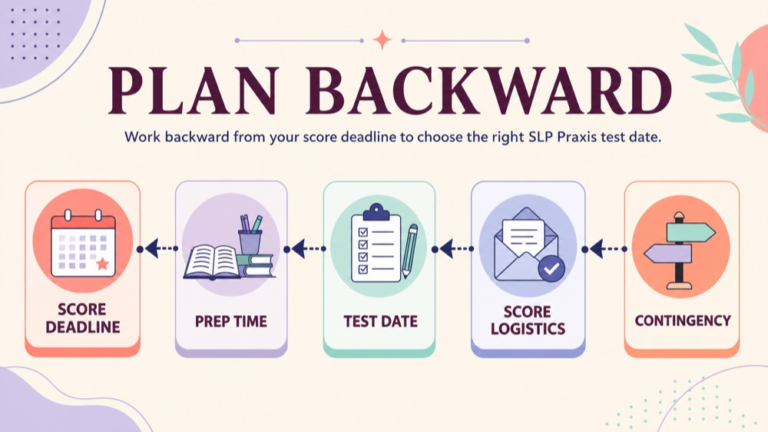
Start with the receiving organization, not the calendar grid. Identify the date by which the score must be received or documented, then work backward. Add time for registration, preparation, the appointment itself, any current ETS score-report information, and a contingency decision if the first plan changes. Do not invent a universal buffer; the right buffer depends on the specific pathway and the current information supplied by ETS and the receiving organization.
For example, a student applying to a graduate or professional pathway might need a score for a later review cycle, while another student might be aligning a score with a state or employment requirement. The word deadline can describe different events. Ask whether the organization wants a score report, a passing score, an official record, or another document, and ask which date controls.
Make a planning table before you search:
| Planning item | Write down |
|---|---|
| Receiving organization | The program, state, employer, or certification pathway that needs the result. |
| Required event | The score report, application, credential step, or documentation that must be complete. |
| Target date | The date supplied by the current receiving organization, not a guess from an old forum post. |
| Latest comfortable test date | A personal planning date that leaves room for preparation and current score logistics. |
| Preferred options | Several dates, times, locations, or delivery methods that could work. |
This table gives you a decision rule: search for an appointment that supports the required event and the preparation plan. If the dates shown do not fit, pause and clarify the deadline or contact the current ETS support channel rather than selecting a date solely because it is open.
Search live ETS availability
Use the current ETS registration path to find the Speech-Language Pathology Praxis test and search the appointment choices shown for your account. A public page can explain the process, but the live account is where you see the dates, locations, and options available for the transaction. Availability may vary by location, delivery type, and time of search.
- Sign in to the correct ETS Praxis account.
- Locate the current Speech-Language Pathology test and verify the test code.
- Review the delivery choices displayed for your registration.
- Search the locations or ZIP code relevant to your plan.
- Compare several dates rather than stopping at the first open result.
- Read the appointment summary for date, time, time zone, location, and delivery method.
- Save the confirmation after registration and set reminders for later checks.
Search strategically. If a center is unavailable, consider another authorized location only if the travel and check-in plan are realistic. If an at-home option appears, read the current requirements and decide whether your workspace, equipment, and schedule support it. Do not infer availability from another person’s screenshot. The relevant inventory is the one the current account displays.
Compare the appointment options
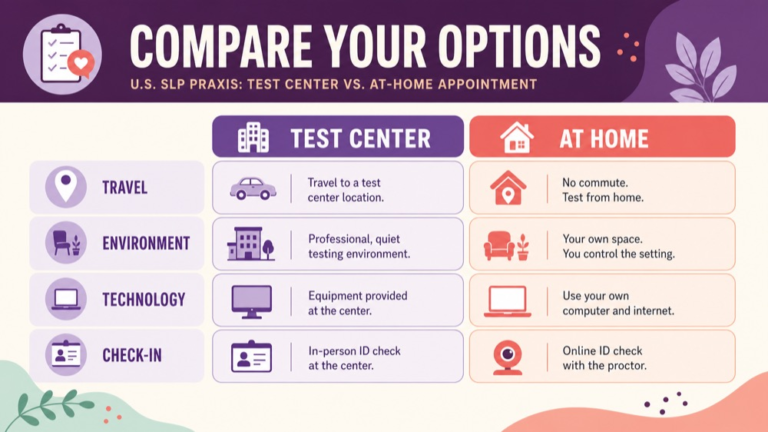
A test center and an at-home appointment can solve different logistical problems. A center may reduce the need to prepare a home testing environment but can add travel. An at-home appointment may reduce travel but place more responsibility on your room, equipment, internet connection, check-in, and environment. The correct comparison is practical, not ideological.
| Factor | Test center question | At-home question |
|---|---|---|
| Travel | Can I reach the authorized location with enough time? | Can I be ready in the approved home setting without interruptions? |
| Environment | Have I reviewed the center instructions and identification expectations? | Can my room and surrounding conditions meet current ETS rules? |
| Technology | What does the center provide and what must I bring? | Does my equipment and connection meet the current at-home requirements? |
| Schedule | Can I manage travel and check-in at the selected time? | Can I reserve the full appointment window in a controlled setting? |
| Contingency | What is my plan if travel or weather changes? | What is my plan if the home environment or technology is not ready? |
Read the current ETS instructions for the option you choose. Appointment labels, availability, and policies are not permanent content. If you need an accommodation, resolve the relevant process before treating a date as secure. A date that works on the calendar may still be a poor choice if the required support has not been confirmed.
Protect the appointment
After you register, keep the confirmation and review it again closer to the appointment. Confirm the location or at-home setting, time zone, name and identification plan, travel route or workspace, and any current check-in instruction. Keep reminders in a private calendar and do not share personal appointment details publicly.
If you need to change the date, read the current ETS appointment-management and policy information first. The ability to change, cancel, or reschedule may depend on timing and the specific transaction. Do not rely on an old rule or assume that another test’s policy applies to Praxis 5331.
Use the extra time before the appointment for focused study rather than endless date searching. Once a workable date is confirmed, build a study plan around the exam blueprint, practice pacing, and the skills you need to strengthen. The date search should serve preparation, not replace it.
Common date-planning mistakes
- Treating a public calendar or another student’s screenshot as your personal availability.
- Choosing the earliest date without checking the receiving organization’s score requirement.
- Confusing the test date with the date a score is needed.
- Ignoring time-zone, travel, check-in, or full appointment-window details.
- Choosing at-home testing without reading current environment and equipment expectations.
- Assuming a date remains available while you delay checkout.
- Forgetting to record the confirmation and set a reminder to review it.
- Changing an appointment based on an old cancellation or rescheduling rule.
These problems are preventable when you treat date planning as a small project. Write the deadline, search the live account, compare options, confirm logistics, and save the result. If a key fact is uncertain, mark it as a question and verify it through ETS or the receiving organization.
Quick date check
Before you choose an SLP Praxis test date, answer these questions:
- What organization needs the score, and what event or deadline does it specify?
- How much preparation time do I need for this exam and my current study stage?
- Which live dates and settings appear in my ETS account?
- Can I meet the center or at-home requirements for the chosen option?
- Does the date fit my school, clinical, work, travel, and personal schedule?
- Have I checked the current identification, accommodation, and appointment rules?
- Did I save the confirmation and write down the next logistics task?
- What is my evidence-based contingency if the selected plan changes?
The best date is the one you can support with current information and a realistic plan. Keep the live ETS page and the receiving organization’s instructions nearby, then move from scheduling into preparation with a clear calendar.
Sources and next steps
Verify current ETS Speech-Language Pathology Praxis 5331 information, follow the ETS registration process, and use the ETS test center search for live location and appointment information. Policies, fees, dates, and available slots can change, so confirm them in the current account before you commit.
Continue your preparation: Explore the SLP Study Center learning resources.