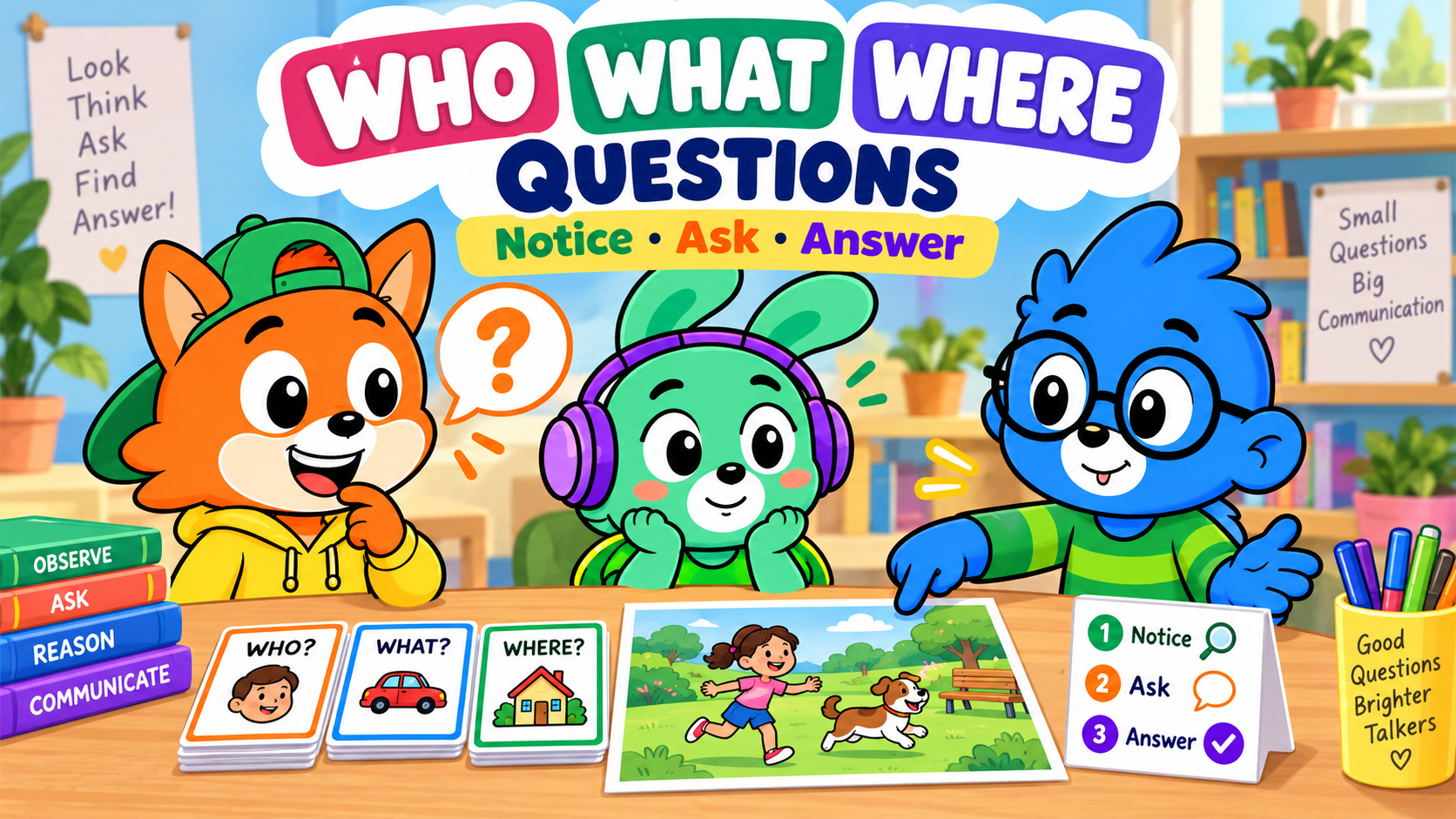
The focus phrase wh questions with pictures points to a practical planning question: how can an SLP, educator, caregiver, or student turn question words, visual supports, response formulation, comprehension, and carryover into an observable routine? A useful answer connects the target to a real person, a real context, a reasonable support level, and a way to notice change. This guide is designed to clarify the decision-making process without treating one worksheet, prompt, or score as a universal answer.
For clinical or classroom use, the goal is functional participation: choose a target that matters, make access possible, and adjust the support when the learner shows readiness. The examples below are starting points for professional judgment, not predetermined scripts. Consider the learner’s preferences, communication modes, sensory and motor access, language background, age, environment, and the response of communication partners before finalizing a plan.
Table of Contents
- What wh questions with pictures should help you decide
- Define the target before choosing a resource
- Build a routine that makes practice meaningful
- Prompts, supports, and fading
- Examples and adaptations
- Data, reflection, and carryover
- Common questions
What wh questions with pictures Should Help You Decide
Start with the communication or learning job, not the worksheet title. Define what the learner will do, where the opportunity occurs, what support is available, and what observation will guide the next session. The same resource can be appropriate for one learner and poorly matched for another. A strong plan makes the target visible without narrowing the learner’s communication to one form. It leaves room for speech, gesture, sign, writing, pictures, a speech-generating device, partner-assisted communication, or a combination of modes when those modes are available and useful.
When a team reviews wh questions with pictures, it should be able to answer several connected questions. What is the learner trying to accomplish? What does a successful opportunity look like? Which part of the task is difficult: understanding, planning, retrieving language, producing a response, accessing a system, regulating attention, or communicating with a partner? What support can be added without taking over the interaction? What information will be recorded so the next decision is based on more than memory?
Use the resource as a flexible scaffold. A visual can reduce language load, a model can demonstrate an option, a pause can create processing time, and a choice can make the first response easier. These supports are not a substitute for listening to the learner. They are ways to make participation more possible while the team learns what helps.
Define the Target Before Choosing a Resource
Start with one observable target and one meaningful context. “Improve language” is too broad to guide a session. A more useful target names an action, a situation, and the type of response that matters. For wh questions with pictures, the action may involve who is involved, what happened, where it occurred, when it happened, why it may have happened, and how a learner can explain or solve it. The final target should be written in language that every team member can recognize during an actual routine.
Write down the starting point before deciding what counts as progress. The baseline does not need to be complicated. It may be a short sample, a tally of opportunities, a note about the level of support, or a description of how the learner currently communicates the message. Include the conditions that shaped the sample, such as group size, topic familiarity, fatigue, access to materials, and whether a partner modeled language.
Separate the skill from the surface form. A learner may demonstrate the same communication purpose in several ways. A spoken answer, a selected symbol, a gesture paired with eye gaze, and a written response may each be meaningful depending on the person and task. Define the target broadly enough to respect valid communication, then record the mode and support so the team can see patterns.
Build a Routine That Makes Practice Meaningful
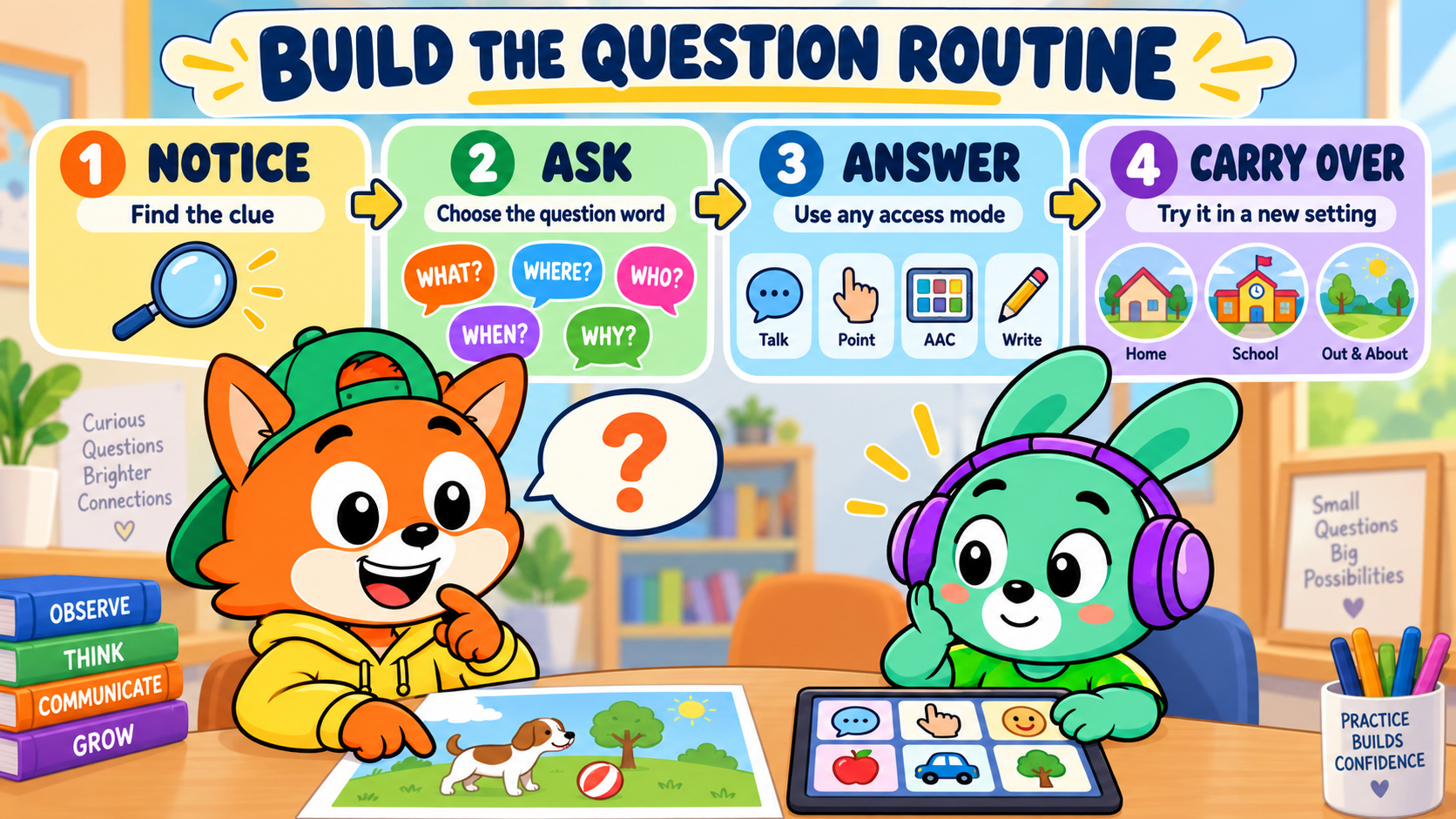
Plan the routine in a predictable sequence. Begin by previewing the purpose in plain language. Provide the materials or visual supports before the learner needs them. Model one example without requiring immediate imitation. Offer a genuine opportunity, wait long enough for processing, and respond to the learner’s message. Then repeat with a small change so the team can see whether the skill is flexible.
The activity should have a reason to communicate. For example, a closed container can create a reason to request help, a surprising picture can invite an explanation, a missing story element can create a reason to retell, and a partner’s misunderstanding can create a reason to repair. If the practice has no meaningful consequence, a correct response may tell the team less than it appears to tell.
Keep the first routine small enough to finish. A short set of well-supported opportunities can provide clearer information than a long worksheet completed after attention has faded. Adjust the number of trials, the amount of language on the page, the size of the visual field, and the amount of time between turns. Document those adjustments so a later comparison is fair.
Prompts, Supports, and Fading
Choose the least intrusive support that still makes the opportunity accessible, but do not treat independence as the only valuable outcome. A partner may need to model language, point to a visual, repeat the question, simplify the choices, or give more time. The important question is whether the support helps the learner communicate and whether the team can gradually make the routine more flexible.
Useful support decisions include:
- Offer a visual or written cue before repeating a long verbal direction.
- Model an available response without demanding that the learner copy it.
- Use a pause and an expectant look to create processing time.
- Reduce the number of choices when the display or language load is overwhelming.
- Add a partner, topic, or setting change to test whether the response carries over.
- Record the support level with the response so progress is not hidden by vague notes.
Fading should be planned as an experiment, not as a sudden removal of access. Change one condition at a time. A team might reduce a verbal cue while keeping the visual available, increase wait time before adding a prompt, or move from a model to a gesture. If performance drops sharply, restore the support and ask what the learner was communicating about the task. A support that remains available can still be a successful access feature.
Examples and Adaptations
The following examples show how to adapt the target without turning the article into a fixed script. For a younger learner, use familiar people, objects, routines, and short turns. For an older learner, use classroom content, personal interests, community situations, or self-advocacy. For a learner who uses AAC, make sure the relevant vocabulary is available before the activity starts and give partners a way to model without blocking the system.
For a beginning level, demonstrate the target and offer two meaningful options. For an emerging level, use a visual reminder and wait for the learner to initiate or complete the response. For a more independent level, change the partner, topic, or setting and ask the learner to explain, repair, or generalize the skill. Across levels, honor refusals and alternative responses so the practice does not teach compliance at the expense of communication.
Adapt the materials in more than one direction. Increase the visual support when the target is new, but reduce clutter rather than simply adding more pictures. Increase language complexity when the learner needs a richer challenge, but keep the purpose recognizable. Add a peer or family partner when the skill must transfer beyond therapy. Record which adaptation was used, because the adaptation is part of the context for the result.
Data, Reflection, and Carryover
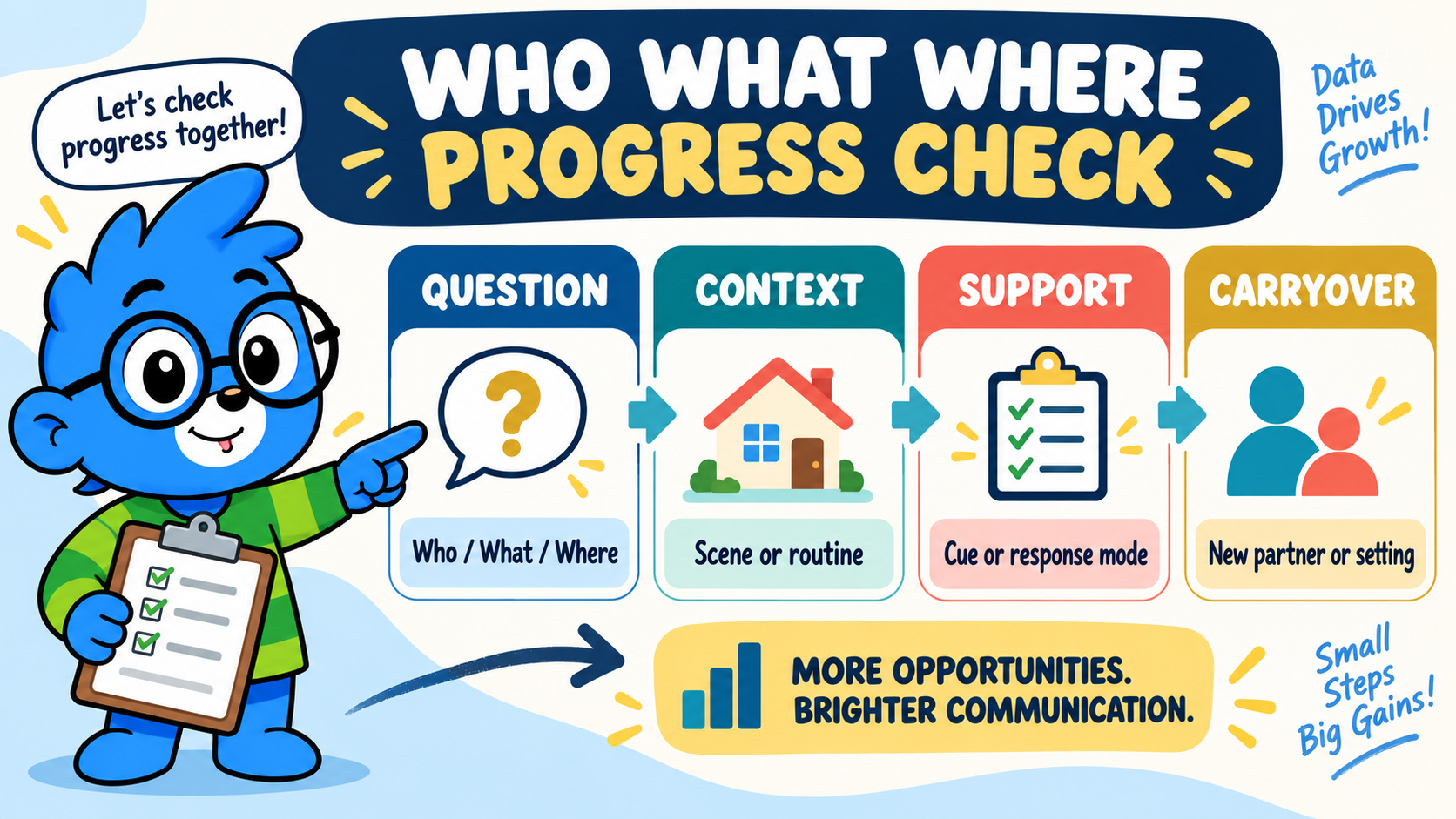
Use a small set of measures that match the target. You might record the number of opportunities, whether the learner initiated, the accuracy or completeness of the response, the communication mode, the support level, the partner’s understanding, and whether the skill appeared in a second routine. Not every session needs every measure. Choose the smallest set that can answer the current planning question.
After the activity, review the pattern rather than a single number. Ask whether the learner had enough access, whether the prompt changed the response, whether the target was meaningful, and whether the partner responded in a way that supported participation. A flat result can reflect an inaccessible task, an unfamiliar topic, insufficient processing time, or a mismatch between the goal and the learner’s priorities.
Carryover is easier when the team shares one short description of the target and one partner response. Send home a plain-language example, add the visual to the routine where it matters, or invite the classroom team to record one comparable opportunity. The purpose is not to create identical sessions. It is to learn whether the learner can use the skill with different people, materials, and purposes.
Common Questions
How much support should be included?
Include enough support to make the opportunity accessible and meaningful, then describe it precisely. “With prompts” does not tell the next team member whether the prompt was a model, a choice, a gesture, a repetition, or extra wait time. A clear note makes it easier to compare opportunities and decide what to try next.
How can a team avoid over-practicing one response?
Vary the context, partner, material, and communication mode while keeping the target function recognizable. If the learner uses a different but effective response, record it and respond to the message. Flexibility is part of real communication and may be more useful than producing one memorized form.
What should happen when progress is inconsistent?
Look at the conditions around the response. Compare access, topic familiarity, partner behavior, sensory load, processing time, and support level. Then change one condition and collect another small sample. Inconsistency is information that can guide a better match between the target and the routine.
Which sources should guide professional decisions?
Use current professional guidance, the learner’s own preferences and observations, family and team input, and data collected in meaningful routines. The ASHA Practice Portal provides topic-specific professional information; exam candidates should also consult the ETS Praxis information for current published testing details. Local policy and individual assessment still matter.
A Simple Next-Step Checklist
Before the next session or planning meeting, confirm the following:
- The focus is stated as an observable action in a meaningful context.
- The learner has access to the materials, vocabulary, and communication modes needed.
- The partner knows how to model, wait, respond, and honor a refusal or repair.
- The team has chosen a small set of measures that match the target.
- The next adaptation is specific enough to test and document.
- The same skill can be invited in at least one routine outside the original activity.
WH Questions With Pictures is most useful when it supports a clear decision rather than becoming a destination by itself. Start with the learner’s purpose, make the routine accessible, observe the response, and use the pattern to choose the next support. That process keeps the work practical, respectful, and connected to participation.