
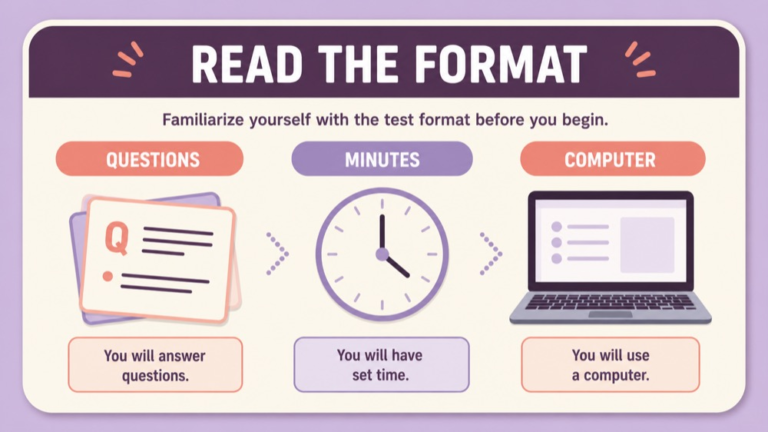
When learners ask about praxis speech language pathology exam length, they usually need two answers: what the current ETS listing says, and how to use that information without turning the test into a frantic stopwatch exercise. ETS currently lists Speech-Language Pathology 5331 as a computer-delivered test with 132 selected-response questions and a 150-minute test length. Those details create a useful planning frame, but the live ETS page and your appointment instructions remain the authority for current administration.
Table of Contents
- Read the Current ETS Format Carefully
- Turn the Numbers Into Planning Math
- Use a Repeatable Question Workflow
- Build Checkpoints Without Creating Panic
- Separate Testing Time From Appointment Procedures
- Rehearse the Same Length You Will Manage
- A Practical Answer to “How Long Is It?”
Exam length is not only a number. It affects how you read a case, how long you can investigate one uncertain option, when you mark an item, and how much review margin you want. It also interacts with the test interface, check-in, approved accommodations, and any instructions that apply to your appointment. The goal is a flexible plan that protects careful reasoning while preventing one difficult item from consuming the session.
Read the Current ETS Format Carefully
The current ETS 5331 page lists three facts that belong together: 132 questions, selected-response format, and 150 minutes. It also identifies computer delivery. The 150 minutes refers to the listed test length, not necessarily every minute you spend traveling, checking in, reading instructions, or completing provider procedures. Treat the appointment as a larger event and the testing clock as the part you rehearse for.
ETS also notes that the test may contain questions that do not count toward the score. That is one reason not to try to reverse-engineer a score from the visible number of items or to decide that an unfamiliar question must be a trick. Answer the item using the information provided, follow the interface directions, and keep moving according to your pacing plan.
The ETS Study Companion adds useful context for computer testing. It explains that test takers can learn how to answer questions, skip questions, and return to skipped questions before testing time begins. Use that orientation as a chance to remove interface uncertainty. Your practice should include reading a question on screen, selecting an answer, marking a question when the platform allows it, and returning without losing the main task.
- Current listed question count: 132 selected-response questions.
- Current listed test length: 150 minutes.
- Current listed delivery: computer delivered.
- Current question type: selected response, with the test instructions controlling navigation.
- Current caution: some questions may not count toward the score.
- Current authority: the live ETS 5331 page and your appointment instructions.
Turn the Numbers Into Planning Math
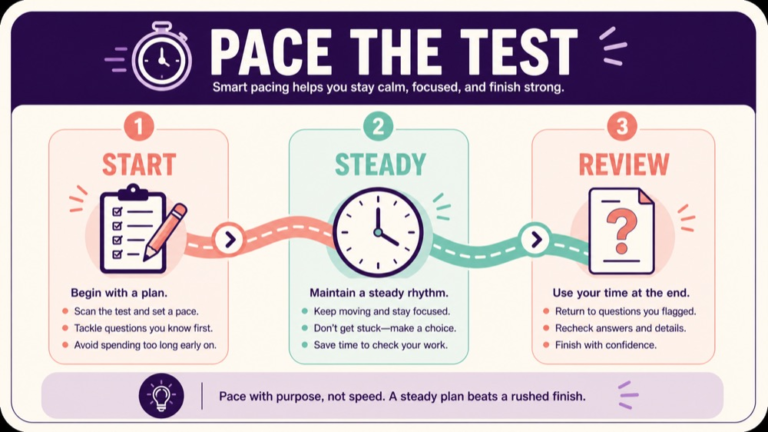
A simple division gives 150 minutes divided by 132 questions, or about 1.14 minutes per question—roughly 68 seconds. This is an average planning figure, not an official time limit assigned to each item. Some questions will be quick; others may require a careful read of a clinical or professional-practice scenario. The value of the math is that it gives you a warning sign: if one question has absorbed several average intervals, mark it and protect the rest of the test.
Do not force every question into the same time box. A short definition may need only a few seconds after you recognize the concept. A case-based question may deserve more reading time because the population, setting, safety issue, or scope boundary changes the best answer. Your plan should allow that variation while using checkpoints to prevent drift.
One practical method is a three-pass rhythm:
- Pass one: answer items for which the stem and options support a clear decision.
- Pass two: return to marked items and use focused comparison rather than starting the whole problem over.
- Pass three: scan for unanswered items, misread words, and avoidable selection errors.
The passes do not need to be equal in length. They are a mental model for moving forward, returning with purpose, and protecting a final check. If the interface uses a different navigation design or gives different instructions, follow the provider’s directions.
Use a Repeatable Question Workflow
Pacing improves when your reasoning has a stable order. Before looking for the attractive option, identify the task. Is the question asking for an assessment choice, an intervention priority, a professional responsibility, a definition, an interpretation, or the best next step? Then identify the population, setting, evidence, and constraints. Finally, compare the options against the task rather than against the most familiar phrase.
For SLP content, the same fact can lead to different actions depending on age, communication profile, medical status, participation goal, environment, and safety. A fast answer that skips those modifiers may be less useful than a slightly slower answer that reads the whole stem. Conversely, a long internal debate over an option unsupported by the stem is a pacing leak.
Use a short reset when you notice that you are rereading without gaining information. Put the question into your own words, cross out options that conflict with the stem, and choose the remaining answer that best matches the requested task. If two options remain plausible, note the distinction that separates them and move forward if the platform permits a later review.
- Read the final question sentence so you know the decision being requested.
- Underline mentally the population, setting, and time frame.
- Look for safety, ethics, scope, and evidence modifiers.
- Eliminate an option that answers a different question than the one asked.
- Prefer the option supported by the complete stem, not one isolated keyword.
- Mark uncertainty with a reason, such as “definition” or “best next step.”
- Return to marked items with fresh comparison rather than emotional replay.
- Use the final minutes to check completion and wording, not to invent new facts.
Build Checkpoints Without Creating Panic
Checkpoints should be broad. You might check after a meaningful group of items whether your pace is steady, whether too many questions are marked, and whether you have preserved review time. Avoid setting a rigid emotional rule such as “I must be at exactly this number.” The test contains different item types, and your reading speed will vary.
If you are moving slowly, make a deliberate adjustment. Shorten the next few item decisions, avoid rewriting the stem in your head, and mark only questions where a later return has a clear purpose. If you are moving quickly, use that margin to check whether you missed a negative word, selected an option before reading all choices, or overlooked a setting detail.
Practice this adjustment before test day. Take mixed-domain sets under a timer, then label each miss: knowledge gap, interpretation, careless reading, or time pressure. A learner who repeatedly loses time to long stems needs a different intervention from a learner who knows the content but changes correct answers without evidence. Use the label to choose the next practice action.
Separate Testing Time From Appointment Procedures
Do not assume that travel, identity verification, security procedures, tutorials, breaks, or accommodation arrangements are identical across delivery methods or centers. The current ETS listing and appointment instructions control your situation. Ask the provider before test day if you need a precise answer about breaks, food, water, personal items, or the effect of an approved accommodation on timing.
For a test-center appointment, plan your route and arrival buffer separately from the 150-minute testing figure. The ETS Study Companion describes proper identification at the center and an opportunity to learn the computer interface before testing time begins. Treat that orientation as preparation, not as a reason to arrive at the last possible minute. For an at-home appointment, verify the current equipment and room requirements in the instructions attached to your registration.
- Confirm the delivery method in the live appointment record.
- Read the current check-in and identification directions.
- Verify how approved accommodations affect your appointment.
- Ask about breaks and permitted items when the policy is unclear.
- Plan travel or room setup as a separate task from question pacing.
- Keep the provider’s support route available before the session.
Rehearse the Same Length You Will Manage
Use at least one practice session to rehearse sustained attention rather than only short quizzes. The point is not to predict your score. It is to learn how your attention changes, where you spend too long, and how you recover after a difficult item. Use the current ETS Study Companion for topic and format context, and use practice materials that clearly identify themselves as practice.
After the session, review the process before reviewing every answer. Record the time at which you began rushing, how many items you marked, whether you used the interface comfortably, and which question types caused slowdowns. Then review the content. A pacing problem may improve through a shorter decision routine, while a knowledge gap needs targeted learning and spaced retrieval.
In the final week, reduce novelty. Rehearse the first five minutes, your mark-and-return rule, your checkpoint language, and your final review. Make the test-day plan boring enough to follow under stress. If the live ETS page changes, update the plan to match the current instructions rather than protecting an old routine.
A Practical Answer to “How Long Is It?”
The current published frame is 132 selected-response questions in 150 minutes for the computer-delivered 5331 test. The practical answer is to average a little over a minute per question while preserving flexibility for reading-intensive items and a return pass. Keep the administrative event separate from the testing clock, verify current instructions, and practice a workflow that lets you make a reasoned decision, mark strategically, and continue.
For current facts, read the ETS Speech-Language Pathology 5331 listing and the ETS Study Companion. For credential context, review the ASHA Praxis exam guidance. For a structured preparation path, explore SLP Study Center preparation resources and adapt the schedule to your own coursework and practice evidence.