
Praxis for SLP candidates is easier to organize when preparation has three parts: verify the current official requirements, map the exam content, and practice making decisions in clinical scenarios. A long list of notes can feel productive while leaving gaps in retrieval, prioritization, or reading the question’s actual task.
This guide gives SLP students and candidates a practical preparation framework. It explains what to verify, how to organize the blueprint, how to review practice-question errors, and how to plan the final period. Use the official ETS Speech-Language Pathology test page, current study companion, and ASHA Praxis information as the sources of truth for changing exam details.
Table of Contents
- Verify the current requirements first
- Turn the blueprint into a study map
- Use a repeatable practice cycle
- Review questions by reasoning error
- Prepare for timing and test day
- Frequently asked questions
Verify the Current Requirements First
Before choosing a study schedule, write down which requirement you are trying to meet. A graduate student preparing for a first attempt may need broad coverage. A repeat candidate may need a plan based on missed reasoning steps. A candidate working toward certification may also need to track score reporting, application timing, or a separate state requirement.
Use a requirements checklist:
- confirm the current test name and code on the ETS page;
- read the current timing, delivery, scheduling, and identification information;
- check the score requirement with the authority receiving your score;
- review accommodation and accessibility information early;
- download the current ETS study companion; and
- record the date you checked each official source.
Current details can change, so avoid treating an old outline or social-media summary as the final authority. The ASHA overview of the Speech-Language Pathology Praxis exam explains the exam’s relationship to ASHA certification, while state boards and programs may publish additional requirements.
Turn the Blueprint Into a Study Map
Use the current study companion to create a map with four columns: topic, confidence, evidence, and next action. “I have seen this in class” is background information. Evidence might be explaining the concept without notes, applying it to a new case, or comparing two plausible clinical choices.
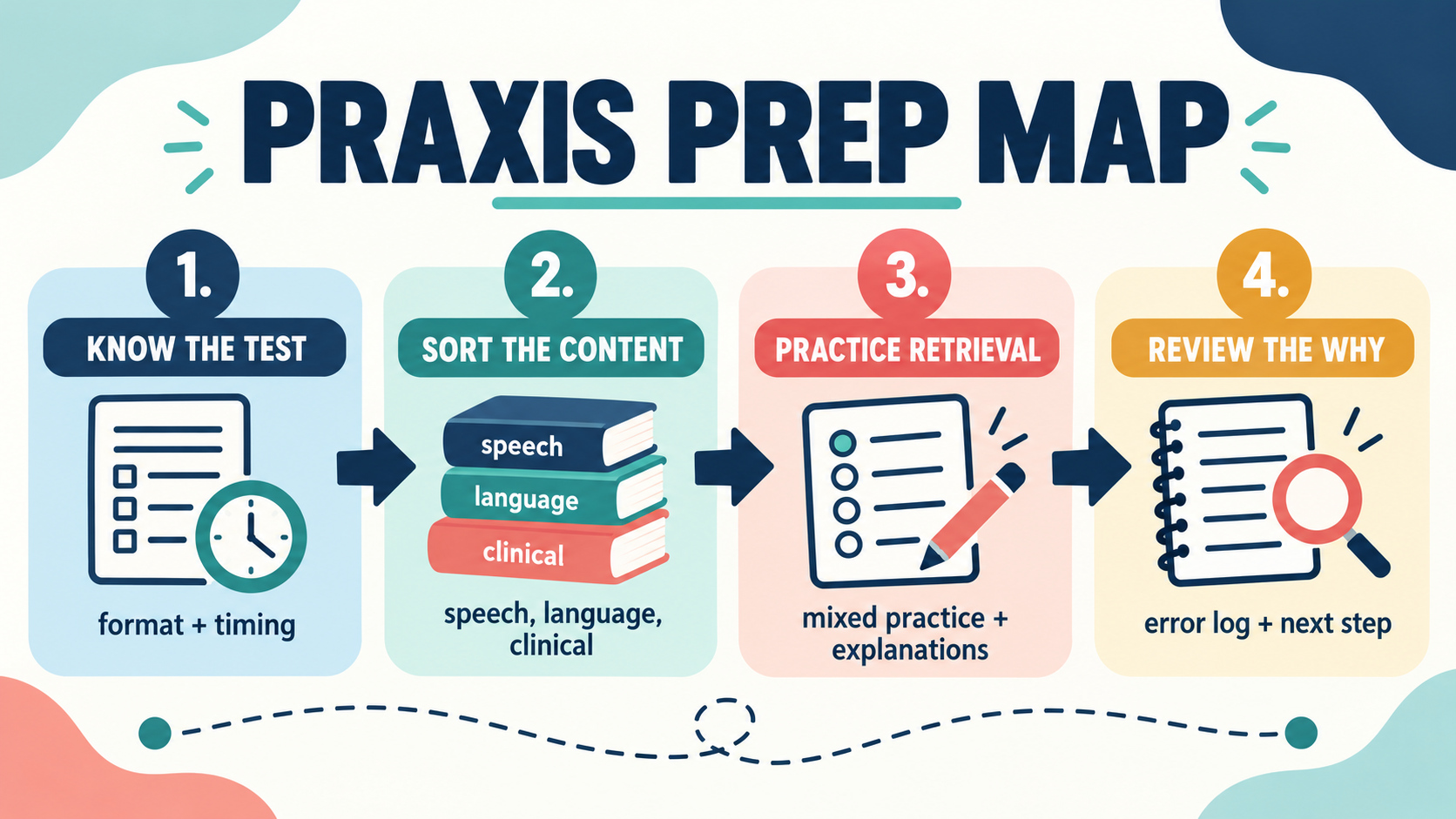
Include the major areas named in the current outline, such as professional practice, foundations, screening, assessment, evaluation, diagnosis, treatment planning, implementation, and treatment evaluation. Organize practice areas that may include speech sound production, fluency, voice and resonance, motor speech, receptive and expressive language, social communication, cognitive communication, AAC, hearing, and feeding or swallowing.
Do not turn the map into a giant notebook. For each topic, write one concise explanation, one important distinction, one example, and one question that would show whether you can use the idea. Mark a topic as developing when you recognize the vocabulary but cannot explain the clinical decision it supports.
The map should also reflect the time you actually have. A plan built around uninterrupted three-hour sessions may not work during clinic, work, or family responsibilities. Short repeated sessions with a clear action can produce better information about what still needs attention.
Use a Repeatable Practice Cycle
Use three passes, each with a different purpose. During the first pass, orient to the official outline and identify unfamiliar concepts. During the second, apply ideas to mixed questions and short cases. During the third, stabilize the reasoning by revisiting errors and practicing under a reasonable time boundary.
One study session can follow this pattern:
- recall a few concepts without opening the notes;
- answer a short mixed set;
- identify the task, client, context, and evidence in each item;
- explain why the best option fits and why alternatives do not; and
- write the next review action before ending the session.
Mixing topics after the initial orientation helps you practice switching from assessment to treatment, ethics, professional practice, or a specific disorder area. Keep the session short enough that you can repeat it and varied enough that you are not only recognizing the same examples.
For a weekly rotation, assign one block to foundations and professional practice, one to assessment and diagnosis, one to treatment planning and implementation, and one to mixed practice. Use the remaining time for error review and a short transfer exercise in which you explain a concept without notes. This rotation keeps familiar material in view while giving weaker areas a defined place on the calendar.
Review Questions by Reasoning Error
Record more than right or wrong. Tag an error as a content gap, missed cue, reasoning gap, wording issue, priority error, confidence change, or a testing-condition issue such as fatigue or timing. Each tag points to a different next action.
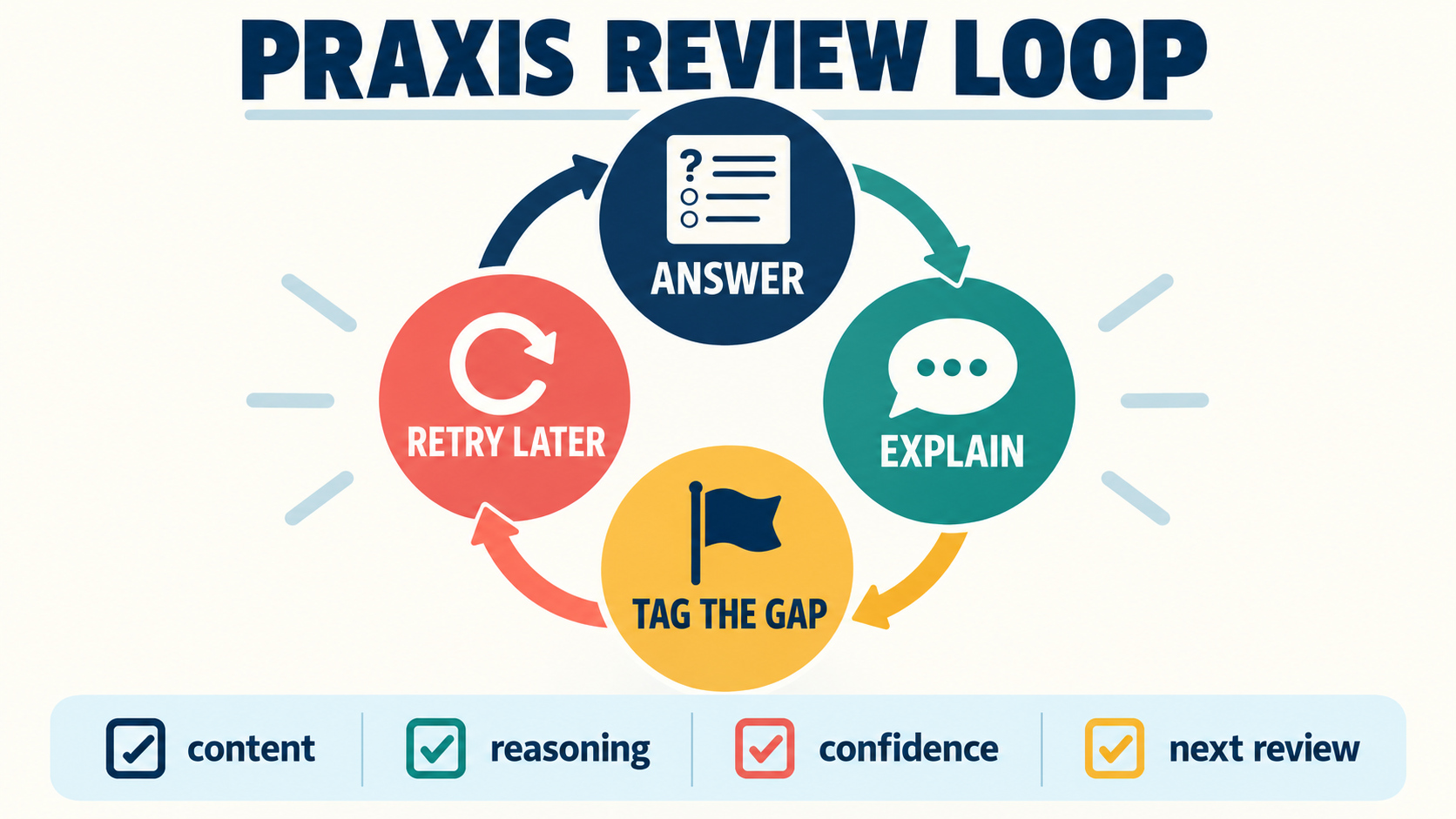
For a content gap, return to the current outline or a trusted source and write a short explanation. For a missed cue, underline the detail that should have changed the decision. For a reasoning gap, compare two plausible answers and state which evidence makes one more appropriate. For a wording issue, practice slowing at terms such as first, best, most appropriate, except, or least likely.
Review guessed answers too. A correct guess can still reveal that the explanation is weak or confidence is unstable. Cover the answer, make the decision, name the evidence, and then compare your reasoning with the explanation. Copying a long rationale without reconstructing the decision does not show whether you can use it on a new item.
Look for patterns across several sessions. If most errors are content gaps, schedule focused review. If most are priority errors, practice identifying the purpose and timing of the question before reading every option. If fatigue or time pressure dominates, adjust study conditions before replacing your entire content plan.
Prepare for Timing and Test Day
During the final period, reduce new resources. Use the current ETS materials, your error log, and short explanations of high-priority gaps. Recheck official pages early enough that registration, identification, travel, technology, or accommodation questions do not compete with the final content review.
Use a final practical checklist:
- confirm the appointment, delivery setting, and check-in instructions;
- recheck the official test and score-requirement pages;
- review recurring error patterns instead of every note;
- complete manageable mixed sets without making every session a full test;
- prepare permitted items and accessibility supports; and
- protect sleep, food, hydration, and a realistic transition into the session.
During the exam, follow the current testing instructions and review rules. If an item is taking too long, choose the best-supported answer, mark it when allowed, and return with a specific reason for review. Keep attention on the evidence in the item rather than inferring what an earlier question means for the next one.
Frequently Asked Questions
What does “Praxis for SLP” refer to?
It commonly refers to preparation for the ETS Speech-Language Pathology Praxis exam. Verify the current test code, test details, and requirements on the official ETS page before registering or scheduling.
How should I study if I keep missing different topics?
Use mixed practice and tag each error instead of restarting the entire review. Identify whether the pattern reflects unfamiliar content, a missed cue, a reasoning step, wording, priorities, confidence, or testing conditions, then match the next study action to that pattern.
Should I study one topic at a time?
Focused review can help when a concept is unfamiliar. After orientation, mixed retrieval is useful because the exam can shift between content areas and decision types. Keep a rotation that includes foundations, assessment, treatment, and professional practice.
How do I use practice scores?
Treat each score as one sample under one set of questions and conditions. Compare several sessions, review the reason for each error, and look for changes in reasoning and transfer. The useful result is a specific next action, not a broad prediction from one number.
Praxis for SLP candidates can be prepared for with a repeatable loop: verify current requirements, map the blueprint, retrieve across mixed topics, explain the reasoning, tag the gap, and revisit it under a new condition.