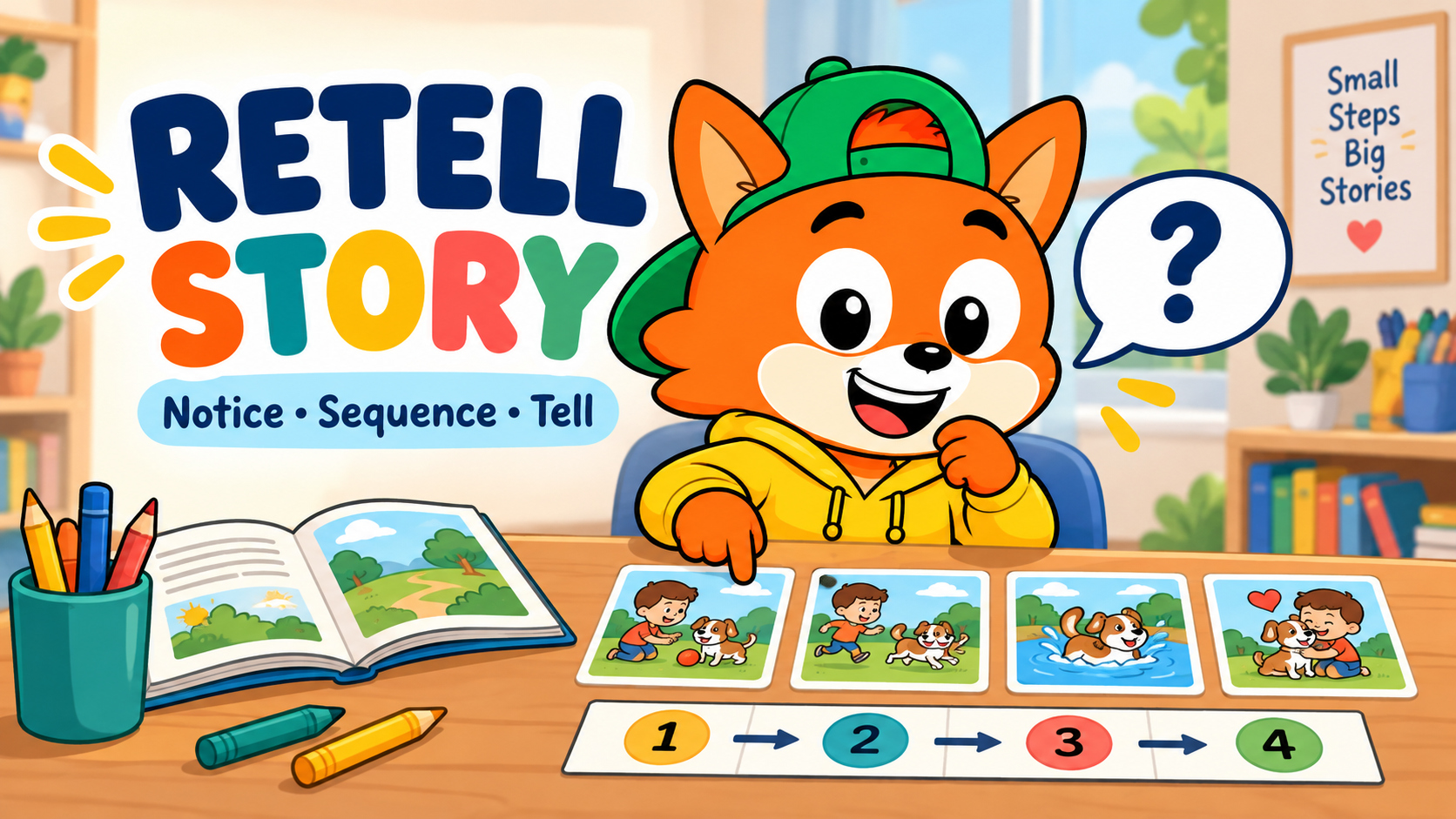
When a learner needs to retell the story, the goal is not to repeat every sentence from memory. The learner is communicating the important people, events, problem, action, outcome, or perspective in an order a listener can follow. The retell may be spoken, signed, written, selected on AAC, drawn, pointed, or expressed through several modes together.
This guide focuses on making story retell understandable to a listener. It includes setup, a flexible routine, prompts, examples, differentiation, data ideas, and transfer. Individual goals should be coordinated with the qualified SLP and team. The ASHA Practice Portal provides broader context for functional, individualized language support.
Table of Contents
- What makes a retell listener-friendly
- Choose the story and the communication purpose
- Use a notice-order-tell-check routine
- Prompt the missing relationship instead of supplying the answer
- Adapt the retell for different learners
- Record progress and plan transfer
- Frequently asked questions
What Makes a Retell Listener-Friendly
A listener needs enough information to understand who or what the story is about, what changed, and how the event connects. The exact amount of detail depends on the listener, topic, setting, and purpose. A short retell of a routine may need three actions, while a classroom discussion may require a problem, evidence, and outcome.
Story retell can involve several related skills:
- selecting the events that matter for the listener;
- arranging events in a logical or chronological order;
- connecting actions with time, cause, result, or perspective;
- communicating through an accessible mode;
- noticing when the listener needs more information; and
- repairing or revising the message when the story changes.
Do not score every missing story element as the same problem. A learner may understand the story but need help organizing the message. Another may sequence the events but need access to vocabulary or AAC. A third may include many details but need a listener-focused routine to make the sequence clear.
Choose the Story and the Communication Purpose
Choose a familiar story, personal event, play sequence, or shared routine with a reason to tell it. A three-scene picture sequence can support an introduction, while an older learner may retell a classroom event, community activity, short chapter, work task, or personal experience. Age-respectful content keeps the skill connected to participation.
Decide who needs to hear the retell. The listener might be a caregiver who did not attend the event, a peer joining a game, a teacher checking understanding, or a partner who needs to follow a procedure. A real listener changes how much context and detail the learner needs to provide.
Preview access before the full retell. The learner may handle objects, review scenes, read short notes, listen to an audio version, use a story map, arrange symbols, or access relevant AAC vocabulary. Previewing the format supports the message without giving away every sentence.
Before starting, define:
- the event or story and its reason for being told;
- the important people, actions, problem, or outcome;
- the response modes and access supports available;
- the prompt hierarchy and wait time; and
- what observation will guide the next retell.
Use a Notice-Order-Tell-Check Routine
A predictable routine provides a path through the story while leaving room for the learner’s own details and wording. Keep the broad steps stable, then change one condition at a time: partner, topic, number of scenes, visual support, or communication purpose.
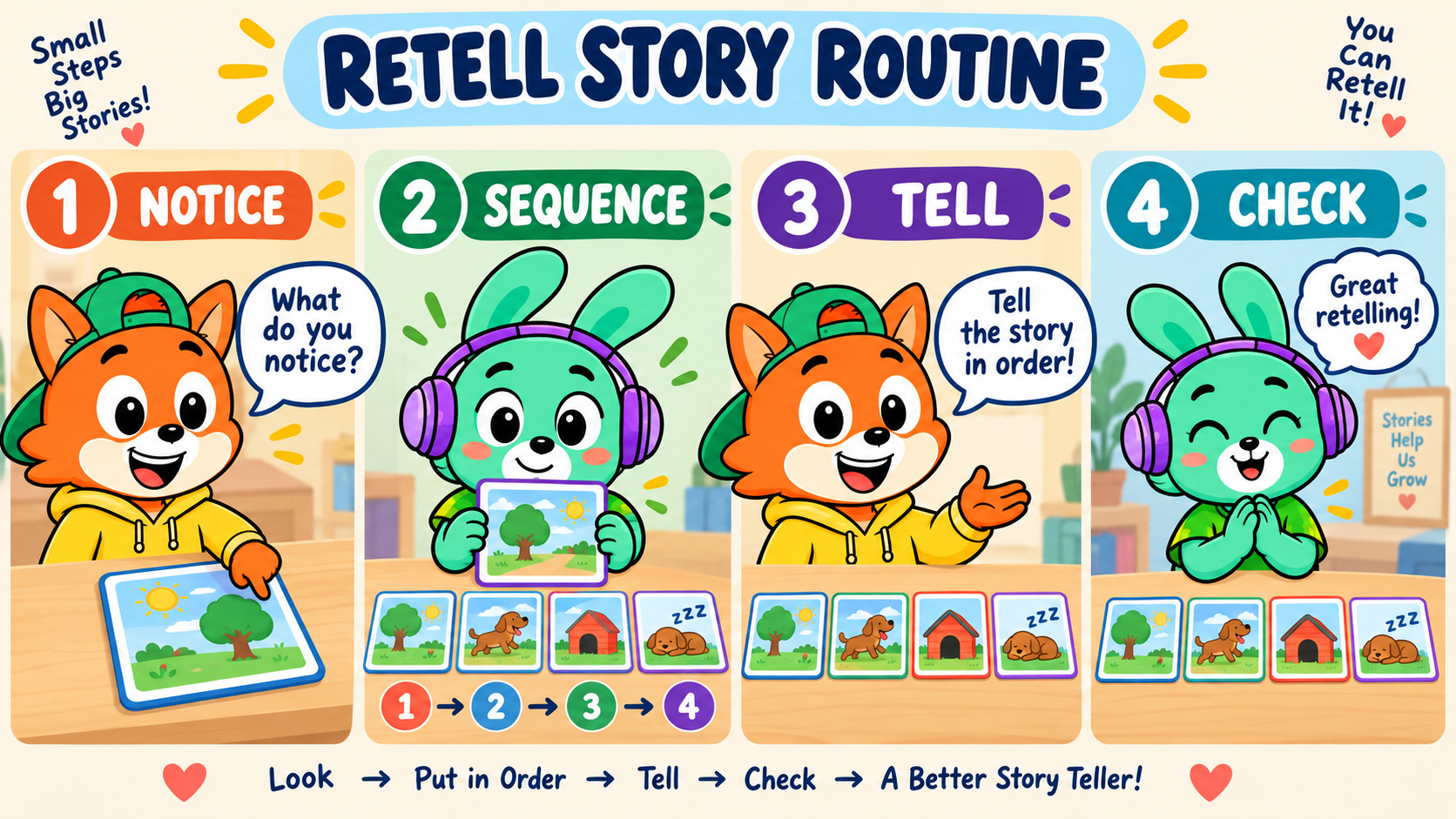
Notice: Identify who, where, what happened, and which detail may matter to the listener. The learner can look, point, select, gesture, or describe one event. The goal is relevant attention, not naming every picture.
Order: Arrange the events or ideas in a sequence that makes sense. Use first, next, then, last, arrows, numbered scenes, or a beginning-middle-end frame. If the learner uses AAC or pictures, allow arranging and selecting before expecting a spoken explanation.
Tell: Communicate the retell to the listener. The learner may use a sentence, several messages, an AAC sequence, a signed explanation, written notes, a drawing, or a combination. Model a connection when needed, then leave room for the learner to choose the details.
Check: Give the learner a way to notice whether the listener understood. The learner might add a missing detail, answer a clarification question, repair the sequence, or ask what the listener needs to know.
Repeat the routine with a new listener or a small change in the story. If the learner has relied on a visual sequence, remove one support only when the learner still has an accessible route to the message. The purpose is flexible communication, not a test of memory without supports.
Prompt the Missing Relationship Instead of Supplying the Answer
Prompt the relationship the learner is trying to communicate. If the order is unclear, point to the sequence. If the listener needs context, ask what information is missing. If the learner has a detail but no connection, model a short link such as because, then, after, or so.
Useful prompts include:
- “What does your listener need to know first?”
- “Which event happened next?”
- “What changed after that action?”
- “Why does this detail matter in the story?”
- “How could you show or say that another way?”
- “What could you add so your partner can follow?”
Avoid repeating a leading question until the learner guesses the adult’s answer. An unexpected interpretation may reflect a different perspective, unclear material, a missing access support, or a meaningful detail that the adult did not plan to score. Acknowledge it, clarify the purpose, and adjust the task before drawing a broad conclusion.
Wait time matters. A pause gives the learner time to look, plan, navigate a communication system, and decide which detail to include. Rapid prompts can make the retell appear more dependent than it is and can replace the learner’s opportunity to own the message.
Adapt the Retell for Different Learners
For early communicators, use familiar routines, objects, and two- or three-event sequences. Accept looking, reaching, gesture, symbol selection, vocalization, signs, or words as meaningful contributions when they communicate an event or choice. Model one link at a time and repeat the routine across daily activities.
For preschool and early school-age learners, use shared books, picture scenes, play sequences, and personal events. Practice first, next, and last with visible support, then add a problem, action, feeling, or outcome when the learner has an accessible response route.
For school-age learners, increase the need for key details, cohesive links, perspective, and listener knowledge. Ask the learner to retell to someone who did not share the story, compare two versions, or explain why an event mattered. Brief notes, icons, or a self-generated organizer can gradually replace dense picture support when that change improves participation.
For adolescents and adults, use age-respectful contexts such as a work task, appointment, community event, personal experience, or problem-solving sequence. A retell can support a handoff, incident report, classroom explanation, or self-advocacy message. Do not make the activity childish simply because it involves sequencing.
For multilingual learners and multimodal communicators, consider the languages and modes used in real life. A learner may understand the event while still developing the language of the activity. Provide the response route that gives access to the message, and coordinate interpretation with the broader team.
Record Progress and Plan Transfer
Data should describe the retell and the conditions around it. Record the event, listener, sequence, key details, response mode, prompt, access support, listener understanding, and repair. A percentage without the story, partner, and support can hide a major change in task demand.
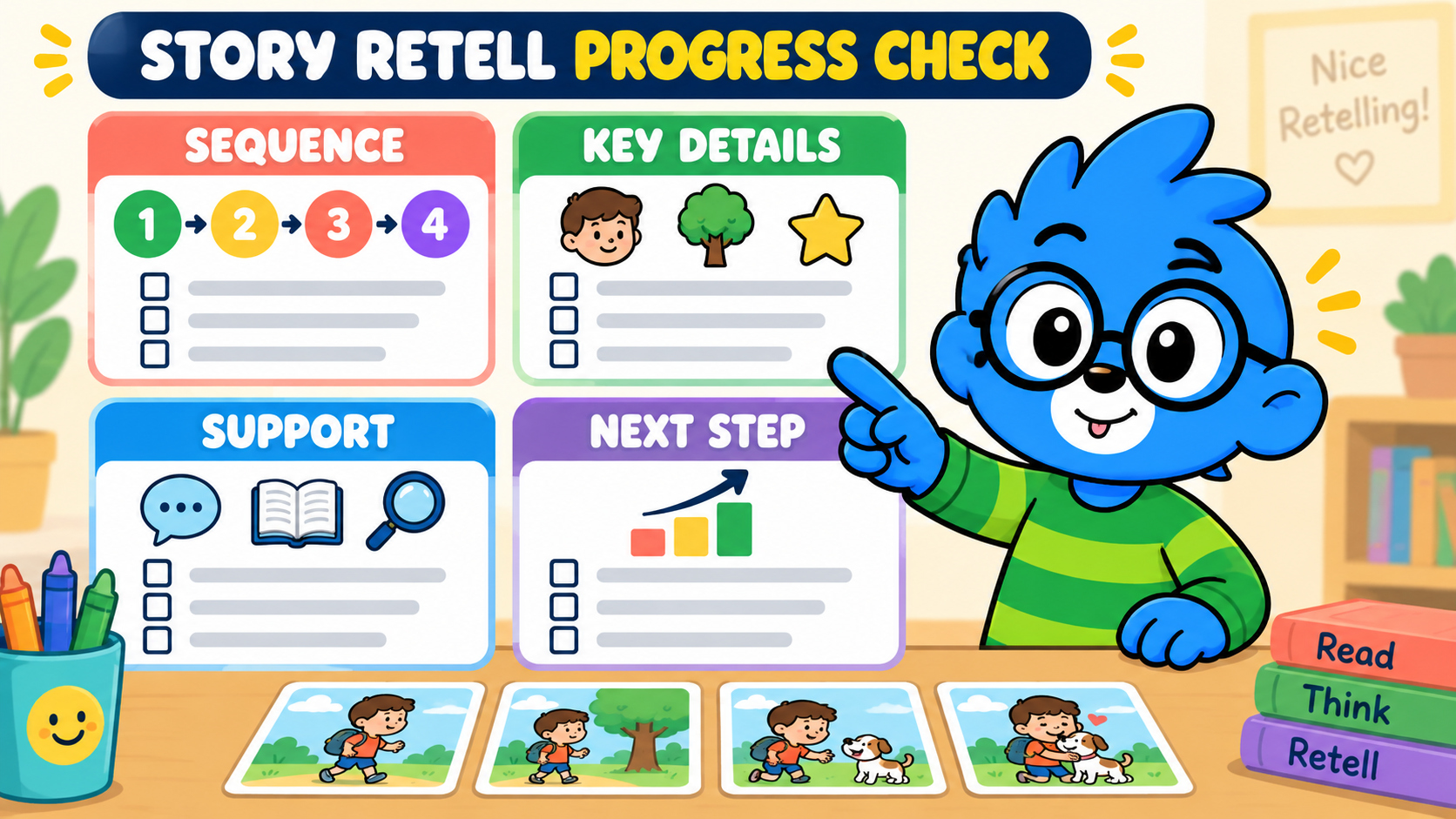
Possible review fields include:
- events or story parts communicated;
- important details included or omitted;
- response mode and message clarity;
- prompt level, wait time, and visual support;
- listener understanding or need for repair;
- partner, setting, and story variation; and
- the next support or variation to try.
Review patterns across more than one story when possible. If sequence is strong but key context is missing, keep the order support and add one listener-focused detail cue. If details are rich but the order is difficult to follow, return to a visual sequence frame. If the learner retells with a familiar partner but not a new one, vary the partner gradually while keeping the routine predictable.
Carryover works best when the learner has a reason to tell someone who does not already know the event. Ask the learner to report what happened, explain how to repeat a routine, share a personal experience, or repair a message after the listener asks for clarification. Keep access supports available while changing one context at a time.
Frequently Asked Questions
Does retelling the story have to be spoken?
No. A retell can use speech, AAC, sign, gesture, writing, drawing, pointing, pictures, or a combination. The response mode should match the learner’s access and the listener’s communication purpose.
How many story parts should I teach?
Start with the smallest set that lets the listener understand the event. Add setting, problem, action, feeling, outcome, or evaluation when those details are meaningful for the story and purpose.
How do I support a learner who labels pictures but does not retell?
Add a listener and a reason to communicate, then connect two events with a visible sequence. Model a short link, pause, and accept a multimodal contribution before adding more details.
How can I measure retell progress?
Track sequence, key information, response mode, support, listener understanding, repair, and transfer across stories, partners, and settings. Choose a measure that answers the next planning question instead of counting every detail by default.
Retell the story practice works best when the learner has a meaningful listener, an accessible response route, and a clear way to connect events. Use a predictable routine, preserve learner ownership, and let the retell data shape the next opportunity.