An SLP lesson plan template can make a session easier to prepare when it connects the learner’s communication purpose to the activity, access supports, partner role, observation, and next step. The template should guide clinical thinking without turning the session into a script that leaves no room for learner choice, refusal, repair, or an unexpected communication opportunity.
This guide explains which fields are most useful in an SLP-focused lesson plan, how to choose a measurable observation, and how to adapt the plan across speech, language, AAC, social communication, fluency, and functional participation. It is an educational planning guide rather than individualized clinical advice. The ASHA Practice Portal provides broader topic-specific context for assessment and intervention.
Table of Contents
- What an SLP lesson plan should answer
- Start with the communication purpose and access
- Build the template from practical fields
- Plan the teaching move and partner role
- Record data while preserving flexibility
- Review the plan after the session
- Frequently asked questions
What an SLP Lesson Plan Should Answer
A useful plan helps the SLP and support partners answer a few questions before the session starts: What communication matters today? What will the learner and partner do? What access supports and materials are ready? What observation will inform the next decision? The page can be one sheet, a digital note, or a brief routine card as long as it supports those decisions.
The plan is not the same as a data sheet. A lesson plan describes what the team intends to make possible and how the activity will be organized. A data sheet records what happened under a defined condition. The two can share fields, but the plan should leave room for the session to change when the learner communicates a different purpose.
Avoid writing “work on language” or “practice articulation” without a context. A more useful purpose may be request help during a classroom task, produce a target sound in meaningful words, explain a picture sequence, repair a misunderstanding, or use AAC to participate in a shared activity.
Start With the Communication Purpose and Access
Begin with what the learner needs to communicate, understand, produce, or participate in. Identify the partner and routine where the skill matters. Then decide which response modes will be available: speech, AAC, sign, gesture, writing, drawing, pointing, eye gaze, or a multimodal combination.
Ask:
- What does the learner want the listener or partner to understand?
- Which communication modes are already effective or emerging?
- What material, position, visual, model, or wait time supports access?
- What will the partner do before, during, and after the learner’s response?
- What observation will tell the team whether to repeat, vary, or generalize?
This step prevents the template from quietly making one output mode the only successful response. If the purpose is participation, the plan should preserve the mode that gives the learner access to that participation while the team works on a more specific speech or language target.
Build the Template From Practical Fields
A flexible SLP lesson plan template can include the following fields. Keep optional fields optional so the page remains usable during real work.
Learner and purpose: Record the learner, communication job, target, relevant routine, and why the activity matters. Use plain language that another partner can understand.
Materials and access: List pictures, objects, book, cue cards, AAC vocabulary, visual schedule, writing tools, positioning, sensory supports, or partner arrangements. Note what must be ready before the learner arrives.
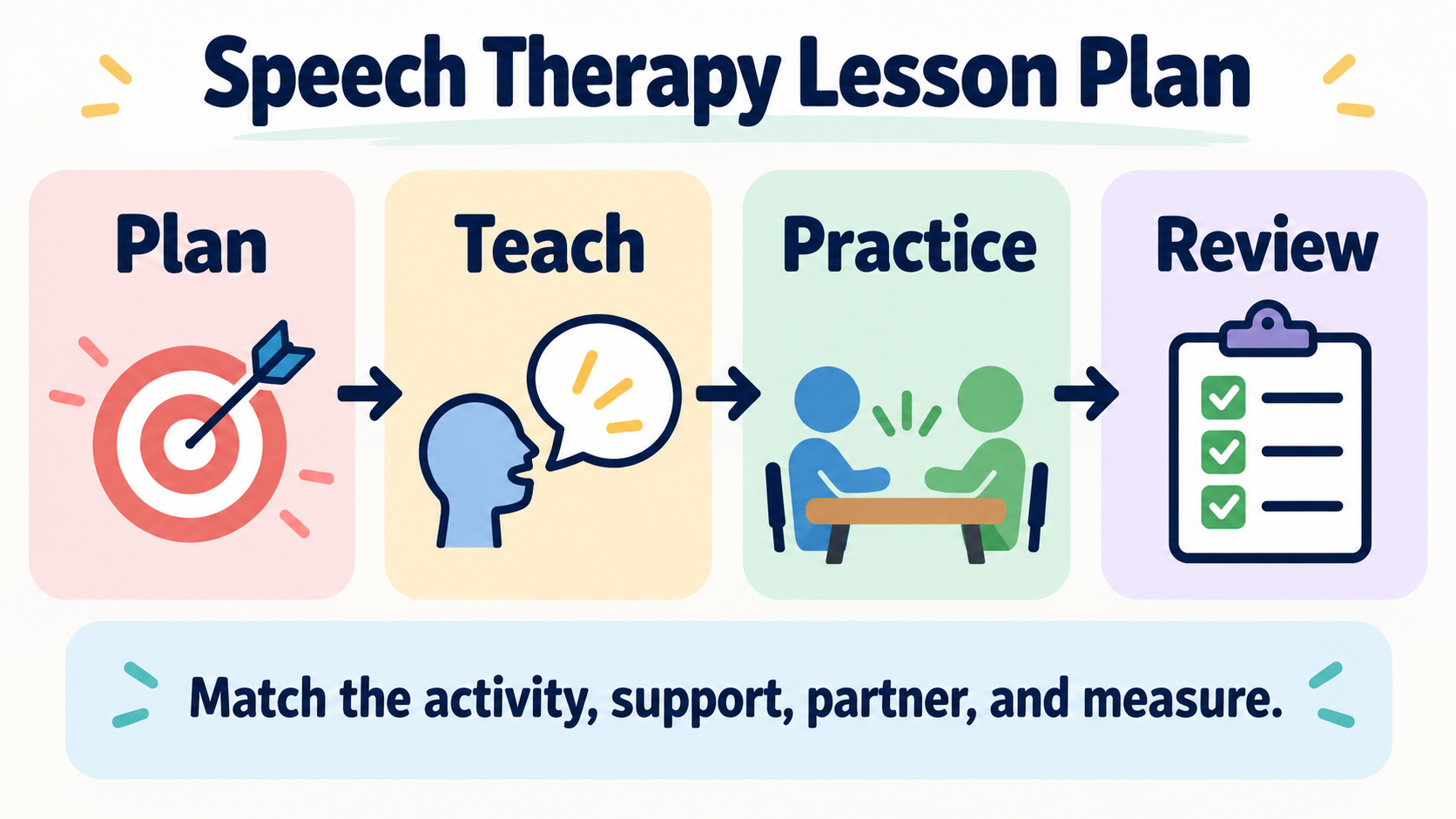
Teaching move: Describe the model, cue, explanation, contrast, demonstration, or partner response that will make the target more accessible. Include wait time and how the learner can request help or a change.
Practice opportunity: State what the learner will do and how the activity connects to a real communication purpose. Include the beginning, middle, and natural ending without scripting every possible response.
Observation and data: Choose the measure that answers the current question. It might be accuracy, frequency, duration, latency, prompt level, intelligibility, listener understanding, initiation, repair, or participation.
Next step: Leave room to note what should be repeated, changed, generalized, supported differently, or discussed with the team.
The amount of detail can vary by target. An AAC routine may need access and partner fields. A speech sound session may need target position and cue details. A conversation session may need partner knowledge, repair options, and listener response.
Plan the Teaching Move and Partner Role
The partner is part of the lesson condition. Write what the partner will model, when the partner will pause, how the partner will respond to a refusal, and how the partner will acknowledge a message communicated through AAC, gesture, sign, writing, or speech. A support that is not written down can be applied inconsistently.
Use the least intrusive prompt likely to help the learner make the next move. A pause, visual cue, or natural model may be enough. Add a choice, gesture, or more specific prompt when needed, and record what actually helped. The goal is not to remove every support; it is to help the learner communicate with access and increasing control.
Plan a small variation when the learner is ready. Change one condition at a time: a new partner, a new material, less visual support, a different routine, or a new communication purpose. Keeping the other conditions stable helps the team interpret what the learner can do.
Use age-respectful materials and topics. A young learner may practice through play or a shared book, while an older learner may use a classroom project, personal experience, work routine, appointment, or community task. The target can remain specific without making the activity feel disconnected from the learner’s life.
Record Data While Preserving Flexibility
Data collection should support a decision, not compete with interaction. Define the opportunity and record the response, support, communication mode, partner, setting, and listener outcome. A percentage without its condition can hide whether the learner responded in a structured drill or a new real-world routine.
Possible fields include:
- target and communication purpose;
- activity, partner, and setting;
- response mode and message or production;
- prompt, model, wait time, and access support;
- listener understanding, repair, or partner response; and
- the next support or variation to try.
Include meaningful communication that does not fit a narrow trial count. A learner may initiate, refuse, repair, direct a partner, use a new mode, or participate longer than planned. These observations can guide the next lesson even when they do not produce a neat percentage.
Review the Plan After the Session
Complete the next-step field while the session is still clear. What helped? What created a barrier? Did the learner communicate a different purpose? Did the partner need to change wait time, visual support, positioning, or response? Did the materials support access in the actual routine?
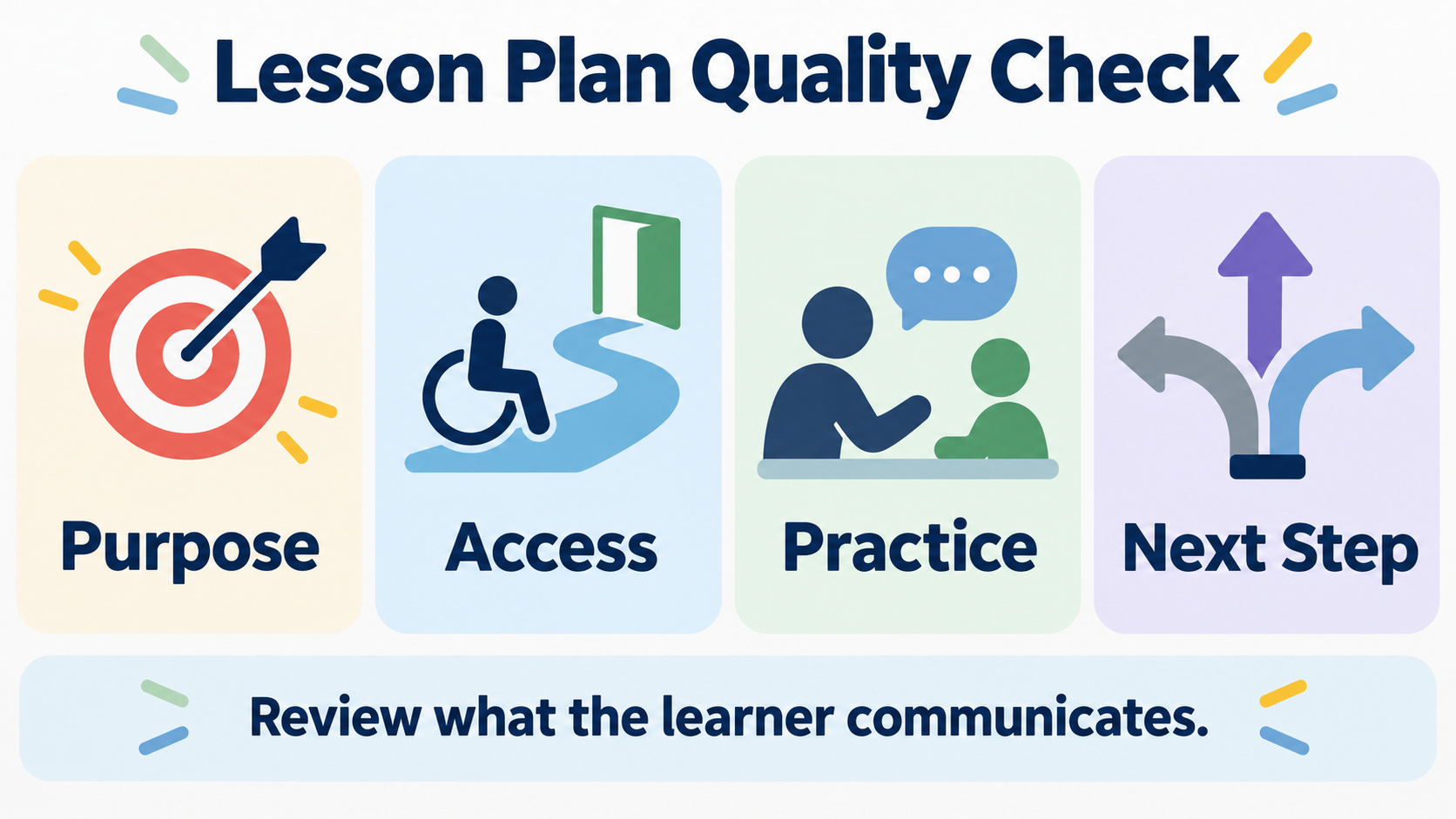
Use a short review checklist:
- Was the communication purpose visible to the learner and partner?
- Could the learner access the materials and response route?
- Did the activity create meaningful opportunities rather than only repetitions?
- Was the support recorded clearly enough to repeat or change?
- Did the data answer the planning question?
- What one condition should change next time?
Review the template itself too. If adults skip a field repeatedly, it may not be useful for that lesson type. If an important observation has nowhere to go, add a flexible note area. A good template changes with the team while keeping the learner’s communication purpose visible.
Frequently Asked Questions
What should an SLP lesson plan template include?
Include the learner’s communication purpose, target, materials, access supports, teaching move, practice routine, partner role, observation or data plan, and next step. Add specialized fields when the target requires them.
Does every speech therapy session need a detailed written plan?
The amount of detail should match the target, setting, partner, and risk of confusion. A repeatable short routine may be enough for a familiar activity, while a new AAC, speech, or classroom-support plan may need more access and partner detail.
Can a lesson plan include AAC and other modes?
Yes. Note how AAC, speech, sign, gesture, writing, drawing, or visual choices will be available and modeled. The plan should describe the communication purpose and access supports rather than assume one output mode.
How is an SLP lesson plan different from a data sheet?
The plan describes what the team intends to support and how the activity will be organized. The data sheet records what happened under defined conditions. Sharing some fields can make the transition from planning to review easier.
An SLP lesson plan template works best as a flexible clinical planning aid. Start with the learner’s purpose, prepare access and partner supports, record the context, and let the session notes shape the next opportunity.