A speech goal bank can save planning time by offering sample language for articulation, phonology, language, AAC, fluency, voice, social communication, and functional participation. A sample goal is not automatically the right goal for a learner. It becomes useful only after the team connects it to the learner’s communication purpose, access, context, baseline, and next decision.
This guide explains how to evaluate and adapt a speech goal bank without copying generic wording into an individualized plan. It covers goal components, measurement, communication modes, context, collaboration, and review. It is educational information rather than legal, educational, or clinical advice. The ASHA Practice Portal offers topic-specific professional context for assessment and intervention planning.
Table of Contents
- What a speech goal bank can and cannot do
- Start with participation and the communication purpose
- Rewrite a sample goal into observable parts
- Choose a measure and define the condition
- Include access, partner, and response mode
- Review progress and revise the goal
- Frequently asked questions
What a Speech Goal Bank Can and Cannot Do
A goal bank is a collection of example targets, not a checklist of goals to assign in order. It can help a team find language for a target area, compare possible measures, or remember a component that needs to be documented. It cannot determine whether the target is meaningful, accessible, developmentally appropriate, or relevant to a particular setting.
Use a goal bank to generate questions:
- What communication or participation problem is the learner trying to solve?
- Which skill would make that participation easier?
- What can the learner do now under a defined condition?
- Which response modes and supports provide access?
- What evidence will show a useful change?
- What will the team do after reviewing the result?
Sample language is especially risky when it sounds precise but leaves the opportunity undefined. “Improve expressive language” does not tell another adult what to present or observe. “Use a message to request help during a classroom task” identifies a purpose, but it still needs a response definition, access route, support, and context.
Start With Participation and the Communication Purpose
Begin with the learner’s life, not the goal bank category. Ask what the learner wants to communicate, understand, produce, or participate in at home, school, work, therapy, or community routines. A speech sound target may matter because unfamiliar listeners miss a key message. A language target may matter because the learner cannot explain a problem or join a classroom discussion.
Name the communication job in plain language. Possible jobs include asking for help, telling a partner what happened, explaining a sequence, answering a question, repairing a misunderstanding, choosing a preferred activity, producing a target sound in meaningful words, or participating in a shared conversation.
The purpose affects the goal design. A structured word-level measure may answer a question about a speech sound pattern. A narrative sample may better answer whether a learner can communicate connected information. A frequency or descriptive note may be more useful for AAC initiation, refusal, repair, or partner participation.
Before selecting sample wording, record:
- the routine and partner where the communication matters;
- the learner’s current response and communication modes;
- the support already available;
- the barrier the team is trying to reduce; and
- the decision the next data review should support.
Rewrite a Sample Goal Into Observable Parts
Use a goal bank sentence as raw material. Break it into condition, learner action, response definition, support, and measure. Then remove any wording that requires the learner to perform an adult’s preferred style when the actual purpose is broader communication.
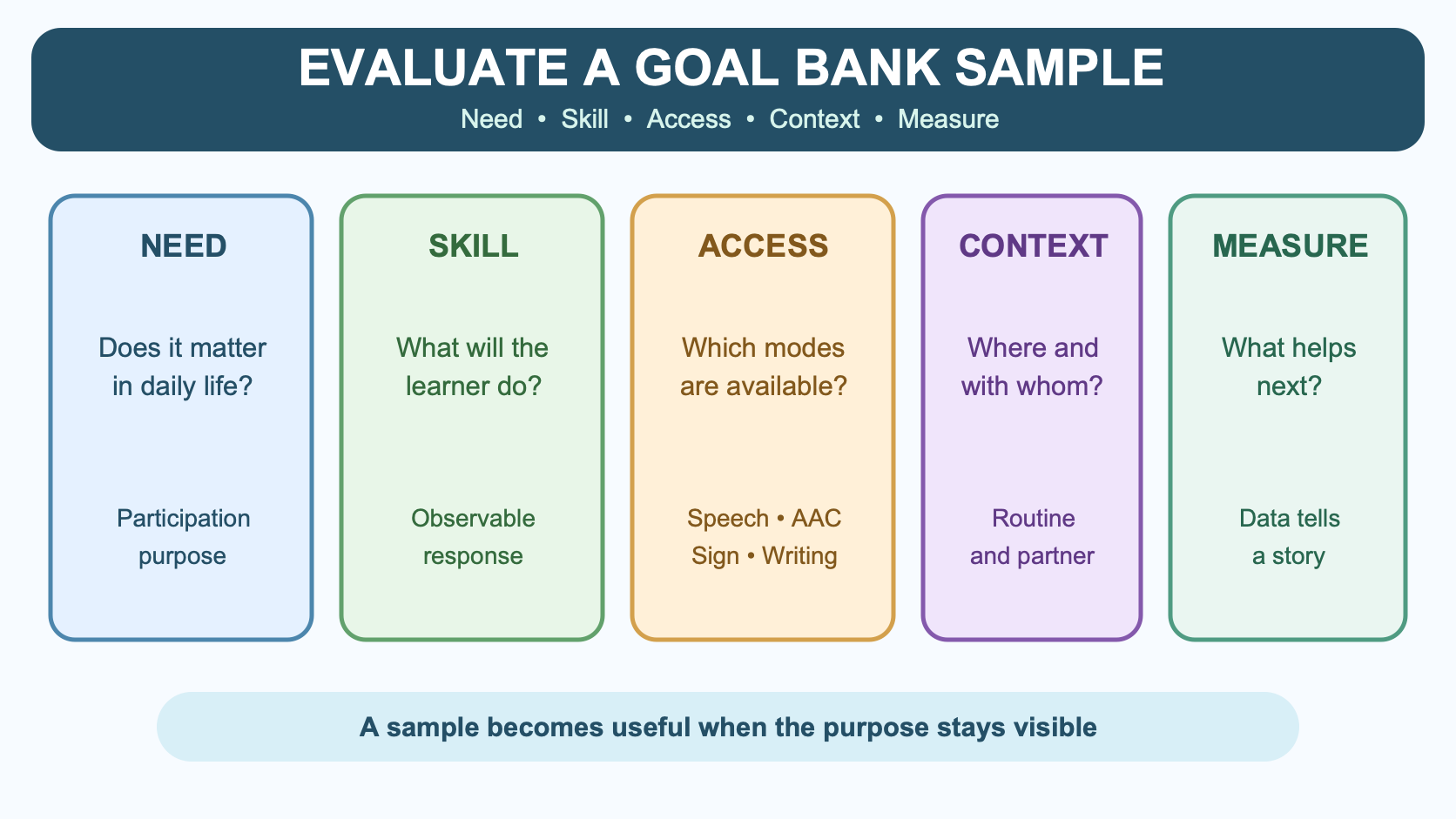
Condition: When, where, with whom, and using what materials will the opportunity occur? A picture scene, classroom routine, personal event, shared book, or conversation can create a different task.
Learner action: What will the learner communicate or do? Use an observable verb such as select, request, describe, answer, explain, repair, produce, sequence, or participate.
Response definition: What counts as a relevant response? Include the information, speech target, message purpose, or interaction move rather than only the number of words.
Support and access: What visual, prompt, model, wait time, AAC system, partner behavior, or physical arrangement is available? If support level is part of the goal, define how it will be recorded.
Measure: Will the team track accuracy, frequency, duration, latency, independence, support level, intelligibility, listener understanding, or transfer? Choose a measure that answers the planning question.
A goal can be concise while the planning notes hold more detail. The team should be able to tell what opportunity to create, what response to recognize, and what result would guide the next step.
Choose a Measure and Define the Condition
Accuracy is useful when the response and scoring rule are stable. It is not the only useful measure. Frequency can describe initiations or repairs. Duration can describe participation. Latency can describe time to a response. A prompt or independence scale can describe how support changes. A descriptive note can preserve a complex communication event.
Define the opportunity before counting. “Four of five” in repeated picture trials differs from four responses during a new classroom activity. Record the number and type of opportunities, materials, partner, setting, response mode, and support when those details could change interpretation.
For speech sound goals, include target context, word position, cue level, and whether the measure is structured or connected speech. For language goals, define the information, relationship, or message being communicated. For pragmatic goals, include the partner, communication purpose, listener understanding, repair, and transfer.
Do not build a measure that is too burdensome to use. A small, repeatable field often creates better longitudinal information than a long form that is skipped. If a data sheet takes attention away from the learner, simplify it while preserving the decision-critical fields.
Include Access, Partner, and Response Mode
A speech goal should not quietly turn one output mode into the only successful response. A learner may communicate through speech, AAC, sign, gesture, writing, drawing, pointing, or a multimodal combination. Record the mode that carried the message and the support that made access possible.
Partner behavior is part of many communication goals. Note whether the partner waited, modeled, asked a leading question, accepted a refusal, offered a choice, responded to AAC, or repaired a misunderstanding. If the learner’s performance changes with a new partner, the next goal or support may need to include partner practice.
Check language, culture, sensory access, motor access, hearing, and age-respectful context. A goal bank phrase may be written for one population or setting and require substantial adaptation for another. The team should explain the learner’s actual communication need rather than treating a template as evidence.
Review Progress and Revise the Goal
Review data after enough defined opportunities have occurred to show a pattern. Look at performance across routines, partners, response modes, supports, and settings when transfer is part of the goal. One strong or difficult session can inform the plan, but it should not carry the entire interpretation.
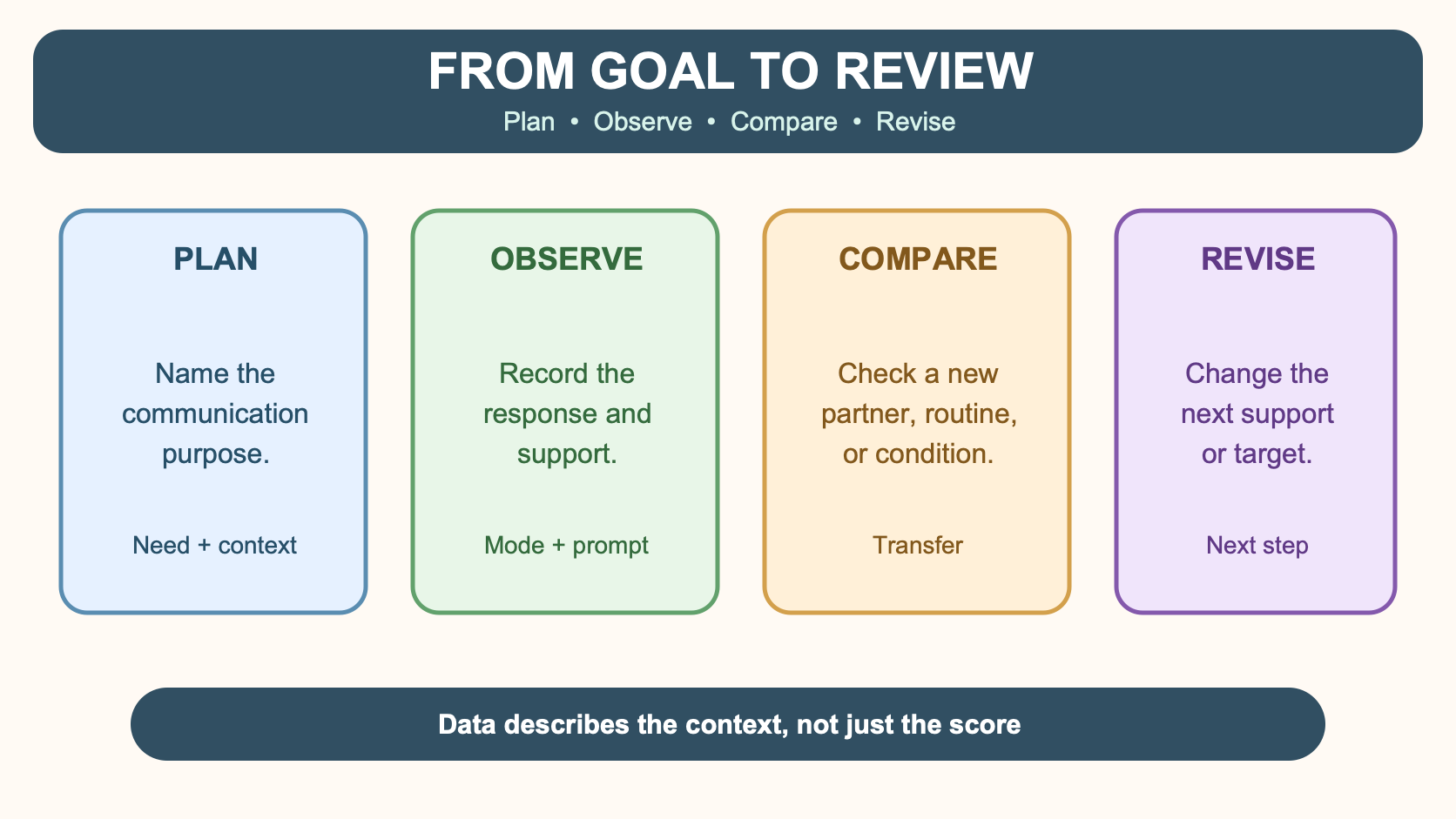
Ask four questions:
- What happened under the recorded condition?
- Which support or context changed access or participation?
- Did the learner communicate the intended purpose, even through another mode?
- What is the smallest useful change to try next?
If accuracy improves in structured practice but communication does not transfer, keep the target visible while changing one context at a time. If the learner communicates independently with a visual, consider whether the visual is an access support to preserve rather than a prompt to remove. If a goal no longer represents the learner’s priorities, revise it instead of continuing to collect irrelevant data.
Coordinate goal language with the learner, family, educators, and relevant team members. A goal bank can support shared vocabulary, but the final goal should reflect the learner’s life, communication system, and participation needs.
Frequently Asked Questions
Can I copy a goal directly from a speech goal bank?
Use a sample as a starting point, not a finished individualized goal. Rewrite the condition, learner action, response definition, support, and measure so the goal reflects the learner’s communication purpose and access.
What makes a speech goal measurable?
The opportunity, response, support, and measure are defined clearly enough that the team can observe and record them. The measure may be accuracy, frequency, duration, latency, independence, support level, intelligibility, listener understanding, or transfer.
Should a goal require spoken words?
Not when the communication purpose can be met through AAC, sign, gesture, writing, drawing, pointing, speech, or a combination. Define the message or skill and record the response mode rather than limiting access without a reason.
When should I stop using a goal bank sample?
Stop or revise it when the wording does not match the learner’s priorities, the condition cannot be created reliably, the measure does not guide a decision, or the target no longer reflects meaningful participation.
A speech goal bank is most useful as a planning prompt. Start with participation, individualize the condition and response, include access and partner context, choose a decision-relevant measure, and let the data shape the next goal or support.